
Titanium Machining Companies: A Complete Guide to Precision Titanium CNC Parts Manufacturing
Titanium has become one of the most important engineering materials for industries requiring high strength, lightweight structures, corrosion resistance, and long-term reliability. However, manufacturing titanium components is significantly more challenging than machining common metals such as aluminum or mild steel.
Professional titanium machining companies must combine advanced CNC equipment, experienced programmers, optimized cutting strategies, and strict quality management systems to produce precision titanium parts.
From aerospace structural components to medical implants and high-performance industrial equipment, titanium CNC machining requires much more than standard machining knowledge. The right manufacturing partner must understand titanium behavior throughout the entire production process, including material selection, tool management, machining parameters, finishing, and inspection.
Titanium CNC Machining Capabilities and Manufacturing Processes
Advanced CNC Technologies Used by Titanium Machining Companies
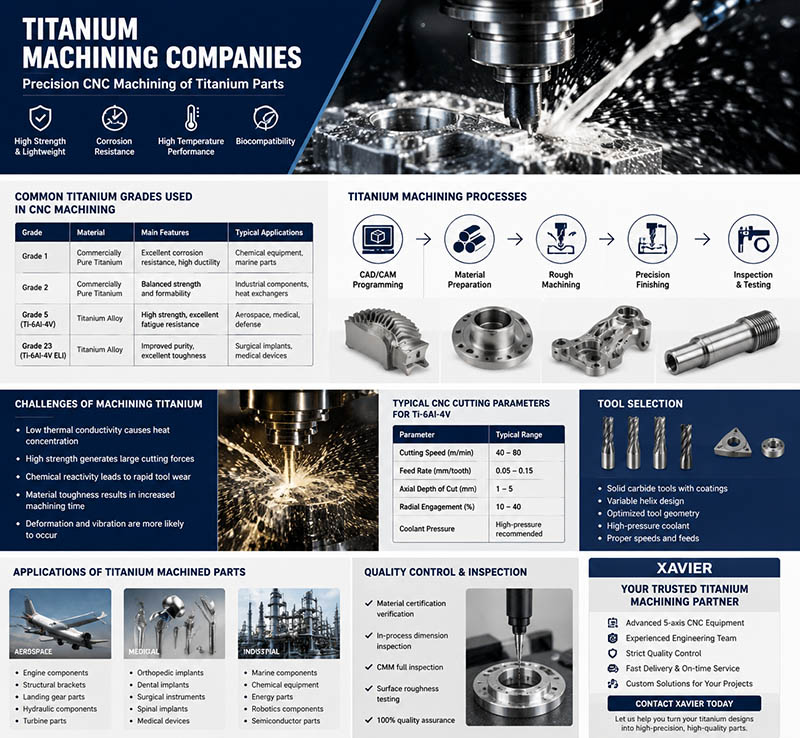
Titanium machining requires highly stable CNC machines because titanium alloys generate significant cutting forces and heat during machining. Professional titanium machining companies usually utilize multi-axis CNC equipment, including 3-axis machining centers, 4-axis machines, 5-axis CNC mills, and precision CNC turning centers.
Compared with conventional machining, 5-axis CNC machining provides major advantages when producing complex titanium parts.
For example:
| CNC Machine Type | Typical Titanium Applications | Advantages |
|---|---|---|
| 3-axis CNC milling | Simple brackets, plates, housings | Cost-effective for basic geometries |
| 4-axis CNC machining | Rotational components, shafts | Better accessibility and reduced setup time |
| 5-axis CNC machining | Aerospace structures, turbine parts, medical components | Complex angles, fewer setups, higher accuracy |
| CNC turning | Titanium shafts, pins, rings, threaded parts | High precision cylindrical machining |
For aerospace titanium components, 5-axis machining is particularly valuable because many parts contain curved surfaces, thin walls, and complex internal structures. A single setup can reduce positioning errors and improve dimensional consistency.
Titanium Milling and Turning Process Optimization
Unlike aluminum machining, titanium CNC machining requires carefully controlled cutting conditions.
Titanium has a low thermal conductivity compared with many metals. During machining, heat tends to remain concentrated near the cutting edge instead of being quickly transferred away through the chips. This increases tool wear and can shorten cutter life if machining parameters are incorrect.
A typical titanium machining process includes:
| Manufacturing Step | Description |
|---|---|
| CAD/CAM Programming | Engineers create optimized tool paths based on part geometry |
| Material Preparation | Titanium alloy stock is inspected before machining |
| Rough Machining | Large amounts of material are removed using strong cutting tools |
| Semi-Finishing | Machining allowance is reduced before final accuracy machining |
| Precision Finishing | Final dimensions and surface requirements are achieved |
| Inspection | CMM measurement verifies tolerance requirements |
A professional titanium machining company does not simply increase spindle speed to improve productivity. Instead, machining parameters are balanced between:
- Cutting speed
- Feed rate
- Depth of cut
- Tool engagement
- Coolant efficiency
This approach prevents excessive heat accumulation and maintains consistent part quality.
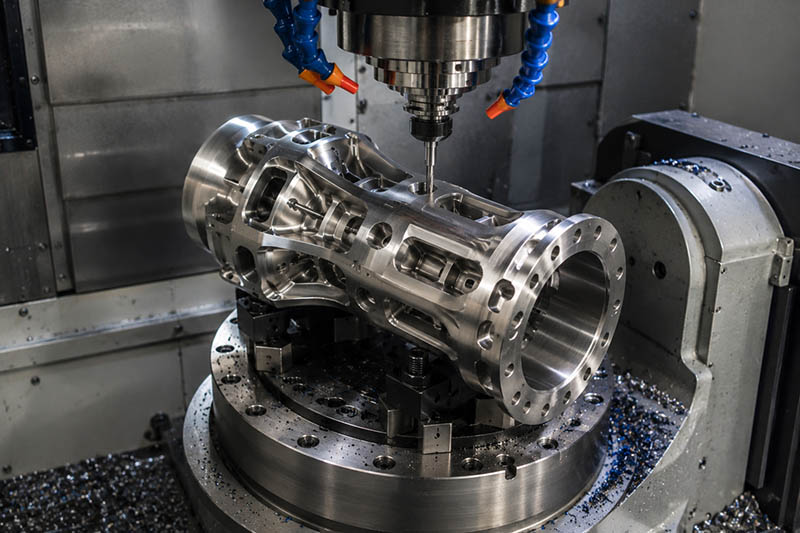
Example: Manufacturing a Titanium Aerospace Bracket
A titanium aerospace bracket may look simple externally, but the manufacturing process is highly demanding.
Typical requirements:
| Parameter | Requirement |
|---|---|
| Material | Ti-6Al-4V Grade 5 Titanium |
| Part Size | 250 mm × 180 mm × 60 mm |
| Machining Method | 5-axis CNC milling |
| Tolerance | ±0.02 mm |
| Surface Finish | Ra 1.6 μm |
| Inspection Method | CMM + surface testing |
The machining company must consider:
- Thin-wall deformation during cutting
- Heat accumulation
- Tool deflection
- Residual stress after machining
- Final dimensional stability
A supplier without titanium machining experience may produce parts that meet initial dimensions but fail after stress relaxation or environmental testing.
Titanium Grades Commonly Used by CNC Machining Companies
Ti-6Al-4V Grade 5 Titanium: The Most Popular Machining Alloy
Among all titanium alloys, Ti-6Al-4V Grade 5 is the most widely used material for CNC machining.
It contains approximately:
| Element | Percentage |
|---|---|
| Titanium | Balance |
| Aluminum | 6% |
| Vanadium | 4% |
This alloy offers an excellent combination of:
- High strength
- Low density
- Fatigue resistance
- Corrosion resistance
- Temperature performance
Because of these properties, Ti-6Al-4V is commonly selected for aerospace and medical applications. Many titanium CNC machining suppliers focus heavily on this grade because it represents a large portion of industrial titanium demand.
Comparison of Common Titanium Materials
| Titanium Grade | Main Features | Typical Applications |
|---|---|---|
| Grade 1 | Highest corrosion resistance, excellent ductility | Chemical equipment, marine parts |
| Grade 2 | Commercially pure titanium with balanced properties | Industrial components, heat exchangers |
| Grade 5 (Ti-6Al-4V) | High strength and excellent performance | Aerospace, medical, defense |
| Grade 23 (Ti-6Al-4V ELI) | Improved purity and toughness | Surgical implants |
How Titanium Grade Selection Affects Machining Results
Choosing the wrong titanium grade can increase machining difficulty and manufacturing costs.
For example:
A medical implant manufacturer may prefer Grade 23 because it provides excellent biocompatibility and fracture resistance.
An aerospace manufacturer may select Grade 5 because aircraft structures require maximum strength-to-weight performance.
A chemical processing company may choose Grade 2 because corrosion resistance is more important than extreme mechanical strength.
Therefore, experienced titanium machining companies must understand not only machining technology but also material application requirements.
Titanium Machining Challenges and Solutions
Why Titanium Is Considered a Difficult Material for CNC Machining
Titanium is widely recognized as a challenging material in precision manufacturing. Although titanium provides outstanding mechanical properties, these same characteristics make it more demanding to machine compared with aluminum, brass, or stainless steel.
The main difficulty comes from the unique physical properties of titanium:
| Titanium Property | Machining Impact |
|---|---|
| High strength-to-weight ratio | Generates high cutting forces during machining |
| Low thermal conductivity | Heat remains concentrated near the cutting zone |
| High chemical reactivity | Titanium can react with cutting tools at high temperatures |
| Low elastic modulus | The material tends to deform and vibrate during machining |
| High toughness | Causes increased tool wear and machining time |
For titanium machining companies, understanding these characteristics is essential. A machining strategy that works well for aluminum cannot simply be applied to titanium.
Heat Management During Titanium CNC Machining
Controlling Cutting Temperature to Protect Tools and Parts
One of the biggest challenges in titanium machining is heat control.
Unlike aluminum, which quickly transfers machining heat into chips, titanium has poor thermal conductivity. Approximately 75% of the generated heat can remain concentrated around the cutting edge, causing rapid tool degradation.
When temperatures become excessive, several problems may occur:
- Cutting tools lose hardness
- Tool edges become damaged
- Surface finish quality decreases
- Dimensional accuracy becomes unstable
- Production costs increase
Professional titanium machining companies usually use several strategies to manage heat:
| Heat Control Method | Manufacturing Benefit |
|---|---|
| High-pressure coolant systems | Removes heat from the cutting zone efficiently |
| Flood coolant | Reduces temperature during continuous cutting |
| Optimized tool paths | Prevents excessive tool engagement |
| Lower cutting speeds | Reduces thermal stress |
| Carbide tools with coatings | Improves heat resistance and tool life |
For example, when machining Ti-6Al-4V aerospace components, manufacturers often use constant tool engagement strategies. Instead of allowing the cutter to suddenly enter large amounts of material, the CAM programming maintains a more stable cutting load.
This reduces temperature fluctuations and improves both tool life and surface quality.
Tool Selection for Titanium Machining
Carbide Cutting Tools and Specialized Coatings
The choice of cutting tools directly affects titanium machining performance.
High-speed steel tools are generally unsuitable for high-precision titanium production because titanium generates excessive heat and cutting pressure.
Most professional titanium machining companies use:
- Solid carbide end mills
- Carbide inserts
- Variable helix cutters
- Coated cutting tools
Common coating options include:
| Tool Coating | Advantages |
|---|---|
| TiAlN coating | Excellent heat resistance |
| AlTiN coating | Suitable for high-temperature machining |
| Diamond-like coatings | Improved wear resistance for specific applications |
However, tool selection is not only about choosing harder materials.
Experienced machinists must also consider:
- Tool diameter
- Number of flutes
- Cutting direction
- Radial engagement
- Axial depth
- Workpiece rigidity
For thin titanium aerospace structures, excessive cutting force can cause part deformation. Therefore, machining companies often use smaller radial depths of cut combined with multiple passes.
Titanium Machining Parameters Optimization
Typical CNC Cutting Parameters for Titanium Alloy
Machining parameters must be carefully optimized because titanium reacts differently under various cutting conditions.
Example parameters for Ti-6Al-4V CNC milling:
| Parameter | Typical Range |
|---|---|
| Cutting Speed | 40-80 m/min |
| Feed Rate | 0.05-0.15 mm/tooth |
| Axial Depth of Cut | 1-5 mm |
| Radial Engagement | 10-40% |
| Coolant Pressure | High-pressure preferred |
Actual parameters depend on:
- Machine rigidity
- Tool material
- Part geometry
- Required tolerance
- Surface finish requirements
For complex titanium parts, experienced CNC engineers usually perform test machining before full production. This reduces risk and helps establish stable production parameters.
Applications of Titanium Machined Parts in Aerospace, Medical, and Industrial Fields
Titanium CNC Parts for Aerospace Manufacturing
Lightweight and High-Strength Components
The aerospace industry is one of the largest users of titanium machined components.
Aircraft manufacturers prefer titanium because it provides an excellent strength-to-weight ratio. Titanium components can withstand extreme mechanical loads while reducing overall aircraft weight.
Common aerospace titanium parts include:
| Component | Manufacturing Requirements |
|---|---|
| Engine brackets | High temperature resistance and strength |
| Landing gear components | High fatigue resistance |
| Structural connectors | Tight tolerance machining |
| Hydraulic components | Corrosion resistance |
| Turbine components | Heat resistance and precision |
Aerospace titanium machining often requires extremely strict dimensional control.
Typical requirements:
| Requirement | Example Value |
|---|---|
| Dimensional tolerance | ±0.01 mm to ±0.05 mm |
| Surface roughness | Ra 0.8-1.6 μm |
| Material certification | Required |
| Inspection | CMM measurement |
A titanium machining company serving aerospace customers must have strong process control because even small dimensional errors can affect assembly performance.
Titanium Medical Parts Manufacturing
Biocompatibility and Precision Requirements
Titanium is one of the most important materials in medical manufacturing because it is highly compatible with the human body.
Medical titanium applications include:
- Bone implants
- Dental implants
- Surgical instruments
- Orthopedic components
- Prosthetic parts
The most common medical titanium alloys include:
- Grade 5 titanium
- Grade 23 titanium (Ti-6Al-4V ELI)
Medical titanium machining requires additional attention because parts often have:
- Complex curved surfaces
- Micro features
- High cleanliness requirements
- Strict surface requirements
Example:
A dental implant component may require:
| Feature | Requirement |
|---|---|
| Material | Titanium Grade 23 |
| Diameter accuracy | ±0.005 mm |
| Surface finish | Ra <0.8 μm |
| Production method | CNC turning + grinding |
| Inspection | Optical measurement |
Medical manufacturers often select titanium machining companies that understand not only machining but also contamination control and traceability.
Industrial Titanium Components
Marine, Chemical, and Energy Applications
Titanium’s corrosion resistance makes it valuable in harsh industrial environments.
Applications include:
| Industry | Titanium Components |
|---|---|
| Marine | Propeller shafts, valves, connectors |
| Chemical processing | Heat exchanger parts |
| Energy | Turbine components |
| Semiconductor | Precision chambers and fixtures |
| Robotics | Lightweight structural parts |
For example, titanium components used in seawater environments can provide significantly longer service life compared with traditional steel parts.
Although titanium has a higher material cost, reduced maintenance and longer operational life can make it economically attractive.
How to Choose a Reliable Titanium Machining Company
Evaluate CNC Equipment Capability
A professional titanium machining supplier should have advanced manufacturing equipment.
Important equipment includes:
| Equipment | Purpose |
|---|---|
| 5-axis CNC machining centers | Complex titanium geometries |
| CNC turning centers | Precision cylindrical parts |
| CMM inspection machines | Dimensional verification |
| CAD/CAM software | Optimized machining programming |
| Surface finishing equipment | Final appearance and performance |
Companies with only basic CNC equipment may struggle with complex titanium projects.
Check Titanium Machining Experience
Titanium machining experience is often more important than general CNC experience.
A supplier that mainly machines aluminum may not have sufficient knowledge of titanium behavior.
Important experience indicators include:
- Previous titanium projects
- Industry applications served
- Material knowledge
- Machining strategies
- Quality documentation
Example comparison:
| Supplier Type | Titanium Capability |
|---|---|
| General CNC workshop | Limited titanium experience |
| Aluminum-focused manufacturer | Moderate capability |
| Aerospace titanium machining supplier | Advanced capability |
Quality Control and Inspection Standards
Precision titanium parts require strict inspection procedures.
Reliable titanium machining companies usually implement:
Incoming Material Inspection
Before machining:
- Verify titanium grade
- Check material certificates
- Confirm chemical composition
In-Process Inspection
During production:
- Measure critical dimensions
- Monitor tool wear
- Check machining stability
Final Inspection
Before shipment:
- CMM inspection
- Surface roughness testing
- Thread inspection
- Visual inspection
Example inspection equipment:
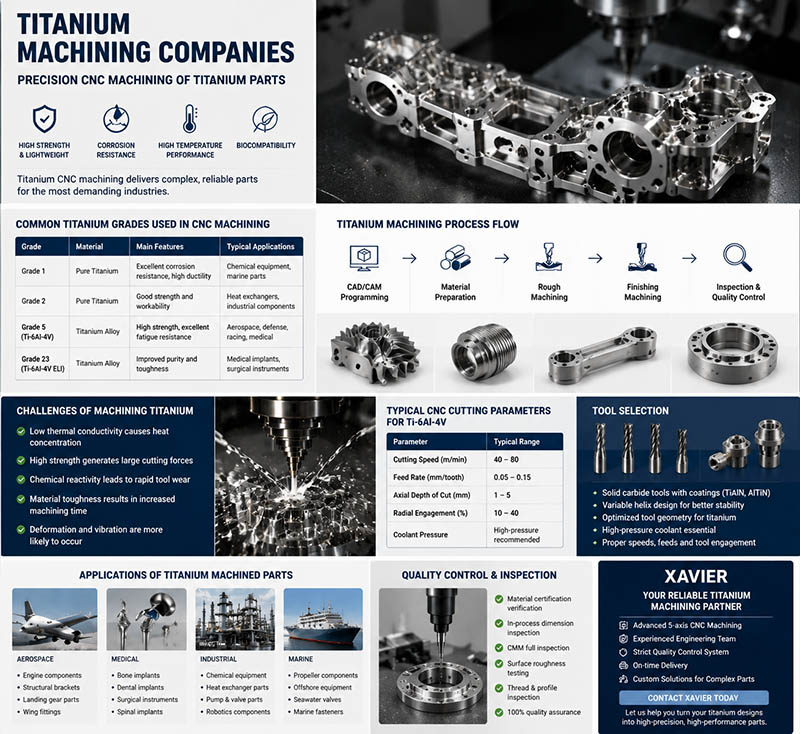
| Inspection Equipment | Accuracy |
|---|---|
| Coordinate Measuring Machine (CMM) | Micron-level measurement |
| Optical Comparator | Profile inspection |
| Surface Roughness Tester | Surface quality analysis |
| Height Gauge | Dimensional verification |
Why Choose Xavier for Titanium Machining Services
Selecting the right titanium machining company is critical for manufacturers that require precision, reliability, and consistent quality. Titanium parts are often used in industries where failure is unacceptable, including aerospace, medical, robotics, automotive, and advanced industrial equipment.
Xavier provides professional CNC machining solutions for titanium components, combining advanced manufacturing equipment, experienced engineers, strict quality inspection processes, and flexible production capabilities.
With extensive experience in machining difficult materials, Xavier understands the challenges involved in titanium manufacturing, including heat control, tool selection, surface protection, and dimensional stability.
Whether customers need prototypes, small-batch production, or large-volume titanium components, Xavier can provide customized machining solutions based on specific application requirements.
The company supports various titanium alloys, including:
| Titanium Material | Typical Applications |
|---|---|
| Titanium Grade 2 | Industrial equipment, marine components |
| Titanium Grade 5 (Ti-6Al-4V) | Aerospace structures, high-strength components |
| Titanium Grade 23 (Ti-6Al-4V ELI) | Medical implants and precision parts |
Xavier’s titanium machining capabilities include:
- CNC milling
- 5-axis CNC machining
- CNC turning
- Precision drilling
- Thread machining
- Surface finishing
- Dimensional inspection
By combining engineering expertise with modern CNC technology, Xavier helps customers transform complex titanium designs into reliable finished components.
For companies searching for experienced titanium machining companies, Xavier offers a dependable manufacturing partnership focused on precision, quality, and long-term cooperation.
We are a professional CNC machining manufacturer integrating industry and trade, specializing in custom CNC machining services and the production of various metal parts. We provide reliable CNC anodizing surface finishing, CNC electroless nickel surface finishing, and CNC passivation surface finishing solutions for different applications. As a trusted CNC anodizing surface finishing manufacturer, we offer bulk CNC electroless nickel surface finishing services and provide competitive CNC passivation surface finishing prices. Feel free to contact us for professional CNC machining solutions.
Some of the images and text in this article are collected and compiled from the internet. If there is anything inappropriate, please contact us for processing.