
Low Volume CNC Machining Services: Costs, Materials, Processes & Benefits
10 Key Topics Covered in This Article
- What Is Low Volume CNC Machining?
- Common Applications of Low Volume CNC Machining
- CNC Machining Processes for Small Batch Production
- Best Materials for Low Volume CNC Machining
- Design for Manufacturability (DFM) in Low Volume Production
- Cost Factors and Pricing of Low Volume CNC Machining
- Dimensional Tolerances and Quality Control
- Low Volume CNC Machining vs. 3D Printing, Injection Molding, and Mass Production
- Lead Times, Production Flexibility, and Supply Chain Advantages
- How to Choose a Reliable Low Volume CNC Machining Manufacturer
What Is Low Volume CNC Machining?
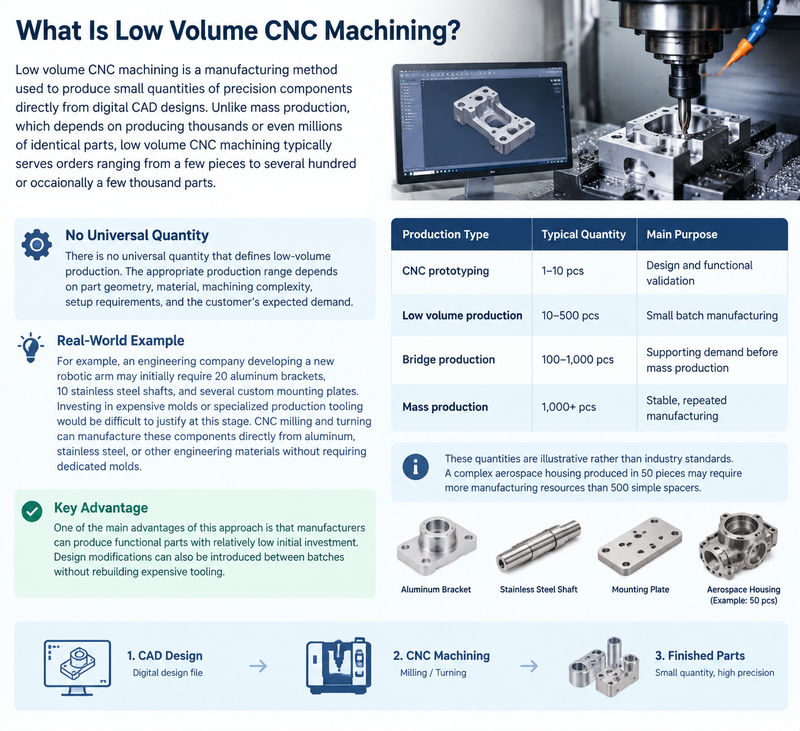
Low volume CNC machining is a manufacturing method used to produce small quantities of precision components directly from digital CAD designs. Unlike mass production, which depends on producing thousands or even millions of identical parts, low volume CNC machining typically serves orders ranging from a few pieces to several hundred or occasionally a few thousand parts.
There is no universal quantity that defines low-volume production. The appropriate production range depends on part geometry, material, machining complexity, setup requirements, and the customer’s expected demand.
For example, an engineering company developing a new robotic arm may initially require 20 aluminum brackets, 10 stainless steel shafts, and several custom mounting plates. Investing in expensive molds or specialized production tooling would be difficult to justify at this stage. CNC milling and turning can manufacture these components directly from aluminum, stainless steel, or other engineering materials without requiring dedicated molds.
One of the main advantages of this approach is that manufacturers can produce functional parts with relatively low initial investment. Design modifications can also be introduced between batches without rebuilding expensive tooling.
| Production Type | Typical Quantity | Main Purpose |
|---|---|---|
| CNC prototyping | 1–10 pcs | Design and functional validation |
| Low volume production | 10–500 pcs | Small batch manufacturing |
| Bridge production | 100–1,000 pcs | Supporting demand before mass production |
| Mass production | 1,000+ pcs | Stable, repeated manufacturing |
These quantities are illustrative rather than industry standards. A complex aerospace housing produced in 50 pieces may require more manufacturing resources than 500 simple spacers.
Common Applications of Low Volume CNC Machining
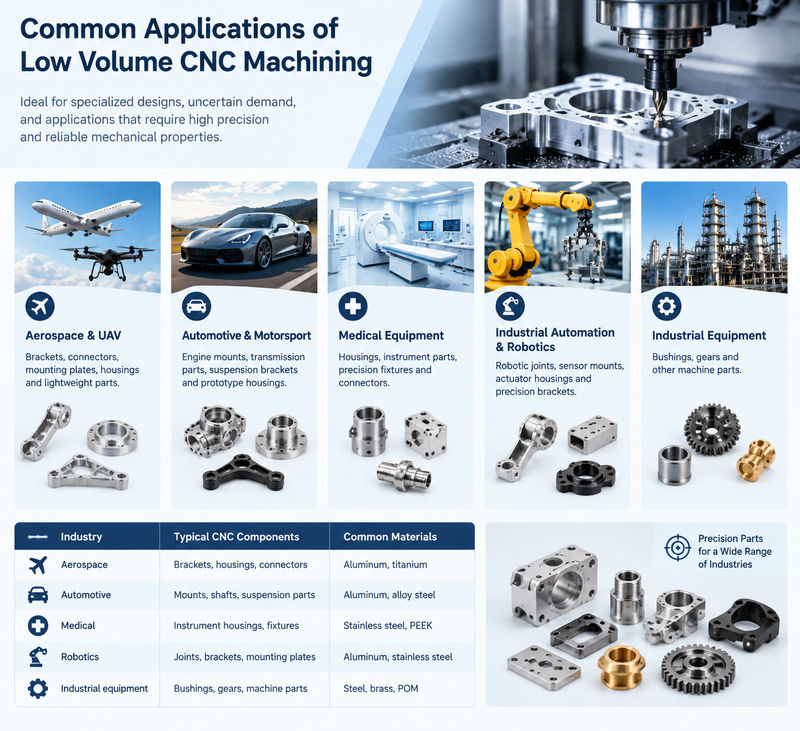
Low volume CNC machining is particularly suitable for industries where product designs are specialized, demand is uncertain, or components require precise dimensions and reliable mechanical properties.
Aerospace and UAV components: Aerospace manufacturers frequently require small batches of aluminum brackets, structural connectors, mounting plates, housings, and lightweight mechanical components. Materials such as 6061-T6, 7075-T6, and titanium alloys are commonly selected according to strength, weight, and environmental requirements.
Automotive and motorsport parts: Custom engine mounts, transmission components, suspension brackets, and prototype housings are typical applications. Small production batches allow engineers to test different geometries and material specifications before committing to larger production quantities.
Medical equipment: CNC-machined housings, instrument components, precision fixtures, and equipment connectors may be manufactured in relatively small quantities. Stainless steel, aluminum, and engineering plastics are selected according to mechanical performance, cleaning requirements, and applicable regulatory requirements.
Industrial automation and robotics: Robotic joints, sensor mounts, actuator housings, and precision brackets often require customized dimensions. Low volume production makes it possible to manufacture components for different machine configurations without maintaining large inventories.
| Industry | Typical CNC Components | Common Materials |
|---|---|---|
| Aerospace | Brackets, housings, connectors | Aluminum, titanium |
| Automotive | Mounts, shafts, suspension parts | Aluminum, alloy steel |
| Medical | Instrument housings, fixtures | Stainless steel, PEEK |
| Robotics | Joints, brackets, mounting plates | Aluminum, stainless steel |
| Industrial equipment | Bushings, gears, machine parts | Steel, brass, POM |
CNC Machining Processes for Small Batch Production
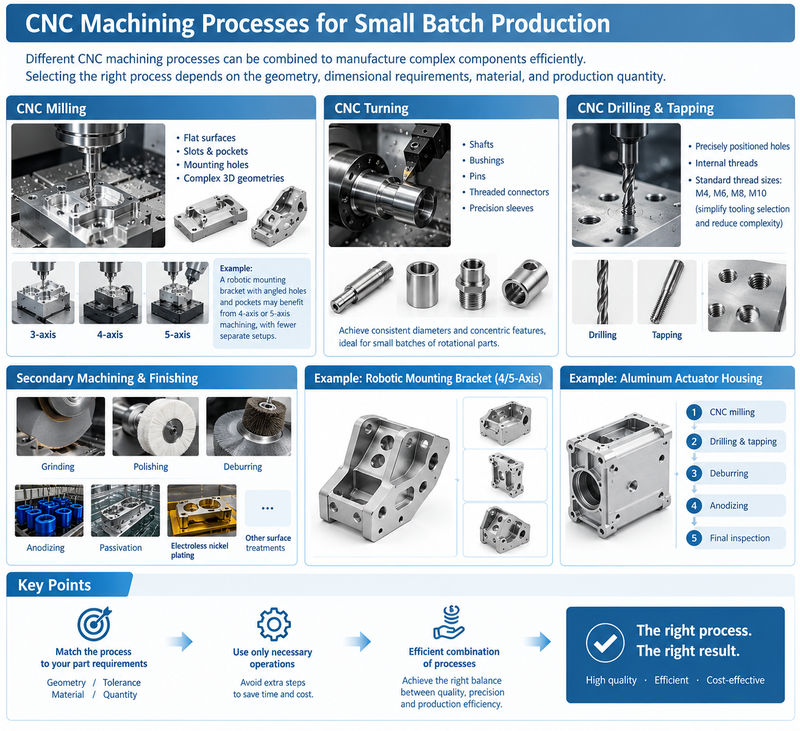
Different CNC machining processes can be combined to manufacture complex components efficiently. Selecting the right process depends on the geometry, dimensional requirements, material, and production quantity.
CNC milling is commonly used for producing flat surfaces, slots, pockets, mounting holes, and complex three-dimensional geometries. Three-axis milling is suitable for many standard components, while four-axis and five-axis machining can reduce repositioning and improve access to multiple surfaces.
For example, a robotic mounting bracket with several angled holes and machined pockets may benefit from four-axis or five-axis machining because fewer separate setups are required.
CNC turning is suitable for cylindrical components such as shafts, bushings, pins, threaded connectors, and precision sleeves. Turning can achieve consistent diameters and concentric features, making it an effective choice for small batches of rotational parts.
CNC drilling and tapping produce accurately positioned holes and internal threads. Standard thread sizes such as M4, M6, M8, and M10 can simplify tooling selection and reduce manufacturing complexity.
Secondary machining and finishing may include grinding, polishing, deburring, anodizing, passivation, electroless nickel plating, and other surface treatments.
A practical manufacturing route for an aluminum actuator housing might include CNC milling, drilling and tapping, deburring, anodizing, and final dimensional inspection.
The key is to select processes that meet the functional requirements without introducing unnecessary machining operations.
Best Materials for Low Volume CNC Machining
Material selection directly affects machining time, component performance, raw material costs, and final product quality. In low volume CNC machining, choosing an appropriate material is particularly important because small orders provide fewer opportunities to offset material waste and purchasing costs.
Aluminum alloys are widely used because they offer a favorable balance of weight, strength, corrosion resistance, and machinability. Aluminum 6061-T6 is suitable for general-purpose brackets, housings, and structural components. Aluminum 7075-T6 provides higher strength and is often used in aerospace and high-performance mechanical applications.
Stainless steel is selected when corrosion resistance, strength, and durability are important. Grades 304 and 316 are common choices for equipment components, while 17-4 PH stainless steel offers higher strength after appropriate heat treatment.
Carbon and alloy steels are useful for shafts, gears, fixtures, and load-bearing components. Materials such as 1045 and 4140 provide different combinations of strength, hardness, and machinability.
Engineering plastics are suitable for lightweight components, electrical insulation, wear resistance, and chemical compatibility. POM (Delrin), nylon, PEEK, and PTFE are frequently used in precision plastic machining.
| Material | Main Characteristics | Typical Applications |
|---|---|---|
| Aluminum 6061-T6 | Lightweight, good machinability | Brackets, housings |
| Aluminum 7075-T6 | High strength-to-weight ratio | Aerospace components |
| Stainless Steel 304 | Corrosion resistance | Equipment fittings |
| Stainless Steel 316 | Improved corrosion resistance | Marine components |
| 4140 Steel | High strength, heat-treatable | Shafts, mechanical parts |
| Brass C360 | Excellent machinability | Connectors, fittings |
| POM | Low friction, dimensional stability | Bushings, gears |
| PEEK | High temperature and chemical resistance | Medical and industrial parts |
Material selection should always consider the actual operating environment. For example, 6061-T6 may be sufficient for a standard equipment bracket, while 7075-T6 may be more appropriate when higher mechanical strength is required.
Design for Manufacturability (DFM) in Low Volume Production
Design for Manufacturability (DFM) is one of the most effective ways to reduce manufacturing costs and improve production efficiency.
In low volume CNC machining, programming, workholding, and machine setup costs are distributed across relatively few parts. Consequently, even a small design modification can have a noticeable effect on the total quotation.
Several design considerations deserve attention.
Internal corner radii: CNC milling cutters are cylindrical, so they naturally produce rounded internal corners. Designing pockets with practical corner radii allows manufacturers to use standard cutting tools instead of smaller, slower cutters.
Wall thickness: Extremely thin walls can vibrate, deform, or generate excessive heat during machining. For aluminum components, walls around 1–2 mm may be feasible depending on their height, geometry, and support, but thicker walls generally improve machining stability.
Pocket depth: Deep, narrow pockets require longer cutting tools and increase the risk of tool deflection. Whenever possible, use wider pockets, practical depths, and accessible tool paths.
Tolerance requirements: Avoid applying extremely tight tolerances to every dimension. A mounting bore may require ±0.02 mm, while a noncritical external dimension may function correctly with ±0.10 mm or a suitable general tolerance.
Workholding and setup: Designs that allow machining from fewer orientations reduce repositioning, alignment errors, and setup costs.
For example, redesigning an aluminum enclosure so that most holes, slots, and pockets can be machined from two orientations rather than four can simplify production considerably.
Cost Factors and Pricing of Low Volume CNC Machining
The cost of low volume CNC machining is determined by several factors rather than production quantity alone. Small batches often have higher unit prices because programming, setup, and inspection expenses are distributed across fewer components.
The main cost factors include:
| Cost Factor | How It Affects Pricing |
|---|---|
| CAD/CAM programming | Initial engineering and toolpath preparation |
| Machine setup | Workholding, alignment, and tool preparation |
| Raw materials | Material grade, size, and availability |
| Machining time | Cutting complexity and material removal |
| Tolerances | Additional machining and inspection requirements |
| Surface finishing | Anodizing, plating, polishing, and coating |
| Quality inspection | Measurement equipment and reporting |
| Packaging and shipping | Protection, handling, and transportation |
Consider an order for 20 aluminum 6061-T6 brackets.
Suppose programming and setup cost $200, while machining, material, and finishing cost $40 per part. The estimated manufacturing cost would be:
[ 200+(20\times40)=$1,000 ]
The average cost would therefore be $50 per part, excluding any additional charges not included in the example.
If the same order increases to 100 pieces and the original setup cost remains unchanged:
[ 200+(100\times40)=$4,200 ]
The average cost decreases to $42 per part.
These figures are illustrative, not market quotations. Actual prices depend on geometry, machine time, material, finishing, inspection, and supplier capacity.
To reduce costs, customers should provide complete drawings, use standard material grades where appropriate, avoid unnecessary tight tolerances, and consolidate machining operations whenever possible.
Dimensional Tolerances and Quality Control
Dimensional accuracy is essential in low volume CNC machining, especially when components must fit together with other mechanical assemblies. Producing a single accurate prototype is not enough; every component in the batch must meet the specified requirements.
A reliable quality control process should cover three stages.
First Article Inspection (FAI): Before producing the entire batch, the manufacturer machines an initial sample and checks its dimensions against the engineering drawing. Critical dimensions, hole positions, thread specifications, and mating features should receive particular attention. This helps identify programming or setup problems before they affect the remaining parts.
In-process inspection: During machining, operators monitor important dimensions to identify tool wear, thermal deformation, or dimensional deviations. For a batch of 100 precision aluminum housings, checking the first few parts and monitoring critical features throughout production can help maintain consistency.
Final inspection: Finished components are checked using appropriate measuring instruments, including digital calipers, micrometers, height gauges, thread gauges, and coordinate measuring machines (CMMs).
Typical inspection considerations include:
| Inspection Item | Common Equipment | Purpose |
|---|---|---|
| External dimensions | Digital calipers, micrometers | Verify overall dimensions |
| Hole diameter | Bore gauges, pin gauges | Check hole accuracy |
| Position tolerance | CMM | Verify feature locations |
| Thread dimensions | Thread gauges | Confirm thread specifications |
| Surface roughness | Surface roughness tester | Measure surface quality |
| Geometric tolerances | CMM | Check flatness, position, and other GD&T requirements |
For example, a precision shaft may require a diameter tolerance of ±0.02 mm and controlled concentricity to ensure smooth operation inside a bearing assembly. These requirements should be clearly identified on the drawing so the machining and inspection processes can be planned accordingly.
Customers should also specify whether they need material certificates, dimensional inspection reports, or first-article documentation.
Low Volume CNC Machining vs. 3D Printing, Injection Molding, and Mass Production
Choosing the right manufacturing method is important because different production technologies have different cost structures, material capabilities, and dimensional limitations.
Low volume CNC machining is particularly attractive when customers need functional components made from actual engineering materials without investing in expensive molds.
| Comparison Factor | CNC Machining | 3D Printing | Injection Molding |
|---|---|---|---|
| Initial tooling | Low | Low | High |
| Material selection | Metals and plastics | Process-dependent materials | Thermoplastics and other moldable materials |
| Dimensional accuracy | Generally high | Depends on technology | Depends on mold and process |
| Mechanical properties | Bulk material properties | Depends on printing direction and process | Depends on material and molding conditions |
| Design modifications | Relatively easy | Relatively easy | Often requires mold modifications |
| Small batch suitability | Excellent | Excellent | Often uneconomical |
| Large-scale production | Higher unit cost | Often higher unit cost | Excellent |
CNC machining vs. 3D printing: CNC machining is often preferable when components require metal construction, accurate threaded holes, precision bores, good surface finishes, or specific bulk material properties. 3D printing may be more economical for complex internal geometries, lightweight lattice structures, and conceptual prototypes.
CNC machining vs. injection molding: Injection molding requires an initial mold investment, which can make small production runs expensive. CNC machining avoids this mold expense and allows design changes without rebuilding a mold. However, when demand becomes stable and reaches sufficiently large quantities, injection molding may offer a significantly lower unit cost.
Low volume vs. mass production: Low volume production prioritizes flexibility, lower initial investment, and reduced inventory risk. Mass production prioritizes manufacturing efficiency and lower unit costs through optimized processes, dedicated tooling, and automation.
The best option should be evaluated using total project cost rather than unit price alone.
Lead Times, Production Flexibility, and Supply Chain Advantages
One of the biggest advantages of low volume CNC machining is the ability to manufacture custom components without waiting for dedicated molds or extensive production tooling.
For companies developing new products, this flexibility can shorten the time between engineering approval and functional testing.
A typical low-volume manufacturing project may follow this workflow:
- Drawing and quotation: The customer submits 3D CAD files, 2D engineering drawings, material requirements, and order quantities.
- DFM review: Engineers evaluate machining access, tolerances, workholding, and potential production problems.
- Programming and setup: CAM toolpaths are generated, materials are prepared, and the CNC machine is configured.
- Sample production: Initial components are machined and inspected.
- Batch manufacturing: After sample approval, the remaining parts are produced under the agreed process.
- Finishing and inspection: Components receive the specified surface treatments and final quality checks.
- Packaging and delivery: Finished parts are protected and prepared for shipment.
For planning purposes, a relatively simple CNC-machined prototype may take approximately 3–10 business days, while more complex small-batch orders can require several weeks. These are indicative planning ranges rather than guaranteed delivery times.
Material availability, machining complexity, batch size, inspection requirements, and external finishing processes can all affect the actual schedule.
Low volume CNC machining also helps companies reduce inventory exposure. Instead of ordering thousands of components before market demand is established, businesses can purchase smaller batches and adjust subsequent orders according to actual sales or engineering requirements.
This approach is especially useful for startups, specialized equipment manufacturers, and companies producing customized industrial machinery.
How to Choose a Reliable Low Volume CNC Machining Manufacturer
Selecting a suitable manufacturing partner involves more than comparing unit prices. A supplier must understand the engineering requirements, provide consistent machining quality, and manage small production batches efficiently.
Before placing an order, customers should evaluate several important factors.
CNC machining capabilities: Check whether the manufacturer offers CNC milling, CNC turning, multi-axis machining, precision drilling, tapping, and other processes required by the component design. A supplier with integrated manufacturing capabilities may reduce the need for multiple subcontractors.
Material sourcing: Confirm that the supplier can provide the specified material grade and, when required, corresponding material certificates. Substituting 6061 aluminum for 7075 aluminum, for example, may significantly change the mechanical performance of the finished component.
Quality management: Ask about inspection equipment, first-article inspection, dimensional reports, and the procedures used to control repeat orders. A professional supplier should be able to explain how critical dimensions are verified.
Surface finishing capabilities: If parts require anodizing, electroless nickel plating, passivation, polishing, or other treatments, confirm that these operations are included in the production plan. Surface finishing can affect dimensions, appearance, and delivery schedules.
Communication and engineering support: A capable supplier should identify drawing conflicts, suggest practical design modifications, and communicate potential manufacturing risks before production begins.
When requesting a quotation, customers should ideally provide:
- 3D CAD files in STEP, STP, or IGES format.
- 2D engineering drawings with dimensions and tolerances.
- Required material grades and conditions.
- Surface finish and coating specifications.
- Order quantity and estimated annual demand.
- Inspection and certification requirements.
- Target delivery date and shipping destination.
Providing this information allows manufacturers to evaluate the project more accurately and prepare a quotation that reflects the actual production requirements.
Choose Xavier for Reliable Low Volume CNC Machining Services
Low volume CNC machining provides an effective manufacturing solution for companies that need precision components without committing to expensive tooling or large production quantities. From functional prototypes and engineering validation to pilot production and repeat small-batch orders, it offers flexibility throughout the product development cycle.
At Xavier, we specialize in custom CNC machining and precision metal component manufacturing, providing integrated manufacturing and trading services for international B2B customers. Our machining capabilities cover CNC milling, CNC turning, and customized machining of various metal and engineering plastic components.
Whether you need 10 aluminum brackets, 50 stainless steel shafts, or 200 precision-machined mechanical housings, our team can evaluate your drawings, material specifications, machining requirements, and finishing needs to develop a suitable manufacturing solution.
We understand that small production orders still require dependable dimensional accuracy, consistent quality, and clear communication. Our goal is to help customers move from prototype development to small-batch manufacturing with practical engineering support and reliable production coordination.
Looking for a reliable low volume CNC machining manufacturer in China?
Send your 3D CAD files, engineering drawings, material requirements, and estimated order quantity to Xavier. Our team will review your project and provide a customized quotation to help bring your precision components into production.
Contact Xavier today to discuss your low volume CNC machining requirements.
As an integrated CNC machining manufacturer and trading company, Xavier specializes in custom CNC machining and outsourced manufacturing of a wide range of metal components. We provide flexible machining solutions for different materials and applications, including CNC machining of PEEK, CNC machining of aluminum, and CNC machining of stainless steel. Our material capabilities also cover alloy steel, brass, bronze, copper, Inconel, Invar 36, mild steel, titanium, tool steel, ABS, FR4, G-10, nylon, PEI, PET, PMMA (acrylic), polycarbonate, polyethylene, polypropylene, POM (acetal), PPSU, PTFE, and PVC. We manufacture custom components for robotics, aerospace, marine, automotive, medical, and other precision engineering applications.
As an experienced CNC machining of PEEK manufacturer, we provide bulk CNC machining of aluminum services to meet various production requirements. Feel free to contact us for CNC machining of stainless steel pricing. We look forward to supporting your next project.
Some of the images and text in this article are collected and compiled from the internet. If there is anything inappropriate, please contact us for processing.