
CNC Machining Medical Devices: A Guide to Custom Medical Components
Medical device manufacturing requires more than dimensional accuracy. Every component must meet its intended functional requirements, and depending on its application, it may also need specific material properties, biocompatibility, corrosion resistance, surface finish, cleanliness, and manufacturing traceability.
CNC machining for medical applications is widely used to produce surgical instruments, orthopedic implants, dental components, diagnostic equipment parts, medical device housings, and precision mechanical components. Compared with conventional industrial machining, medical CNC machining places greater emphasis on material verification, surface integrity, inspection procedures, and consistent production quality.
For medical device manufacturers and engineering procurement teams, choosing the right CNC machining partner can directly affect product reliability, manufacturing costs, and development schedules.
This guide explores 10 important aspects of CNC machining for medical applications, from material selection and machining processes to tolerances, surface finishing, regulatory requirements, and supplier evaluation.
10 Key Topics in Medical CNC Machining
- What Is CNC Machining for Medical Applications?
- Common Materials Used in Medical CNC Machining
- CNC Machining Processes for Medical Components
- Precision Requirements and Dimensional Tolerances
- Surface Finish and Biocompatibility Considerations
- Medical Component Design and DFM Optimization
- Quality Control, Inspection, and Traceability
- Medical CNC Machining Applications and Components
- Manufacturing Challenges and Cost Factors
- How to Choose a Reliable Medical CNC Machining Supplier
1. What Is CNC Machining for Medical Applications?
CNC machining for medical applications is a subtractive manufacturing process that uses computer-controlled cutting tools to manufacture precision components from metal or engineering plastic stock. The machine removes material according to a programmed toolpath until the workpiece reaches the dimensions and geometry specified in the engineering drawing.
Unlike ordinary mechanical components, medical parts may have direct or indirect contact with the human body, surgical instruments, medication, or diagnostic fluids. Consequently, material composition, surface condition, dimensional consistency, and cleanliness can be just as important as the finished geometry.
Why Is CNC Machining Important in Medical Manufacturing?
CNC machining offers several advantages for medical device manufacturers:
- High dimensional accuracy: Suitable for manufacturing small components, precision holes, complex slots, threads, and mating surfaces.
- Material flexibility: Supports stainless steel, titanium alloys, cobalt-chromium alloys, PEEK, and other engineering plastics.
- Repeatability: Programmed machining operations help maintain consistent dimensions across production batches.
- Design flexibility: Complex geometries can be produced without dedicated injection molds or casting dies.
- Prototype production: Engineers can manufacture functional prototypes before committing to larger production quantities.
For example, a surgical instrument may contain a precision-machined handle, a stainless steel connecting shaft, and a small threaded locking component. CNC milling and turning can produce these features with controlled dimensions, allowing the components to fit together during assembly.
Medical CNC machining is particularly useful for prototypes, customized components, low-to-medium-volume production, and precision parts that require material properties difficult to achieve through conventional molding.
2. Common Materials Used in Medical CNC Machining
Material selection is one of the most important decisions in medical component manufacturing. The correct material must provide the required mechanical strength, corrosion resistance, machinability, sterilization compatibility, and biological performance for its intended application.
Not every material described as medical grade is suitable for every medical application. The actual material grade, applicable standard, processing history, and intended patient-contact conditions must be evaluated.
Common Medical CNC Machining Materials
| Material | Main Characteristics | Typical Medical Applications |
|---|---|---|
| 316L Stainless Steel | Corrosion resistance, toughness, good cleanability | Surgical instruments, medical equipment |
| 17-4 PH Stainless Steel | High strength, heat-treatable | Instrument components, mechanical assemblies |
| Ti-6Al-4V | High strength-to-weight ratio, corrosion resistance | Orthopedic and dental components |
| Ti-6Al-4V ELI | Low interstitial content, suitable for specified implant applications | Bone plates, orthopedic implants |
| Cobalt-Chromium Alloys | Wear resistance, hardness, strength | Joint replacement components |
| PEEK | Lightweight, chemical resistance, dimensional stability | Medical housings, selected implant components |
| UHMWPE | Low friction, excellent wear properties | Selected orthopedic bearing components |
Stainless Steel: 316L and 17-4 PH
316L stainless steel is widely used for surgical instruments and medical equipment components because of its corrosion resistance and relatively good machinability. Its low carbon content helps reduce the risk of sensitization during welding or exposure to certain thermal processes.
17-4 PH stainless steel offers higher mechanical strength after appropriate heat treatment. It is suitable for structural components, locking mechanisms, and instrument parts that experience repeated mechanical loads.
However, 316L and 17-4 PH are not interchangeable. Engineers should specify the exact grade and condition according to the component’s mechanical and corrosion requirements.
Titanium Alloys: Ti-6Al-4V and ELI
Titanium alloys are especially important in orthopedic and dental manufacturing. Ti-6Al-4V provides a favorable combination of strength, low density, and corrosion resistance.
Ti-6Al-4V ELI, commonly associated with ASTM F136 for implant applications, has controlled interstitial content. This makes it suitable for certain implant applications where material properties and applicable standards are critical.
Titanium is more difficult to machine than aluminum because of its relatively low thermal conductivity and tendency to retain heat near the cutting zone. Proper tool selection, cutting parameters, coolant delivery, and chip evacuation are essential to prevent excessive tool wear and surface damage.
Medical-Grade Engineering Plastics
PEEK is commonly selected for applications requiring a combination of mechanical strength, chemical resistance, and dimensional stability. However, standard industrial PEEK should not automatically be considered suitable for implantation.
For example, a medical equipment housing may use an appropriate PEEK grade because of its mechanical and chemical properties, while an implantable component requires additional verification of material specifications and biological suitability.
3. CNC Machining Processes for Medical Components
Different medical components require different machining strategies. The choice depends on part geometry, material, dimensional requirements, surface quality, and production volume.
CNC Milling
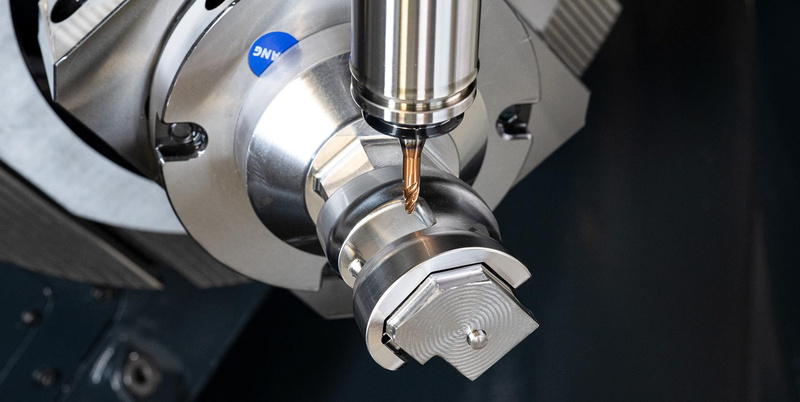
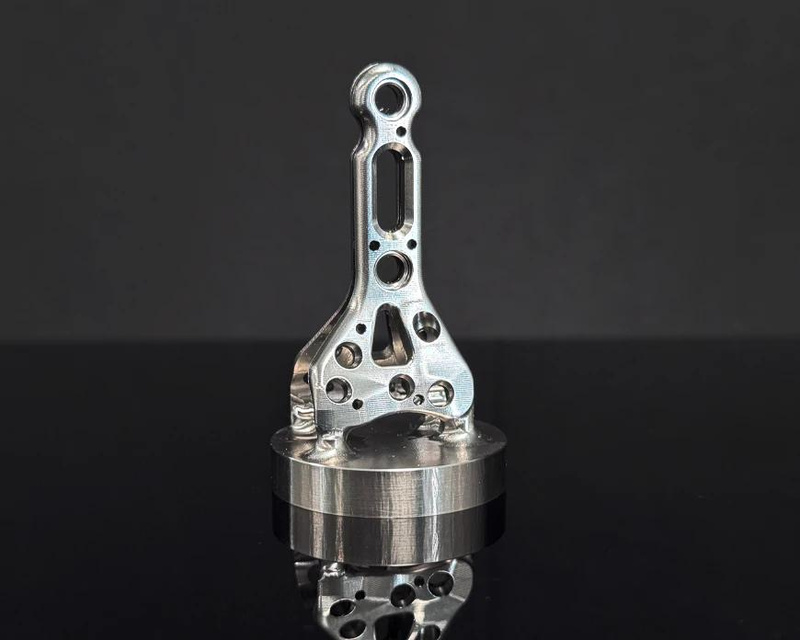
CNC milling is commonly used to manufacture medical equipment housings, instrument handles, mounting brackets, orthopedic components, and complex structural parts.
Three-axis milling is suitable for conventional flat surfaces, pockets, and drilled features. Four-axis and five-axis machining are useful when a component has angled surfaces, curved geometries, or multiple machining faces.
For example, a titanium orthopedic component with several curved surfaces and accurately positioned mounting holes may benefit from five-axis machining. Completing more features in fewer setups can reduce repositioning errors and improve geometric consistency.
CNC Turning and Swiss Machining
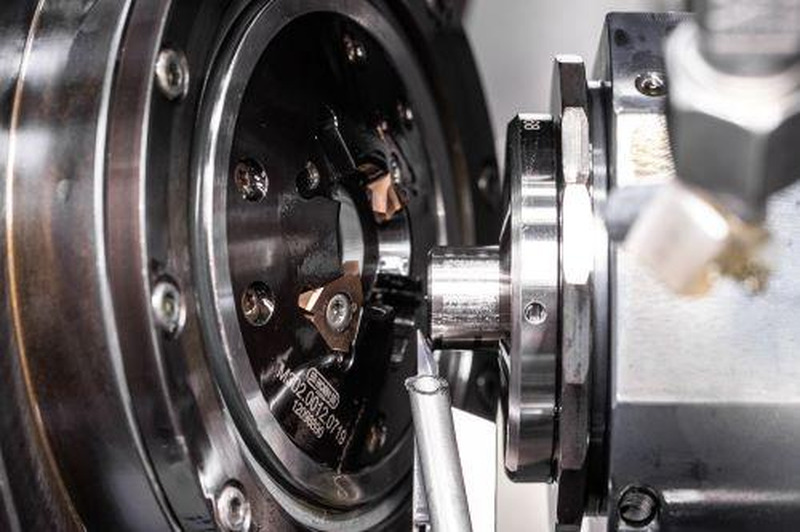
CNC turning is particularly suitable for cylindrical medical components such as pins, shafts, connectors, sleeves, and threaded fasteners.
Swiss-type CNC machining is valuable for small-diameter and slender components. The guide bushing supports the workpiece close to the cutting area, helping control deflection during machining.
This process is especially useful for manufacturing miniature surgical instrument components, dental posts, and precision medical fasteners.
Grinding and Secondary Operations
Some medical parts require grinding to achieve specific dimensional accuracy, roundness, flatness, or surface finish.
Secondary operations may include drilling, reaming, tapping, deburring, polishing, passivation, and electropolishing. These operations should be included in the manufacturing plan rather than treated as optional finishing steps.
4. Precision Requirements and Dimensional Tolerances
Dimensional accuracy is critical in medical CNC machining because small deviations can affect assembly, mechanical movement, sealing performance, and component functionality.
However, not every feature requires the same tolerance. A bearing interface, threaded connection, and non-functional external surface have different engineering requirements.
Typical Medical CNC Machining Tolerance References
| Feature or Application | Illustrative Tolerance | Inspection Considerations |
|---|---|---|
| General machined dimensions | ±0.05 mm | Calipers, micrometers |
| Precision mounting features | ±0.02 mm | Micrometers, CMM |
| Critical bores and fits | ±0.005–0.01 mm | Bore gauges, CMM |
| Precision turned diameters | ±0.005–0.02 mm | Micrometers, air gauges |
| Complex geometric profiles | Drawing-dependent | CMM, profile measurement |
These values are illustrative manufacturing targets, not universal medical industry requirements. Actual achievable tolerances depend on material, geometry, machine capability, workholding, thermal conditions, and inspection methods.
Why GD&T Matters in Medical Parts
Geometric Dimensioning and Tolerancing (GD&T) defines how individual features relate to one another.
For example, a medical equipment housing may contain several mounting holes that must align with an internal mechanism. Controlling hole position relative to a common datum system is often more meaningful than simply applying a tight dimensional tolerance to each hole.
Engineers should prioritize critical functional dimensions, specify suitable datums, and avoid unnecessarily tight tolerances on non-critical surfaces. This improves manufacturability without compromising component performance.
5. Surface Finish and Biocompatibility Considerations
Surface finish is an important factor in medical CNC machining because it can influence corrosion resistance, cleanability, wear behavior, and the performance of components that contact tissue or fluids.
A component may satisfy every dimensional requirement but still be unsuitable if its surface contains burrs, embedded particles, machining defects, or excessive roughness.
Common Surface Finish Requirements
Surface roughness is commonly measured using Ra (arithmetical mean roughness), expressed in micrometers (µm).
| Medical Component | Illustrative Surface Finish | Recommended Consideration |
|---|---|---|
| General medical equipment parts | Ra 0.8–1.6 µm | Consistent machining finish |
| Surgical instrument surfaces | Ra 0.4–0.8 µm | Smooth, cleanable surfaces |
| Fluid-contact components | Ra 0.2–0.8 µm | Cleaning and contamination control |
| Precision sealing surfaces | Ra 0.2–0.4 µm | Leakage and sealing performance |
| Implant articulating surfaces | Application-specific, potentially below Ra 0.05 µm | Wear and tribological performance |
These are engineering reference ranges rather than universal regulatory limits. The device manufacturer’s specifications and validated application requirements determine the actual surface finish.
Common Medical Surface Finishing Processes
Passivation: Commonly applied to stainless steel to remove free iron and promote the formation of a corrosion-resistant passive surface. It is particularly useful for surgical instruments and stainless steel medical components.
Electropolishing: An electrochemical process that removes a thin layer of material, helping reduce microscopic surface irregularities. It can improve surface smoothness and cleanability when properly specified and controlled.
Mechanical Polishing: Uses abrasive materials to improve surface appearance and reduce roughness. It is suitable for components requiring smoother contact surfaces or improved appearance.
Deburring: Removes sharp edges and unwanted material left by drilling, milling, and turning. Burrs around small holes and internal channels are especially problematic because they can interfere with assembly or retain contaminants.
One important consideration is that surface finishing can change component dimensions. For example, electropolishing removes material, while certain coatings add thickness. Critical dimensions should therefore be evaluated after the complete finishing process, not just immediately after CNC machining.
6. Medical Component Design and DFM Optimization
Design for Manufacturing (DFM) is an important part of medical CNC machining. A component that looks straightforward in a CAD model may be difficult or expensive to manufacture because of deep cavities, thin walls, inaccessible internal corners, or unnecessarily complicated geometries.
A DFM review before production helps engineers identify manufacturing risks and reduce avoidable costs.
Important Medical CNC Design Considerations
- Avoid unnecessarily thin walls
Thin walls can vibrate or deform under cutting forces, particularly when machining titanium and stainless steel. If a medical equipment housing requires a wall thickness of 0.8 mm, the manufacturer should evaluate its height, unsupported length, material, and machining strategy before confirming manufacturability.
- Use practical internal corner radii
CNC milling tools are generally cylindrical, so they cannot produce perfectly sharp internal corners through ordinary milling. Designing suitable corner radii reduces machining time and avoids unnecessary use of small, fragile cutting tools.
- Consider hole depth and diameter
Deep, narrow holes are more difficult to machine because chip evacuation becomes less efficient and tool deflection increases. Where possible, engineers should avoid excessive depth-to-diameter ratios and provide appropriate access for drilling and inspection.
- Design for cleaning and inspection
Medical components should avoid unnecessary gaps, inaccessible recesses, and complicated internal geometries that make cleaning difficult. Features requiring inspection should also remain accessible to suitable measurement equipment.
Example: Designing a Titanium Medical Bracket
Consider a titanium mounting bracket used in a medical positioning system. The original design includes several deep pockets, thin supporting walls, and multiple mounting holes.
A DFM review may recommend increasing the internal corner radii, adjusting unsupported wall sections, and consolidating machining features into fewer setups.
These modifications can reduce cutting time, tool wear, and workholding complexity while maintaining the required mechanical performance.
7. Quality Control, Inspection, and Traceability
Quality control is one of the most important differences between general CNC machining and medical component manufacturing.
Medical device manufacturers need more than a finished component that appears dimensionally correct. Depending on the product and contractual requirements, they may also need evidence of material identity, manufacturing history, inspection results, and controlled finishing operations.
Common Inspection Methods
| Inspection Method | Main Purpose |
|---|---|
| Coordinate Measuring Machine (CMM) | Measures complex dimensions and geometric relationships |
| Digital Calipers | Checks general external dimensions |
| Micrometers | Measures precision diameters and thicknesses |
| Bore Gauges | Inspects internal diameters |
| Surface Roughness Tester | Measures Ra surface roughness |
| Optical Comparator | Checks profiles and small geometric features |
| Hardness Tester | Verifies specified material hardness |
For example, a precision-machined stainless steel medical connector may require inspection of its external diameter, internal bore, thread dimensions, and sealing surface. A CMM report can verify geometric relationships, while specialized gauges can check the functional dimensions.
ISO 13485 and Medical Manufacturing Quality
ISO 13485 is an internationally recognized quality management system standard for medical device organizations.
It addresses areas such as document control, production controls, supplier management, risk management, nonconformity handling, and traceability.
It is important to distinguish between the responsibilities of a medical device manufacturer and those of its machining supplier. A CNC machining supplier is not automatically required to hold ISO 13485 certification in every sourcing arrangement. However, medical OEMs may require certification or specific quality-system controls from their suppliers as part of their purchasing and regulatory obligations.
For US-market products, FDA requirements also matter. The FDA’s Quality Management System Regulation (QMSR), effective February 2, 2026, incorporates ISO 13485:2016 by reference, subject to FDA-specific requirements.
Why Material Traceability Matters
Material traceability allows a finished component to be connected to its original raw material batch.
A typical documentation package may include:
- Material Test Report (MTR).
- Raw material grade and specification.
- Material heat or lot number.
- First Article Inspection (FAI) report.
- Dimensional inspection records.
- Surface treatment and process records.
- Certificate of Conformance (CoC).
For example, if a manufacturer orders titanium components specified to ASTM F136, the supplier should be able to demonstrate that the material used matches the required grade and that the relevant documentation corresponds to the delivered production lot.
8. Medical CNC Machining Applications and Components
Medical CNC machining supports many different product categories. Each application has specific requirements based on mechanical loading, environmental exposure, sterilization methods, and the intended contact between the component and the patient.
Orthopedic and Dental Components
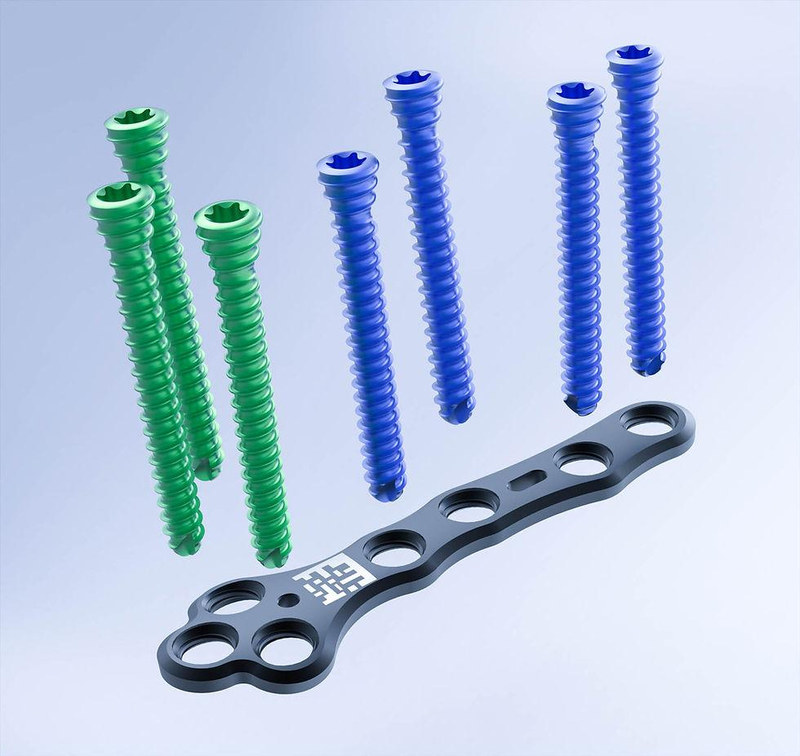
Orthopedic components include bone plates, bone screws, joint replacement components, and spinal fixation parts. Titanium alloys and cobalt-chromium alloys are frequently specified for applications requiring particular combinations of strength, corrosion resistance, and wear performance.
Dental components include implant abutments, prosthetic connectors, and precision fixtures. CNC turning and milling are particularly useful for producing small features and accurate mating interfaces.
Surgical Instruments
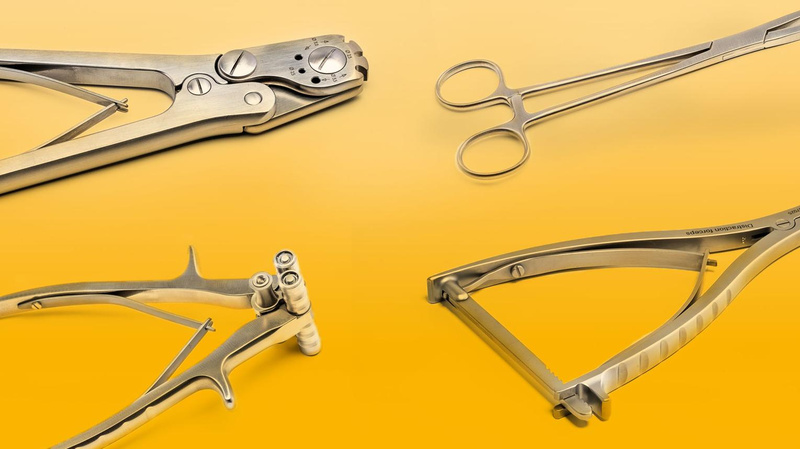
Surgical instruments such as forceps, clamps, retractors, and instrument handles often contain intricate mechanical features.
316L stainless steel is a common material choice because of its corrosion resistance and suitability for many cleaning and sterilization environments. Precision machining is important for maintaining alignment, movement, grip, and assembly consistency.
Diagnostic and Medical Equipment
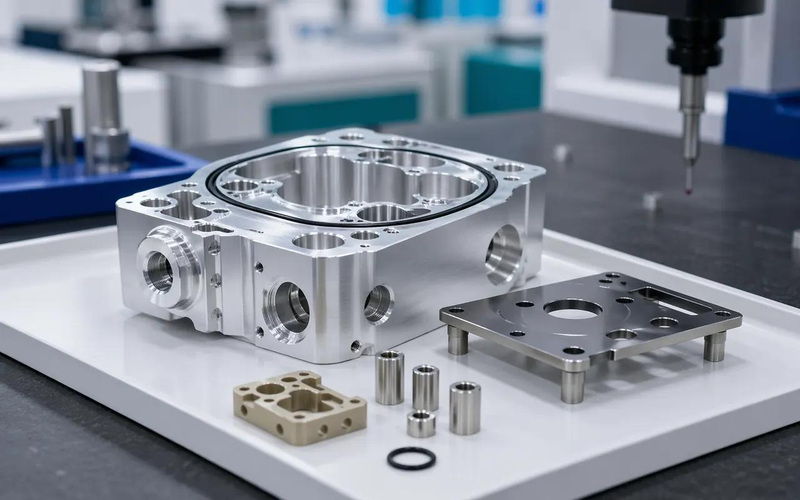
Diagnostic equipment often contains precision-machined housings, mounting brackets, fluid connectors, heat-dissipation components, and structural supports.
For example, an imaging equipment assembly may require aluminum brackets with accurately positioned mounting holes to maintain alignment between mechanical and electronic components.
These parts may not contact the patient directly, but dimensional accuracy and mechanical stability remain essential to the performance of the complete device.
9. Manufacturing Challenges and Cost Factors
Medical CNC machining can be more expensive than ordinary industrial machining because the total manufacturing cost includes more than machine operating time.
Material selection, cutting difficulty, inspection requirements, finishing operations, documentation, and production quantity all influence the final quotation.
Main Factors Affecting Medical CNC Machining Costs
| Cost Factor | Impact on Manufacturing Cost |
|---|---|
| Material selection | Titanium and cobalt-chromium generally cost more to machine than aluminum |
| Tight tolerances | Increase machining, measurement, and rejection-control requirements |
| Complex geometry | Requires additional setups, programming, or five-axis machining |
| Surface finishing | Adds processing time and dimensional verification |
| Inspection requirements | May require CMM reports and specialized gauges |
| Documentation | Adds material verification and production record management |
| Production quantity | Affects setup cost per part and purchasing efficiency |
Why Titanium Medical Components Cost More
Titanium alloys have relatively low thermal conductivity, meaning heat generated during cutting tends to concentrate near the cutting edge.
This increases tool wear and makes cutting conditions more demanding. Manufacturers may need specialized carbide tooling, controlled cutting speeds, suitable coolant delivery, and careful chip evacuation.
A titanium orthopedic component with complex curved surfaces and tight dimensional requirements will generally cost more than a simple aluminum medical equipment bracket.
How to Reduce Medical CNC Machining Costs
Cost reduction should focus on improving manufacturability without compromising safety or functional performance.
- Apply tight tolerances only to critical dimensions.
- Avoid unnecessarily deep pockets and narrow slots.
- Use practical corner radii.
- Select materials according to actual application requirements.
- Consolidate machining operations where practical.
- Confirm finishing and inspection requirements before production.
A detailed drawing review before quotation can prevent expensive engineering changes after machining begins.
10. How to Choose a Reliable Medical CNC Machining Supplier
Selecting a medical CNC machining supplier requires evaluating technical capability and quality management together. A manufacturer may have advanced CNC equipment but still lack the inspection procedures, documentation, or material controls required for a particular medical project.
Five Important Supplier Evaluation Criteria
- Material Verification
Confirm that the supplier can source the exact material grade and provide the required material certificates. For implant-related projects, verify the applicable ASTM or ISO material specification rather than relying on a general description such as medical-grade titanium.
- Machining Capability
Evaluate whether the manufacturer has suitable CNC milling, turning, drilling, grinding, and secondary finishing capabilities. Complex titanium components may require five-axis machining, while miniature cylindrical components may benefit from Swiss-type turning.
- Inspection Equipment
Ask about CMM capability, precision measuring instruments, surface roughness testing, and first-article inspection procedures. Inspection capability should match the actual drawing requirements.
- Quality Documentation
Clarify whether the supplier can provide material certificates, inspection reports, lot identification, and certificates of conformity. If your project requires ISO 13485 certification, verify the certificate’s scope and validity rather than assuming a general quality certificate is sufficient.
- Communication and Engineering Support
A capable supplier should be able to review drawings, identify potential manufacturing difficulties, recommend practical machining methods, and explain how critical dimensions will be inspected.
For international medical device manufacturers, clear technical communication is particularly important when managing drawing revisions, material specifications, production schedules, and inspection requirements.
Conclusion: Partner with Xavier for Precision Medical CNC Machining
Medical CNC machining requires a combination of precision manufacturing, appropriate material selection, controlled surface finishing, and reliable quality inspection. From stainless steel surgical instrument components to titanium orthopedic parts and PEEK medical equipment components, every manufacturing decision should be based on the component’s actual application and engineering specifications.
At Xavier, we specialize in precision CNC machining services and custom manufacturing of metal components for international B2B customers. Our manufacturing capabilities support CNC milling, CNC turning, precision drilling, boring, and other machining operations for components with different geometries, materials, and dimensional requirements.
Whether you are developing medical equipment prototypes, sourcing custom stainless steel components, or planning small-batch production of precision-machined parts, Xavier can help evaluate your drawings and manufacturing requirements.
Looking for a reliable CNC machining manufacturer for your medical component project?
Contact Xavier today. Send us your 2D drawings, 3D CAD files, material specifications, and estimated order quantity. Our team can review your requirements, recommend suitable machining solutions, and provide a competitive quotation for your project.
As an integrated CNC machining manufacturer and trading company, Xavier specializes in custom CNC machining and contract manufacturing of a wide range of metal components. We provide precision manufacturing solutions for various industries and applications, supporting CNC machining of PEEK, CNC machining of stainless steel, and CNC machining of aluminum, along with alloy steel, brass, bronze, copper, Inconel, Invar 36, mild steel, titanium, tool steel, ABS, FR4, G-10, nylon, PEI, PET, PMMA (acrylic), polycarbonate, polyethylene, polypropylene, POM (acetal), PPSU, PTFE, and PVC. Our machining capabilities serve a broad range of applications, including robotics, aerospace components, marine parts, automotive components, medical components, and other precision-engineered parts.
As a PEEK machining manufacturer, we provide bulk stainless steel CNC machining services. Feel free to contact us for aluminum CNC machining pricing. We look forward to supporting your manufacturing projects.
Some of the images and text in this article are collected and compiled from the internet. If there is anything inappropriate, please contact us for processing.