
What Are TRD Cast Aluminum Running Boards and Why Use Cast Aluminum?
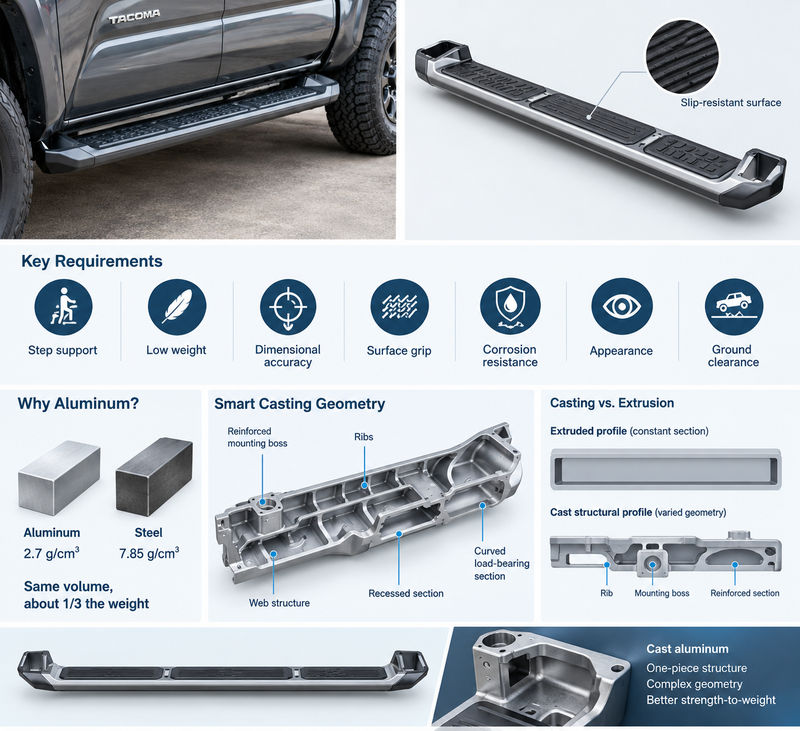
TRD cast aluminum running boards are fixed side steps designed to make it easier to enter and exit trucks and SUVs while maintaining a relatively clean appearance and reasonable ground clearance. Toyota currently lists cast aluminum running boards as an accessory for the Tacoma Double Cab, with a listed MSRP of $1,199 on its 2025 and 2026 accessory pages. Toyota describes them as durable aluminum construction with a slip-resistant coating.
The important point is that cast aluminum is not simply a lighter version of a steel running board. The manufacturing process allows designers to create a relatively complex one-piece or near-net-shape structure with ribs, mounting areas, recessed sections, and curved profiles that would require several fabrication operations if produced from sheet metal.
For a running board, this matters because the part has to perform several functions at the same time:
| Requirement | Why It Matters |
|---|---|
| Step support | Must safely support the user’s weight |
| Low weight | Reduces unnecessary vehicle accessory mass |
| Dimensional accuracy | Mounting holes must align with the vehicle |
| Surface grip | Reduces slipping in wet or dirty conditions |
| Corrosion resistance | Running boards are exposed to water, salt, mud, and road debris |
| Appearance | The part is highly visible along the vehicle side |
| Ground clearance | Excessive downward projection can reduce off-road clearance |
Why Aluminum Is Suitable for Running Boards
Aluminum alloys provide a useful balance between weight, strength, machinability, corrosion resistance, and castability. A steel running board may provide excellent strength, but its higher density increases the weight of a long pair of side steps.
For comparison, aluminum has a density of roughly 2.7 g/cm³, while carbon steel is approximately 7.85 g/cm³. This means that, for the same geometric volume, aluminum weighs only about one-third as much as steel.
That does not mean a cast aluminum running board should simply be made thinner. A properly engineered casting uses geometry to achieve the required stiffness.
For example, instead of creating a completely solid rectangular section, a casting designer can introduce:
- Internal ribs
- Reinforced mounting bosses
- Curved load-bearing sections
- Localized thicker areas around bolt holes
- Recessed sections to reduce unnecessary material
- Web structures between the upper step surface and lower structural section
This is one of the major reasons cast aluminum is attractive for automotive accessories.
Casting Geometry Versus Simple Extrusion
An aluminum extrusion generally has a constant cross-section. A running board, however, often needs different geometry at different locations.
The center of the board may need one structural profile, while the front and rear mounting areas may require reinforced bosses or different attachment geometry.
Casting provides considerably more freedom.
A simplified example is:
Extruded profile:========================
Cast structural profile:==[rib]==[mounting boss]==[reinforced section]==
This allows engineers to put material where the loads actually occur rather than making the entire part unnecessarily thick.
Cast Aluminum Running Board Structure, Strength, and Load Distribution
The most important engineering question is not simply whether cast aluminum is “strong.” The better question is how the running board transfers a person’s load into the vehicle mounting points.
When someone steps on the center of a running board, the load does not remain at that point. It travels through the board and into the brackets, bolts, and vehicle mounting structure.
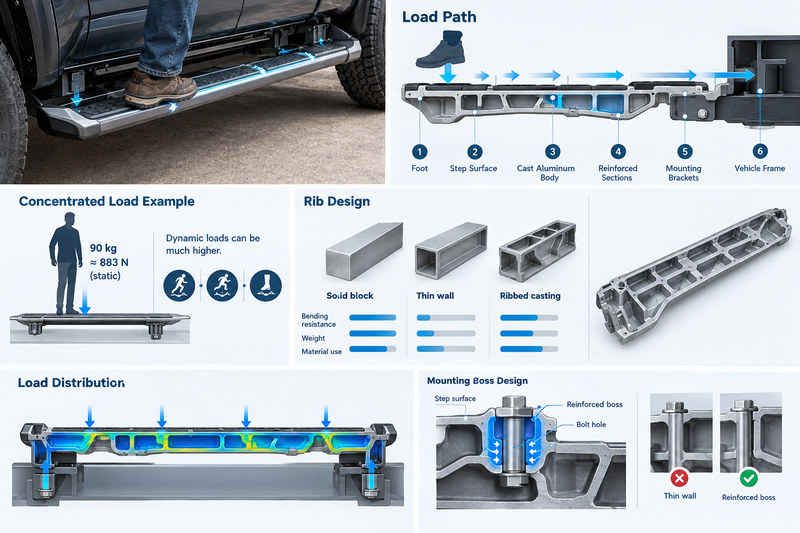
A simplified load path looks like this:
Foot → Step Surface → Cast Aluminum Body → Reinforced Sections → Mounting Brackets → Vehicle Frame/Body Mounting Points
How a Running Board Handles a Concentrated Load
Suppose a person with a mass of 90 kg stands on one small area of the running board.
The static gravitational force is approximately:
90 kg × 9.81 m/s² = 883 N
That is already close to 0.88 kN under static conditions.
But real use is not perfectly static. A person may step down quickly, jump onto the board, or place most of their weight on one foot. Dynamic loading can therefore be considerably higher than the simple body-weight calculation.
This is why a good running board design should not depend on the nominal material strength alone.
The geometry, bracket spacing, bolt locations, local wall thickness, casting quality, and vehicle attachment points all contribute to the final performance.
Rib Design Is Particularly Important
Ribs are commonly used in cast components because they increase stiffness without requiring the entire part to become solid.
Imagine two aluminum structures with the same external dimensions:
| Design | Material Use | Bending Resistance | Weight |
|---|---|---|---|
| Solid block | Very high | High | High |
| Thin unsupported wall | Low | Low | Low |
| Ribbed casting | Moderate | High | Moderate |
The ribbed design is generally more efficient because material is concentrated around the areas that contribute most to stiffness.
For a long running board, this is especially important because the board behaves somewhat like a beam between mounting locations.
If the distance between mounting brackets is too large, the center section can experience increased bending. If the casting is too thin or poorly ribbed, the surface can flex even when the aluminum alloy itself has sufficient tensile strength.
Mounting Bosses Need Special Attention
The mounting area is one of the most critical portions of the casting.
A bolt hole drilled directly through a thin casting wall can create a stress concentration. A better design may use a reinforced boss around the hole.
A typical conceptual section could look like:
      Step Surface
  ______________________
 /                      \
|       Reinforcement    |
|          ______        |
|_________|      |_______|
          | Bolt |
          | Hole |
          |______|
The additional material around the mounting hole helps distribute the fastening load over a larger area.
However, too much material can also create casting problems, including differential cooling and porosity. Therefore, the design must balance mechanical strength with manufacturability.
Casting Quality Matters as Much as Alloy Selection
A strong aluminum alloy does not automatically produce a strong running board.
Casting defects can influence structural performance. Depending on the casting method and process control, manufacturers need to consider:
- Porosity
- Shrinkage cavities
- Cold shuts
- Incomplete filling
- Cracks
- Dimensional distortion
- Inconsistent wall thickness
For an automotive running board, X-ray inspection, CT inspection, dimensional inspection, or other appropriate quality-control methods may be considered for critical development programs.
The exact inspection method depends on the customer’s engineering requirements and the risk level of the component.
Vehicle Fitment: Tacoma, 4Runner, TRD Sport, TRD Off-Road, and TRD Pro
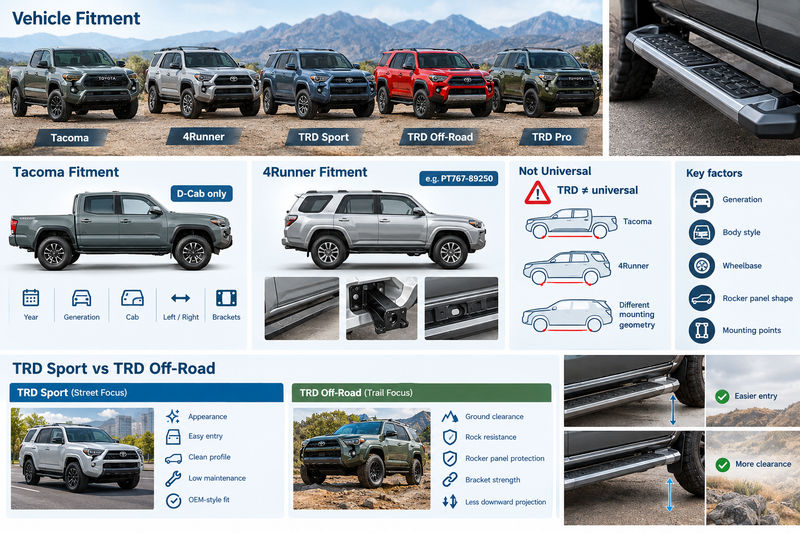
One of the biggest mistakes when purchasing or manufacturing a running board is assuming that a product that fits one Toyota model will automatically fit every TRD vehicle.
TRD is a performance-oriented Toyota vehicle/accessory designation, not a universal mounting standard.
The mounting geometry can change according to vehicle generation, body configuration, wheelbase, cab style, rocker-panel shape, and factory mounting points.
Toyota’s current Tacoma accessory information specifically identifies its cast aluminum running boards as D-Cab only.
Tacoma Fitment
For Tacoma applications, the first question should be the exact vehicle generation and cab configuration.
For example, a supplier should not quote a running board only as:
“Toyota Tacoma running board”
A better engineering description would include:
- Model year
- Tacoma generation
- Cab configuration
- Left/right application
- Fixed or powered design
- Mounting-hole configuration
- Required brackets
- Finish
- OEM or aftermarket replacement status
This prevents a common problem in automotive aftermarket manufacturing: the product looks correct but the mounting holes do not align.
4Runner Fitment
The same principle applies to the 4Runner.
Current enthusiast discussions show that cast aluminum running boards are being used on 2025+ 4Runner applications, including TRD Sport and TRD Off-Road configurations. One commonly discussed part number is PT767-89250.
However, the existence of a similar-looking running board does not mean that every model uses the same brackets.
For a manufacturing project, the vehicle-specific mounting interface should be treated as a separate engineering requirement.
TRD Sport Versus TRD Off-Road
The intended vehicle use also matters.
A street-oriented TRD Sport owner may prioritize:
- Appearance
- Easy entry
- Clean side profile
- Low maintenance
- OEM-style fit
An off-road owner may put greater emphasis on:
- Ground clearance
- Rock impact resistance
- Protection of rocker panels
- Bracket strength
- Reduced downward projection
This creates an important design trade-off.
A very low running board can make vehicle entry easier but may become more exposed to rocks and uneven terrain. A higher board may improve clearance but provide less convenient stepping height.
One 4Runner owner discussion specifically noted that the OEM cast aluminum board sits higher than some drop-step designs and can be useful without hanging excessively low during off-road driving.
Installation, Mounting Brackets, and Dimensional Accuracy
A high-quality running board is not complete when the casting comes out of the mold.
For automotive applications, dimensional accuracy is critical because the component must interface with an existing vehicle.
A casting may look perfect visually while still failing during installation because a hole is only a few millimeters out of position.
Critical Dimensions During Manufacturing
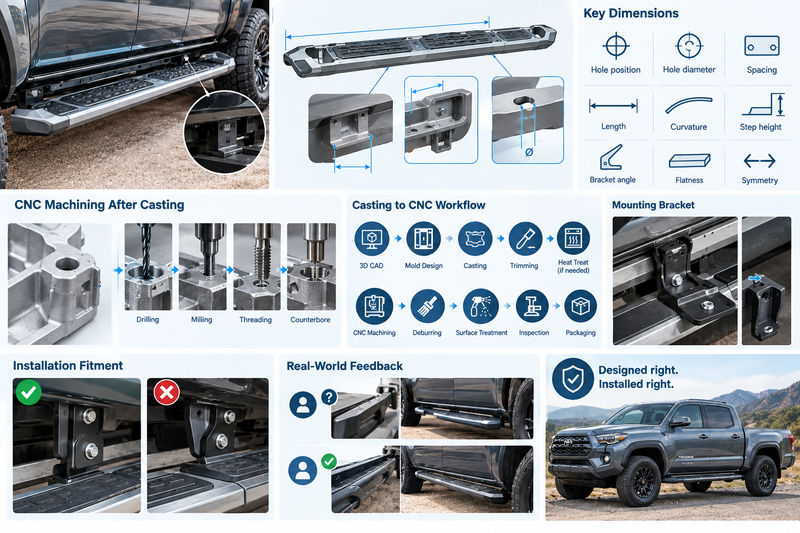
A CNC machining supplier should identify the following dimensions as critical-to-function:
| Feature | Typical Manufacturing Concern |
|---|---|
| Mounting-hole position | Vehicle alignment |
| Hole diameter | Bolt fit |
| Hole-to-hole spacing | Bracket installation |
| Board overall length | Vehicle body fit |
| Board curvature | Rocker-panel clearance |
| Step height | User access |
| Bracket angle | Correct installation orientation |
| Mounting surface flatness | Stable fastening |
| Left/right symmetry | Consistent appearance |
The exact tolerance should always come from the customer’s drawing or OEM specification rather than being guessed.
Why CNC Machining May Be Used After Casting
Casting is excellent for creating the basic geometry, but certain interfaces may still require secondary CNC machining.
Typical operations can include:
- CNC drilling
- CNC milling
- Counterboring
- Spot facing
- Thread machining
- Datum surface machining
- Bracket interface machining
For example, a cast mounting boss may be produced slightly oversized and then CNC-machined to create an accurate bolt hole.
This approach combines the productivity of casting with the dimensional accuracy of CNC machining.
Example of a Casting-to-CNC Workflow
A practical production process could be:
3D CAD → Mold Design → Aluminum Casting → Trimming → Heat Treatment if required → CNC Machining → Deburring → Surface Treatment → Dimensional Inspection → Assembly Inspection → Packaging
Each stage addresses a different risk.
Casting creates the complex shape.
CNC machining establishes critical dimensions.
Surface finishing protects the part and improves appearance.
Inspection verifies that the finished component actually matches the drawing.
Installation Accuracy Is a Real-World Quality Test
Real-world installation reports show why mounting accuracy matters. In a 2025 Tacoma forum discussion, one user questioned whether the angled mounting brackets on TRD cast aluminum running boards would require adjustment, while another reported installing the boards without modification.
This illustrates an important manufacturing principle:
A running board should be designed so that the installer does not need to “correct” the product during installation.
If a customer needs to enlarge holes, bend brackets, grind mounting surfaces, or force bolts into alignment, the problem is generally upstream in design, tooling, machining, or assembly control.
Surface Finish, Corrosion Resistance, and Long-Term Outdoor Performance
Running boards operate in one of the harsher environments on a vehicle.
They are exposed to:
- Rain
- Road salt
- Mud
- Dust
- UV radiation
- Temperature changes
- Water splash
- Cleaning chemicals
- Small stone impacts
For this reason, surface treatment is not simply an aesthetic step.
Toyota describes its Tacoma cast aluminum running boards as having a slip-resistant coating.
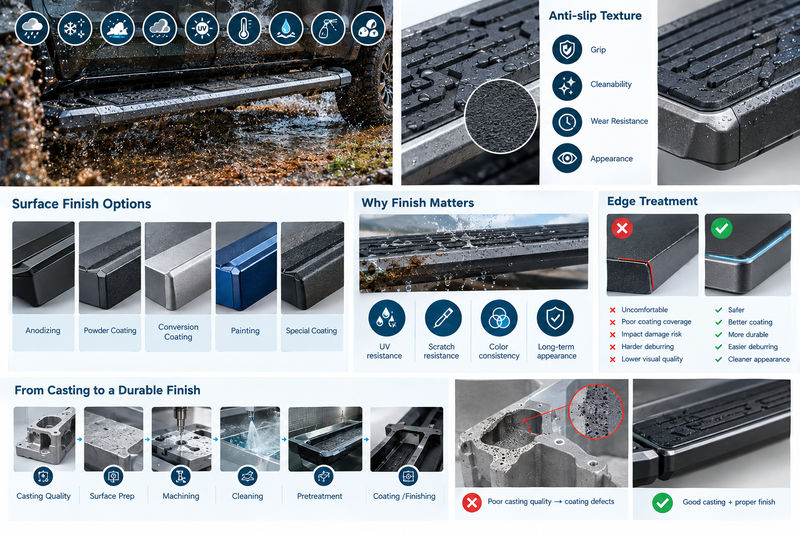
Why the Step Surface Needs Texture
A perfectly smooth metal surface can become slippery when covered with rainwater, mud, snow, or road grime.
A running board therefore needs controlled surface texture or an applied anti-slip treatment.
The objective is not simply to make the surface rough.
The texture needs to balance:
Grip + Cleanability + Wear Resistance + Appearance
If the texture is too aggressive, mud can accumulate and cleaning becomes difficult. If it is too smooth, wet traction may decrease.
Aluminum Corrosion Behavior
Aluminum naturally forms a thin oxide layer when exposed to air. This provides some inherent corrosion resistance, but outdoor automotive components can still benefit from engineered surface protection.
Depending on the customer’s requirements, possible finishing routes for aluminum components include:
- Anodizing
- Powder coating
- Conversion coating
- Painting
- Specialized protective coatings
The best choice depends on appearance, environmental exposure, wear requirements, and production cost.
For a black OEM-style running board, the finish should also be evaluated for:
- Color consistency
- UV resistance
- Adhesion
- Scratch resistance
- Edge coverage
- Long-term appearance
Surface Finish Should Be Considered During Casting Design
The finishing process cannot always compensate for poor casting quality.
For example, if a casting contains excessive surface porosity, coating may reveal pinholes or produce an inconsistent appearance.
Therefore, the correct production sequence starts with controlling the casting itself.
A useful quality chain is:
Casting Quality → Surface Preparation → Machining → Cleaning → Pretreatment → Coating/Finishing → Final Inspection
This is especially important for visible automotive parts because customers can detect surface defects immediately.
Example: Why Edge Treatment Matters
Consider the outer edge of a running board.
If the casting has a sharp edge, several problems can occur:
- It may be uncomfortable or unsafe to contact.
- Coating coverage can be inconsistent.
- The edge may be more vulnerable to impact damage.
- Deburring becomes more difficult.
- Visual quality may be poor.
A controlled radius or chamfer can improve both appearance and manufacturability.
How to Specify Cast Aluminum Running Boards for Custom Manufacturing
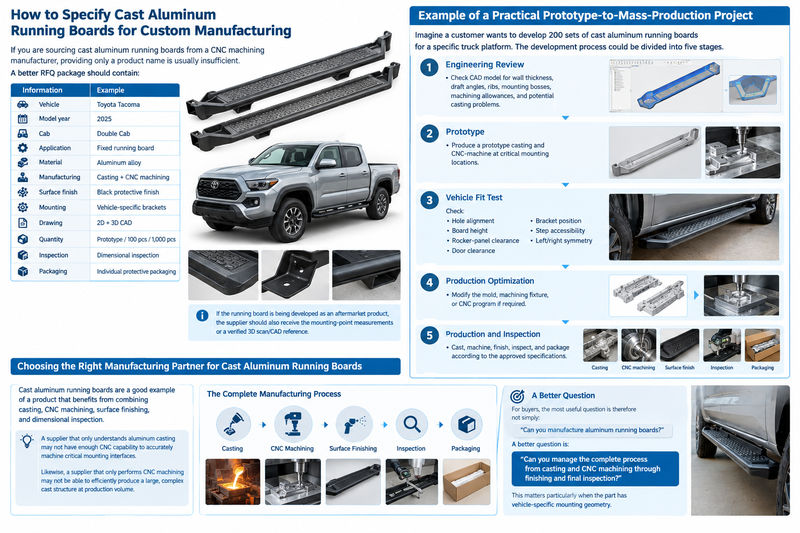
If you are sourcing cast aluminum running boards from a CNC machining manufacturer, providing only a product name is usually insufficient.
A better RFQ package should contain:
| Information | Example |
|---|---|
| Vehicle | Toyota Tacoma |
| Model year | 2025 |
| Cab | Double Cab |
| Application | Fixed running board |
| Material | Aluminum alloy |
| Manufacturing | Casting + CNC machining |
| Surface finish | Black protective finish |
| Mounting | Vehicle-specific brackets |
| Drawing | 2D + 3D CAD |
| Quantity | Prototype / 100 pcs / 1,000 pcs |
| Inspection | Dimensional inspection |
| Packaging | Individual protective packaging |
If the running board is being developed as an aftermarket product, the supplier should also receive the mounting-point measurements or a verified 3D scan/CAD reference.
Example of a Practical Prototype-to-Mass-Production Project
Imagine a customer wants to develop 200 sets of cast aluminum running boards for a specific truck platform.
The development process could be divided into five stages.
Stage 1 — Engineering Review
The manufacturer checks the CAD model for wall thickness, draft angles, ribs, mounting bosses, machining allowances, and potential casting problems.
Stage 2 — Prototype
A prototype casting is produced and CNC-machined at critical mounting locations.
Stage 3 — Vehicle Fit Test
The prototype is physically installed on the target vehicle.
Engineers check:
- Hole alignment
- Board height
- Rocker-panel clearance
- Door clearance
- Bracket position
- Step accessibility
- Left/right symmetry
Stage 4 — Production Optimization
After the first fit test, the mold, machining fixture, or CNC program can be modified if required.
Stage 5 — Production and Inspection
The final parts are cast, machined, finished, inspected, and packaged according to the approved specifications.
This approach is considerably safer than moving directly from CAD to mass production without physical fit verification.
Choosing the Right Manufacturing Partner for Cast Aluminum Running Boards
Cast aluminum running boards are a good example of a product that benefits from combining casting, CNC machining, surface finishing, and dimensional inspection.
A supplier that only understands aluminum casting may not have enough CNC capability to accurately machine critical mounting interfaces.
Likewise, a supplier that only performs CNC machining may not be able to efficiently produce a large, complex cast structure at production volume.
For buyers, the most useful question is therefore not simply:
“Can you manufacture aluminum running boards?”
A better question is:
“Can you manage the complete process from casting and CNC machining through finishing and final inspection?”
This matters particularly when the part has vehicle-specific mounting geometry.
Xavier CNC Manufacturing Recommendation
For customers developing or sourcing TRD-style cast aluminum running boards, Xavier can provide a manufacturing-oriented approach that combines aluminum component production with CNC machining and secondary finishing.
The focus should be on the complete part rather than only the casting itself: material selection, casting geometry, mounting bosses, CNC-machined interfaces, dimensional inspection, surface finishing, and production consistency all need to work together.
For prototype or production projects, customers can provide 2D drawings, 3D CAD files, samples, or vehicle-specific dimensional requirements. Xavier can then evaluate the manufacturing process and determine which features should be cast and which should receive secondary CNC machining.
For a component such as a running board, the goal is straightforward: accurate fit, controlled dimensions, reliable structural performance, consistent surface quality, and repeatable production from the first part to the last.
We are an integrated manufacturing and trading company specializing in CNC machining services, with a strong focus on CNC contract manufacturing and the production of various precision metal parts. We support CNC machining PEEK, CNC machining titanium, and CNC machining brass, along with alloy steel, aluminum, bronze, copper, Inconel, Invar 36, mild steel, stainless steel, tool steel, ABS, FR4, G-10, nylon, PEI, PET, PMMA (acrylic), polycarbonate, polyethylene, polypropylene, POM (acetal), PPSU, PTFE, and PVC. Our machining capabilities serve a wide range of applications, including robotics, aerospace components, marine parts, automotive components, medical parts, and other precision-engineered products.
As a PEEK machining manufacturer, we provide titanium machining services for volume production and can help you check brass machining prices based on your drawings, specifications, and order quantity. Contact us to discuss your CNC machining requirements.
Some of the images and text in this article are collected and compiled from the internet. If there is anything inappropriate, please contact us for processing.