
Precision Requirements and Manufacturing Standards for Custom Medical CNC Machining
Medical CNC machining differs significantly from general industrial machining because every component may directly affect patient safety or the performance of medical equipment. Whether manufacturing an orthopedic implant, a surgical guide, or a diagnostic instrument housing, manufacturers must consistently produce identical parts within extremely tight tolerances.
Unlike automotive or consumer electronics, where minor dimensional deviations may be acceptable, many medical components require tolerances ranging from ±0.005 mm to ±0.01 mm, while critical implant interfaces may demand even tighter control.
Why Precision Matters in Medical Manufacturing
Even microscopic dimensional errors can lead to functional failure.
Examples include:
| Medical Component | Consequence of Poor Precision |
|---|---|
| Bone plate | Misalignment with screw holes |
| Hip implant | Premature wear and loosening |
| Dental abutment | Improper fit with implant |
| Endoscope housing | Optical axis deviation |
| Surgical robot joint | Reduced positioning accuracy |
| Catheter connector | Leakage or poor sealing |
For instance, a titanium spinal fixation screw must precisely match the thread profile specified by the implant design. A deviation of only 0.02 mm may increase insertion torque, damage surrounding bone, or reduce implant stability.
This level of precision explains why medical CNC machining facilities invest heavily in temperature-controlled workshops, high-end CNC equipment, and advanced metrology systems.
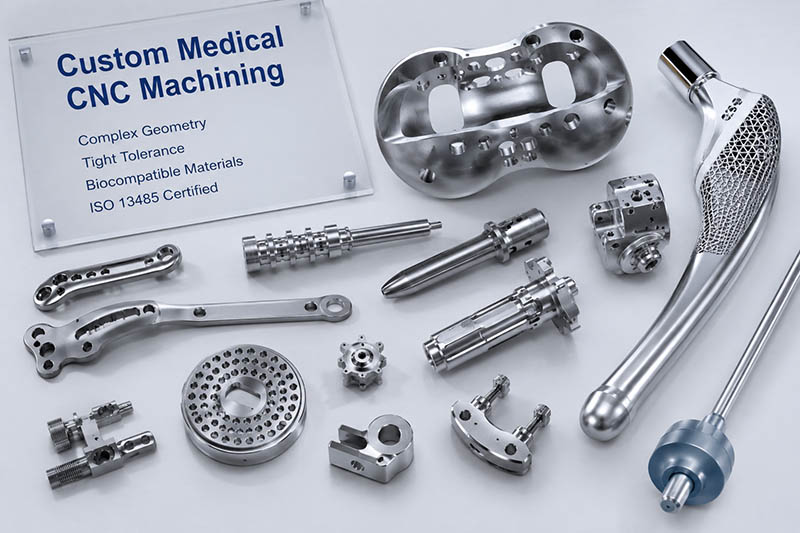
Typical Tolerance Requirements
The acceptable tolerance depends on the application.
| Component Type | Typical Tolerance |
|---|---|
| Surgical instrument handles | ±0.05 mm |
| Medical equipment housings | ±0.03 mm |
| Orthopedic implants | ±0.01 mm |
| Dental implant components | ±0.005 mm |
| Robotic surgical joints | ±0.005 mm |
| Precision guide pins | ±0.003 mm |
Many manufacturers also specify:
- Surface flatness
- Roundness
- Parallelism
- Concentricity
- Position tolerance
- Thread accuracy
Modern CNC machining centers equipped with linear scales and thermal compensation systems can repeatedly maintain these requirements during long production runs.
Environmental Control During Production
Medical machining shops often maintain strict environmental conditions.
Common controls include:
- Temperature maintained at 20±1°C
- Humidity control
- Positive-pressure clean machining areas
- Oil mist filtration
- Dust-free inspection rooms
Temperature stability is particularly important because metals expand and contract.
Example:
A 200 mm titanium component may expand approximately 2 μm for every 1°C increase in temperature. Although this appears insignificant, multiple dimensional changes across several machining operations can result in assemblies falling outside specification.
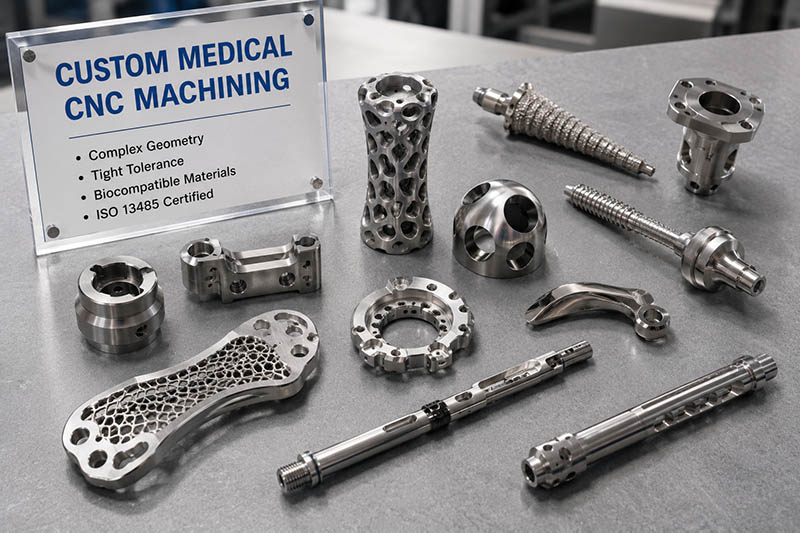
Machine Calibration and Preventive Maintenance
High precision is impossible without stable machinery.
Medical CNC manufacturers typically perform:
| Maintenance Item | Frequency |
|---|---|
| Ball screw backlash inspection | Weekly |
| Tool holder runout inspection | Weekly |
| Laser calibration | Quarterly |
| Spindle accuracy verification | Monthly |
| Probe calibration | Daily |
| Machine leveling | Semi-annually |
Routine calibration reduces cumulative machining errors and improves process repeatability.
Coordinate Measuring Machine (CMM) Inspection
After machining, critical dimensions are commonly verified using Coordinate Measuring Machines (CMMs).
Typical measurements include:
- Hole locations
- Thread geometry
- Radius accuracy
- Profile tolerance
- Surface geometry
- GD&T verification
Unlike manual inspection tools, CMMs automatically generate dimensional reports that can be archived for traceability.
Example inspection workflow:
- CNC machining completed
- Ultrasonic cleaning
- CMM dimensional inspection
- Surface roughness measurement
- Passivation or anodizing
- Final inspection
- Packaging
Process Validation Before Mass Production
Medical projects rarely proceed directly into full production.
Manufacturers generally follow this sequence:
| Stage | Objective |
|---|---|
| Prototype | Verify design |
| Engineering sample | Optimize machining process |
| First Article Inspection (FAI) | Confirm dimensional compliance |
| Pilot production | Validate consistency |
| Mass production | Stable manufacturing |
This approach minimizes production risks while ensuring each batch maintains identical quality.
Example: Precision Manufacturing of a Surgical Clamp
Consider a stainless steel surgical clamp consisting of six CNC-machined components.
Critical requirements include:
- Jaw alignment within 0.01 mm
- Smooth hinge rotation
- Burr-free edges
- Mirror-polished gripping surfaces
- Corrosion resistance after sterilization
Production process:
Material Preparation → CNC Milling → CNC Turning → Deburring → Electropolishing → Passivation → Assembly → Functional Testing → Packaging
Every stage is documented, and each component receives a production batch number for traceability.
Material Selection for Custom Medical CNC Machining
Material selection is one of the most critical decisions in medical manufacturing. The chosen material influences not only machinability but also biocompatibility, corrosion resistance, sterilization durability, mechanical strength, and the overall lifespan of the final product.
Different medical applications require different material properties. An orthopedic implant demands excellent biocompatibility and fatigue resistance, while a surgical instrument must withstand repeated sterilization cycles without corrosion or dimensional change.
Factors Affecting Material Selection
Medical engineers typically evaluate materials based on several key criteria:
- Biocompatibility
- Mechanical strength
- Weight
- Corrosion resistance
- Wear resistance
- Sterilization compatibility
- Chemical resistance
- Machinability
- Cost
- Regulatory acceptance
A balanced material selection helps optimize both performance and manufacturing efficiency.
Titanium Alloys
Titanium is widely regarded as the benchmark material for implantable medical devices due to its exceptional strength-to-weight ratio and excellent compatibility with human tissue.
Common Grade:
- Ti-6Al-4V ELI (Grade 23)
Typical applications include:
- Hip implants
- Knee implants
- Bone screws
- Dental implants
- Spinal fixation systems
- Trauma plates
| Property | Value |
|---|---|
| Density | 4.43 g/cm³ |
| Tensile Strength | 860–950 MPa |
| Corrosion Resistance | Excellent |
| Biocompatibility | Excellent |
| MRI Compatibility | Excellent |
Advantages:
- High fatigue strength
- Excellent osseointegration
- Lightweight
- Resistant to body fluids
- Long implant life
Machining challenges:
Titanium generates high cutting temperatures and has low thermal conductivity, requiring sharp carbide tools, controlled cutting parameters, and effective coolant strategies to prevent tool wear and maintain dimensional accuracy.
Stainless Steel
Medical-grade stainless steel remains one of the most commonly machined materials for reusable surgical instruments and medical equipment components.
Popular grades include:
- 316L
- 304
- 17-4PH
- 420 Stainless Steel
Typical products include:
- Surgical scissors
- Forceps
- Endoscope components
- Medical instrument shafts
- Hospital equipment fittings
Comparison:
| Grade | Primary Use |
|---|---|
| 316L | Surgical instruments |
| 304 | Equipment housings |
| 17-4PH | High-strength mechanical parts |
| 420 | Cutting tools |
Advantages include:
- Excellent corrosion resistance
- Good polishability
- High strength
- Cost-effective
- Readily machinable (depending on grade)
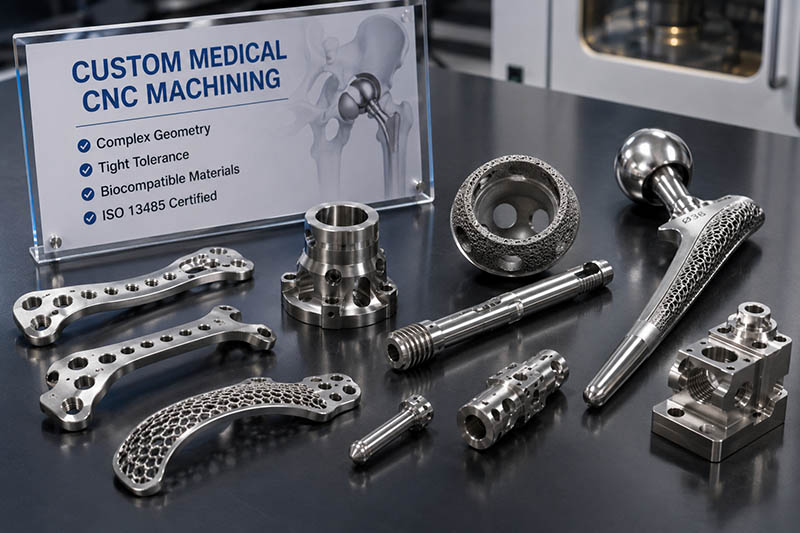
Surface treatments such as electropolishing and passivation further enhance corrosion resistance and facilitate cleaning and sterilization.
Aluminum Alloys
Although aluminum is generally unsuitable for implantable devices, it is extensively used in non-contact medical equipment because of its lightweight properties and excellent machinability.
Common grades:
- 6061-T6
- 7075-T6
Applications include:
- Ultrasound equipment frames
- Medical imaging housings
- Laboratory automation systems
- Robotic structures
- Portable medical devices
Advantages:
- Low density
- High machining efficiency
- Good thermal conductivity
- Excellent anodizing performance
However, because aluminum has lower wear resistance and biocompatibility compared to titanium or stainless steel, it is primarily used for external or structural components rather than parts that come into direct contact with the human body.
Engineering Plastics
High-performance plastics are increasingly important in medical manufacturing, especially where electrical insulation, chemical resistance, lightweight construction, or radiolucency is required.
Common engineering plastics include:
| Material | Typical Medical Application |
|---|---|
| PEEK | Spinal implants, trauma devices |
| Delrin (POM) | Precision gears and bushings |
| PTFE | Catheter components and seals |
| UHMW-PE | Joint replacement liners |
| Polycarbonate | Transparent medical covers |
| ABS | Medical equipment enclosures |
Among these, PEEK (Polyether Ether Ketone) has become a preferred alternative to metal in certain implantable applications due to its combination of strength, chemical resistance, and an elastic modulus closer to that of natural bone. Unlike titanium, PEEK is radiolucent, meaning it does not interfere with X-ray or CT imaging, making postoperative evaluation easier for clinicians.
From a machining perspective, plastics require different cutting strategies than metals. Excessive spindle speeds or feed rates can cause heat buildup, leading to melting, deformation, or poor surface finishes. Precision CNC machining with optimized tooling ensures dimensional stability while maintaining excellent surface quality.
CNC Processes Used for Medical Components
Medical devices often contain miniature features, intricate geometries, and demanding surface finish requirements that cannot be achieved through conventional manufacturing methods. To meet these challenges, manufacturers employ a range of advanced CNC machining processes, each selected based on the part geometry, material, and functional requirements.
Unlike general machining, medical CNC production emphasizes repeatability, burr-free edges, superior surface integrity, and process validation throughout every manufacturing stage.
CNC Milling for Complex Medical Parts
CNC milling is the most widely used process in medical manufacturing. Modern 3-axis, 4-axis, and especially 5-axis machining centers can produce highly complex components from solid blocks of titanium, stainless steel, aluminum, or engineering plastics.
Typical milled medical components include:
- Bone plates
- Spinal fixation systems
- Surgical guides
- Robotic surgery components
- Endoscope housings
- Orthopedic implants
- Medical device enclosures
One major advantage of CNC milling is the ability to machine multiple surfaces in a single setup, reducing repositioning errors and improving dimensional consistency.
Example: Orthopedic Bone Plate
A titanium bone plate may include:
- More than 20 precision-drilled screw holes
- Curved anatomical surfaces
- Countersunk features
- Chamfered edges
- Polished contact surfaces
Producing these features requires simultaneous multi-axis interpolation to ensure every hole angle and surface contour matches the CAD model precisely.
| Feature | CNC Milling Capability |
|---|---|
| Complex curved surfaces | Excellent |
| High positional accuracy | Excellent |
| Thin-wall machining | Excellent |
| Multiple-face machining | Excellent |
| Prototype flexibility | Excellent |
Swiss CNC Turning for Miniature Components
Swiss-type CNC lathes are indispensable for manufacturing long, slender, and extremely small medical parts. Unlike conventional lathes, Swiss machines support the workpiece close to the cutting tool, minimizing vibration and maintaining exceptional accuracy.
Common Swiss-machined components include:
- Bone screws
- Dental implant screws
- Catheter connectors
- Guide pins
- Cannulated shafts
- Surgical fasteners
Swiss machining is particularly effective for parts with diameters ranging from 1 mm to 20 mm, where maintaining concentricity and surface finish is critical.
Example: Dental Implant Screw
A typical dental implant screw may require:
- Thread tolerance within ±0.005 mm
- Mirror-finished thread flanks
- Internal hex drive
- Rounded thread root to reduce stress concentration
- Burr-free tip
These features are efficiently produced in a single Swiss turning operation with live tooling.
5-Axis CNC Machining for Complex Geometry
As medical devices become more sophisticated, 5-axis CNC machining has become increasingly common. By allowing the cutting tool to approach the workpiece from virtually any angle, 5-axis machining enables the production of highly intricate components while reducing the number of setups.
Advantages include:
- Machining deep cavities
- Improved surface quality
- Better tool access
- Reduced fixture changes
- Higher geometric accuracy
- Shorter production time
Typical applications include:
| Medical Product | Reason for Using 5-Axis Machining |
|---|---|
| Hip implants | Freeform anatomical surfaces |
| Knee implants | Complex curved geometry |
| Spinal cages | Multi-angle features |
| Surgical robot arms | Multi-face machining |
| Custom cranial implants | Organic 3D contours |
For example, a patient-specific cranial implant generated from CT scan data often contains irregular freeform surfaces. A 5-axis machining center can finish the entire implant in one setup, minimizing alignment errors and preserving the intended anatomical shape.
Micro CNC Machining
Many modern medical devices continue to shrink in size. Components used in minimally invasive surgery, cardiovascular interventions, and ophthalmology often require micro-scale features that demand specialized machining techniques.
Typical micro-machined parts include:
- Micro forceps
- Catheter tips
- Endoscopic jaws
- Drug delivery components
- Ophthalmic surgical tools
Characteristics of micro machining:
- Feature sizes below 1 mm
- Micro drills as small as 0.1 mm
- High spindle speeds (up to 60,000 rpm or more)
- Precision toolpath control
- Minimal burr formation
Challenges
Micro machining presents unique difficulties:
- Tool breakage due to extremely small diameters
- Heat accumulation
- Chip evacuation
- Machine vibration
- Inspection of tiny features
Manufacturers often combine micro CNC machining with high-magnification optical inspection to verify dimensional accuracy and edge quality.
Surface Finishing After CNC Machining
The machining process is only one part of producing a medical component. Surface finishing is equally important because it affects cleanliness, corrosion resistance, friction, and compatibility with sterilization processes.
Common post-processing methods include:
| Surface Finish | Purpose |
|---|---|
| Electropolishing | Smooths surface and improves corrosion resistance |
| Passivation | Removes free iron and enhances stainless steel corrosion resistance |
| Anodizing | Protects aluminum components and provides color coding |
| Bead Blasting | Creates a uniform matte appearance |
| Precision Polishing | Reduces surface roughness for implants |
| Laser Marking | Permanent identification and traceability |
For implantable components, polished surfaces can reduce bacterial adhesion and improve interaction with surrounding tissue. Conversely, certain orthopedic implants intentionally incorporate textured regions to encourage bone ingrowth.
Example Workflow: Manufacturing a Titanium Bone Screw
Below is a typical production sequence for a custom titanium bone screw:
- Titanium bar stock preparation
- Swiss CNC turning of the main profile
- Thread cutting
- Milling of internal hex drive
- Deburring
- Ultrasonic cleaning
- Surface passivation
- Dimensional inspection using CMM and optical systems
- Laser marking with batch number
- Final packaging in a controlled environment
This integrated workflow ensures that every bone screw meets strict dimensional, mechanical, and traceability requirements.
Typical Medical CNC Machining Applications
Custom CNC machining supports nearly every segment of the medical industry, from implantable devices to diagnostic equipment and robotic surgery systems. Its flexibility allows manufacturers to produce both one-off patient-specific parts and high-volume production components with consistent quality.
Orthopedic Implants
Orthopedic implants are among the most demanding CNC-machined medical products. They must withstand repeated mechanical loads while remaining biocompatible over many years.
Typical orthopedic components include:
- Hip stems
- Acetabular cups
- Knee femoral components
- Bone plates
- Trauma screws
- Spinal cages
- Intramedullary nails
These parts often feature complex anatomical contours and require precision machining followed by polishing, passivation, or specialized surface treatments.
Example
A patient-specific tibial plate may be designed using CT scan data to match the exact bone geometry. CNC machining translates the digital model into a finished titanium component with exceptional dimensional fidelity, improving surgical fit and reducing operating time.
Dental Components
The dental industry relies heavily on custom CNC machining for both restorative and implant applications.
Common products include:
| Dental Component | Typical Material |
|---|---|
| Implant fixtures | Titanium |
| Abutments | Titanium / Zirconia-compatible bases |
| Surgical guides | PEEK or PMMA |
| Impression trays | Aluminum or plastic |
| Orthodontic fixtures | Stainless steel |
Custom abutments are particularly well suited to CNC machining because each patient’s anatomy differs. CAD/CAM workflows allow digital impressions to be converted directly into precision-machined components.
Surgical Instruments
Reusable surgical instruments require exceptional dimensional consistency and smooth operation.
Examples include:
- Forceps
- Hemostats
- Needle holders
- Retractors
- Scalpel handles
- Arthroscopic tools
Key manufacturing priorities include:
- Precise hinge alignment
- Smooth articulation
- Burr-free cutting edges
- Corrosion resistance
- Ease of sterilization
High-quality CNC machining minimizes manual fitting during assembly, improving both efficiency and long-term reliability.
Diagnostic and Laboratory Equipment
Medical imaging systems, laboratory analyzers, and diagnostic instruments contain numerous precision-machined structural and functional components.
Examples include:
- MRI support structures
- CT scanner assemblies
- Ultrasound probe housings
- Optical alignment brackets
- Sample handling mechanisms
- Precision positioning stages
Although these parts do not typically contact patients directly, they require high dimensional accuracy to ensure proper alignment of sensors, optics, and mechanical systems.
For instance, even slight deviations in an optical mounting bracket can affect image quality or measurement accuracy in diagnostic equipment.
Robotic Surgery Systems
Robotic-assisted surgery represents one of the fastest-growing areas of medical manufacturing. These systems depend on lightweight, high-precision components capable of delivering smooth and repeatable motion.
Typical CNC-machined parts include:
- Robotic arm joints
- Gear housings
- Instrument adapters
- Precision shafts
- End-effector components
- Camera support brackets
These parts often combine aluminum alloys for lightweight structures with stainless steel or titanium for high-strength wear components.
Because robotic surgery systems demand exceptional positioning accuracy, CNC-machined components must maintain tight tolerances and excellent surface finishes to minimize backlash and ensure reliable performance over thousands of operating cycles.
Quality Control, Validation and Traceability
In medical manufacturing, machining accuracy alone is not enough. A component must also be fully inspected, documented, traceable, and validated before it can be released for clinical use. This is especially important for implantable devices and critical surgical instruments, where any defect may affect patient safety.
A robust quality management system ensures that every production batch can be traced back to its raw material, machining process, inspection records, and final packaging.
Incoming Material Verification
Quality control begins before machining starts. Raw materials must be verified to confirm that they meet the required medical specifications.
Typical checks include:
- Material grade confirmation
- Heat or lot number verification
- Chemical composition analysis
- Mechanical property certification
- Surface condition inspection
For example, titanium used for implantable devices is often supplied with a material certificate confirming compliance with ASTM or ISO standards.
| Verification Item | Purpose |
|---|---|
| Material certificate | Confirms alloy grade |
| Heat number | Enables traceability |
| Chemical composition | Verifies material purity |
| Mechanical properties | Confirms strength requirements |
| Surface inspection | Detects defects before machining |
In-Process Inspection
During machining, critical dimensions are monitored continuously rather than waiting until the final inspection stage.
Common in-process controls include:
- Tool wear monitoring
- Probe measurement inside the CNC machine
- First-piece inspection
- Statistical process control (SPC)
- Dimensional checks between operations
This approach helps detect deviations early, reducing scrap and ensuring consistent production quality.
Example: Bone Screw Production
| Production Stage | Inspection Method |
|---|---|
| Bar stock preparation | Diameter measurement |
| Swiss turning | In-process probing |
| Thread cutting | Optical thread inspection |
| Hex drive milling | Pin gauge verification |
| Final cleaning | Visual inspection |
| Final inspection | CMM report |
Final Dimensional Inspection
After machining and finishing, critical medical components undergo comprehensive final inspection.
Typical measurements include:
- Overall dimensions
- Hole locations
- Thread geometry
- Surface roughness
- Concentricity
- Flatness
- Parallelism
- GD&T requirements
Coordinate Measuring Machines (CMMs), optical measurement systems, laser scanners, and surface roughness testers are commonly used.
| Inspection Equipment | Typical Use |
|---|---|
| CMM | Complex dimensional measurement |
| Optical comparator | Small feature inspection |
| Laser scanner | Surface profile verification |
| Surface roughness tester | Ra measurement |
| Thread gauge | Thread accuracy |
| Pin gauge | Hole size verification |
Surface Roughness and Edge Quality
Medical components often require controlled surface finishes to ensure proper function and cleanliness.
Typical surface roughness targets:
| Application | Typical Ra Value |
|---|---|
| Surgical instruments | 0.4–0.8 μm |
| Orthopedic implants | 0.2–0.8 μm |
| Dental abutments | 0.1–0.4 μm |
| Catheter components | <0.4 μm |
| Equipment housings | 1.6–3.2 μm |
In addition to roughness, edges must be free from burrs, sharp corners, and loose particles.
Deburring methods may include:
- Manual deburring
- Thermal deburring
- Electrochemical deburring
- Vibratory finishing
- Precision hand finishing
Cleaning and Contamination Control
After machining, medical components must be thoroughly cleaned to remove:
- Cutting oil
- Metal chips
- Abrasive particles
- Polishing residue
- Fingerprints
- Packaging contaminants
A typical cleaning process may include:
- Ultrasonic cleaning
- Rinsing with purified water
- Drying with filtered air
- Visual inspection
- Particle inspection
- Clean packaging
For implantable devices, particle contamination limits are often strictly controlled.
Traceability Requirements
Traceability is one of the defining characteristics of medical manufacturing. Every finished component should be traceable throughout its entire production history.
Typical traceability records include:
| Record Type | Example |
|---|---|
| Material batch | Titanium heat number |
| CNC machine used | Machine ID |
| Operator | Production record |
| Tooling information | Tool batch |
| Inspection results | CMM report |
| Surface treatment batch | Passivation record |
| Cleaning batch | Cleaning log |
| Packaging batch | Final release record |
Laser marking is commonly used to permanently identify medical components with serial numbers, lot numbers, or manufacturing codes.
Process Validation
Before full production begins, medical CNC machining processes are often validated to demonstrate consistent performance.
Typical validation stages include:
| Validation Stage | Objective |
|---|---|
| IQ (Installation Qualification) | Verify equipment installation |
| OQ (Operational Qualification) | Verify operating parameters |
| PQ (Performance Qualification) | Verify production consistency |
For example, a validated bone screw manufacturing process may require multiple consecutive production batches to meet all dimensional and mechanical requirements before approval.
Example: Traceability of a Titanium Implant
A finished titanium implant may be linked to:
- Titanium heat number
- CNC machine ID
- Tooling batch
- Operator ID
- Inspection report
- Surface treatment batch
- Cleaning batch
- Packaging batch
- Shipment record
This level of documentation allows manufacturers to investigate any issue quickly and efficiently if a product inquiry occurs.
Xavier: A Reliable Partner for Custom Medical CNC Machining
Xavier specializes in precision CNC machining for complex metal and plastic components, including demanding medical applications. By combining advanced multi-axis machining equipment, strict quality control procedures, and comprehensive traceability systems, Xavier helps customers manufacture components that meet the high standards required by the medical industry.
Whether the project involves orthopedic implants, dental components, surgical instruments, robotic surgery parts, or precision medical equipment housings, Xavier focuses on delivering:
- Tight dimensional tolerances
- Excellent surface finishes
- Medical-grade material processing
- Multi-axis machining capability
- Comprehensive inspection reports
- Batch traceability
- Reliable prototype and production support
For companies seeking a dependable manufacturing partner for custom medical CNC machining, Xavier provides the technical expertise, production consistency, and quality-focused approach required for precision medical components.
FAQ
What materials are commonly used in medical CNC machining?
The most common materials include titanium alloys, medical-grade stainless steel, aluminum alloys for non-contact equipment components, and high-performance plastics such as PEEK, PTFE, and Delrin.
What tolerance can medical CNC machining achieve?
Depending on the component and machining process, medical CNC machining can commonly achieve tolerances from ±0.01 mm to ±0.005 mm, with tighter tolerances possible for critical features.
Why is 5-axis machining important for medical parts?
5-axis machining allows complex anatomical surfaces and multi-angle features to be produced in fewer setups, improving accuracy and surface quality.
Can CNC machining produce patient-specific implants?
Yes. Patient-specific implants can be manufactured from CT or MRI data using CAD/CAM workflows and precision multi-axis CNC machining.
How are medical CNC parts inspected?
Inspection may include CMM measurement, optical inspection, surface roughness testing, thread inspection, visual inspection, and full dimensional reporting.
What is the advantage of Swiss CNC machining for medical components?
Swiss CNC machining provides excellent accuracy for small-diameter, long, and slender components such as bone screws, dental screws, guide pins, and catheter parts.
We are an integrated manufacturer and supplier specializing in custom CNC machining services, providing high-precision CNC manufacturing for a wide range of metal and engineering plastic components. Our capabilities include CNC Titanium Machining, CNC PEEK Machining, and CNC Brass Machining, serving industries such as robotics, aerospace, marine, automotive, medical, and other precision engineering applications.
As a trusted CNC Titanium Machining Manufacturer, we provide high-volume CNC PEEK Machining Services. Contact us today for competitive CNC Brass Machining Pricing and professional manufacturing support.
Some of the images and text in this article are collected and compiled from the internet. If there is anything inappropriate, please contact us for processing.