
How Sandblasting Improves CNC Machined Parts Surface Quality
1. What Is Sandblasting and How Does the Process Work?
This is the fundamental topic users search for when they want to understand sandblasting. It explains the working principle, equipment, abrasive media, compressed air pressure, and how abrasive particles modify metal surfaces.
2. Different Types of Sandblasting Media and Their Applications
The choice of abrasive material directly affects surface roughness, appearance, material removal rate, and compatibility with CNC parts. Common media include aluminum oxide, glass beads, silicon carbide, garnet, and ceramic abrasives.
3. Sandblasting Surface Finish on CNC Machined Parts
Engineers and buyers are concerned about how sandblasting changes CNC components, including surface texture, Ra value, dimensional tolerance, corrosion resistance, and coating adhesion.
4. Sandblasting vs Bead Blasting vs Other Surface Finishing Methods
Many customers confuse sandblasting with bead blasting, shot blasting, polishing, and anodizing. Understanding the differences helps select the correct finishing solution.
5. Applications, Advantages, and Design Considerations of Sandblasting CNC Parts
This topic focuses on practical manufacturing applications, including aerospace parts, automotive components, aluminum housings, medical devices, and precision mechanical parts.
Sandblasting for CNC Machined Parts: Process, Materials, Surface Finish, and Applications
What Is Sandblasting in CNC Manufacturing?
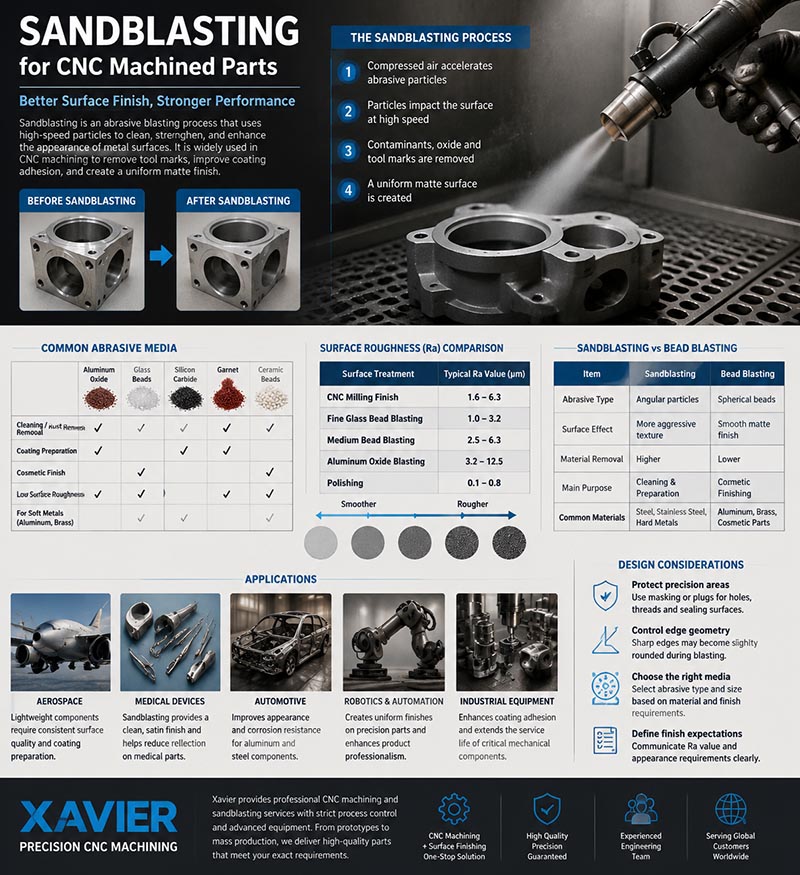
Sandblasting is a mechanical surface finishing process that uses compressed air to accelerate abrasive particles at high speed onto the surface of a workpiece. The impact force removes contaminants, machining marks, oxidation layers, and unwanted surface textures while creating a controlled surface profile.
In CNC machining, sandblasting is not simply a cleaning method. It is an important secondary finishing process used to improve appearance, prepare surfaces for coatings, and achieve consistent textures on precision metal components.
After CNC milling or CNC turning, metal parts usually contain visible tool paths, cutter marks, minor burrs, and machining textures. Although these features may not affect dimensional accuracy, they can reduce the visual quality of the final product, especially for consumer products, aerospace components, and high-end equipment housings.
Sandblasting solves this problem by creating a uniform surface appearance.
For example:
| CNC Machined Condition | After Sandblasting |
|---|---|
| Visible milling tool marks | Uniform matte texture |
| Slight oxidation or contamination | Clean metal surface |
| Uneven reflection | Non-reflective finish |
| Poor coating adhesion | Improved coating bonding |
Unlike machining processes that remove material through cutting tools, sandblasting mainly modifies the surface layer. The material removal is usually measured in microns, making it suitable for many precision components when properly controlled.
How Does the Sandblasting Process Work?
The Basic Principle of Abrasive Impact
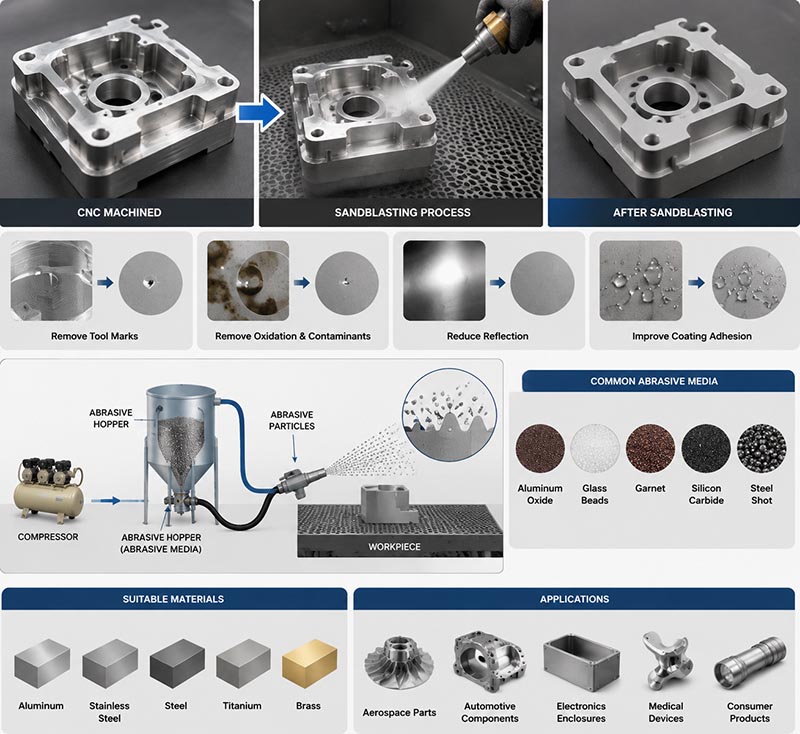
The working principle of sandblasting is based on kinetic energy conversion.
Compressed air creates a high-speed airflow inside the blasting system. Abrasive particles are mixed into this airflow and accelerated through a nozzle toward the workpiece surface.
When abrasive particles hit the metal surface, several effects occur:
- Surface contamination is removed.
- Microscopic peaks and machining marks are reduced.
- Surface roughness is modified.
- A new texture is created for appearance or coating preparation.
The basic process includes five main steps:
| Step | Process Description |
|---|---|
| 1 | CNC machining completes the part geometry |
| 2 | Parts are cleaned to remove oil and chips |
| 3 | Appropriate abrasive media is selected |
| 4 | Blasting pressure and angle are adjusted |
| 5 | Finished parts are inspected for appearance and tolerance |
Important Sandblasting Parameters
The final surface result depends heavily on process control.
A professional CNC manufacturer does not simply “blast the part.” Engineers need to control multiple variables.
| Parameter | Typical Range | Effect |
|---|---|---|
| Air pressure | 40-120 PSI | Higher pressure increases aggressiveness |
| Nozzle distance | 50-200 mm | Controls impact intensity |
| Spray angle | 45°-90° | Changes texture uniformity |
| Abrasive size | 50-250 μm | Determines surface roughness |
| Processing time | Seconds to minutes | Controls finish consistency |
For example:
An aluminum CNC housing requiring a premium cosmetic finish may use:
- Fine glass beads
- Lower pressure
- Short blasting time
while a steel structural component requiring paint preparation may use:
- Aluminum oxide abrasive
- Higher pressure
- Longer exposure time
Using identical parameters for different materials often creates poor results.
Types of Sandblasting Media Used for CNC Parts
The abrasive media is one of the most important factors determining the final surface quality. Different materials create different textures and levels of aggressiveness.
Aluminum Oxide Sandblasting
Strong Abrasive Media for Surface Preparation
Aluminum oxide is one of the most widely used industrial blasting materials because of its hardness and cutting ability.
It is commonly used for:
- Stainless steel components
- Tool steel parts
- Welded structures
- Paint removal
- Coating preparation
Aluminum oxide particles have sharp edges that aggressively cut into the surface.
Advantages:
| Feature | Description |
|---|---|
| High hardness | Effective for tough metals |
| Fast cleaning | Removes rust and coatings quickly |
| Reusable | Good industrial efficiency |
| Consistent profile | Suitable for coating preparation |
However, aluminum oxide is usually not the first choice for cosmetic CNC parts because excessive pressure can create a rough appearance or affect small features.
Example:
A stainless steel bracket before powder coating may require aluminum oxide blasting to create a stronger mechanical bonding surface.
Glass Bead Sandblasting
Preferred Choice for Cosmetic CNC Components
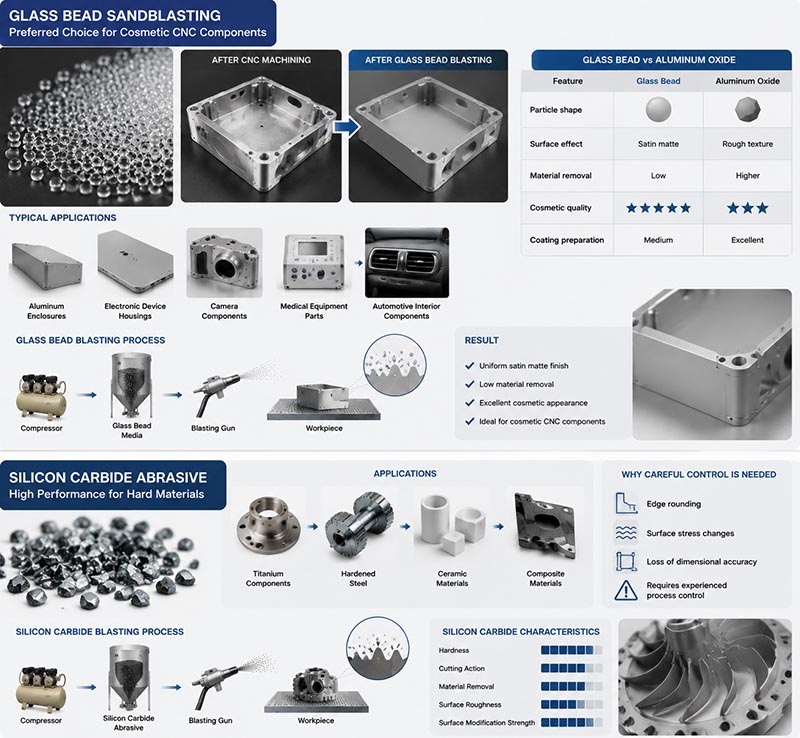
Glass bead blasting is widely used for aluminum CNC machining parts where appearance matters.
Unlike sharp abrasive particles, glass beads are spherical. They impact the surface and create a smoother satin texture instead of aggressively cutting into the metal.
Typical applications include:
- Aluminum enclosures
- Electronic device housings
- Camera components
- Medical equipment parts
- Automotive interior components
Example:
A CNC machined aluminum enclosure after milling may show visible tool paths. Glass bead blasting can transform the surface into a uniform matte finish before anodizing.
Comparison:
| Feature | Glass Bead | Aluminum Oxide |
|---|---|---|
| Particle shape | Round | Angular |
| Surface effect | Satin matte | Rough texture |
| Material removal | Low | Higher |
| Cosmetic quality | Excellent | Moderate |
| Coating preparation | Medium | Excellent |
Silicon Carbide Abrasive
High Performance for Hard Materials
Silicon carbide is one of the hardest blasting media available.
It is mainly used when manufacturers need aggressive cutting action.
Applications include:
- Titanium components
- Hardened steel
- Ceramic materials
- Composite materials
Because of its high hardness, silicon carbide can quickly modify surfaces but requires experienced process control.
For precision CNC parts, excessive blasting may cause:
- Edge rounding
- Surface stress changes
- Loss of dimensional accuracy
Therefore, engineers usually select silicon carbide only when the application requires strong surface modification.
Sandblasting Surface Finish on CNC Machined Parts
How Sandblasting Changes CNC Machined Surfaces
After CNC milling, turning, or grinding, metal parts usually have directional machining marks caused by cutting tools. These marks are acceptable for functional components, but many industries require better visual appearance, improved coating performance, or a more consistent surface texture.
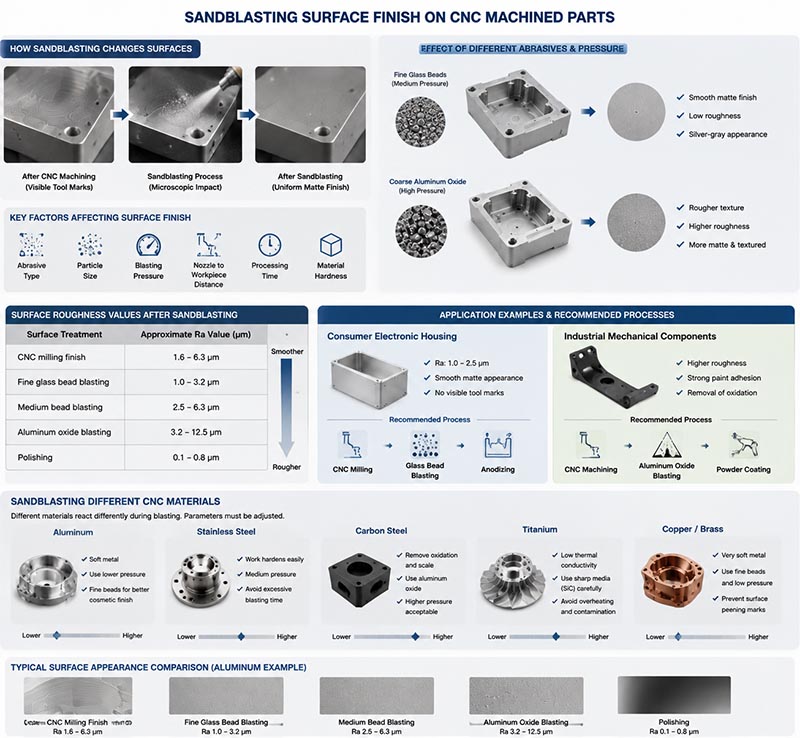
Sandblasting modifies the top surface layer by creating thousands of microscopic impact points. These impacts remove machining traces and produce a controlled texture.
The final appearance depends on several factors:
- Type of abrasive media
- Particle size
- Blasting pressure
- Distance between nozzle and workpiece
- Processing time
- Material hardness
For example, a CNC machined aluminum part processed with fine glass beads at moderate pressure will usually have a smooth silver-gray matte finish. The same aluminum part blasted with coarse aluminum oxide at high pressure may appear rougher and more textured.
Surface Roughness Values After Sandblasting
Surface roughness is one of the most important technical indicators when evaluating sandblasting quality.
Engineers often use Ra (arithmetical average roughness) to measure surface texture.
Typical values:
| Surface Treatment | Approximate Ra Value |
|---|---|
| CNC milling finish | 1.6-6.3 μm |
| Fine glass bead blasting | 1.0-3.2 μm |
| Medium bead blasting | 2.5-6.3 μm |
| Aluminum oxide blasting | 3.2-12.5 μm |
| Polishing | 0.1-0.8 μm |
The required roughness depends on the final application.
For example:
Consumer Electronic Housing
A CNC aluminum housing for electronic equipment may require:
- Ra: 1.0-2.5 μm
- Smooth matte appearance
- No visible tool marks
Recommended process:
CNC milling → glass bead blasting → anodizing
This combination provides both appearance and corrosion resistance.
Industrial Mechanical Components
A steel mechanical bracket may require:
- Higher roughness
- Strong paint adhesion
- Removal of oxidation
Recommended process:
CNC machining → aluminum oxide blasting → powder coating
The rougher profile allows coatings to mechanically lock onto the surface.
Sandblasting Different CNC Materials
Different metals react differently during blasting because hardness, ductility, and surface characteristics vary.
A professional CNC manufacturer must adjust blasting parameters according to material properties.
Sandblasting Aluminum CNC Parts
The Most Common Application in Precision Manufacturing
Aluminum is one of the most popular materials for CNC machining because of its excellent machinability, lightweight characteristics, and corrosion resistance.
Common CNC aluminum grades include:
| Aluminum Grade | Application |
|---|---|
| 6061 Aluminum | Aerospace brackets, machine components |
| 7075 Aluminum | High-strength aerospace parts |
| 5052 Aluminum | Sheet metal and enclosures |
| 6082 Aluminum | Industrial components |
Sandblasting aluminum creates:
- Uniform matte appearance
- Reduced machining marks
- Better anodizing preparation
- Improved surface consistency
However, aluminum is relatively soft compared with steel. Excessive pressure can create:
- Overly rough surfaces
- Rounded edges
- Dimensional changes on small features
For precision aluminum CNC parts, manufacturers usually prefer:
- Glass bead blasting
- Ceramic bead blasting
- Fine abrasive particles
Example:
A CNC machined aluminum camera mount may have several pocket features and thin walls. A controlled glass bead blasting process can improve appearance without damaging delicate structures.
Sandblasting Stainless Steel Components
Stainless steel parts often require sandblasting for both cosmetic and functional reasons.
Common grades include:
- 304 stainless steel
- 316 stainless steel
- 17-4 PH stainless steel
Applications:
- Medical devices
- Food processing equipment
- Aerospace components
- Marine parts
Benefits include:
Removing Heat Marks
During CNC machining or welding, stainless steel may develop discoloration caused by heat exposure.
Sandblasting can remove these visible marks.
Creating Uniform Appearance
Machined stainless steel often shows different reflection directions.
Sandblasting creates a consistent satin finish.
Improving Coating Adhesion
For stainless steel parts requiring:
- PVD coating
- Paint
- Ceramic coating
sandblasting creates a better bonding surface.
Sandblasting Titanium CNC Parts
Titanium is widely used in aerospace and medical industries because of its:
- High strength-to-weight ratio
- Excellent corrosion resistance
- Biocompatibility
However, titanium requires careful blasting control.
Typical applications:
| Industry | Titanium CNC Parts |
|---|---|
| Aerospace | Aircraft brackets, engine components |
| Medical | Implants, surgical tools |
| Racing | Lightweight performance parts |
Recommended blasting methods:
- Glass beads
- Ceramic abrasives
- Controlled pressure blasting
Avoid overly aggressive blasting because titanium can develop surface contamination if improper abrasive materials are used.
Sandblasting Brass and Copper Components
Brass and copper are softer metals with excellent electrical conductivity and appearance.
Applications include:
- Electrical connectors
- Decorative components
- Valve parts
- Precision mechanical parts
Fine glass bead blasting is often preferred because it creates a smooth satin finish while maintaining the natural color of the material.
For example:
A CNC brass decorative knob may be polished for a shiny appearance, while another customer may prefer sandblasting to achieve a premium industrial matte style.
Sandblasting vs Bead Blasting vs Other Surface Finishing Methods
Many customers confuse sandblasting with bead blasting because both use abrasive particles. However, their purposes and results are different.
Sandblasting vs Bead Blasting
| Comparison | Sandblasting | Bead Blasting |
|---|---|---|
| Abrasive type | Usually angular media | Mostly spherical glass beads |
| Surface effect | More aggressive texture | Smooth matte finish |
| Material removal | Higher | Lower |
| Main purpose | Cleaning and preparation | Cosmetic finishing |
| Common materials | Steel, stainless steel | Aluminum, cosmetic parts |
In CNC manufacturing, the term “sandblasting” is sometimes used broadly to describe all abrasive blasting processes. However, technically, bead blasting is a specific type of abrasive blasting.
Sandblasting vs Anodizing
Anodizing is a chemical/electrochemical surface treatment that creates an oxide layer on aluminum.
The two processes are often combined.
Example:
Aluminum CNC Housing Process
Step 1:
CNC milling creates the shape.
Step 2:
Glass bead blasting removes machining marks.
Step 3:
Anodizing creates corrosion resistance and color.
The result:
- Premium appearance
- Better durability
- Improved oxidation resistance
Comparison:
| Feature | Sandblasting | Anodizing |
|---|---|---|
| Changes texture | Yes | Limited |
| Adds protective layer | No | Yes |
| Creates color | No | Yes |
| Improves appearance | Yes | Yes |
| Common combination | Before anodizing | After blasting |
Applications of Sandblasting CNC Parts
Sandblasting is widely used across industries because it provides both aesthetic and functional benefits.
Aerospace Industry
Aerospace components require:
- Lightweight materials
- High precision
- Excellent surface quality
Typical sandblasted parts:
- Aluminum aircraft brackets
- Titanium structural components
- Engine mounting parts
Advantages:
- Removes machining marks
- Improves coating performance
- Creates consistent appearance
Medical Equipment Industry
Medical CNC parts often require clean and professional finishes.
Applications:
- Surgical instruments
- Medical device housings
- Implant components
Sandblasting helps achieve:
- Smooth touch feeling
- Reduced reflection
- Easy cleaning surface
For implant-related titanium components, manufacturers must carefully control abrasive selection and cleanliness.
Automotive Industry
Modern automotive components increasingly use CNC machining and lightweight metals.
Examples:
- Engine components
- Suspension parts
- Interior aluminum parts
- Custom racing components
Sandblasting provides:
- Attractive appearance
- Better coating adhesion
- Reduced visible machining marks
Robotics and Automation Equipment
Robotic components often require:
- High precision
- Lightweight construction
- Professional appearance
Common materials:
- Aluminum 6061
- Aluminum 7075
- Stainless steel
Sandblasting helps create consistent finishes for:
- Robot arms
- Sensor housings
- Precision brackets
Design Considerations Before Sandblasting CNC Parts
Protect Precision Features
Although sandblasting removes very little material, designers should still consider sensitive areas.
Areas requiring protection:
- Precision holes
- Threaded sections
- Bearing surfaces
- Sealing areas
Manufacturers may use:
- Masking tape
- Rubber plugs
- Special fixtures
to protect critical dimensions.
Consider Edge Geometry
Sharp edges can become slightly rounded during aggressive blasting.
For precision parts:
Recommended:
- Maintain sufficient edge thickness
- Avoid extremely sharp external corners
- Specify masking requirements
Example:
A CNC aerospace bracket with a 0.2 mm edge may require softer blasting parameters than a structural steel component.
Select the Correct Finish Requirement
Before manufacturing, customers should define the final expectation.
| Requirement | Recommended Process |
|---|---|
| Matte cosmetic finish | Glass bead blasting |
| Remove rust | Aluminum oxide blasting |
| Prepare coating | Aggressive abrasive blasting |
| Premium aluminum appearance | Bead blasting + anodizing |
| Cleaning precision parts | Fine abrasive blasting |
Why Choose Professional CNC Sandblasting Services?
Sandblasting quality depends not only on equipment but also on manufacturing experience.
Professional suppliers understand:
- Material characteristics
- Surface requirements
- Dimensional tolerance
- Abrasive selection
- Post-processing requirements
A general blasting company may focus mainly on cleaning, while a CNC machining manufacturer understands how surface finishing affects the entire production process.
For precision CNC components, sandblasting should be considered part of the complete manufacturing solution rather than an independent finishing step.
CNC Sandblasting Services by Xavier
Xavier specializes in precision CNC machining and professional surface finishing solutions for customers worldwide. With extensive experience in CNC milling, CNC turning, metal fabrication, and surface treatments, Xavier provides customized sandblasting services for complex metal components.
Whether you need aluminum housings with a smooth matte appearance, stainless steel parts with uniform texture, or titanium components requiring controlled surface preparation, Xavier can optimize the blasting process according to your material, application, and performance requirements.
From prototype production to low-volume manufacturing and large-scale production, Xavier combines advanced CNC machining capability with strict surface finishing control to deliver high-quality parts that meet industrial standards.
If you are looking for a reliable CNC machining partner with professional sandblasting capability, Xavier provides complete solutions from raw materials to finished components.
We are an integrated CNC machining manufacturer specializing in custom CNC machining services and precision machining of various metal parts. Our capabilities cover a wide range of surface finishing solutions, including CNC anodizing surface finishing, CNC passivation surface finishing, and CNC electroless nickel plating surface finishing.
As a professional anodizing manufacturer, we provide high-volume passivation service and offer competitive electroless nickel plating price for customers worldwide. Feel free to contact us for more details and customized CNC machining solutions.
Some of the images and text in this article are collected and compiled from the internet. If there is anything inappropriate, please contact us for processing.