
Black Oxide Steel Finish: Complete Engineering Guide for CNC Machined Components
Introduction
Black oxide steel finish is one of the most widely used surface treatments for precision steel components. Unlike electroplating, painting, or powder coating, black oxide is a conversion coating that chemically transforms the outermost surface of steel into magnetite (Fe₃O₄). This creates a uniform black appearance while maintaining dimensional accuracy.
The process is extensively used in CNC machining, aerospace, automotive manufacturing, tooling, military hardware, fasteners, gears, and precision mechanical assemblies because it offers corrosion resistance, lubricity, glare reduction, and attractive aesthetics at a relatively low cost. Studies and industry data show that properly sealed black oxide coatings can provide meaningful corrosion protection while adding virtually no measurable thickness to the part surface.
What Is a Black Oxide Steel Finish?
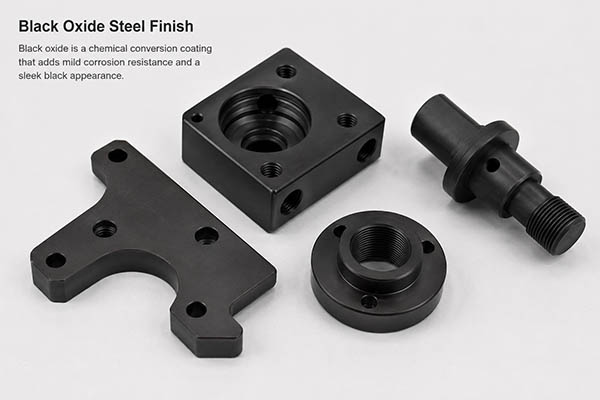
Black oxide is a chemical conversion coating that transforms the steel surface into magnetite (Fe₃O₄). Unlike zinc plating or nickel plating, it does not deposit a new metallic layer onto the part.
| Feature | Black Oxide |
|---|---|
| Coating Type | Conversion Coating |
| Color | Matte Black / Satin Black |
| Base Material | Steel, Stainless Steel, Iron |
| Thickness | 0.5–5 μm |
| Dimensional Impact | Minimal |
| Corrosion Resistance | Moderate (with sealant) |
| Cost | Low |
The resulting surface provides a deep black appearance that is particularly desirable for industrial products requiring both aesthetics and functionality.
The Chemistry Behind Black Oxide (Fe₃O₄ Formation)
Black oxide forms when steel reacts with alkaline oxidizing salts under controlled temperature conditions.
The simplified reaction is:
Iron (Fe) → Magnetite (Fe₃O₄)
Instead of adding material, the process converts the outer surface layer into a stable oxide.
Typical bath chemicals include:
- Sodium hydroxide (NaOH)
- Sodium nitrate (NaNO₃)
- Sodium nitrite (NaNO₂)
Processing temperatures generally range from:
| Process Type | Temperature |
|---|---|
| Hot Black Oxide | 135–150°C |
| Mid-Temperature | 95–105°C |
| Cold Black Oxide | 20–30°C |
The resulting magnetite layer is tightly bonded to the substrate, making it far less likely to chip or peel compared with paint coatings.
Black Oxide Process Steps and Manufacturing Workflow
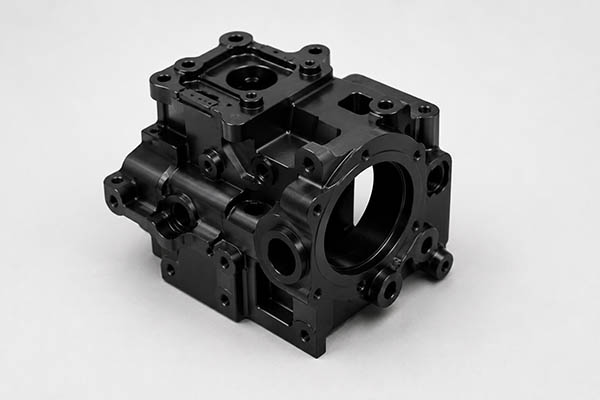
A successful black oxide finish depends heavily on preparation.
Cleaning and Degreasing
Any oil, coolant residue, or machining contamination can lead to uneven coloration.
Descaling and Pickling
Rust, mill scale, and oxidation are removed before coating.
Black Oxide Conversion
Parts are immersed in the heated black oxide solution where the Fe₃O₄ layer forms.
Rinsing
Residual chemicals are removed.
Post-Sealing
Oil, wax, or specialty sealants penetrate the porous oxide layer.
A standard production sequence:
CNC Machining
      ↓
Degreasing
      ↓
Pickling
      ↓
Black Oxide Bath
      ↓
Rinse
      ↓
Oil/Wax Seal
      ↓
Inspection
Many black oxide failures originate from poor cleaning rather than chemistry issues.
Types of Black Oxide: Hot, Mid-Temperature, and Cold
Hot Black Oxide
The industry standard.
Advantages:
- Deep black color
- Excellent uniformity
- Best durability
Temperature:
135–150°C
Mid-Temperature Black Oxide
A safer alternative requiring less energy.
Advantages:
- Reduced operating costs
- Lower chemical hazards
Temperature:
95–105°C
Cold Black Oxide
Often used for maintenance and repair applications.
Advantages:
- Low equipment investment
Disadvantages:
- Lower durability
- Reduced corrosion resistance
| Type | Appearance | Durability | Cost |
|---|---|---|---|
| Hot | Excellent | Excellent | Medium |
| Mid-Temp | Very Good | Good | Medium |
| Cold | Fair | Fair | Low |
Suitable Materials for Black Oxide Coating
Black oxide works best on ferrous metals.
Common materials include:
Carbon Steel
Most common application.
Examples:
- 1018 Steel
- 1045 Steel
- 4140 Steel
Tool Steel
Examples:
- D2
- A2
- O1
Stainless Steel
Requires activation before oxidation.
Examples:
- 303 Stainless
- 304 Stainless
- 316 Stainless
- 17-4 PH
Copper and Brass
Specialized formulations can produce black finishes.
Black Oxide Thickness and Dimensional Stability
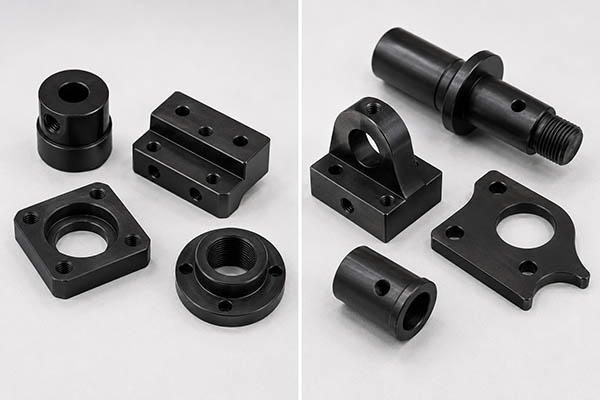
One of the greatest advantages of black oxide is dimensional neutrality.
Typical coating thickness:
| Finish | Thickness |
|---|---|
| Black Oxide | 0.5–5 μm |
| Zinc Plating | 5–25 μm |
| Electroless Nickel | 10–50 μm |
| Powder Coating | 50–150 μm |
For precision CNC components, even a few microns can affect assembly.
Examples include:
- Threads
- Bearings
- Gear fits
- Hydraulic valves
- Precision shafts
Because black oxide converts the surface rather than adding material, dimensional changes are negligible.
Corrosion Resistance Performance of Black Oxide
Many engineers misunderstand black oxide corrosion performance.
The black oxide layer alone provides limited corrosion protection.
The real protection comes from:
- Oil impregnation
- Wax sealing
- Corrosion inhibitors
Typical performance:
| Surface Condition | Salt Spray Resistance |
|---|---|
| Black Oxide Only | 24–48 Hours |
| Black Oxide + Oil | 72–96 Hours |
| Enhanced Sealants | 200+ Hours |
For outdoor marine applications, zinc plating usually outperforms black oxide.
Oil, Wax, and Sealants: Why Post-Treatment Matters
The black oxide layer is microscopically porous.
This porosity allows:
- Oil retention
- Wax absorption
- Corrosion inhibitor penetration
Common sealants:
Water Displacing Oil
Best for machine components.
Dry Film Lubricants
Ideal for moving assemblies.
Wax Sealants
Preferred when appearance matters.
Without sealing, black oxide protection decreases dramatically.
Wear Resistance and Lubricity Benefits
Black oxide is not a hard coating like DLC or TiN.
However, it provides:
- Reduced friction
- Improved oil retention
- Better anti-galling behavior
Typical applications:
- Gears
- Bushings
- Fasteners
- Tool holders
Machine shops frequently specify black oxide on tooling because lubricating oils adhere more effectively to the treated surface.
Black Oxide vs Zinc Plating
| Property | Black Oxide | Zinc Plating |
|---|---|---|
| Thickness | Very Thin | Moderate |
| Corrosion Resistance | Moderate | Excellent |
| Dimensional Accuracy | Excellent | Moderate |
| Cost | Low | Moderate |
| Appearance | Matte Black | Silver/Yellow/Black |
| Outdoor Use | Limited | Excellent |
Use black oxide when:
- Tight tolerances matter
- Appearance matters
- Cost is critical
Use zinc plating when:
- Corrosion protection is the primary goal
Black Oxide vs Powder Coating
| Feature | Black Oxide | Powder Coating |
|---|---|---|
| Thickness | 0.5–5 μm | 50–150 μm |
| Dimensional Impact | Minimal | Significant |
| Appearance | Industrial | Decorative |
| Durability | Moderate | High |
| Precision Parts | Excellent | Poor |
Powder coating is unsuitable for many precision CNC components due to coating buildup.
Black oxide is often preferred for machined assemblies requiring exact tolerances.
Industrial Applications of Black Oxide Steel Parts
Industries using black oxide include:
Aerospace
- Fasteners
- Tooling
- Fixtures
Automotive
- Brackets
- Gears
- Engine hardware
Firearms
- Sights
- Receivers
- Barrels
Industrial Equipment
- Shafts
- Couplings
- Machine tooling
Electronics
- Anti-glare hardware
The finish is particularly useful where reflective surfaces could interfere with optical systems.
Common Defects and Quality Control Measures
Common issues include:
Uneven Black Color
Cause:
- Oil contamination
- Incomplete cleaning
Red Rust Formation
Cause:
- Missing sealant
- Poor storage
Gray Appearance
Cause:
- Improper bath temperature
Surface Streaking
Cause:
- Inadequate rinsing
Quality control methods:
- Visual inspection
- Salt spray testing
- Coating uniformity verification
- Adhesion evaluation
Cost Analysis and Manufacturing Economics
Black oxide remains one of the most economical finishing methods available.
Approximate comparison:
| Finish | Relative Cost |
|---|---|
| Black Oxide | 1× |
| Zinc Plating | 1.5–2× |
| Electroless Nickel | 4–8× |
| Hard Anodizing | 3–5× |
| DLC Coating | 10×+ |
For large production runs, black oxide often delivers the best balance between appearance, protection, and manufacturing cost.
Black Oxide for CNC Machined Parts
For CNC machining companies, black oxide offers several unique advantages:
- Maintains thread tolerances
- Preserves bearing fits
- Improves product appearance
- Reduces glare
- Lowers finishing costs
Example:
A CNC-machined 4140 steel shaft with a tolerance of ±0.005 mm may fail assembly after zinc plating due to coating buildup. The same component can receive a black oxide finish with virtually no dimensional change, eliminating rework and maintaining design intent.
Why Xavier Recommends Black Oxide for Precision CNC Components
At Xavier, we frequently recommend black oxide finishing for precision-machined steel parts that require dimensional stability, professional appearance, and cost-effective corrosion protection. Whether manufacturing custom shafts, gears, brackets, tooling components, fasteners, or industrial assemblies, black oxide remains one of the most practical finishing options available.
Our engineering team evaluates each project based on operating environment, corrosion requirements, tolerance specifications, and production volume to ensure the most suitable surface treatment is selected. For applications where micron-level accuracy is critical, black oxide often provides a superior balance between functionality and manufacturing efficiency compared with thicker coating systems.
As an integrated manufacturer specializing in CNC machining services, we focus on custom CNC machining and the production of various metal components. We also provide
CNC electroless nickel plating surface finishing,
CNC zinc plating surface finishing, and
CNC electrolytic polishing surface finishing
to meet different application requirements.
As a CNC electroless nickel plating surface finishing manufacturer, we provide high-volume
CNC zinc plating surface finishing services. For competitive
CNC electrolytic polishing surface finishing prices, please feel free to contact us.
Some of the images and text in this article are collected and compiled from the internet. If there is anything inappropriate, please contact us for processing.