
Automotive Chassis Design and Manufacturing: CNC Machining & Sheet Metal Solutions
The automotive chassis is one of the most important structures in a vehicle because it provides the foundation for mounting major components such as the engine, suspension system, steering mechanism, transmission, and braking system. As the core supporting structure, the chassis directly affects vehicle strength, safety, handling performance, and overall driving experience.
Different vehicle categories require different chassis designs. Passenger cars, racing vehicles, trucks, and off-road vehicles often use different structural concepts to achieve the required balance between weight, durability, rigidity, and manufacturing cost.
Without a properly designed chassis, a vehicle cannot maintain structural stability or safely support the weight of its components. Therefore, manufacturers need a deep understanding of automotive chassis design, material selection, manufacturing methods, and production technologies to create reliable and high-performance vehicle structures.
This article explores the fundamentals of car chassis structures, common chassis types, manufacturing processes, materials, finishing methods, and future trends to help businesses make better decisions when developing automotive components.
What Is an Automotive Car Chassis?
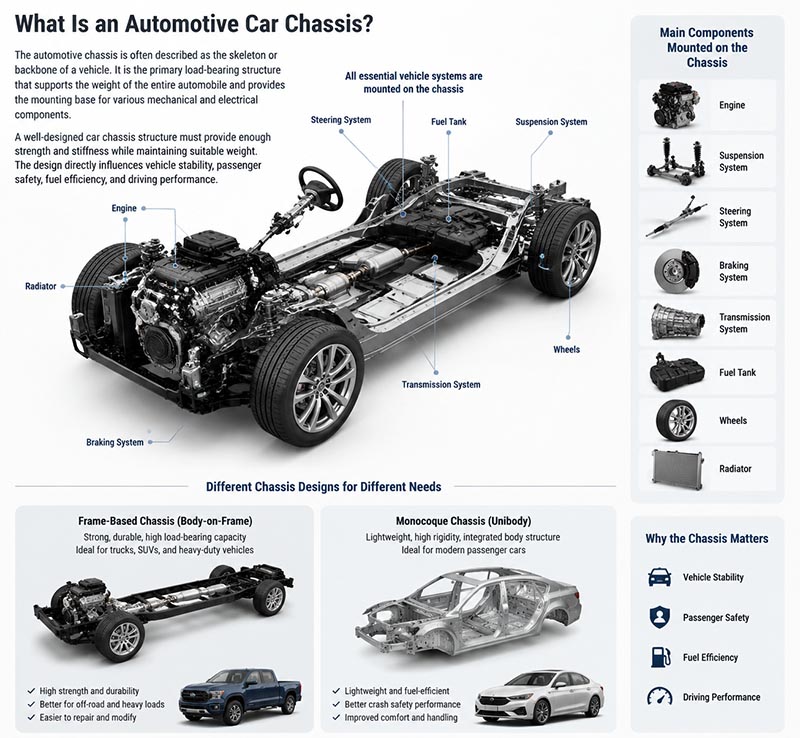
The automotive chassis is often described as the skeleton or backbone of a vehicle. It is the primary load-bearing structure that supports the weight of the entire automobile and provides the mounting base for various mechanical and electrical components.
All essential vehicle systems, including the engine, fuel tank, suspension system, steering system, braking components, wheels, radiator, and transmission system, are attached to the chassis.
A well-designed car chassis structure must provide enough strength and stiffness while maintaining suitable weight. The design directly influences vehicle stability, passenger safety, fuel efficiency, and driving performance.
Modern automotive manufacturers use different chassis designs depending on vehicle requirements. For example, heavy-duty trucks usually require stronger frame-based chassis, while modern passenger vehicles often use lightweight monocoque chassis design to improve efficiency and safety.
Main Functions of an Automotive Chassis
An automotive chassis performs several important roles in vehicle operation and manufacturing.
Providing Vehicle Structural Strength
The primary function of a chassis is to maintain the structural integrity of the vehicle. It supports the vehicle body and absorbs external forces generated during driving, braking, acceleration, and collisions.
A strong automotive chassis frame helps reduce deformation during accidents and improves passenger protection by controlling how impact energy is distributed throughout the structure.
Providing Mounting Points for Vehicle Components
The chassis acts as the main connection platform for different automotive systems. Components such as the steering system, suspension system, engine, gearbox, and braking system are installed directly onto the chassis.
High chassis rigidity ensures accurate positioning of these parts, improves vehicle alignment, and enhances overall driving stability.
Improving Weight Distribution and Handling
Another important function of a car chassis is distributing vehicle weight between the front and rear axles.
Proper weight balance improves traction, cornering ability, braking performance, and overall vehicle control. This is especially important for sports cars, racing vehicles, and high-performance automobiles.
Structure of an Automotive Car Chassis
Automotive chassis structures vary depending on vehicle type, but most traditional designs include several important components that work together to provide strength and stability.
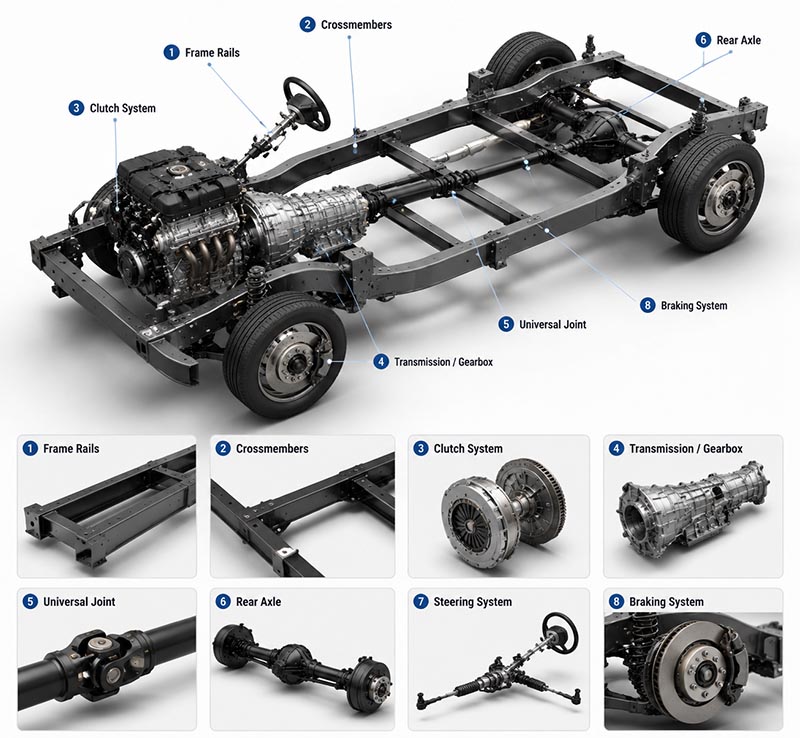
Frame Rails
Frame rails are long structural beams usually made from steel or aluminum. They run along the length of the vehicle and carry most of the chassis load.
Different chassis designs use different frame rail configurations. For example, a ladder frame chassis commonly consists of two parallel longitudinal rails connected by crossmembers.
Modern manufacturers often choose lightweight materials such as aluminum alloys to reduce vehicle weight while maintaining structural performance.
Crossmembers
Crossmembers are horizontal beams that connect the frame rails together. Their main purpose is to increase chassis rigidity and prevent twisting during vehicle operation.
They also provide additional mounting locations for important automotive components, including suspension parts and drivetrain systems.
Clutch System
The clutch is an important drivetrain component connected to the engine crankshaft. It controls the connection between engine power and the transmission system.
By engaging and disengaging power transmission, the clutch allows smooth vehicle acceleration and gear changes.
Transmission System / Gearbox
The transmission system transfers engine power to the wheels and controls vehicle speed according to driving conditions.
As a critical part connected to the chassis structure, the gearbox must be securely mounted to maintain proper alignment and reduce vibration.
Universal Joint
The universal joint connects the transmission system with the drive shaft and allows power transfer at different angles.
It compensates for movement between drivetrain components and ensures continuous transmission of rotational force from the engine to the wheels.
Rear Axle
The rear axle supports the rear wheels and transfers power from the differential to the driving wheels.
In many vehicles, the rear axle consists of two half shafts connected through a differential system, allowing wheels to rotate at different speeds during cornering.
Steering System
The steering system controls the direction of the vehicle. Modern vehicles generally use hydraulic steering systems or electric power steering systems.
A rigid chassis design helps maintain accurate steering response and improves driving control.
Braking System
The braking system reduces vehicle speed by converting the rotational energy of the wheels into heat energy through friction.
The chassis must provide stable mounting locations for braking components to ensure reliable braking performance and vehicle safety.
Types of Automotive Car Chassis
Automotive chassis designs have evolved significantly with advances in vehicle engineering and manufacturing technology. Each chassis type has unique advantages and limitations, making it suitable for different applications such as passenger vehicles, commercial trucks, racing cars, and off-road vehicles.
Selecting the right automotive chassis design depends on factors including vehicle purpose, required strength, production volume, material choice, and performance requirements.
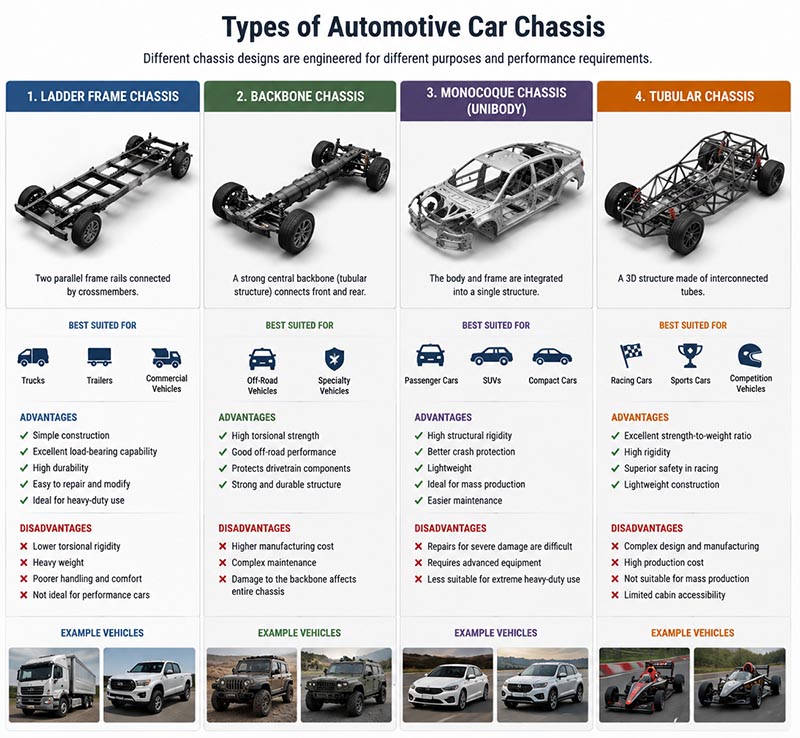
The four most common types of car chassis include ladder frame chassis, backbone chassis, monocoque chassis, and tubular chassis.
Ladder Frame Chassis
The ladder frame chassis is one of the oldest and most traditional automotive chassis designs. It gets its name because its structure resembles a ladder, consisting of two long parallel frame rails connected by multiple crossmembers.
This type of car chassis frame provides excellent load-carrying capability, making it widely used in heavy-duty vehicles such as trucks, trailers, and commercial vehicles.
The simple structure makes ladder chassis designs easy to manufacture and repair. However, their large weight and limited torsional stiffness make them less suitable for modern performance vehicles.
Advantages of Ladder Frame Chassis
- Simple construction and easy assembly process
- Excellent load-bearing capability
- High durability for heavy-duty applications
- Suitable for off-road and commercial vehicles
Disadvantages of Ladder Frame Chassis
- Lower torsional rigidity compared with newer designs
- Increased vehicle weight
- Reduced cornering performance
- Not ideal for lightweight performance cars
Backbone Chassis
The backbone chassis is named because its central structure resembles the backbone of a human body. It usually consists of a strong hollow tubular structure that connects the front and rear suspension systems.
This type of vehicle chassis design provides good torsional strength and is commonly used in off-road vehicles and specialty automobiles where structural durability is important.
The central backbone supports drivetrain components while protecting important mechanical parts from external impacts.
Advantages of Backbone Chassis
- High torsional strength
- Good performance in off-road conditions
- Strong protection for drivetrain components
- Suitable for specialized vehicles
Disadvantages of Backbone Chassis
- Higher manufacturing cost
- More complicated maintenance process
- Damage to the central structure can affect the entire chassis system
Monocoque Chassis
The monocoque chassis, also called a unibody chassis, combines the vehicle body and structural frame into a single integrated shell.
This design is the most common structure used in modern passenger vehicles, including sedans, SUVs, and compact cars.
A monocoque chassis design improves safety because the integrated structure can distribute crash forces more effectively. It also reduces manufacturing complexity when produced in large quantities.
Advantages of Monocoque Chassis
- High structural rigidity
- Improved crash protection
- Lightweight compared with traditional frame designs
- Suitable for mass production
- Easier vehicle maintenance and repair
Disadvantages of Monocoque Chassis
- Repairing severe damage can be difficult
- Requires advanced manufacturing equipment
- Less suitable for extremely heavy-duty applications
Tubular Chassis
The tubular chassis is a three-dimensional structure made from interconnected metal tubes. It is commonly used in racing cars, sports vehicles, and competition automobiles because of its excellent strength-to-weight ratio.
Compared with traditional frame designs, a tubular chassis frame can achieve higher rigidity while maintaining lower weight.
The vehicle components are usually designed around the tubular structure, creating a strong protective cage for drivers.
Advantages of Tubular Chassis
- Excellent strength-to-weight ratio
- High rigidity and structural performance
- Improved safety for racing applications
- Lightweight construction
Disadvantages of Tubular Chassis
- Complex design and manufacturing process
- Higher production costs
- Not suitable for large-scale production
- Difficult cabin accessibility in some designs
Common Automotive Chassis Manufacturing Processes
The manufacturing method used for automotive chassis production depends on several factors, including chassis design, material selection, production quantity, required precision, and application requirements.
Modern automotive manufacturers combine different technologies such as sheet metal fabrication, CNC machining, welding, casting, and surface treatment to produce durable and precise chassis components.
Sheet Metal Fabrication for Automotive Chassis
Sheet metal fabrication is one of the most widely used manufacturing methods in automotive production. It allows manufacturers to create strong and lightweight chassis components through cutting, forming, and joining processes.
For custom car chassis manufacturing, sheet metal fabrication provides excellent flexibility for producing complex structures with accurate dimensions.
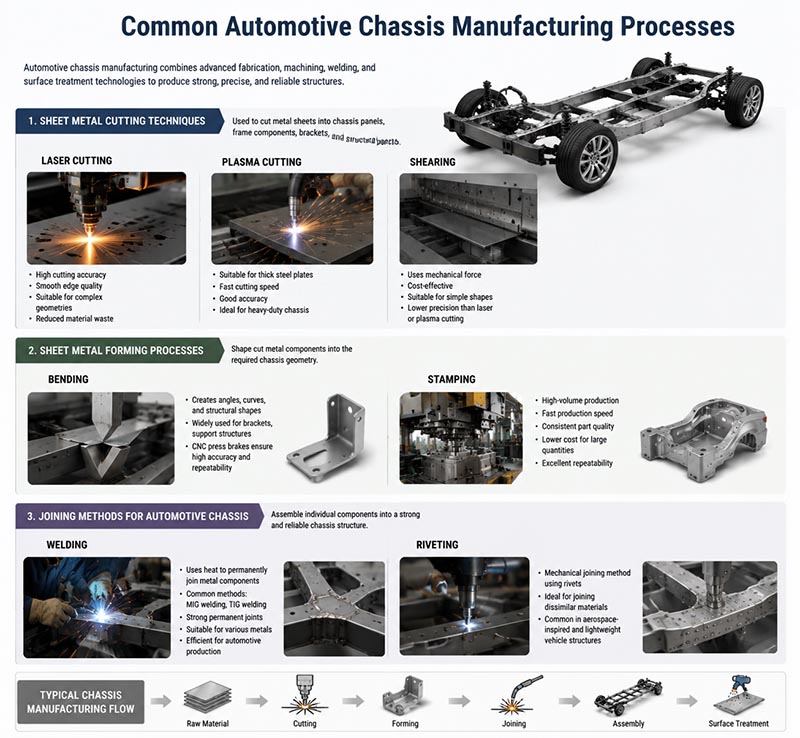
The main sheet metal fabrication processes include cutting, forming, and joining.
Sheet Metal Cutting Techniques
Cutting processes are used to create chassis panels, frame components, brackets, and structural parts from metal sheets.
Common cutting methods include laser cutting, plasma cutting, and mechanical shearing.
Laser Cutting
Laser cutting uses a concentrated laser beam to melt and remove metal material, producing highly accurate cuts.
Because automotive chassis parts often require complex shapes and tight dimensional tolerances, laser cutting services are widely used for precision automotive components.
Benefits include:
- High cutting accuracy
- Smooth edge quality
- Suitable for complex geometries
- Reduced material waste
Plasma Cutting
Plasma cutting uses high-temperature ionized gas to cut metal materials.
It is especially suitable for thicker steel plates used in heavy-duty chassis applications.
Compared with traditional cutting methods, plasma cutting provides faster production speed while maintaining acceptable accuracy.
Shearing
Shearing uses mechanical force to cut sheet metal into specific sizes and shapes.
Although it does not provide the same precision as laser or plasma cutting, it remains useful for producing simple chassis parts such as frame sections that do not require extremely tight tolerances.
Sheet Metal Forming Processes
After cutting, sheet metal components are shaped through forming processes to achieve the required chassis geometry.
The most common forming techniques include bending and stamping.
Bending
Sheet metal bending uses equipment such as press brakes to create angles, curves, and structural shapes.
This process is widely used for producing brackets, support structures, and other automotive sheet metal parts.
Modern CNC bending machines improve repeatability and accuracy, making them suitable for complex chassis components.
Stamping
Stamping is a high-volume manufacturing process where a metal sheet is pressed into a mold to create identical parts.
Automotive manufacturers use stamping because it provides:
- Fast production speed
- Consistent part quality
- Lower cost for large quantities
- Excellent repeatability
It is commonly applied to mass-produced vehicle chassis components.
Joining Methods for Automotive Chassis
After individual components are produced, different parts must be assembled together using reliable joining methods.
The most common joining technologies include welding and riveting.
Welding
Welding uses heat to permanently join metal components together.
Common welding methods used in automotive chassis manufacturing include MIG welding and TIG welding.
The selected welding method depends on material type, production requirements, and structural strength requirements.
Advantages of welding include:
- Strong permanent joints
- Suitable for various metals
- Efficient for automotive production
Riveting
Riveting is a mechanical joining method where a rivet is inserted through prepared holes and deformed to secure two components.
It is especially useful when joining different materials that may be difficult to weld together.
Riveting is commonly used in aerospace-inspired automotive structures and lightweight vehicle manufacturing.
CNC Machining for Automotive Chassis Components
CNC machining plays an important role in producing precision automotive chassis parts that require accurate dimensions and complex geometries.
Manufacturing processes such as CNC milling, CNC turning, drilling, and precision machining are commonly used to create:
- Mounting brackets
- Suspension components
- Transmission supports
- Chassis connection parts
Compared with traditional machining methods, custom CNC machining services provide higher accuracy, better repeatability, and improved production efficiency.
At Xavier, advanced CNC machining technology helps manufacturers produce reliable automotive components with strict quality requirements.
Die Casting for Automotive Chassis Parts
Die casting is another manufacturing method used for producing automotive structural components.
During the process, molten metal is injected into a specially designed mold under high pressure. After cooling and solidification, the final component takes the shape of the mold.
Die casting is commonly used for producing:
- Aluminum frame components
- Structural brackets
- Crossmembers
- Lightweight automotive parts
Although die casting is not suitable for producing a complete vehicle chassis, it is valuable for manufacturing specific lightweight structural components.
Common Materials Used for Automotive Chassis Manufacturing
Material selection is one of the most important factors in automotive chassis design because it directly affects vehicle strength, weight, durability, safety, and manufacturing cost.
Modern automotive manufacturers choose different materials according to vehicle requirements. A high-performance sports car may prioritize lightweight construction, while commercial vehicles require maximum strength and load-bearing capability.
The most commonly used materials for car chassis production include steel, aluminum, composite materials, and magnesium alloys.
Steel for Automotive Chassis
Steel remains the most widely used material in car chassis manufacturing because of its excellent strength, durability, machinability, and relatively low production cost.
Different steel grades are selected according to application requirements. Carbon steel and low-carbon mild steel are commonly used because they provide good weldability, formability, and impact resistance.
Advantages of steel chassis materials include:
- High mechanical strength
- Excellent durability
- Good weldability
- Cost-effective production
- Easy availability
Low-carbon steel is especially suitable for automotive structures because it can be easily formed into complex shapes while maintaining sufficient toughness.
However, steel has a higher density compared with lightweight materials, which increases vehicle weight and can affect fuel efficiency.
Aluminum for Automotive Chassis
Aluminum has become increasingly popular in modern lightweight automotive chassis design because of its excellent strength-to-weight ratio.
Compared with steel, aluminum is significantly lighter while still providing good structural rigidity and corrosion resistance.
The advantages of aluminum chassis components include:
- Reduced vehicle weight
- Improved fuel efficiency
- Strong corrosion resistance
- Good machinability
- Excellent thermal performance
Aluminum is commonly used in electric vehicles, luxury cars, and performance vehicles where reducing weight is a major priority.
Composite Materials for Automotive Chassis
Composite materials, including carbon fiber reinforced polymers and fiberglass composites, are advanced materials used in high-performance vehicle applications.
These materials offer outstanding strength while maintaining extremely low weight.
Benefits of composite chassis materials include:
- Superior strength-to-weight ratio
- Excellent corrosion resistance
- High design flexibility
- Lightweight construction
However, the high material cost and complex manufacturing process limit their use in mass-market vehicles.
Magnesium Alloys for Automotive Chassis
Magnesium alloys are lightweight materials that are becoming increasingly important in advanced automotive applications.
Materials such as AZ91D magnesium alloy provide excellent weight reduction while maintaining acceptable mechanical performance.
Magnesium alloys are commonly used in:
- Racing vehicles
- Electric vehicles
- High-performance automotive components
Their low density makes them attractive for manufacturers looking to improve vehicle efficiency.
Common Surface Finishing Methods for Automotive Chassis
Surface finishing plays an important role in improving the performance, appearance, and service life of automotive chassis components.
Proper finishing can improve corrosion resistance, surface quality, wear resistance, and durability.
Common automotive surface finishing processes include grinding, polishing, galvanizing, anodizing, and painting.
Grinding
Grinding is a precision finishing process used to remove surface defects and improve dimensional accuracy.
During grinding, abrasive materials such as silicon carbide or diamond remove small amounts of material from the surface.
This process helps automotive manufacturers achieve:
- Smoother surfaces
- Better dimensional accuracy
- Reduced surface imperfections
Grinding is often used for precision chassis components that require improved surface quality.
Polishing
Polishing is commonly applied during the final stages of automotive component manufacturing.
The process removes minor surface imperfections and improves the appearance and smoothness of metal parts.
Although chassis components do not always require mirror-like finishes, polishing can improve corrosion resistance and surface performance.
Galvanizing
Galvanizing is a surface protection process that applies a zinc coating to steel chassis components.
The zinc layer provides strong protection against corrosion and environmental damage.
Benefits of galvanized chassis parts include:
- Improved corrosion resistance
- Longer service life
- Better protection in harsh environments
This process is especially useful for vehicles exposed to moisture, road salt, and outdoor conditions.
Anodizing
Anodizing is mainly used for aluminum automotive chassis components.
The process creates a thin, hard oxide layer on the aluminum surface, improving corrosion resistance and wear protection.
Anodizing surface finishing is widely used for aluminum, magnesium, and titanium parts that require improved durability in demanding environments.
Advantages include:
- Increased corrosion resistance
- Improved surface hardness
- Better appearance options
- Enhanced component lifespan
Painting
Painting is one of the most common protection methods for automotive chassis structures.
A properly applied coating system helps prevent corrosion while improving the appearance of vehicle components.
Modern automotive painting technologies provide long-term protection against:
- Moisture
- Chemicals
- Environmental exposure
- Oxidation
Future Trends in Custom Automotive Chassis Design
The automotive industry is continuously developing new chassis technologies to improve efficiency, safety, and vehicle performance.
Future custom car chassis design trends will focus on lightweight materials, electric vehicle integration, modular structures, intelligent technology, and enhanced safety systems.
Lightweight Material Applications
Reducing vehicle weight has become a major goal for automotive manufacturers.
The use of lightweight materials such as aluminum, carbon fiber, titanium, and advanced composites helps reduce energy consumption while maintaining structural strength.
Lightweight chassis designs are especially important for electric vehicles because lower weight can increase driving range and efficiency.
Integration of Electric Powertrains
The growth of electric vehicles is changing traditional chassis design.
Electric powertrains require new structural layouts to accommodate battery packs, motors, and electronic systems.
Modern electric vehicle chassis design focuses on:
- Better battery protection
- Improved weight distribution
- Higher structural safety
- Increased driving efficiency
Modular Chassis Platforms
Modular chassis platforms allow manufacturers to use the same basic structure for multiple vehicle models.
This approach provides:
- Lower production costs
- Faster product development
- Greater manufacturing flexibility
- Easier customization
Many automotive companies are adopting modular architectures to improve production efficiency.
Connected Vehicle Technology
Smart vehicle technologies are influencing future chassis development.
Integrated sensors and digital monitoring systems can provide information about vehicle conditions, enabling:
- Remote diagnostics
- Predictive maintenance
- Improved driving assistance
- Better vehicle performance monitoring
Advanced Safety Features
Safety continues to be a major focus in automotive chassis development.
Future chassis systems will integrate advanced safety technologies such as:
- Collision warning systems
- Emergency braking assistance
- Intelligent structural protection
- Improved crash energy management
These innovations will create safer and more reliable vehicles.
Work with Xavier for One-Stop Automotive Manufacturing Solutions
Looking for a reliable partner for automotive parts manufacturing?
Xavier provides professional manufacturing solutions including CNC machining, sheet metal fabrication, and precision component production for automotive applications.
With advanced manufacturing capabilities and engineering expertise, Xavier helps customers develop high-quality chassis components that meet strict requirements for accuracy, durability, and performance.
From prototype development to mass production, our manufacturing solutions support various automotive projects, including structural parts, brackets, precision components, and customized vehicle parts.
Contact Xavier today to transform your automotive design ideas into reliable manufactured products.
Conclusion
The automotive chassis is the foundation of every vehicle, supporting essential systems while influencing safety, performance, and driving experience.
Understanding different automotive chassis types, manufacturing methods, materials, and surface treatments helps companies make better decisions when developing vehicle components.
Choosing an experienced manufacturing partner is also critical for achieving reliable results. Xavier provides professional custom CNC machining services, sheet metal fabrication, and advanced manufacturing solutions to help customers produce high-quality automotive components.
With advanced technology and strict quality control, Xavier is committed to delivering precision parts that meet modern automotive industry requirements.
FAQs About Automotive Chassis Design
Which chassis type is commonly used in racing cars?
Racing vehicles typically use tubular chassis and monocoque chassis designs.
Formula racing cars usually rely on lightweight monocoque structures, while many off-road racing vehicles use tubular chassis designs because of their excellent strength and safety performance.
Where can I find my vehicle chassis number?
The chassis number location depends on the vehicle manufacturer and model.
Common locations include:
- Driver-side dashboard area
- Inside the driver-side door frame
- Engine compartment
- Vehicle registration documents
Are a car frame and chassis the same thing?
No, a car frame and chassis are different components.
The vehicle chassis is the main structural foundation that supports mechanical systems such as the engine, suspension, steering, and braking components.
The frame refers to the structural body section that supports the vehicle shell.
In older vehicles, the frame and chassis were separate structures. Modern vehicles often combine them into a single integrated design known as a monocoque or unibody structure.
We are an integrated CNC machining manufacturer specializing in custom CNC machining services and precision manufacturing of various metal parts. Our capabilities include professional CNC anodizing surface finishing, CNC electroless nickel plating surface finishing, and CNC passivation surface finishing to meet different requirements for durability, corrosion resistance, and appearance.
We are a reliable CNC anodizing manufacturer, providing high-volume CNC electroless nickel plating service, and offering competitive CNC passivation price. Feel free to contact us for professional CNC machining solutions and customized metal component manufacturing support.
Some of the images and text in this article are collected and compiled from the internet. If there is anything inappropriate, please contact us for processing.