
Cast Aluminum vs Cast Iron: 10 Key Differences, Properties, Applications, and How to Choose
Choosing between cast aluminum and cast iron is an important decision in mechanical engineering, automotive manufacturing, industrial equipment production, and precision component machining. Both materials offer excellent casting capabilities, but their physical properties, mechanical performance, weight, thermal behavior, and manufacturing costs are significantly different.
Cast aluminum is widely selected for lightweight components, corrosion resistance, and efficient heat dissipation. Cast iron, on the other hand, is preferred for applications requiring high compressive strength, wear resistance, vibration damping, and structural stability.
However, neither material is universally better. The right choice depends on the component’s operating environment, load conditions, dimensional requirements, production volume, and expected service life.
This guide compares cast aluminum vs cast iron in detail to help engineers, manufacturers, and purchasing professionals make an informed material selection.
1. Material Composition and Types of Cast Aluminum and Cast Iron
The first difference between cast aluminum and cast iron comes from their chemical composition and metallurgical structure. Although both materials are produced by pouring molten metal into molds, their alloying elements and solidification characteristics are quite different.
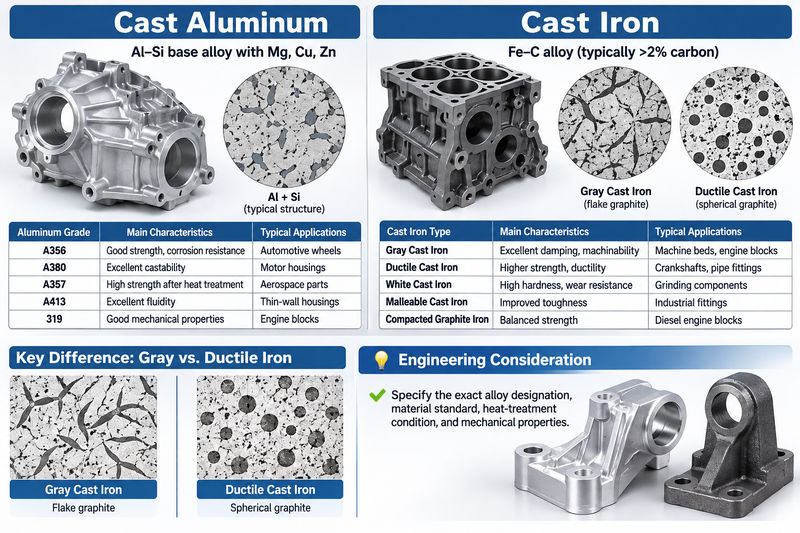
Cast aluminum is primarily composed of aluminum combined with elements such as silicon, magnesium, copper, and zinc. Silicon improves fluidity during casting, allowing molten aluminum to fill complex mold cavities. Magnesium can improve strength through heat treatment, while copper can increase mechanical strength but may reduce corrosion resistance.
Common cast aluminum grades include:
| Aluminum Grade | Main Characteristics | Typical Applications |
|---|---|---|
| A356 | Good strength, corrosion resistance, heat treatable | Automotive wheels, structural housings |
| A380 | Excellent castability and machinability | Motor housings, brackets, covers |
| A357 | High strength after heat treatment | Aerospace and structural components |
| A413 | Excellent fluidity and pressure-tight casting potential | Thin-wall housings, hydraulic components |
| 319 | Good mechanical properties and machinability | Engine blocks and cylinder heads |
Cast iron is an iron-carbon alloy that generally contains more than 2% carbon, together with silicon and other alloying elements. Its carbon content and graphite structure significantly influence hardness, brittleness, machinability, and wear resistance.
The major types of cast iron include:
| Cast Iron Type | Main Characteristics | Typical Applications |
|---|---|---|
| Gray Cast Iron | Excellent vibration damping and machinability | Machine beds, engine blocks |
| Ductile Cast Iron | Higher tensile strength and ductility | Crankshafts, pipe fittings, brackets |
| White Cast Iron | High hardness and wear resistance | Grinding components, wear plates |
| Malleable Cast Iron | Improved toughness and ductility | Industrial fittings, mechanical connectors |
| Compacted Graphite Iron | Balanced strength and thermal properties | Diesel engine blocks, cylinder heads |
The distinction between gray cast iron and ductile iron is particularly important. Gray iron contains flake-shaped graphite, which provides excellent vibration damping but creates stress concentrations that reduce tensile strength. Ductile iron contains spherical graphite nodules, improving tensile strength and elongation.
Engineering consideration: When selecting a material, specifying only “cast aluminum” or “cast iron” is insufficient. A drawing should identify the exact alloy designation, applicable material standard, heat-treatment condition, and required mechanical properties.
2. Density and Weight: Cast Aluminum Is Significantly Lighter
Weight is one of the most obvious differences between cast aluminum and cast iron. Aluminum alloys have a much lower density, making them particularly suitable for components where reducing mass is a major design objective.
Typical material density values are:
| Property | Cast Aluminum | Cast Iron |
|---|---|---|
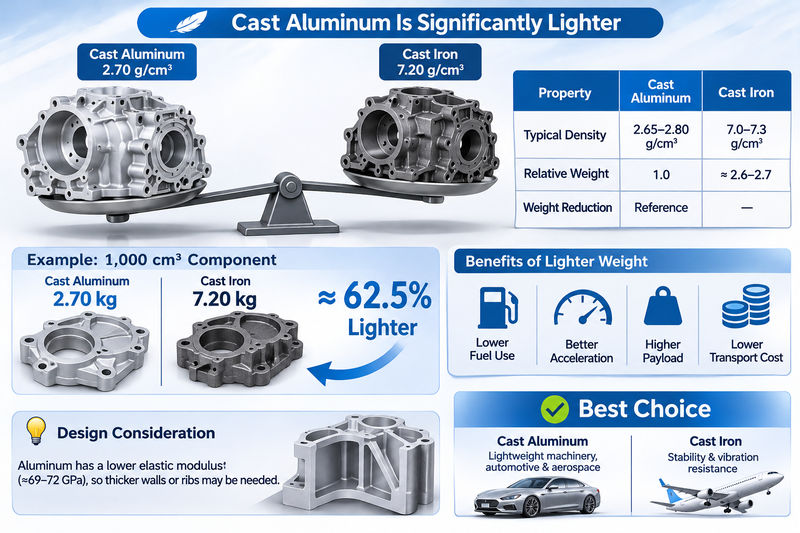
| Typical Density | 2.65–2.80 g/cm³ | 7.0–7.3 g/cm³ |
| Relative Weight | 1.0 | Approximately 2.6–2.7 |
| Weight Reduction | Reference | — |
Cast aluminum generally weighs around one-third as much as cast iron for an equivalent volume.
For example, consider two components with identical external dimensions and a volume of 1,000 cm³.
- Cast aluminum at 2.70 g/cm³ weighs approximately 2.70 kg.
- Cast iron at 7.20 g/cm³ weighs approximately 7.20 kg.
The cast aluminum component is approximately 62.5% lighter.
This difference becomes especially important in automotive and aerospace applications. Reducing component weight can help lower vehicle energy consumption, improve acceleration, increase payload capacity, and reduce transportation costs.
For example, an aluminum engine housing can replace a heavier cast iron housing when the design can maintain the necessary stiffness, strength, and dimensional stability.
However, lower density does not automatically mean that an aluminum component can replace an iron component without redesign. Aluminum has a lower elastic modulus, approximately 69–72 GPa compared with roughly 100–170 GPa for common cast irons, depending on grade and graphite structure.
Consequently, an aluminum component may require thicker walls, additional ribs, or reinforced mounting areas to achieve comparable stiffness.
Best choice: Cast aluminum is generally preferable for lightweight machinery, automotive housings, portable equipment, and aerospace structures. Cast iron is more suitable when component mass contributes to machine stability or vibration resistance.
3. Strength and Mechanical Properties: Which Material Is Stronger?
Strength is one of the most misunderstood aspects of the cast aluminum vs cast iron comparison.
Many people assume cast iron is always stronger because it is heavier and harder. In reality, mechanical strength depends heavily on the specific alloy, casting process, microstructure, and heat treatment.
The following table provides representative mechanical property ranges for common engineering grades.
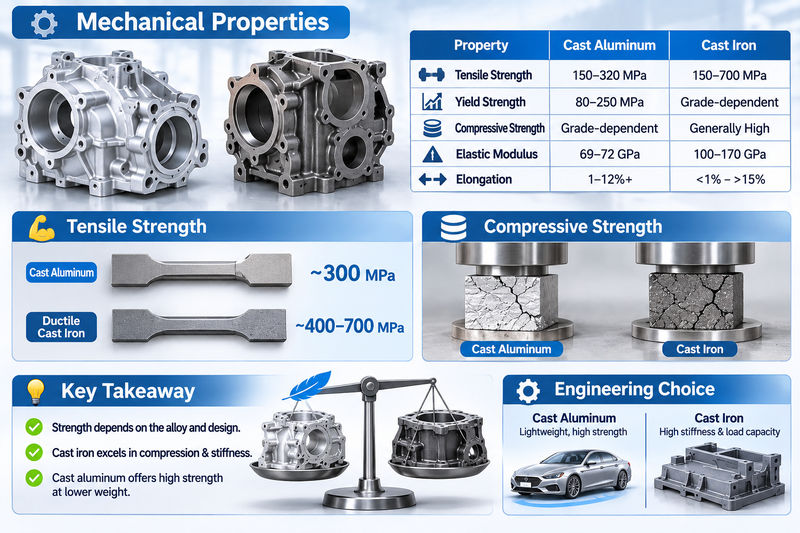
| Mechanical Property | Cast Aluminum | Cast Iron |
|---|---|---|
| Tensile Strength | 150–320 MPa | 150–700 MPa |
| Yield Strength | 80–250 MPa | Grade-dependent |
| Compressive Strength | Grade-dependent | Generally high |
| Elastic Modulus | 69–72 GPa | Approximately 100–170 GPa |
| Elongation | 1–12% or higher | Below 1% to over 15%, depending on type |
These are indicative ranges, not guaranteed design values. Gray iron does not have a clearly defined conventional tensile yield point, so its mechanical evaluation differs from that of ductile aluminum alloys and ductile iron.
Tensile Strength
Tensile strength measures the maximum stress a material can withstand when pulled before fracture.
Common A380 aluminum die castings can achieve tensile strengths around 300–320 MPa in representative test conditions. Heat-treated A356 aluminum castings can also provide good tensile and yield strength.
Gray cast iron generally has lower tensile strength than ductile iron because its flake graphite structure creates local stress concentrations.
Ductile cast iron grades can achieve tensile strengths of approximately 400–700 MPa, depending on the grade and specification.
Therefore, ductile cast iron may be a better option for components exposed to substantial tensile loads, while selected heat-treated aluminum alloys can provide competitive strength at a much lower weight.
Compressive Strength
Cast iron is particularly effective under compressive loading. Its microstructure and high stiffness make it suitable for machine bases, support structures, heavy-duty housings, and components subjected to repeated compressive forces.
For example, a large industrial machine base made from gray cast iron can support substantial equipment loads while maintaining excellent vibration damping.
Cast aluminum can also withstand significant compressive loads, but component geometry and wall thickness must be carefully designed to prevent deformation.
Practical recommendation: Evaluate the actual load direction and failure mode rather than comparing tensile strength alone. A component subjected to bending, impact, fatigue, and compression may require a completely different material selection from one subjected primarily to static tension.
4. Hardness and Wear Resistance
Hardness describes a material’s resistance to localized indentation and deformation. Wear resistance describes its ability to resist material loss caused by friction, abrasion, or repeated contact.
Cast iron often performs better in applications involving sliding contact, abrasive particles, and repeated mechanical movement.
Gray cast iron commonly has a Brinell hardness range of approximately 150–250 HB, although the actual value varies with grade and casting condition. Some white cast irons can reach substantially higher hardness levels because of their carbide-rich microstructure.
Cast aluminum alloys are generally softer. Common A380 and A356 castings typically have lower hardness than wear-resistant cast iron grades.
| Property | Cast Aluminum | Cast Iron |
|---|---|---|
| Typical Hardness | Approximately 60–110 HB | Approximately 150–250 HB for common gray iron |
| Abrasion Resistance | Moderate | Good to excellent, depending on grade |
| Sliding Wear Performance | Application-dependent | Often excellent |
| Surface Modification | Anodizing and coatings | Hardening treatments and coatings, depending on grade |
One important advantage of gray cast iron is its graphite structure. Graphite can provide a degree of self-lubricating behavior during sliding contact, which helps reduce friction in certain applications.
For example, gray cast iron is commonly used in machine guideways, brake components, and industrial equipment where dimensional stability and wear performance are important.
Cast aluminum can also be used in moving components, but its relatively low hardness may require surface protection, hard anodizing where suitable, or additional wear-resistant inserts.
For example, an aluminum housing with a bearing seat may use a steel or bronze insert to prevent excessive wear at the contact surface.
Material selection tip: For abrasive environments, heavy sliding loads, and high-contact-pressure applications, cast iron is often the stronger candidate. For lightweight housings that experience limited friction, cast aluminum may be more economical over the product’s lifecycle.
5. Thermal Conductivity and Heat Resistance
Thermal performance is another major difference between cast aluminum and cast iron.
Cast aluminum has relatively high thermal conductivity, allowing heat to move through the material quickly. This makes it useful for engine housings, electronic enclosures, heat-dissipation structures, and components that need to transfer heat efficiently.
Typical thermal conductivity values are:
| Material | Approximate Thermal Conductivity |
|---|---|
| Cast Aluminum Alloys | 90–180 W/m·K |
| Gray Cast Iron | 35–55 W/m·K |
| Ductile Cast Iron | Approximately 25–40 W/m·K |
Actual conductivity depends on alloy composition, graphite morphology, temperature, and casting structure.
Cast iron has lower thermal conductivity than most cast aluminum alloys, but it can offer excellent thermal stability in heavy industrial components.
The difference is important when designing engine components.
An aluminum cylinder head can transfer combustion heat efficiently toward the cooling system. This helps manage operating temperatures and reduces component mass.
Cast iron, however, offers good wear performance and dimensional stability in many engine and industrial applications. It is also commonly used in components that need substantial thermal mass.
Another important factor is the coefficient of thermal expansion.
| Material | Typical Thermal Expansion Coefficient |
|---|---|
| Cast Aluminum | 20–24 × 10⁻⁶/K |
| Cast Iron | 9–12 × 10⁻⁶/K |
Cast aluminum generally expands more when temperature increases.
This means that engineers must account for thermal expansion when designing precision fits, bearing seats, mounting interfaces, and assemblies containing different materials.
For example, an aluminum housing containing a steel bearing may experience changes in bearing-seat clearance during temperature cycling. The interference fit must be designed according to the expected operating temperature.
Best choice: Cast aluminum is usually preferable for efficient heat transfer. Cast iron is often better when high stiffness, thermal mass, and dimensional stability are more important than rapid heat dissipation.
6. Corrosion Resistance and Surface Protection
Corrosion resistance directly affects the service life, maintenance requirements, and appearance of manufactured components.
Cast aluminum naturally develops a thin aluminum oxide layer when exposed to oxygen. This layer helps protect the underlying material from further oxidation.
As a result, many cast aluminum components perform well in atmospheric and humid environments without requiring heavy protective coatings.
However, corrosion resistance varies between aluminum alloys. Copper-rich alloys, including some A380 compositions, may have lower corrosion resistance than other aluminum casting grades.
Cast iron behaves differently. Its iron-based composition makes it susceptible to rust when exposed to moisture and oxygen.
Without suitable protection, cast iron components can develop surface rust, which may eventually affect appearance, dimensional accuracy, and functionality.
Common surface protection methods include:
| Surface Treatment | Cast Aluminum | Cast Iron |
|---|---|---|
| Anodizing | Common for suitable alloys | Not applicable |
| Powder Coating | Available | Available |
| Painting | Available | Widely used |
| Electroless Nickel Plating | Available with proper preparation | Available |
| Zinc Plating | Alloy- and process-dependent | Available |
| Passivation | Alloy-specific conversion treatments | Different chemical protection processes |
Anodizing Cast Aluminum
Anodizing is an electrochemical surface treatment that creates a controlled oxide layer on aluminum.
Type II anodizing is commonly used for decorative and general corrosion protection, while Type III hard anodizing produces a thicker and harder surface layer for applications requiring improved wear resistance.
However, high-silicon die-cast aluminum alloys such as A380 may develop uneven or less attractive anodized finishes because of their alloy composition.
Alloy suitability and cosmetic expectations should therefore be evaluated before selecting anodizing.
Protecting Cast Iron
Cast iron components commonly use painting, powder coating, plating, or other protective treatments to reduce exposure to moisture and corrosive substances.
For example, industrial pump housings made from cast iron may receive protective coatings to extend their service life in outdoor or industrial environments.
Practical recommendation: Choose cast aluminum when natural corrosion resistance and lower maintenance are priorities. Choose cast iron when its mechanical and wear properties justify the additional surface protection requirements.
7. Casting Processes and Manufacturing Complexity
Both materials can produce complex shapes through casting, but their melting temperatures, fluidity, mold requirements, and solidification behavior are different.
Aluminum alloys generally have casting temperatures around 650–750°C, depending on alloy and process. Cast iron is typically poured at substantially higher temperatures, often around 1,300–1,450°C.
The lower melting temperature of aluminum can reduce some processing energy requirements and allows the use of different mold and production systems.
Common casting processes include:
| Casting Process | Cast Aluminum | Cast Iron |
|---|---|---|
| Sand Casting | Yes | Yes |
| Permanent Mold Casting | Yes | Limited applications |
| High-Pressure Die Casting | Common | Not generally used |
| Low-Pressure Casting | Common | Less common |
| Investment Casting | Available | Available for selected alloys |
Sand Casting
Sand casting is suitable for producing large or complex components in both materials.
For example, large cast iron machine bases and industrial pump housings are frequently produced using sand molds.
Aluminum sand casting is useful for prototypes, low-volume production, and structural components requiring specific mechanical properties.
High-Pressure Die Casting
High-pressure die casting is particularly important for aluminum manufacturing.
Molten aluminum is injected into a steel mold under high pressure, allowing manufacturers to produce thin-wall parts with relatively high production efficiency and good dimensional consistency.
A380 and ADC12 are commonly used for automotive housings, electronic enclosures, brackets, and mechanical covers.
However, high-pressure die castings can contain internal porosity. This can affect pressure tightness, welding, heat treatment, and certain critical structural applications.
Permanent Mold and Low-Pressure Casting
These processes are frequently used for aluminum components requiring improved mechanical properties and controlled solidification.
A356 is a common choice for permanent mold and low-pressure casting applications, particularly when heat treatment is required.
Manufacturing consideration: Select the casting process according to part geometry, wall thickness, production quantity, mechanical requirements, and internal quality standards. Material selection and casting process should be evaluated together rather than independently.
8. CNC Machining Performance and Dimensional Accuracy
Casting creates the basic geometry of a component, but many industrial parts still require CNC machining to achieve the final dimensions, surface finish, and functional tolerances.
Typical secondary operations include CNC milling, CNC turning, drilling, boring, tapping, reaming, and precision grinding.
Both cast aluminum and cast iron can be CNC machined, but their cutting behavior is different.
| CNC Machining Factor | Cast Aluminum | Cast Iron |
|---|---|---|
| Cutting Speed | Generally Higher | Generally Lower |
| Tool Wear | Often Lower, but alloy-dependent | Can be higher due to abrasive graphite and carbides |
| Chip Formation | Continuous or fragmented, depending on alloy | Often short and brittle |
| Thermal Conductivity | High | Lower |
| Coolant Requirements | Commonly used | Dry machining is often practical for gray iron |
| Surface Finish | Generally Good | Generally Good with suitable tooling |
| Machining Difficulty | Generally Low to Moderate | Grade-dependent |
CNC Milling of Cast Aluminum
Cast aluminum is generally easier to machine at higher cutting speeds than cast iron.
Carbide cutting tools with suitable geometry are commonly used for milling aluminum housings, mounting brackets, motor covers, and structural components.
However, aluminum can adhere to the cutting edge, creating built-up edge and poor surface finish if tool geometry, cutting parameters, or lubrication are unsuitable.
For example, when machining an A356 aluminum housing, the manufacturer may use CNC milling to produce mounting faces, bearing bores, bolt holes, and sealing surfaces.
CNC Machining of Cast Iron
Gray cast iron generally produces short, brittle chips, making chip control relatively straightforward.
However, graphite and hard inclusions can increase tool wear. Abrasive grades may require suitable carbide or ceramic tooling.
Dry machining is common for gray cast iron because its graphite structure can help with lubrication, although dust extraction and appropriate machine protection are important.
For example, a cast iron machine base may require precision milling of mounting surfaces and boring of alignment holes to ensure that connected components maintain accurate positioning.
Dimensional Accuracy and Casting Defects
An important point is that CNC machining accuracy is not determined by the material alone.
The final result also depends on:
- Casting dimensional variation.
- Internal porosity and shrinkage defects.
- Residual stress and distortion.
- Workholding and fixture rigidity.
- Tool condition and cutting parameters.
- Temperature control during machining.
- Measurement and inspection methods.
For precision components, manufacturers should inspect critical features using coordinate measuring machines (CMM), bore gauges, micrometers, and other suitable instruments.
A cast component may have sufficient material allowance for machining but still experience deformation if internal stress is released during material removal.
Therefore, stress relief, machining sequence, fixture design, and intermediate inspection should be considered for complex components.
CNC manufacturing recommendation: Cast aluminum is often preferred for high-speed machining and lightweight precision housings. Cast iron is a strong choice for machine bases, wear-resistant components, and parts requiring excellent vibration damping.
9. Common Applications and Real-World Examples
Cast aluminum and cast iron are used in many industries, but their applications differ according to performance requirements.
| Industry | Cast Aluminum Applications | Cast Iron Applications |
|---|---|---|
| Automotive | Engine housings, cylinder heads, transmission cases | Engine blocks, brake drums, brake rotors |
| Aerospace | Lightweight housings and structural castings | Specialized ground-support equipment components |
| Industrial Machinery | Pump housings, motor covers, brackets | Machine beds, bases, heavy-duty housings |
| Electronics | Heat sinks, electronic enclosures | Limited specialized applications |
| Agriculture | Lightweight equipment housings | Gearbox housings, heavy-duty machinery parts |
| Fluid Systems | Lightweight pump bodies and manifolds | Valves, pump bodies, pipe fittings |
Automotive Components
Aluminum castings are widely used in modern vehicles because reducing weight can improve fuel economy and electric vehicle driving range.
For example, transmission housings and electric motor housings can be manufactured from aluminum alloys to reduce mass while maintaining adequate mechanical performance.
Cast iron remains important in automotive applications where stiffness, wear resistance, and thermal performance are essential.
Engine blocks, brake components, and certain heavy-duty mechanical parts are examples.
Industrial Machinery
Industrial machine bases are a typical application for gray cast iron.
Its excellent vibration damping helps reduce unwanted machine vibration, supporting machining stability and improving the performance of precision equipment.
Cast aluminum is more suitable for lightweight equipment housings, mounting structures, and components where heat dissipation is important.
Pump and Hydraulic Components
Both materials are used in pumps and hydraulic equipment.
Aluminum pump housings can reduce overall equipment weight, while cast iron pump bodies are often preferred for heavy-duty industrial service and applications requiring greater wear resistance.
The operating fluid, pressure, temperature, and corrosion environment must all be considered before selecting a material.
10. Cost Comparison and How to Choose the Right Material
Material price is important, but comparing cast aluminum and cast iron only by price per kilogram can produce misleading results.
The actual manufacturing cost includes raw material, melting, casting, tooling, machining, finishing, inspection, transportation, and long-term maintenance.
| Cost Factor | Cast Aluminum | Cast Iron |
|---|---|---|
| Material Cost per kg | Generally Higher | Generally Lower |
| Component Weight | Lower | Higher |
| Casting Energy | Generally Lower Melting Temperature | Higher Melting Temperature |
| Machining Productivity | Often High | Grade- and operation-dependent |
| Surface Protection | Often Lower Requirements | Frequently Requires Protection |
| Transportation | Lower Weight Advantage | Higher Weight-Related Cost |
| Tooling Investment | Depends on Casting Process | Depends on Casting Process |
Example: Choosing Material for a Motor Housing
Imagine a manufacturer needs 5,000 motor housings annually.
The component must provide sufficient mechanical strength, dimensional accuracy, thermal management, and resistance to the operating environment.
If weight reduction and heat dissipation are major priorities, A380 or another suitable cast aluminum alloy may be an excellent choice.
High-pressure die casting can also support efficient production at this volume.
However, if the housing is a large industrial motor base that must absorb vibration and support heavy equipment, gray cast iron may be more suitable.
The final decision should consider the complete design rather than simply comparing raw material prices.
When Should You Choose Cast Aluminum?
Choose cast aluminum when:
- Lightweight construction is a major requirement.
- Efficient heat dissipation is important.
- Natural corrosion resistance is beneficial.
- Complex thin-wall housings are required.
- High-volume die casting is economically attractive.
- The component needs secondary CNC machining.
When Should You Choose Cast Iron?
Choose cast iron when:
- High compressive strength is required.
- Excellent vibration damping is important.
- The component experiences substantial sliding wear.
- High stiffness and structural stability are priorities.
- Heavy industrial equipment requires a stable foundation.
- Material cost per kilogram is a significant consideration.
Consider the Total Manufacturing Process
For many projects, the most economical solution is not necessarily the material with the lowest raw material cost.
For example, an aluminum component may cost more per kilogram but weigh considerably less and require less transportation effort. A cast iron component may have a lower material price but require protective coatings and additional handling.
A complete quotation should therefore include casting, CNC machining, surface finishing, inspection, and packaging.
Final Thoughts: Cast Aluminum vs Cast Iron – Which One Is Better?
Cast aluminum and cast iron both have important advantages in modern manufacturing.
Cast aluminum stands out for its low density, good corrosion resistance, high thermal conductivity, and suitability for lightweight components. It is widely used in automotive parts, aerospace components, electronic housings, and precision industrial products.
Cast iron offers excellent compressive performance, wear resistance, stiffness, and vibration damping. It remains an important material for machine bases, heavy-duty industrial equipment, engine components, and mechanical structures.
The best material depends on the component’s functional requirements, operating conditions, production volume, and total manufacturing cost.
If your project requires custom cast components with precision-machined features, Xavier provides CNC machining and custom metal component manufacturing services for international industrial customers.
From material selection and manufacturing process evaluation to CNC milling, turning, drilling, precision boring, and surface finishing, Xavier helps customers develop practical manufacturing solutions for different metal components.
Whether you need lightweight aluminum components or precision-machined iron parts, our manufacturing team can evaluate your drawings, machining requirements, tolerances, and production quantities.
Looking for a reliable CNC machining manufacturer in China?
Contact Xavier today. Send us your 2D drawings or 3D CAD files to discuss your material requirements, manufacturing process, machining tolerances, and project quotation. Our team is ready to support your custom CNC machining projects from prototype development to batch production.
As an integrated CNC machining manufacturer and trading company in China, Xavier specializes in custom CNC machining and precision metal parts manufacturing. We also provide professional surface finishing solutions, including CNC anodizing surface finishing, CNC electroless nickel plating surface finishing, and CNC zinc electroplating surface finishing to meet different component requirements.
As a CNC anodizing manufacturer, we offer bulk electroless nickel plating services. Contact us today to inquire about CNC zinc electroplating pricing. Feel free to get in touch with us for more information.
Some of the images and text in this article are collected and compiled from the internet. If there is anything inappropriate, please contact us for processing.