Understanding Precision Manufacturing: Processes, Benefits, Materials, and Applications
Have you ever wondered how advanced medical equipment can achieve incredible accuracy or how modern aircraft components are manufactured with such flawless performance? These remarkable products are the result of precision manufacturing, a technology that transforms complex designs into highly accurate physical components.
As one of the most advanced production methods available today, precision manufacturing plays a vital role in creating parts with exceptional accuracy, reliability, and consistency. It allows manufacturers to turn innovative ideas into real products while maintaining strict dimensional control and outstanding quality.
From aerospace components and automotive parts to medical devices and electronic products, precision manufacturing has become an essential solution for industries requiring high-performance components.
In this guide, we will explore what precision manufacturing is, why it matters, the main manufacturing techniques involved, common materials used, and its applications across different industries.
What Is Precision Manufacturing?
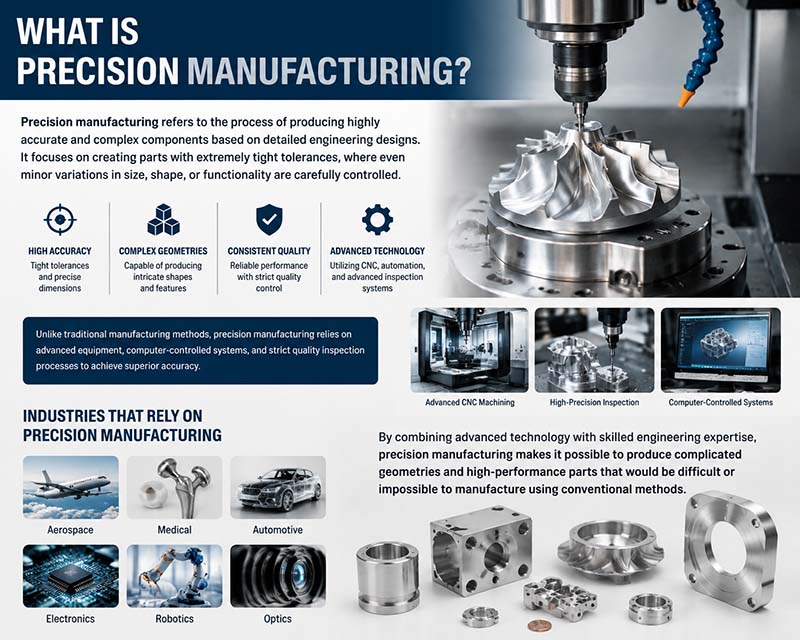
Precision manufacturing refers to the process of producing highly accurate and complex components based on detailed engineering designs. It focuses on creating parts with extremely tight tolerances, where even minor variations in size, shape, or functionality are carefully controlled.
Unlike traditional manufacturing methods, precision manufacturing relies on advanced equipment, computer-controlled systems, and strict quality inspection processes to achieve superior accuracy.
This manufacturing approach is especially important for industries that require reliable performance and consistent quality, including aerospace, medical, automotive, electronics, and robotics.
By combining advanced technology with skilled engineering expertise, precision manufacturing makes it possible to produce complicated geometries and high-performance parts that would be difficult or impossible to manufacture using conventional methods.
Why Is Precision Manufacturing Important?
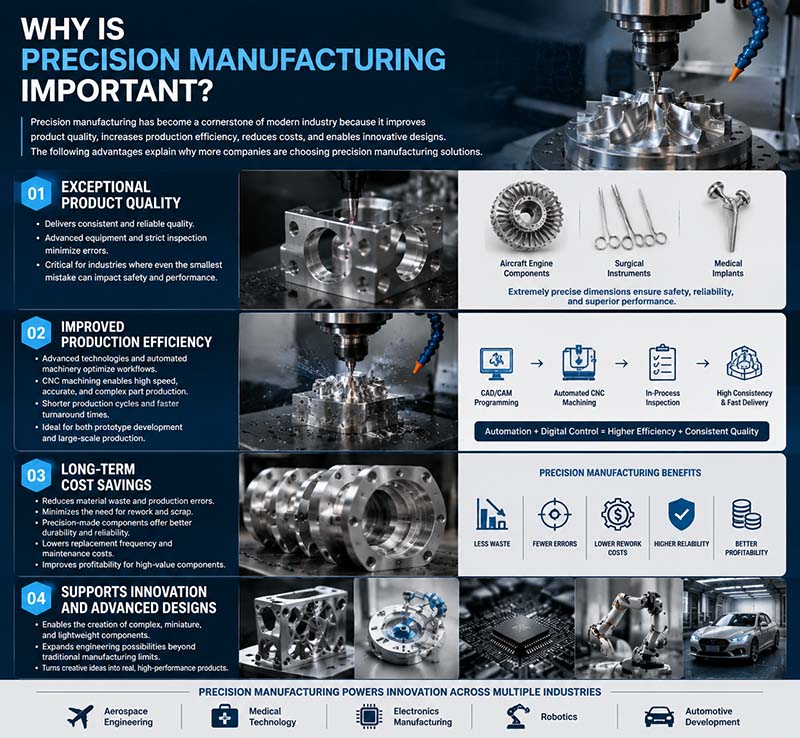
Precision manufacturing has become a cornerstone of modern industry because it improves product quality, increases production efficiency, reduces costs, and enables innovative designs.
The following advantages explain why more companies are choosing precision manufacturing solutions.
Exceptional Product Quality
One of the biggest advantages of precision manufacturing is its ability to deliver consistent and reliable quality throughout the production process.
Advanced manufacturing equipment, automated systems, and strict inspection procedures help minimize production errors and ensure that every component matches the required specifications.
This level of accuracy is especially important for industries such as aerospace and medical manufacturing, where even a small mistake can affect safety, reliability, and product performance.
For example, aircraft engine components, surgical instruments, and medical implants require extremely precise dimensions to function correctly. Precision manufacturing ensures these critical parts meet demanding industry standards.
Improved Production Efficiency
Modern precision manufacturing uses advanced technologies and automated machinery to optimize production workflows.
Processes such as CNC machining allow manufacturers to produce complex components quickly and accurately by using computer-controlled cutting tools. This reduces manual operations, shortens production cycles, and improves overall manufacturing efficiency.
Because of automation and digital control, manufacturers can achieve faster turnaround times while maintaining excellent part consistency.
This makes precision manufacturing suitable for both prototype development and large-scale production.
Long-Term Cost Savings
Although investing in precision manufacturing equipment and technology may require significant initial costs, the long-term benefits often outweigh the investment.
High-accuracy manufacturing reduces material waste, minimizes production errors, and decreases the need for costly rework.
In addition, precision-made components usually offer better durability and reliability, reducing replacement frequency and maintenance expenses over the product’s lifetime.
For businesses producing high-value components, precision manufacturing provides a practical way to improve profitability while maintaining superior quality.
Supports Innovation and Advanced Designs
Precision manufacturing expands the possibilities of product development by allowing engineers to create highly complex components with unique structures and functions.
Traditional manufacturing methods may struggle with miniature parts, complicated geometries, or lightweight designs. However, advanced precision technologies can successfully produce these challenging components.
This capability supports innovation in industries such as:
- Aerospace engineering
- Medical technology
- Electronics manufacturing
- Robotics
- Automotive development
From compact electronic devices to advanced medical equipment, precision manufacturing helps transform creative concepts into functional products.
Main Precision Manufacturing Techniques
Precision manufacturing includes many advanced production methods designed to create accurate and reliable components. Each technique has unique advantages and is suitable for different applications.
Some of the most widely used precision manufacturing processes include CNC machining, metal casting, and injection molding.
CNC Machining
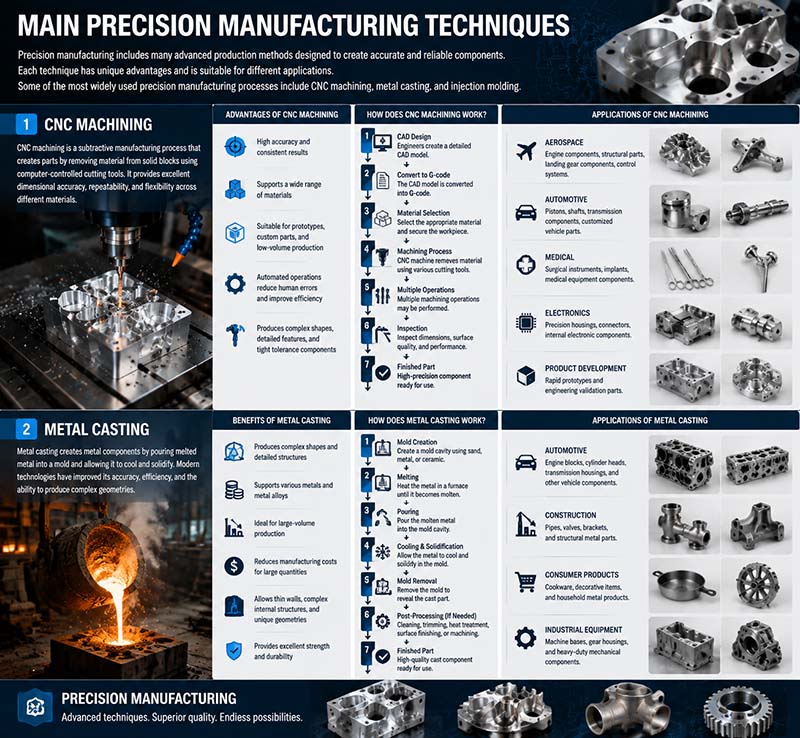
CNC machining is one of the most important and widely used techniques in precision manufacturing. It is a subtractive manufacturing process that creates parts by removing material from solid blocks using computer-controlled cutting tools.
This technology is highly popular because it provides excellent dimensional accuracy, repeatability, and flexibility across different materials.
With advanced CNC equipment, manufacturers can produce everything from simple components to highly complex precision parts.
Advantages of CNC Machining
Choosing CNC machining services provides several important benefits:
- CNC machines operate according to computer-generated instructions, ensuring high accuracy and consistent results.
- It supports a wide range of materials, including aluminum, steel, titanium, plastics, and composite materials.
- CNC machining is suitable for prototypes, custom parts, and low-volume production.
- Automated operations reduce human errors and improve manufacturing efficiency.
- It can produce complex shapes, detailed features, and tight tolerance components.
How Does CNC Machining Work?
The CNC machining process usually includes several important steps:
First, engineers create a detailed Computer-Aided Design (CAD) model of the required component.
Next, the CAD model is converted into G-code, which provides precise instructions for the CNC machine’s movements and cutting operations.
After selecting the appropriate material according to the product requirements, the workpiece is securely fixed inside the CNC machine.
The machine then follows the programmed instructions and uses different cutting tools, such as drills, mills, and turning tools, to remove unwanted material.
Depending on the design complexity, multiple machining operations may be performed to achieve the final shape.
After machining is completed, the finished component undergoes inspection to verify dimensions, surface quality, and overall performance.
Applications of CNC Machining
Due to its flexibility and accuracy, CNC machining is widely used in many industries.
Common applications include:
Aerospace: Aircraft engine components, structural parts, landing gear components, and control systems.
Automotive: Pistons, shafts, transmission components, and customized vehicle parts.
Medical: Surgical instruments, implants, and medical equipment components.
Electronics: Precision housings, connectors, and internal electronic components.
Product Development: Rapid prototypes and engineering validation parts.
Metal Casting
Metal casting is one of the oldest manufacturing methods, but it remains an important process in modern precision manufacturing. This technique creates metal components by pouring melted metal into a specially designed mold and allowing it to cool and solidify.
Although casting has existed for thousands of years, modern technologies have significantly improved its accuracy, efficiency, and ability to produce complex geometries.
Metal casting provides an excellent combination of design flexibility, production efficiency, and material versatility, making it suitable for manufacturing both simple and highly detailed metal parts.
Benefits of Metal Casting
There are several reasons why metal casting continues to be widely used across different industries:
- It can produce components with complex shapes and detailed structures that are difficult to achieve through other manufacturing methods.
- It supports various metals, including aluminum, steel, iron, bronze, and different metal alloys.
- It is highly suitable for large-volume production because multiple parts can be created from a single mold.
- The process reduces manufacturing costs when producing identical components in large quantities.
- Casting allows engineers to design parts with thin walls, complex internal structures, and unique geometries.
- Cast components often provide excellent strength and durability for demanding applications.
How Does Metal Casting Work?
The metal casting process involves several major steps:
First, a mold cavity is created according to the required shape and dimensions of the final component. The mold can be manufactured from materials such as sand, metal, or ceramic.
Next, the selected metal material is heated inside a furnace until it reaches a molten state.
The molten metal is then carefully poured into the prepared mold cavity.
After filling the mold, the metal is allowed to cool and solidify, forming the desired component shape.
Once the metal becomes solid, the mold is removed to reveal the cast part.
Depending on the application requirements, additional processes such as cleaning, trimming, heat treatment, surface finishing, or machining may be performed to improve the final quality.
Applications of Metal Casting
Because of its ability to manufacture strong and complex components efficiently, metal casting is widely used in many industries.
Typical applications include:
Automotive: Engine blocks, cylinder heads, transmission housings, and other vehicle components.
Construction: Pipes, valves, brackets, and structural metal parts.
Consumer Products: Cookware, decorative items, and household metal products.
Industrial Equipment: Machine bases, gear housings, and heavy-duty mechanical components.
Injection Molding
Injection molding is one of the most popular manufacturing processes for producing plastic components. It uses heated plastic materials and high-pressure injection technology to create complex shapes with excellent consistency.
This manufacturing method is highly automated, making it ideal for producing large quantities of identical plastic parts with fast production speeds and stable quality.
From consumer products to automotive components, injection molding plays an important role in modern manufacturing.
Advantages of Injection Molding
The popularity of injection molding services comes from several key benefits:
- It enables high-volume production of identical plastic parts with excellent repeatability.
- The controlled injection process provides accurate dimensions and consistent quality.
- It works with many different plastic materials, each offering specific performance characteristics.
- High automation reduces labor requirements and improves production efficiency.
- Finished parts usually have smooth surfaces and attractive appearances.
- It supports complex designs that require detailed features and precise structures.
How Does Injection Molding Work?
The injection molding process follows several essential steps:
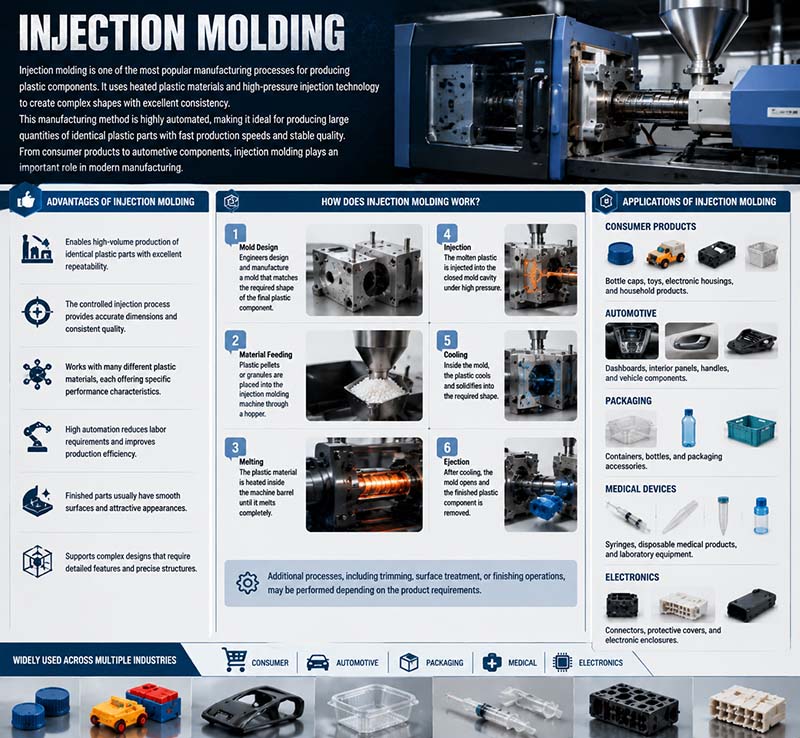
First, engineers design and manufacture a mold that matches the required shape of the final plastic component.
Next, plastic pellets or granules are placed into the injection molding machine through a hopper.
The plastic material is heated inside the machine barrel until it melts completely.
The molten plastic is then injected into the closed mold cavity under high pressure.
Inside the mold, the plastic cools and solidifies into the required shape.
After cooling, the mold opens and the finished plastic component is removed.
Additional processes, including trimming, surface treatment, or finishing operations, may be performed depending on the product requirements.
Applications of Injection Molding
Due to its efficiency and versatility, injection molding is widely used in many industries.
Common applications include:
Consumer Products: Bottle caps, toys, electronic housings, and household products.
Automotive: Dashboards, interior panels, handles, and vehicle components.
Packaging: Containers, bottles, and packaging accessories.
Medical Devices: Syringes, disposable medical products, and laboratory equipment.
Electronics: Connectors, protective covers, and electronic enclosures.
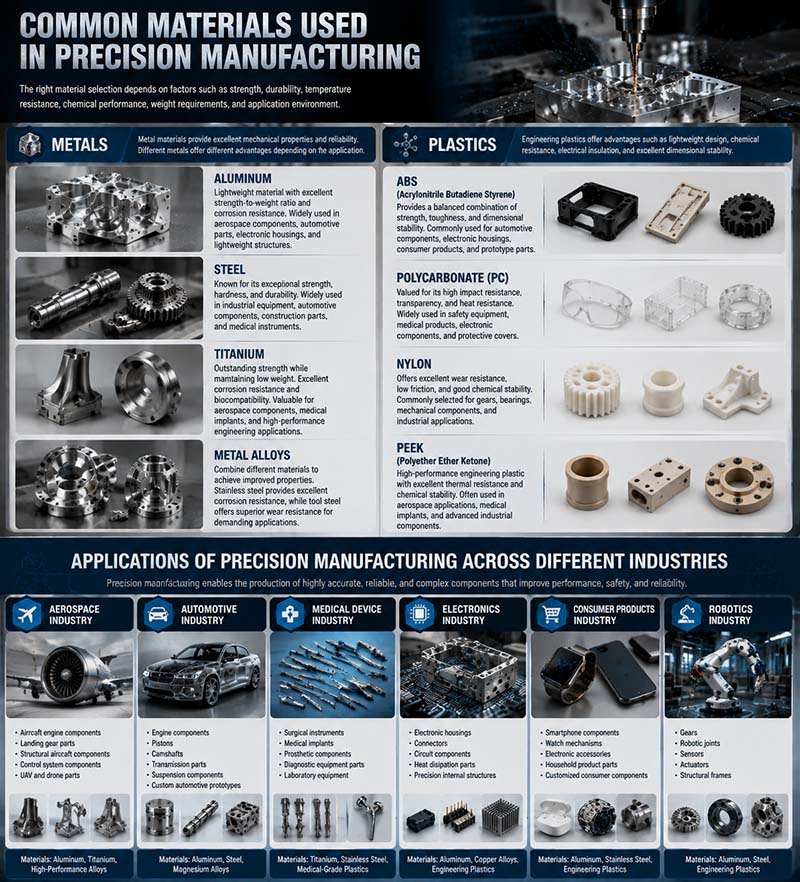
Common Materials Used in Precision Manufacturing
Many people associate precision manufacturing only with metal components, but modern manufacturing involves a wide variety of materials.
The right material selection depends on factors such as strength, durability, temperature resistance, chemical performance, weight requirements, and application environment.
The most common materials used in precision manufacturing include metals and engineering plastics.
Metals
Metal materials are among the most widely used choices in precision manufacturing because they provide excellent mechanical properties and reliability.
However, different metals offer different advantages depending on the application.
Aluminum
Aluminum is a lightweight material with excellent strength-to-weight ratio and corrosion resistance.
Because of these advantages, aluminum machining is commonly used for aerospace components, automotive parts, electronic housings, and lightweight structures.
Steel
Steel is known for its exceptional strength, hardness, and durability.
It is widely used in industrial equipment, automotive components, construction parts, and medical instruments where high mechanical performance is required.
Titanium
Titanium provides outstanding strength while maintaining low weight.
Its excellent corrosion resistance and biocompatibility make titanium machining valuable for aerospace components, medical implants, and high-performance engineering applications.
Metal Alloys
Metal alloys combine different materials to achieve improved properties.
For example, stainless steel provides excellent corrosion resistance, while tool steel offers superior wear resistance for demanding manufacturing applications.
Plastics
Besides metals, engineering plastics are also important materials in precision manufacturing.
Advanced plastics provide advantages such as lightweight design, chemical resistance, electrical insulation, and excellent dimensional stability.
Common plastic materials include:
ABS (Acrylonitrile Butadiene Styrene)
ABS provides a balanced combination of strength, toughness, and dimensional stability.
It is commonly used for automotive components, electronic housings, consumer products, and prototype parts.
Polycarbonate (PC)
Polycarbonate is valued for its high impact resistance, transparency, and heat resistance.
It is widely used in safety equipment, medical products, electronic components, and protective covers.
Nylon
Nylon offers excellent wear resistance, low friction, and good chemical stability.
It is commonly selected for gears, bearings, mechanical components, and industrial applications.
PEEK (Polyether Ether Ketone)
PEEK is a high-performance engineering plastic with excellent thermal resistance and chemical stability.
Because of its outstanding properties, PEEK machining is often used in aerospace applications, medical implants, and advanced industrial components.
Applications of Precision Manufacturing Across Different Industries
Precision manufacturing has become an essential foundation for modern industries because it enables the production of highly accurate, reliable, and complex components.
Many products used in daily life, transportation, healthcare, and advanced technology depend on precision manufacturing processes. From aircraft systems and medical equipment to electronic devices and robotic machines, precision-made components improve performance, safety, and reliability.
Below are some of the major industries that benefit from precision manufacturing.
Aerospace Industry
The aerospace industry requires components with extremely high accuracy, strength, and reliability. Even the smallest manufacturing errors can affect aircraft safety and performance.
Through advanced precision manufacturing processes, manufacturers can produce lightweight yet durable aerospace components that meet strict industry standards.
Common aerospace applications include:
- Aircraft engine components
- Landing gear parts
- Structural aircraft components
- Control system components
- UAV and drone parts
Materials such as aluminum, titanium, and high-performance alloys are commonly used because they provide excellent strength while reducing overall weight.
Automotive Industry
The automotive industry relies heavily on precision manufacturing to produce vehicle components with excellent performance and durability.
Modern vehicles contain thousands of precisely manufactured parts that must work together smoothly and efficiently.
Typical automotive applications include:
- Engine components
- Pistons
- Camshafts
- Transmission parts
- Suspension components
- Custom automotive prototypes
Using technologies such as CNC machining, manufacturers can create automotive parts with tight tolerances and consistent quality, improving vehicle reliability and performance.
Medical Device Industry
Medical equipment requires exceptional accuracy, cleanliness, and reliability because these products directly affect human health.
Precision manufacturing for medical devices allows manufacturers to produce complex components with strict dimensional requirements and excellent surface quality.
Common medical applications include:
- Surgical instruments
- Medical implants
- Prosthetic components
- Diagnostic equipment parts
- Laboratory equipment
Materials such as titanium, stainless steel, and medical-grade plastics are often selected because of their strength, corrosion resistance, and biocompatibility.
Electronics Industry
Modern electronic products continue to become smaller and more sophisticated, creating higher demands for manufacturing accuracy.
Precision manufacturing makes it possible to produce miniature components and complex structures required for modern electronic devices.
Typical applications include:
- Electronic housings
- Connectors
- Circuit components
- Heat dissipation parts
- Precision internal structures
Without advanced manufacturing technologies, many compact electronic products would not be possible.
Consumer Products Industry
Many everyday products also rely on precision manufacturing.
From smartphones and wearable devices to high-end watches and smart home products, precision processes help create products with better functionality, appearance, and durability.
Common applications include:
- Smartphone components
- Watch mechanisms
- Electronic accessories
- Household product parts
- Customized consumer components
Robotics Industry
Robotics requires extremely accurate mechanical components because robot performance depends on precision movement and reliable operation.
Precision machining services help manufacture critical robotic components such as:
- Gears
- Robotic joints
- Sensors
- Actuators
- Structural frames
High-quality precision parts improve robot accuracy, speed, and operational stability.
Custom Precision Manufacturing Services Online from Xavier
Today, businesses no longer need to invest in expensive machines, production equipment, or manufacturing facilities to obtain precision-made components.
With professional online custom precision manufacturing services, customers only need an idea, a design file, and specific requirements to begin producing customized parts.
Xavier provides professional manufacturing solutions that help customers transform digital designs into high-quality physical components through advanced production technologies.
Whether you need prototypes, low-volume production, or customized precision parts, online manufacturing services make the entire process faster and more convenient.
How to Order Precision Manufactured Parts from Xavier
The ordering process is simple and efficient.
Upload Your Design Files
The first step is submitting your design files through Xavier’s secure platform.
Customers can provide 2D drawings such as PDF, DWG, or DXF files, or 3D models including STP, STEP, IGS, and X-T formats.
Professional design review services can help identify potential manufacturing issues before production begins, reducing delays and unnecessary costs.
Select the Right Material
Choosing the correct material is essential for achieving the required performance.
Xavier offers various material options, including:
- Aluminum
- Stainless steel
- Titanium
- Brass
- Copper
- Engineering plastics
- Other specialty materials
Material selection depends on factors such as strength, weight, corrosion resistance, temperature requirements, and application environment.
Define Manufacturing Requirements
Customers need to specify important production details, including:
- Required tolerances
- Surface finish requirements
- Part quantity
- Manufacturing processes
- Delivery expectations
Tighter tolerances may influence manufacturing difficulty, production time, and overall cost.
Receive a Manufacturing Quote
After reviewing the design specifications, customers can receive a detailed quotation.
The quote typically includes:
- Estimated production cost
- Material selection
- Manufacturing method
- Production timeline
- Shipping information
This allows customers to evaluate the project before moving forward.
Confirm Production and Track Progress
Before manufacturing begins, customers can confirm all project details, including:
- Design requirements
- Material choice
- Tolerance specifications
- Quantity
- Cost
- Delivery schedule
Some manufacturing platforms also provide production tracking updates, allowing customers to monitor project progress.
Receive Finished Precision Parts
After production is completed, each component goes through quality inspection to ensure it meets the required specifications.
Once approved, the finished precision-manufactured parts are safely packaged and delivered to the customer.
Final Thoughts on Precision Manufacturing
In conclusion, precision manufacturing has completely transformed the modern manufacturing industry by providing unmatched accuracy, efficiency, and design flexibility.
From CNC machining and metal casting to injection molding and advanced material processing, these technologies allow manufacturers to create complex components for industries worldwide.
As technology continues to advance, the future of precision manufacturing will bring even greater opportunities through automation, digital manufacturing, artificial intelligence, and innovative materials.
Companies that adopt advanced precision manufacturing solutions can achieve better product quality, faster production cycles, and stronger competitiveness in the global market.
For businesses looking for reliable customized components, working with experienced manufacturers like Xavier provides an efficient way to turn innovative designs into high-quality precision parts.
We are an integrated CNC machining manufacturer combining production and trade, focusing on custom CNC machining and the manufacturing of various precision metal components. With extensive machining capabilities, we support CNC PEEK machining, CNC brass machining, and CNC titanium machining for industries including robotics, aerospace, marine, automotive, medical, and other high-precision applications. As a trusted CNC PEEK machining manufacturer, we provide high-volume CNC brass machining services and offer competitive CNC titanium machining prices. Contact us today for professional CNC machining solutions and customized manufacturing support.
Some of the images and text in this article are collected and compiled from the internet. If there is anything inappropriate, please contact us for processing.