
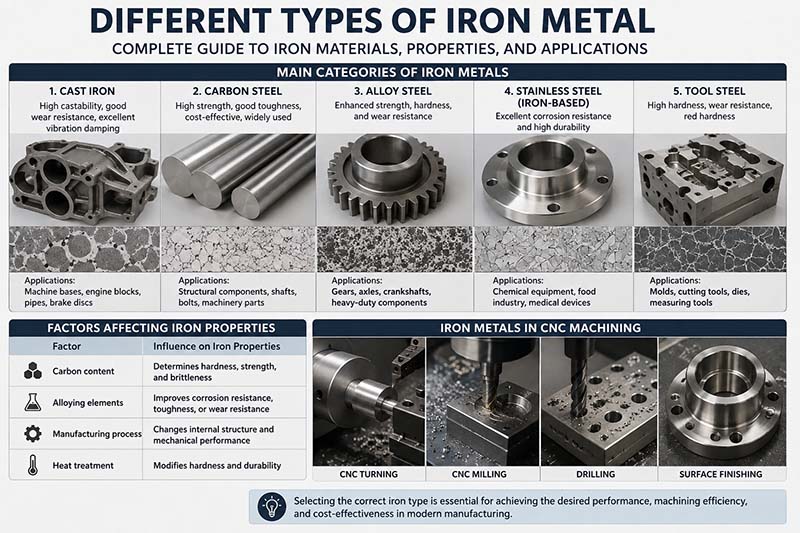
Different Types of Iron Metal: Complete Guide to Iron Materials, Properties, and Applications
Different Types of Iron Metal and Their Importance in Modern Manufacturing
Iron is one of the most widely used metallic elements in human history. From construction structures and automotive components to precision-machined industrial parts, iron-based materials continue to play a critical role because of their excellent combination of strength, availability, and cost efficiency.
However, the term “iron metal” does not represent a single material. Pure iron is rarely used in engineering applications because it lacks sufficient hardness and strength. Instead, manufacturers modify iron by controlling carbon content and adding alloying elements to create different categories of iron materials.
The performance differences between various iron metals mainly come from:
| Factor | Influence on Iron Properties |
|---|---|
| Carbon content | Determines hardness, strength, and brittleness |
| Alloying elements | Improves corrosion resistance, toughness, or wear resistance |
| Manufacturing process | Changes internal structure and mechanical performance |
| Heat treatment | Modifies hardness and durability |
For CNC machining companies and industrial buyers, selecting the correct iron type is essential because different iron materials behave differently during cutting, drilling, milling, and surface finishing processes.
Pure Iron, Cast Iron, and Wrought Iron: The Three Fundamental Types of Iron Metal
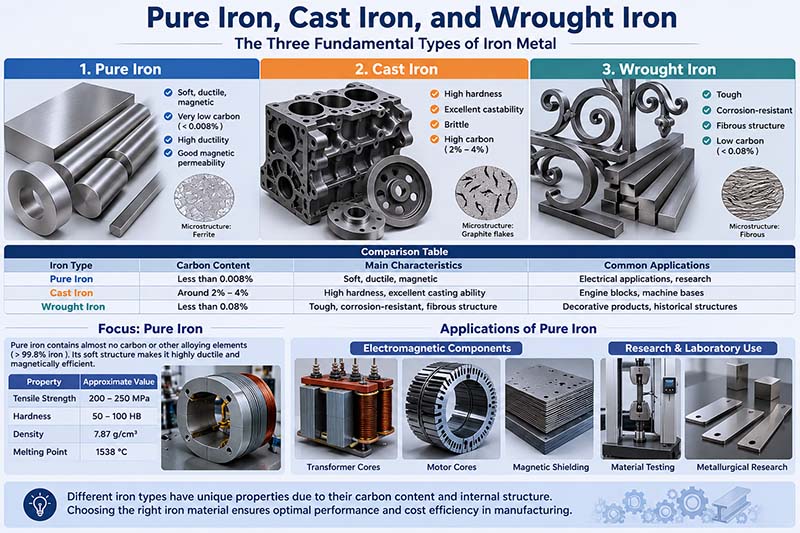
Iron materials are generally divided into three major categories:
| Iron Type | Carbon Content | Main Characteristics | Common Applications |
|---|---|---|---|
| Pure Iron | Less than 0.008% carbon | Soft, ductile, magnetic | Electrical applications, research |
| Cast Iron | Around 2%-4% carbon | High hardness, excellent casting ability | Engine blocks, machine bases |
| Wrought Iron | Less than 0.08% carbon | Tough, corrosion-resistant, fibrous structure | Decorative products, historical structures |
Although all three materials are iron-based, their different carbon levels create completely different mechanical behaviors.
Pure Iron: The Softest Form of Iron Metal
Chemical Composition and Basic Properties of Pure Iron
Pure iron contains almost no carbon or other alloying elements. Commercially pure iron usually contains more than 99.8% iron.
Because of its extremely low carbon content, pure iron has a relatively soft structure.
Typical properties include:
| Property | Approximate Value |
|---|---|
| Tensile strength | 200-250 MPa |
| Hardness | Around 50-100 HB |
| Density | 7.87 g/cm³ |
| Melting point | 1538°C |
Pure iron has excellent ductility, meaning it can deform significantly before breaking. However, its low hardness makes it unsuitable for components requiring high wear resistance.
Applications of Pure Iron
Although pure iron is not commonly used for structural components, it has several specialized applications.
Examples include:
Electromagnetic Components
Pure iron has high magnetic permeability, making it useful for:
- Transformer cores
- Electromagnetic devices
- Magnetic shielding components
The low carbon content reduces magnetic losses, allowing the material to respond efficiently to changing magnetic fields.
Laboratory and Research Equipment
Because pure iron has predictable chemical behavior, it is sometimes used in:
- Metallurgical research
- Material testing
- Scientific experiments
CNC Machining Considerations for Pure Iron
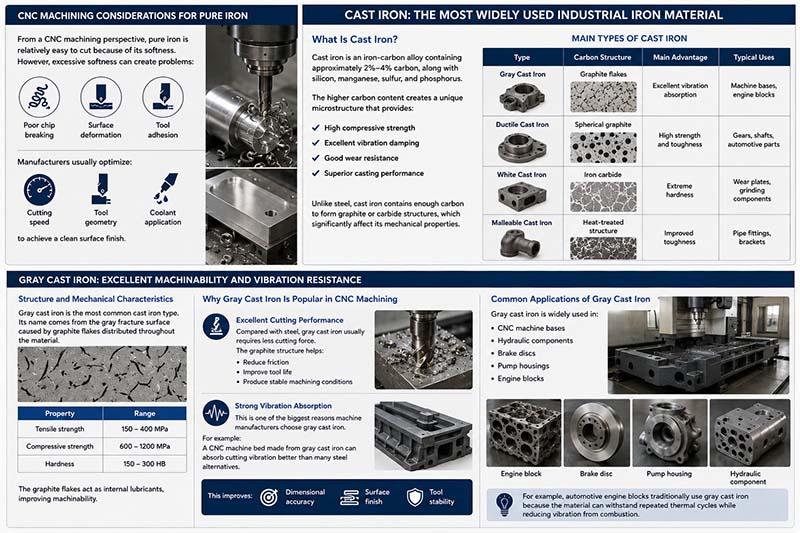
From a CNC machining perspective, pure iron is relatively easy to cut because of its softness. However, excessive softness can create problems:
- Poor chip breaking
- Surface deformation
- Tool adhesion
Manufacturers usually optimize:
- Cutting speed
- Tool geometry
- Coolant application
to achieve a clean surface finish.
Cast Iron: The Most Widely Used Industrial Iron Material
What Is Cast Iron?
Cast iron is an iron-carbon alloy containing approximately 2%-4% carbon, along with silicon, manganese, sulfur, and phosphorus.
The higher carbon content creates a unique microstructure that provides:
- High compressive strength
- Excellent vibration damping
- Good wear resistance
- Superior casting performance
Unlike steel, cast iron contains enough carbon to form graphite or carbide structures, which significantly affect its mechanical properties.
Main Types of Cast Iron
Cast iron is not a single material. It includes several grades with different structures.
| Type | Carbon Structure | Main Advantage | Typical Uses |
|---|---|---|---|
| Gray Cast Iron | Graphite flakes | Excellent vibration absorption | Machine bases, engine blocks |
| Ductile Cast Iron | Spherical graphite | High strength and toughness | Gears, shafts, automotive parts |
| White Cast Iron | Iron carbide | Extreme hardness | Wear plates, grinding components |
| Malleable Cast Iron | Heat-treated structure | Improved toughness | Pipe fittings, brackets |
Gray Cast Iron: Excellent Machinability and Vibration Resistance
Structure and Mechanical Characteristics
Gray cast iron is the most common cast iron type.
Its name comes from the gray fracture surface caused by graphite flakes distributed throughout the material.
Typical properties:
| Property | Range |
|---|---|
| Tensile strength | 150-400 MPa |
| Compressive strength | 600-1200 MPa |
| Hardness | 150-300 HB |
The graphite flakes act as internal lubricants, improving machinability.
Why Gray Cast Iron Is Popular in CNC Machining
For precision machining, gray cast iron provides several advantages:
Excellent Cutting Performance
Compared with steel, gray cast iron usually requires less cutting force.
The graphite structure helps:
- Reduce friction
- Improve tool life
- Produce stable machining conditions
Strong Vibration Absorption
This is one of the biggest reasons machine manufacturers choose gray cast iron.
For example:
A CNC machine bed made from gray cast iron can absorb cutting vibration better than many steel alternatives.
This improves:
- Dimensional accuracy
- Surface finish
- Tool stability
Common Applications of Gray Cast Iron
Gray cast iron is widely used in:
- CNC machine bases
- Hydraulic components
- Brake discs
- Pump housings
- Engine blocks
For example, automotive engine blocks traditionally use gray cast iron because the material can withstand repeated thermal cycles while reducing vibration from combustion.
Ductile Cast Iron: High Strength Iron Material for Heavy-Duty Applications
Structure and Manufacturing Characteristics of Ductile Cast Iron
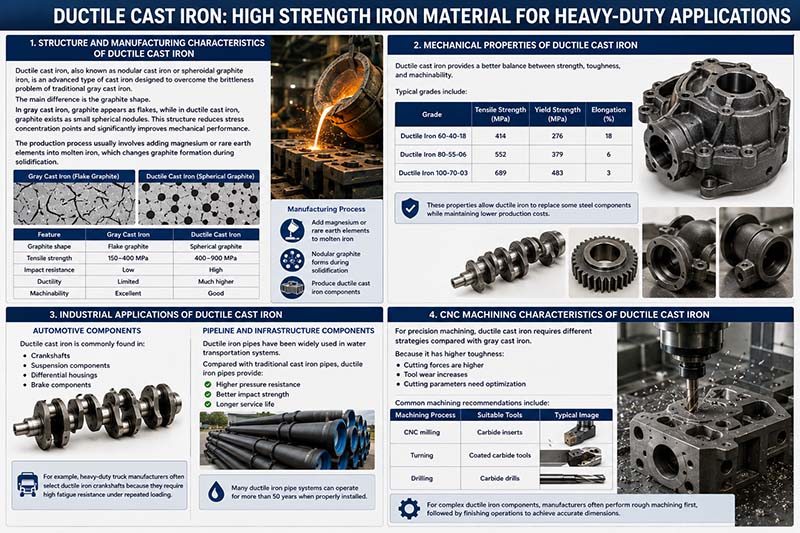
Ductile cast iron, also known as nodular cast iron or spheroidal graphite iron, is an advanced type of cast iron designed to overcome the brittleness problem of traditional gray cast iron.
The main difference is the graphite shape.
In gray cast iron, graphite appears as flakes, while in ductile cast iron, graphite exists as small spherical nodules. This structure reduces stress concentration points and significantly improves mechanical performance.
The production process usually involves adding magnesium or rare earth elements into molten iron, which changes graphite formation during solidification.
| Feature | Gray Cast Iron | Ductile Cast Iron |
|---|---|---|
| Graphite shape | Flake graphite | Spherical graphite |
| Tensile strength | 150-400 MPa | 400-900 MPa |
| Impact resistance | Low | High |
| Ductility | Limited | Much higher |
| Machinability | Excellent | Good |
Mechanical Properties of Ductile Cast Iron
Ductile cast iron provides a better balance between strength, toughness, and machinability.
Typical grades include:
| Grade | Tensile Strength | Yield Strength | Elongation |
|---|---|---|---|
| Ductile Iron 60-40-18 | 414 MPa | 276 MPa | 18% |
| Ductile Iron 80-55-06 | 552 MPa | 379 MPa | 6% |
| Ductile Iron 100-70-03 | 689 MPa | 483 MPa | 3% |
These properties allow ductile iron to replace some steel components while maintaining lower production costs.
Industrial Applications of Ductile Cast Iron
Because of its excellent mechanical properties, ductile iron is widely used in industries requiring durability and impact resistance.
Typical applications include:
Automotive Components
Ductile cast iron is commonly found in:
- Crankshafts
- Suspension components
- Differential housings
- Brake components
For example, heavy-duty truck manufacturers often select ductile iron crankshafts because they require high fatigue resistance under repeated loading.
Pipeline and Infrastructure Components
Ductile iron pipes have been widely used in water transportation systems.
Compared with traditional cast iron pipes, ductile iron pipes provide:
- Higher pressure resistance
- Better impact strength
- Longer service life
Many ductile iron pipe systems can operate for more than 50 years when properly installed.
CNC Machining Characteristics of Ductile Cast Iron
For precision machining, ductile cast iron requires different strategies compared with gray cast iron.
Because it has higher toughness:
- Cutting forces are higher
- Tool wear increases
- Cutting parameters need optimization
Common machining recommendations include:
| Machining Process | Suitable Tools |
|---|---|
| CNC milling | Carbide inserts |
| Turning | Coated carbide tools |
| Drilling | Carbide drills |
For complex ductile iron components, manufacturers often perform rough machining first, followed by finishing operations to achieve accurate dimensions.
White Cast Iron: Extremely Hard Iron Material for Wear Applications
Formation and Characteristics of White Cast Iron
White cast iron contains carbon mainly in the form of iron carbide (cementite), rather than graphite.
This structure creates exceptional hardness but significantly reduces toughness.
Typical properties:
| Property | Value Range |
|---|---|
| Hardness | 400-700 HB |
| Tensile strength | 200-500 MPa |
| Wear resistance | Extremely high |
| Impact resistance | Low |
The fracture surface appears white, which gives this material its name.
Why White Cast Iron Has Superior Wear Resistance
The key factor is the presence of cementite.
Cementite is a very hard iron-carbon compound that resists abrasion.
Therefore, white cast iron performs well in environments involving:
- Continuous friction
- Material impact
- Abrasive particles
Common Applications of White Cast Iron
White cast iron is widely used for wear-resistant components.
Examples include:
Mining Equipment
Mining machinery operates under extremely harsh conditions.
Components such as:
- Crusher liners
- Grinding balls
- Wear plates
often use white cast iron because ordinary steel would wear much faster.
Industrial Rollers
In steel production and metal processing equipment, white cast iron rollers provide:
- High surface hardness
- Long operating life
- Resistance to deformation
Limitations of White Cast Iron
Despite excellent hardness, white cast iron has disadvantages.
It is:
- Difficult to machine
- Brittle
- Sensitive to impact loads
Because of these limitations, CNC machining is usually avoided unless special tooling and processes are used.
Manufacturers often produce white cast iron parts close to final dimensions through casting rather than machining large amounts of material.
Malleable Cast Iron: Improved Toughness Through Heat Treatment
Manufacturing Process of Malleable Cast Iron
Malleable cast iron starts as white cast iron and undergoes a long heat treatment process called annealing.
During this process:
- Cementite decomposes
- Carbon changes into temper graphite
- Internal stress decreases
The result is a stronger and tougher material.
Mechanical Properties of Malleable Cast Iron
Compared with ordinary cast iron, malleable cast iron provides improved ductility.
Typical properties:
| Property | Approximate Range |
|---|---|
| Tensile strength | 350-700 MPa |
| Elongation | 2-18% |
| Hardness | 120-300 HB |
This makes it suitable for parts exposed to mechanical shock.
Applications of Malleable Cast Iron
Common uses include:
Pipe Fittings
Malleable iron fittings are popular because they combine:
- Good strength
- Threading ability
- Corrosion resistance
Applications include:
- Plumbing systems
- Gas pipelines
- Industrial connections
Automotive and Machinery Parts
Examples include:
- Brackets
- Clamps
- Gear housings
- Small structural components
Wrought Iron: Traditional Iron With Excellent Toughness
What Is Wrought Iron?
Wrought iron is one of the oldest forms of commercially used iron.
It contains extremely low carbon content, usually below 0.08%, and includes small amounts of slag fibers.
These slag inclusions create a unique fibrous structure.
Properties of Wrought Iron
Wrought iron is known for:
- Excellent ductility
- High toughness
- Good corrosion resistance
- Easy welding capability
Comparison:
| Material | Carbon Content | Toughness |
|---|---|---|
| Wrought Iron | <0.08% | Very high |
| Mild Steel | 0.05-0.25% | High |
| Cast Iron | 2-4% | Low |
Historical and Modern Applications
Traditional wrought iron was widely used for:
- Gates
- Railings
- Bridges
- Decorative structures
Today, true wrought iron is less common because modern steel provides similar performance at lower cost.
However, restoration projects and premium decorative products still use genuine wrought iron.
Iron Alloys: Why Carbon Content Changes Material Performance
Relationship Between Iron and Carbon
Pure iron is relatively soft. Adding carbon dramatically changes its properties.
The iron-carbon relationship determines whether the final material becomes:
- Steel
- Cast iron
- Other iron alloys
| Material | Carbon Content |
|---|---|
| Pure Iron | <0.008% |
| Low Carbon Steel | 0.05-0.25% |
| Medium Carbon Steel | 0.25-0.60% |
| High Carbon Steel | 0.60-2.1% |
| Cast Iron | 2-4% |
Steel vs Cast Iron: Key Differences
Many people confuse steel and cast iron because both are iron-based alloys.
However, their properties are different.
| Comparison | Steel | Cast Iron |
|---|---|---|
| Carbon content | Lower | Higher |
| Strength | Higher tensile strength | Higher compressive strength |
| Ductility | Better | Lower |
| Casting ability | Moderate | Excellent |
| Machining | Depends on grade | Usually good |
Choosing Between Steel and Cast Iron
Engineers select materials based on application requirements.
For example:
Choose Cast Iron When:
- Vibration damping is important
- Casting complex shapes is required
- Wear resistance is needed
Examples:
- Machine beds
- Engine blocks
- Pump housings
Choose Steel When:
- High tensile strength is required
- Impact loads are significant
- Welding is needed
Examples:
- Shafts
- Frames
- Structural components
CNC Machining Considerations for Different Types of Iron Metal
Why Iron Material Selection Matters in CNC Manufacturing
In precision manufacturing, choosing the correct iron material is not only about mechanical strength. The selected iron type directly affects:
- Cutting performance
- Tool life
- Machining cost
- Surface quality
- Dimensional accuracy
- Production efficiency
For CNC machining suppliers, different iron materials require different machining strategies. A material that performs well in casting may not necessarily be suitable for precision milling or turning.
For example:
- Gray cast iron is easy to machine because graphite flakes act as natural lubricants.
- Ductile cast iron requires stronger cutting tools because of its higher toughness.
- White cast iron is extremely difficult to machine because of its carbide structure.
Understanding these differences helps manufacturers reduce production risks and improve part quality.
Machinability Comparison of Different Iron Metals
Cutting Performance Comparison
The machinability of iron metals varies significantly depending on their microstructure.
| Iron Material | Machinability Rating | Machining Difficulty | Recommended Process |
|---|---|---|---|
| Gray Cast Iron | Excellent | Low | CNC milling, turning, drilling |
| Ductile Cast Iron | Good | Medium | CNC turning, precision milling |
| Malleable Cast Iron | Good | Medium | CNC machining, drilling |
| Pure Iron | Moderate | Low-Medium | Turning, grinding |
| White Cast Iron | Poor | High | Grinding, special machining |
Gray Cast Iron CNC Machining
Gray cast iron remains one of the most CNC-friendly iron materials.
The graphite flakes inside the structure provide natural lubrication during cutting.
Benefits include:
- Lower cutting force
- Reduced tool friction
- Better chip breaking
- Stable machining process
Typical CNC parameters:
| Operation | Typical Tool |
|---|---|
| Milling | Carbide inserts |
| Turning | Ceramic or carbide tools |
| Drilling | Coated carbide drills |
Common CNC machined gray cast iron parts include:
- Machine bases
- Hydraulic valve bodies
- Brake discs
- Pump housings
Ductile Cast Iron CNC Machining
Ductile iron provides better mechanical strength but requires more careful machining control.
Because graphite exists as spherical particles, it does not provide the same lubrication effect as gray iron.
Machining challenges include:
- Higher cutting resistance
- Increased tool wear
- Greater heat generation
Manufacturers usually use:
- Lower cutting speeds
- Stronger carbide tools
- Effective coolant systems
For example, when machining a ductile iron gearbox housing, manufacturers typically perform rough machining first, followed by precision finishing to maintain dimensional stability.
White Cast Iron Machining Challenges
White cast iron is among the most difficult iron materials to machine.
Its cementite structure creates extremely high hardness.
Problems include:
- Rapid tool wear
- Cutting edge damage
- Excessive machining cost
In many cases, manufacturers avoid CNC machining and instead use:
- Grinding
- Abrasive machining
- Near-net-shape casting
White cast iron is usually selected when wear resistance is more important than machinability.
Surface Finishing Options for Iron Metal Components
After CNC machining, iron parts often require surface treatment to improve corrosion resistance, appearance, or service life.
Different iron materials respond differently to finishing processes.
| Surface Treatment | Purpose | Suitable Iron Materials |
|---|---|---|
| Black oxide coating | Appearance and mild corrosion protection | Steel, cast iron |
| Electroplating | Corrosion resistance | Steel, iron components |
| Powder coating | Protective outer layer | Industrial iron parts |
| Painting | Cost-effective protection | Large structures |
| Grinding | Improve surface accuracy | Hard iron materials |
Black Oxide Treatment for Iron Components
Black oxide is commonly applied to iron-based components.
Advantages:
- Low dimensional change
- Improved appearance
- Reduced light reflection
Typical applications:
- Machine components
- Fasteners
- Precision mechanical parts
Because black oxide adds almost no thickness, it is suitable for precision parts where dimensional tolerance is critical.
Grinding and Finishing of Hard Iron Materials
For high-hardness iron materials such as white cast iron, grinding is often preferred over conventional cutting.
Grinding provides:
- Better surface finish
- Improved dimensional accuracy
- Reduced cutting stress
Typical applications include:
- Wear plates
- Industrial rollers
- Tooling components
How to Select the Right Iron Metal for Industrial Applications
Material Selection Based on Mechanical Requirements
Different applications require different combinations of properties.
The following table provides a practical selection guide:
| Application Requirement | Recommended Iron Material |
|---|---|
| High vibration absorption | Gray cast iron |
| High impact resistance | Ductile cast iron |
| Maximum wear resistance | White cast iron |
| Decorative applications | Wrought iron |
| Easy machining | Gray cast iron |
| High strength replacement for steel | Ductile cast iron |
Example 1: Selecting Iron for CNC Machine Bases
A CNC machine base requires:
- High rigidity
- Vibration damping
- Dimensional stability
Gray cast iron is usually preferred because:
- Graphite structure absorbs vibration.
- Casting allows complex shapes.
- The material remains stable under long-term operation.
Using steel instead may increase vibration during high-speed machining.
Example 2: Selecting Iron for Automotive Components
Automotive parts often experience:
- Repeated loading
- Impact forces
- Temperature changes
Ductile cast iron is commonly selected for:
- Crankshafts
- Suspension components
- Hubs
because it provides a better balance between strength and toughness.
Example 3: Selecting Iron for Wear Components
Mining and heavy machinery require materials that resist abrasion.
White cast iron is suitable for:
- Crusher plates
- Grinding components
- Wear liners
Although machining is difficult, its extended service life reduces replacement frequency.
Future Development Trends of Iron-Based Materials
Advanced Cast Iron Development
Modern iron materials continue to improve through:
- Better alloy design
- Heat treatment technology
- Microstructure control
New generations of ductile iron provide:
- Higher strength
- Improved fatigue resistance
- Better machinability
Lightweight and High-Performance Iron Applications
Although aluminum and composites are increasingly used, iron-based materials remain important because of:
- Low raw material cost
- Excellent recyclability
- Established manufacturing processes
Industries such as:
- Automotive
- Renewable energy
- Construction equipment
- Industrial machinery
continue to depend on advanced iron alloys.
Choosing Xavier for Precision Iron Metal CNC Machining
Selecting the correct iron material is only the first step. Producing high-quality iron components requires experienced machining knowledge, advanced CNC equipment, and strict quality control.
At Xavier, we provide professional CNC machining services for various iron-based materials, including gray cast iron, ductile cast iron, carbon steel, and other metal alloys.
With expertise in:
- CNC milling
- CNC turning
- Precision drilling
- Surface finishing
- Custom metal part manufacturing
Xavier helps customers transform complex designs into reliable production components.
Whether you need prototype development, small-batch production, or high-volume manufacturing, our engineering team can recommend the most suitable iron material and machining solution based on your application requirements.
From industrial machinery parts and automotive components to precision mechanical assemblies, Xavier focuses on delivering accurate dimensions, consistent quality, and cost-effective manufacturing solutions.
We are a professional CNC machining manufacturer integrating industry and trade, specializing in custom CNC machining services and the production of various precision metal parts. We provide high-quality CNC aluminum machining, CNC stainless steel machining, and CNC titanium machining solutions for robotic components, aerospace parts, marine components, automotive parts, medical components, and other precision manufacturing applications. As a reliable CNC aluminum machining manufacturer, we offer large-volume CNC stainless steel machining services, and you can contact us to get CNC titanium machining prices. Feel free to contact us for more information.
Some of the images and text in this article are collected and compiled from the internet. If there is anything inappropriate, please contact us for processing.