
Key points of this article:
- What Alloy Steel and Chrome Vanadium Actually Mean
- Chemical Composition and Alloying Elements
- Is Chrome Vanadium a Type of Alloy Steel?
- Strength, Hardness, and Toughness Comparison
- Wear Resistance and Fatigue Performance
- Corrosion Resistance in Real Applications
- Heat Treatment and Hardenability
- CNC Machinability and Tool Wear
- Weldability and Fabrication Considerations
- Common Grades and Industry Standards
- Typical Applications: Tools, Springs, and Machine Parts
- Cost Comparison and Material Availability
- Surface Finishing and Coating Options
- How Engineers Select Between the Two
- Which Material Is Better for CNC Machined Parts?
Alloy Steel vs Chrome Vanadium: Complete Engineering Guide for CNC Machining
When engineers compare alloy steel vs chrome vanadium, the first thing to understand is that this is not a comparison between two completely separate material families.
Chrome vanadium (Cr-V) steel is a specific subtype of alloy steel.
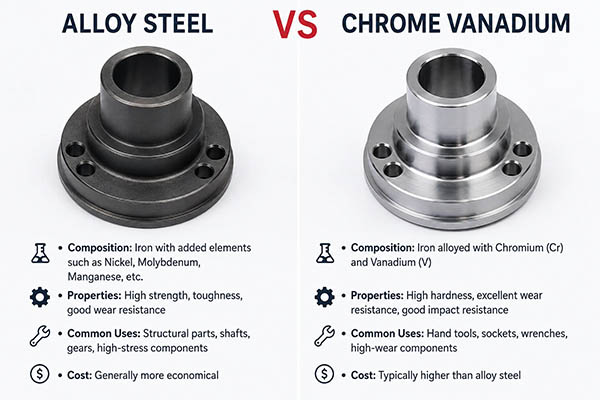
Alloy steel is a broad category of steels containing intentional additions such as chromium, molybdenum, nickel, vanadium, and manganese to improve mechanical performance. Chrome vanadium steel is one specialized alloy steel that primarily uses chromium and vanadium to increase hardness, wear resistance, and fatigue strength. It is especially common in hand tools, springs, and impact-resistant components.
For CNC machining, alloy steel grades like 4140 and 4340 are preferred for shafts, gears, and structural components, while chrome vanadium is often chosen for sockets, wrenches, screwdrivers, and spring steel applications.
What Alloy Steel and Chrome Vanadium Actually Mean
Alloy Steel
Alloy steel includes iron and carbon plus added elements such as:
- Chromium (Cr)
- Nickel (Ni)
- Molybdenum (Mo)
- Vanadium (V)
- Manganese (Mn)
These elements improve:
- Strength
- Hardenability
- Toughness
- Wear resistance
- Heat resistance
Chrome Vanadium Steel
Chrome vanadium steel is an alloy steel containing chromium and vanadium as key strengthening elements.
Typical composition:
- Carbon: 0.45–0.60%
- Chromium: 0.80–1.10%
- Vanadium: 0.15–0.30%
- Manganese: 0.70–0.90%
- Silicon: 0.15–0.35%
This chemistry produces fine grain structure and excellent resistance to deformation under repeated loading.
Chemical Composition and Alloying Elements
| Element | General Alloy Steel | Chrome Vanadium Steel |
|---|---|---|
| Carbon | 0.10–1.00% | 0.45–0.60% |
| Chromium | Optional | 0.80–1.10% |
| Vanadium | Optional | 0.15–0.30% |
| Nickel | Often used | Usually none |
| Molybdenum | Often used | Usually none |
| Manganese | Common | 0.70–0.90% |
Key Difference
Alloy steel can be engineered for countless property combinations. Chrome vanadium follows a narrower chemistry focused on high hardness and fatigue resistance.
Is Chrome Vanadium a Type of Alloy Steel?
Yes.
Chrome Vanadium⊂Alloy Steel
This means:
- Every chrome vanadium steel is an alloy steel.
- Not every alloy steel is chrome vanadium steel.
Analogy
- Alloy steel = the entire vehicle category
- Chrome vanadium = one specialized high-performance model
This distinction is often misunderstood in purchasing and engineering discussions.
Strength, Hardness, and Toughness Comparison
| Property | Chrome Vanadium | 4140 Alloy Steel | 4340 Alloy Steel |
|---|---|---|---|
| Tensile Strength | 900–1,500+ MPa | 950–1,100 MPa | 1,100–1,400 MPa |
| Hardness | Up to ~55 HRC | Up to ~50 HRC | Up to ~55 HRC |
| Toughness | Excellent | Very Good | Outstanding |
| Fatigue Resistance | Excellent | Excellent | Exceptional |
Engineering Interpretation
- Chrome vanadium excels in hand tools and springs.
- 4140 offers excellent general-purpose mechanical performance.
- 4340 provides the highest toughness for aerospace and motorsports.
Wear Resistance and Fatigue Performance
Vanadium forms extremely hard carbides that enhance wear resistance and refine grain size.
Benefits of Vanadium
- Improves fatigue life
- Increases impact resistance
- Reduces crack propagation
- Enhances edge retention
This is why chrome vanadium is widely used for:
- Ratchets
- Sockets
- Pliers
- Screwdrivers
- Coil springs
Corrosion Resistance in Real Applications
Despite the word “chrome,” chrome vanadium steel is not stainless steel.
| Environment | Chrome Vanadium | 4140 | 4340 |
|---|---|---|---|
| Dry indoor use | Good | Good | Good |
| Humid environment | Fair | Fair | Fair |
| Outdoor exposure | Poor without coating | Poor | Poor |
| Saltwater | Poor | Poor | Poor |
Most commercial tools use chrome plating, phosphate, or black oxide to prevent rust.
Heat Treatment and Hardenability
Both chrome vanadium and many alloy steels respond extremely well to heat treatment.
Typical Treatments
- Quenching and tempering
- Induction hardening
- Nitriding
- Stress relieving
Chrome vanadium can achieve high hardness while maintaining good toughness, making it ideal for tools subjected to repeated impact and torsion.
CNC Machinability and Tool Wear
| Material | Relative Machinability (1212 = 100%) |
|---|---|
| 4140 Annealed | 65–70% |
| 4340 Annealed | 55–60% |
| Chrome Vanadium Annealed | 45–65% |
Practical CNC Notes
Chrome vanadium may machine similarly to medium-alloy steel, but hardened conditions require:
- Carbide tooling
- Lower cutting speeds
- Rigid fixturing
- Coolant for heat control
Tool life decreases significantly after hardening.
Weldability and Fabrication Considerations
| Material | Weldability |
|---|---|
| Chrome Vanadium | Moderate to difficult |
| 4140 | Moderate |
| 4340 | Difficult |
Preheat and post-weld heat treatment are often necessary to avoid cracking.
For highly stressed parts, machining from solid stock is usually preferred over welding.
Common Grades and Industry Standards
| Material | Typical SAE/AISI Grades |
|---|---|
| Chrome Vanadium | 6150, 50CrV4, 51CrV4 |
| General Alloy Steel | 4140, 4340, 8620 |
Grade Highlights
- 6150 / 51CrV4: Springs, tools, blades
- 4140: Shafts and spindles
- 4340: Aerospace structures
- 8620: Carburized gears
Typical Applications: Tools, Springs, and Machine Parts
Chrome Vanadium Applications
- Combination wrenches
- Socket sets
- Screwdrivers
- Torsion bars
- Suspension springs
General Alloy Steel Applications
- Gear shafts
- Hydraulic cylinders
- Crankshafts
- Aircraft fittings
- Industrial tooling
Cost Comparison and Material Availability
| Material | Relative Cost |
|---|---|
| 4140 | 1.0× |
| Chrome Vanadium (6150) | 1.2–1.8× |
| 4340 | 1.5–2.5× |
Chrome vanadium costs more than basic alloy steel because of vanadium additions and tool-grade heat treatment requirements.
Surface Finishing and Coating Options
Common Finishes
- Black oxide
- Chrome plating
- Phosphate coating
- Zinc plating
- PVD coating
Many hand tools use decorative chrome plating over chrome vanadium steel to combine corrosion resistance with a polished appearance.
How Engineers Select Between the Two
Choose chrome vanadium when you need:
- Exceptional fatigue resistance
- Tool-grade toughness
- Spring-like elasticity
- Repeated torque loading
Choose general alloy steel when you need:
- Broad grade selection
- Lower cost
- Easier sourcing
- Flexible heat treatment options
Which Material Is Better for CNC Machined Parts?
The answer depends entirely on the application.
Best Uses for Chrome Vanadium
- High-torque tools
- Springs
- Shock-loaded components
Best Uses for Alloy Steel
- Shafts
- Gears
- Structural parts
- Hydraulic components
For most CNC mechanical parts, 4140 is the standard engineering choice. For premium tools and spring applications, chrome vanadium is often superior.
Real-World Example: Socket Wrench vs Gear Shaft
1/2-Inch Drive Socket
Requirements:
- Repeated torque cycles
- Impact loading
- Minimal deformation
Best material: Chrome Vanadium (6150)
CNC Gear Shaft
Requirements:
- High strength
- Tight tolerances
- Cost efficiency
Best material: 4140 Alloy Steel
Quick Decision Matrix
| Priority | Best Material |
|---|---|
| Hand tools | Chrome Vanadium |
| Springs | Chrome Vanadium |
| General CNC shafts | Alloy Steel |
| Lowest cost | Alloy Steel |
| Maximum toughness | 4340 Alloy Steel |
| Best fatigue resistance | Chrome Vanadium |
Frequently Asked Questions
Is chrome vanadium stronger than alloy steel?
Chrome vanadium is itself an alloy steel. Compared with common grades like 4140, it often offers superior fatigue resistance and tool durability.
Is chrome vanadium good for CNC machining?
Yes, especially for tools and springs, though machining becomes more difficult after hardening.
Why do hand tools use chrome vanadium?
Its combination of hardness, toughness, and fatigue resistance makes it ideal for repeated torque loading.
Is chrome vanadium rust-proof?
No. It usually requires chrome plating or another protective coating.
Which is cheaper?
General alloy steels such as 4140 are usually less expensive.
Why Xavier Recommends the Right Steel for Every Precision Part
At Xavier, we manufacture high-precision CNC components in alloy steel, chrome vanadium steel, stainless steel, and specialty metals for customers in automotive, aerospace, industrial automation, and tool manufacturing.
Our engineering team helps customers evaluate:
- Torque and fatigue loads
- Heat treatment requirements
- Corrosion exposure
- Machining complexity
- Surface finishing
- Total lifecycle cost
Whether you need 6150 chrome vanadium sockets, 4140 hardened shafts, 8620 carburized gears, or 4340 aerospace components, Xavier delivers precision CNC machining with dependable quality and competitive lead times.
If you are unsure whether alloy steel or chrome vanadium is the best material for your project, Xavier can recommend the optimal solution based on performance, manufacturability, and cost.
As a professional CNC machining manufacturer and trading company, we specialize in custom CNC machining and the production of precision metal and engineering plastic parts. Our capabilities include CNC machining Inconel alloy, CNC machining polycarbonate, and CNC machining tool steel, serving industries such as robotics, aerospace, marine, automotive, medical, and other precision applications. As a reliable CNC machining Inconel alloy manufacturer, we provide large-scale CNC machining polycarbonate services. Contact us today to request the latest CNC machining tool steel price.
Some of the images and text in this article are collected and compiled from the internet. If there is anything inappropriate, please contact us for processing.