
Melting Temperature of Magnesium: Complete Engineering Guide for CNC Machining and Casting
Magnesium is the lightest structural metal used in modern manufacturing. Its exceptionally low density—approximately 1.74 g/cm³—makes it 35% lighter than aluminum and nearly 78% lighter than steel. One of the most important properties engineers must understand when selecting magnesium for CNC machining, die casting, or aerospace applications is its melting temperature.
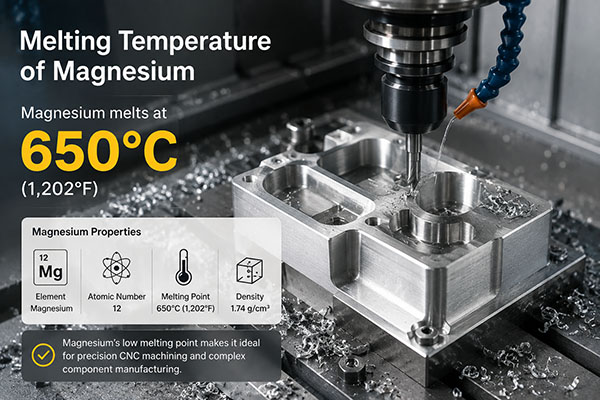
Pure magnesium melts at 650°C (1202°F) under standard atmospheric pressure. This relatively low melting point offers significant advantages in casting and recycling, but it also introduces unique processing and fire-safety challenges.
This in-depth guide explains the melting temperature of magnesium, how alloy composition changes melting behavior, and what this means for CNC machining, welding, and high-performance engineering applications.
15 Essential Topics About Magnesium Melting Temperature
- Exact Melting Point of Pure Magnesium
- Why Magnesium Has a Relatively Low Melting Point
- Solidus vs Liquidus in Magnesium Alloys
- Melting Points of Common Magnesium Alloys
- Magnesium vs Aluminum vs Titanium
- Ignition Temperature and Fire Risk
- Casting Temperatures for Magnesium
- CNC Machining Heat Considerations
- Welding and Heat-Affected Zones
- Influence of Alloying Elements
- Effect of Purity on Melting Temperature
- Boiling Point and Vaporization Behavior
- Recycling and Remelting Magnesium
- Applications Requiring High Temperature Stability
- Material Selection Guidelines
Exact Melting Point of Pure Magnesium
The accepted melting point of pure magnesium is:
| Unit | Value |
|---|---|
| Celsius | 650°C |
| Fahrenheit | 1202°F |
| Kelvin | 923 K |
At this temperature, magnesium transitions from a solid hexagonal close-packed (HCP) crystal structure to a liquid. The latent heat of fusion is approximately 8.5 kJ/mol, which is the energy required to complete the phase change.
Engineering Significance
Because 650°C is relatively low for a structural metal, magnesium:
- Requires less energy to melt
- Casts efficiently
- Recycles economically
- Demands careful oxidation control
Why Magnesium Has a Relatively Low Melting Point
Magnesium belongs to Group 2 of the periodic table. Metallic bonding in magnesium is weaker than in transition metals such as iron, nickel, and titanium.
Atomic Explanation
- Atomic number: 12
- Crystal structure: HCP
- Metallic bonding strength: Moderate
- Electron configuration: [Ne] 3s²
These characteristics reduce the energy needed to disrupt the crystal lattice.
Comparison with Common Metals
| Metal | Melting Point (°C) |
|---|---|
| Zinc | 420 |
| Magnesium | 650 |
| Aluminum | 660 |
| Copper | 1085 |
| Titanium | 1668 |
| Iron | 1538 |
Magnesium melts just 10°C below aluminum, which is why both are often processed in similar temperature ranges.
Solidus vs Liquidus in Magnesium Alloys
Pure magnesium melts at one temperature, but alloys melt over a range.
Definitions
- Solidus: Temperature where melting begins
- Liquidus: Temperature where the alloy is fully liquid
Between these temperatures, the alloy exists as a partially solid, partially liquid “mushy zone.”
This concept is critical in die casting and semi-solid processing.
Melting Points of Common Magnesium Alloys
| Alloy | Solidus (°C) | Liquidus (°C) | Primary Applications |
|---|---|---|---|
| AZ31B | 605 | 630 | Extrusions, sheet, CNC parts |
| AZ91D | 470–595 | ~595 | Die-cast housings |
| AM60B | 545 | 615 | Automotive structural parts |
| ZK60A | 550 | 600 | Aerospace forgings |
| WE43 | 540 | 640 | Medical and aerospace |
Practical Meaning
If you assume all magnesium alloys melt at 650°C, you can easily overheat castings and degrade microstructure.
Magnesium vs Aluminum vs Titanium
| Property | Magnesium | Aluminum 6061 | Titanium Ti-6Al-4V |
|---|---|---|---|
| Density (g/cm³) | 1.74 | 2.70 | 4.43 |
| Melting Point (°C) | 650 | 660 | 1668 |
| Relative Weight | 1.0 | 1.55 | 2.55 |
| Machinability | Excellent | Excellent | Moderate |
Magnesium offers aluminum-like melting behavior while delivering even lower weight.
Ignition Temperature and Fire Risk
A key distinction in magnesium processing is that melting temperature and ignition temperature are not the same.
Typical Ignition Temperature
Depending on form and atmosphere:
- Fine chips or powder can ignite around 473°C and above.
- Bulk solid components are much less likely to ignite.
Why This Matters
During melting, molten magnesium can oxidize rapidly in air, so foundries use:
- Protective gas atmospheres
- Fluxes
- Covered crucibles
- Strict temperature control
Casting Temperatures for Magnesium
Although magnesium melts at 650°C, foundries usually cast it at higher temperatures to improve fluidity.
| Process | Typical Melt Temperature |
|---|---|
| Gravity Casting | 680–730°C |
| High-Pressure Die Casting | 650–700°C |
| Investment Casting | 700–760°C |
Excessive superheat increases:
- Oxidation
- Dross formation
- Grain coarsening
- Fire risk
CNC Machining Heat Considerations
Magnesium machines exceptionally well because:
- Cutting forces are low
- Chips break easily
- Thermal conductivity is high
Safe Machining Practices
- Use sharp tools
- Avoid chip accumulation
- Keep chips dry and separated
- Use appropriate fire extinguishing media (Class D)
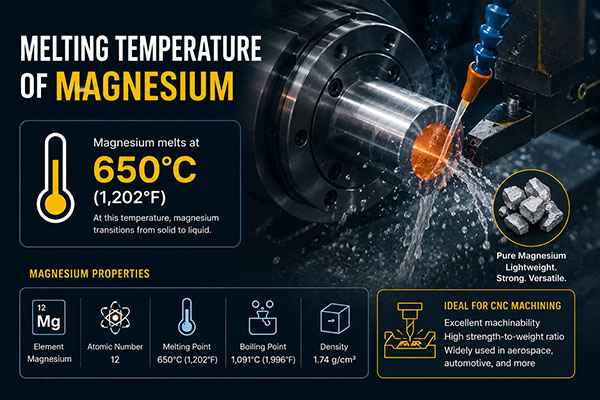
Even though machining temperatures are far below 650°C, fine chips can ignite if improperly handled.
Welding and Heat-Affected Zones
Magnesium can be welded using TIG, MIG, and laser processes.
Thermal Concerns
- Localized temperatures exceed melting point.
- Heat-affected zones can lose strength.
- Protective shielding gas is essential.
Typical shielding gases include argon or helium.
Influence of Alloying Elements
Alloying elements modify melting behavior and performance.
| Element | Effect on Magnesium |
|---|---|
| Aluminum | Improves castability, may lower solidus |
| Zinc | Increases strength |
| Manganese | Improves corrosion resistance |
| Zirconium | Refines grain structure |
| Yttrium / Rare Earths | Improves high-temperature stability |
The exact solidus and liquidus depend on alloy composition, not just the magnesium base.
Effect of Purity on Melting Temperature
High-purity magnesium (99.95%+) melts close to 650°C.
Impurities such as:
- Iron
- Copper
- Nickel
- Silicon
can alter melting behavior and significantly reduce corrosion resistance.
For aerospace and medical applications, impurity control is tightly specified.
Boiling Point and Vaporization Behavior
Magnesium has a boiling point of approximately 1091°C (1994°F).
Why This Matters
The difference between melting and boiling points is relatively small compared with many engineering metals, which means:
- Overheating can cause rapid vaporization.
- Oxidation accelerates.
- Metal loss increases.
This is why precise furnace control is essential.
Recycling and Remelting Magnesium
Magnesium is highly recyclable and can be remelted with low energy consumption.
Recycling Workflow
- Collect clean chips and scrap.
- Remove oils and contaminants.
- Melt under protective atmosphere.
- Refine and cast into ingots.
Compared with primary production, recycling significantly reduces cost and environmental impact.
Applications Requiring High Temperature Stability
Although magnesium melts at a relatively low temperature, many alloys retain useful strength up to 150–250°C.
Common applications include:
- Aircraft gearboxes
- Helicopter housings
- Automotive transmission cases
- Laptop and electronics frames
- Surgical implants
WE43 is especially valued in aerospace and biomedical applications.
Material Selection Guidelines
Choose Magnesium When You Need
- Maximum weight reduction
- Excellent machinability
- Good vibration damping
- Low casting energy
Choose Aluminum When You Need
- Lower cost
- Easier sourcing
- Better corrosion tolerance
Choose Titanium When You Need
- Extreme strength and temperature resistance
Example: Weight Savings in CNC Components
A bracket measuring 200 × 100 × 20 mm has a volume of 400 cm³.
| Material | Density (g/cm³) | Weight |
|---|---|---|
| Magnesium | 1.74 | 696 g |
| Aluminum | 2.70 | 1080 g |
| Titanium | 4.43 | 1772 g |
Result
- Magnesium is 36% lighter than aluminum.
- Magnesium is 61% lighter than titanium.
These savings are highly valuable in aerospace, robotics, and drones.
Common Misconceptions About Magnesium Melting
“Magnesium Burns Easily in Solid Form”
Bulk magnesium components are generally stable under normal use conditions. The primary fire risk comes from fine chips, powder, and molten metal.
“All Magnesium Alloys Melt at 650°C”
Alloys melt over a range and can begin melting well below 650°C.
“Magnesium Cannot Be CNC Machined Safely”
With proper chip management and Class D fire protection, magnesium is routinely machined in aerospace and medical industries.
Frequently Asked Questions
What is the melting temperature of pure magnesium?
650°C (1202°F).
Is magnesium lower than aluminum?
Yes, magnesium melts about 10°C lower than aluminum.
Can magnesium ignite before it melts?
Fine chips and powder can ignite at temperatures lower than the melting point under certain conditions.
What magnesium alloy is most common?
AZ31B for wrought products and AZ91D for die casting.
Is magnesium suitable for CNC machining?
Yes. It is one of the easiest structural metals to machine.
Why Xavier Recommends Magnesium for Lightweight CNC Components
At Xavier, we manufacture custom CNC machined parts for aerospace, robotics, electronics, and automotive customers worldwide. When weight reduction is critical, magnesium alloys such as AZ31B and ZK60 provide exceptional advantages:
- Up to 35% lighter than aluminum
- Excellent machinability
- Fast cycle times
- Reduced tool wear
- High dimensional precision
Our engineering team understands the thermal behavior, melting ranges, and safety requirements of magnesium alloys, ensuring every component is machined and handled correctly. cnc machining service
Whether you need ultra-light drone frames, aerospace housings, or precision structural components, Xavier delivers reliable magnesium machining solutions with tight tolerances and global quality standards.
Some of the images and text in this article are collected and compiled from the internet. If there is anything inappropriate, please contact us for processing.