Precision Machining for Aerospace Manufacturing: An Engineer’s Perspective on Aircraft Parts, UAV Components, Materials and Accuracy
Introduction: What I Have Learned After Purchasing Thousands of Aerospace CNC Parts
After years working as an aerospace manufacturing procurement engineer, I have handled thousands of precision-machined components ranging from aircraft structural brackets and hydraulic fittings to UAV frames, engine components, and high-speed rotating parts.
Many people outside the industry think precision machining simply means “making parts accurately.” That understanding is incomplete.
In aerospace manufacturing, precision machining is not only about achieving a dimension on a drawing. It is about controlling every factor that affects flight reliability:
- Material consistency
- Dimensional accuracy
- Surface integrity
- Thermal stability
- Fatigue resistance
- Manufacturing repeatability
- Inspection traceability
A component installed on an aircraft may appear small, such as a titanium mounting bracket or an aluminum actuator housing, but its failure could affect an entire system.
For example, a UAV camera mounting bracket may only weigh several hundred grams, but if machining deformation causes misalignment by 0.05 mm, the optical system may lose stabilization accuracy. A turbine blade with improper surface finish may experience abnormal stress concentration under thousands of thermal cycles.
This is why aerospace precision machining requires a completely different mindset from ordinary CNC production.
According to aerospace machining industry practices, flight-related CNC parts commonly require tight tolerances, certified materials, and detailed inspection documentation rather than simple dimensional checks.
What Precision Machining Means in Aerospace Manufacturing
Aerospace CNC Machining Materials: Aluminum, Titanium, Inconel and Advanced Alloys
Ultra-Tight Tolerances and Quality Control for Flight-Critical Parts
Advanced Machining Processes: 5-Axis CNC, Turning, Grinding, EDM and Surface Finishing
How to Select a Reliable Precision Machining Supplier for Aerospace and UAV Components
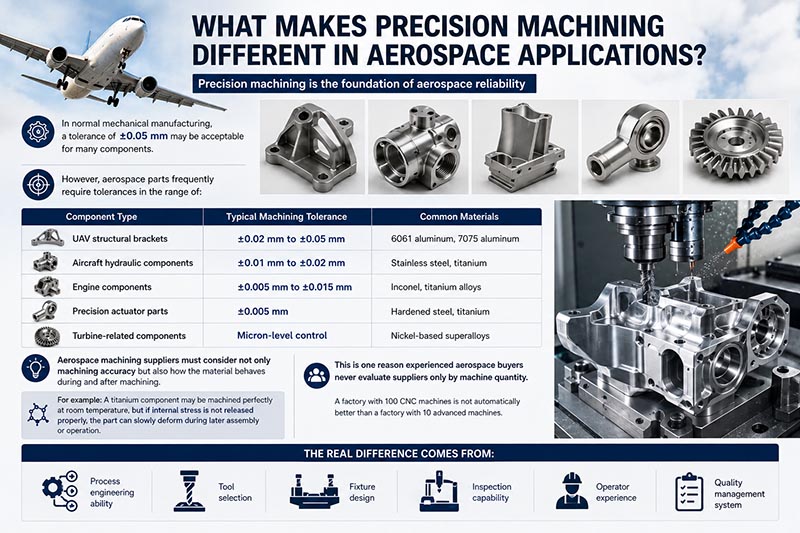
What Makes Precision Machining Different in Aerospace Applications?
Precision machining is the foundation of aerospace reliability
In normal mechanical manufacturing, a tolerance of ±0.05 mm may be acceptable for many components.
However, aerospace parts frequently require tolerances in the range of:
| Component Type | Typical Machining Tolerance | Common Materials |
|---|---|---|
| UAV structural brackets | ±0.02 mm to ±0.05 mm | 6061 aluminum, 7075 aluminum |
| Aircraft hydraulic components | ±0.01 mm to ±0.02 mm | Stainless steel, titanium |
| Engine components | ±0.005 mm to ±0.015 mm | Inconel, titanium alloys |
| Precision actuator parts | ±0.005 mm | Hardened steel, titanium |
| Turbine-related components | Micron-level control | Nickel-based superalloys |
Aerospace machining suppliers must consider not only machining accuracy but also how the material behaves during and after machining.
For example:
A titanium component may be machined perfectly at room temperature, but if internal stress is not released properly, the part can slowly deform during later assembly or operation.
This is one reason experienced aerospace buyers never evaluate suppliers only by machine quantity.
A factory with 100 CNC machines is not automatically better than a factory with 10 advanced machines.
The real difference comes from:
- Process engineering ability
- Tool selection
- Fixture design
- Inspection capability
- Operator experience
- Quality management system
Precision Machining Knowledge Point 1: Understanding Aerospace CNC Machining Requirements
Why aerospace parts demand higher machining standards
Aircraft components operate under some of the harshest engineering conditions:
- Extreme temperature changes
- High vibration
- Continuous mechanical loading
- Pressure differences
- Corrosion exposure
- Long service life requirements
A commercial aircraft may operate for decades. During that period, thousands of takeoff and landing cycles repeatedly stress every critical component.
A small machining error can become a fatigue problem over time.
For example:
A mounting hole on an aircraft structural bracket is designed with a specific position tolerance.
If the hole location deviates:
- Assembly force increases
- Bolt loading becomes uneven
- Local stress concentration occurs
- Fatigue life decreases
The problem may not appear during initial inspection, but after thousands of flight hours.
This is why aerospace machining focuses heavily on:
Dimensional accuracy
The final geometry must match engineering drawings exactly.
Important parameters include:
| Measurement | Purpose |
|---|---|
| Linear dimensions | Ensure proper assembly |
| Hole position accuracy | Maintain alignment |
| Flatness | Prevent uneven loading |
| Parallelism | Control mechanical movement |
| Roundness | Ensure rotating accuracy |
| Profile tolerance | Maintain aerodynamic shape |
Aerospace CNC machining is about repeatability, not just one perfect part
One mistake I often see when evaluating suppliers is that some manufacturers show a beautiful prototype sample.
However, aerospace procurement is not about producing one excellent part.
It is about producing:
- 10 parts
- 100 parts
- 1,000 parts
with identical performance.
For example, suppose a UAV manufacturer orders 500 aluminum frames.
The first five pieces may look perfect.
But if:
- The 100th part shifts by 0.08 mm
- The 200th part develops burr problems
- The 300th part has inconsistent anodizing thickness
the supplier cannot support aerospace production.
A qualified precision machining supplier needs stable process control.
Typical controls include:
- CNC program verification
- Tool life management
- Fixture inspection
- First Article Inspection (FAI)
- CMM measurement reports
- Batch traceability
Precision Machining Knowledge Point 2: Aerospace Materials Selection — Aluminum, Titanium and Inconel
Material selection is one of the first decisions I review when evaluating an aerospace CNC project.
The wrong material choice can create problems that no machining technology can solve.
The material must match:
- Weight requirements
- Strength requirements
- Temperature environment
- Corrosion resistance
- Fatigue performance
- Machining difficulty
Common aerospace CNC materials include aluminum alloys, titanium alloys, stainless steel, and nickel-based superalloys.
Aluminum Alloys: The First Choice for Lightweight Aerospace Structures
Aluminum remains one of the most widely used aerospace machining materials because of its excellent strength-to-weight ratio.
Common grades:
| Aluminum Grade | Application | Characteristics |
|---|---|---|
| 6061-T6 | UAV frames, brackets, housings | Easy machining, good corrosion resistance |
| 7075-T6 | Aircraft structural parts | High strength |
| 2024 | Aircraft skins and structures | Excellent fatigue resistance |
From a procurement perspective, aluminum parts are usually easier to manufacture because:
- Cutting speed can be higher
- Tool wear is lower
- Machining time is shorter
- Cost is more predictable
Example:
A 7075 aluminum UAV arm may require:
- 3-axis or 5-axis milling
- Rough machining
- Stress relief
- Finishing machining
- Anodizing
Total machining time may range from:
| Part Complexity | Machining Time |
|---|---|
| Simple bracket | 1–3 hours |
| Medium UAV component | 5–12 hours |
| Complex aerospace structure | 20+ hours |
Titanium Alloy: The Material That Tests a Machinist’s Experience
Titanium is extremely important in aerospace because it provides:
- High strength
- Low density
- Excellent corrosion resistance
- High temperature performance
The most common grade is:
Ti-6Al-4V (Grade 5 titanium)
Typical applications:
- Aircraft structural components
- Engine mounting parts
- Landing gear components
- Hydraulic system parts
- UAV high-strength frames
However, titanium is difficult to machine.
The problems include:
1. Low thermal conductivity
Unlike aluminum, titanium does not transfer heat efficiently.
During machining:
- Heat stays near the cutting edge
- Tool wear increases
- Surface damage risk increases
2. Chemical reaction with cutting tools
Titanium can react with certain tool materials at high temperatures.
Therefore machining requires:
- Carbide tools
- Lower cutting speed
- Proper coolant strategy
- Stable fixtures
A supplier that machines aluminum successfully may still struggle with titanium.
Precision Machining for Aerospace Manufacturing: An Engineer’s Perspective on Aircraft Parts, UAV Components, Materials and Accuracy
Precision Machining Knowledge Point 2: Aerospace Materials Selection — Aluminum, Titanium and Inconel (Continued)
Inconel and Nickel-Based Superalloys: The Ultimate Challenge for CNC Machining
When I review aerospace machining projects involving engine components, turbine systems, or high-temperature applications, nickel-based superalloys are always among the most challenging materials.
The most common grades include:
- Inconel 718
- Inconel 625
- Hastelloy alloys
- Rene alloys
These materials are specifically developed for extreme environments where conventional metals cannot survive.
For example, inside an aircraft engine, components may experience:
- Temperatures exceeding 700°C
- High-speed rotation
- Continuous thermal cycling
- Severe mechanical stress
Inconel maintains mechanical strength under these conditions, which makes it ideal for:
- Turbine blades
- Combustion chamber components
- Exhaust system parts
- Engine mounts
- High-temperature fasteners
However, from a machining engineer’s perspective, Inconel is one of the most difficult materials to process.
Why Inconel is difficult to machine
The machining difficulty comes from several physical properties.
| Property | Effect During Machining |
|---|---|
| High temperature strength | Cutting forces remain high |
| Low thermal conductivity | Heat concentrates at cutting edge |
| Work hardening tendency | Hard surface forms after machining |
| Abrasive alloy structure | Accelerates tool wear |
A common mistake made by inexperienced suppliers is increasing cutting speed to improve productivity.
For aluminum, higher speed often improves efficiency.
For Inconel, excessive speed usually creates:
- Rapid tool failure
- Poor surface finish
- Dimensional instability
- Increased production cost
Experienced aerospace machining suppliers usually optimize:
- Cutting speed
- Feed rate
- Depth of cut
- Tool coating
- Coolant pressure
rather than simply increasing machine speed.
Example: CNC Machining an Inconel Turbine Component
A typical Inconel 718 aerospace component may require:
| Manufacturing Step | Purpose |
|---|---|
| Material certification review | Confirm alloy composition |
| CNC rough machining | Remove excess material |
| Heat treatment | Release internal stress |
| Semi-finishing machining | Improve dimensional stability |
| Final CNC finishing | Achieve final tolerance |
| Grinding or EDM | Reach critical features |
| CMM inspection | Verify geometry |
The total machining cycle may take:
- Simple Inconel part: 10–20 hours
- Complex turbine geometry: 50+ hours
This explains why aerospace precision parts are expensive.
The cost is not only machine time.
It includes:
- Engineering preparation
- Tool consumption
- Inspection time
- Process development
- Quality documentation
Precision Machining Knowledge Point 3: Ultra-Tight Tolerances and Quality Control for Aerospace Parts
Aerospace machining accuracy is measured in microns, not only millimeters
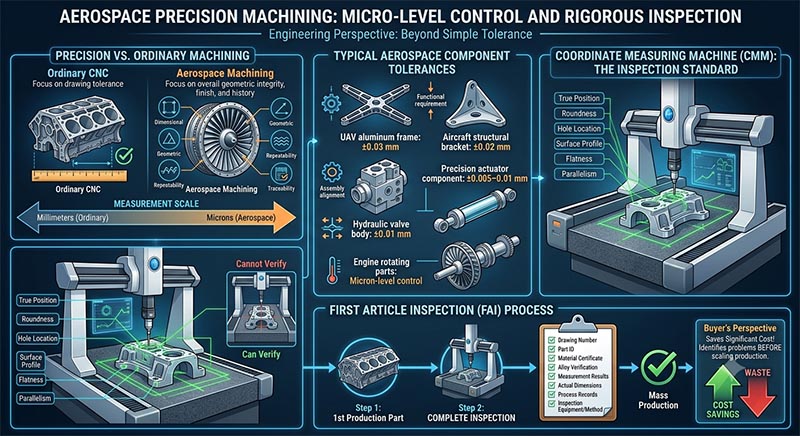
One of the biggest differences between ordinary CNC machining and aerospace precision machining is inspection philosophy.
In general industrial machining, inspection may focus on whether the final dimension falls within drawing tolerance.
In aerospace manufacturing, engineers focus on:
- Dimensional accuracy
- Geometric accuracy
- Surface integrity
- Repeatability
- Traceability
A part is not considered qualified simply because one dimension passes.
The entire manufacturing history must be controlled.
Common Aerospace CNC Tolerance Requirements
Different components require different precision levels.
| Aerospace Component | Typical Accuracy Requirement |
|---|---|
| UAV aluminum frame | ±0.03 mm |
| Aircraft structural bracket | ±0.02 mm |
| Hydraulic valve body | ±0.01 mm |
| Precision actuator component | ±0.005–0.01 mm |
| Engine rotating parts | Micron-level control |
The required tolerance depends on:
- Functional requirements
- Assembly method
- Load conditions
- Operating temperature
Coordinate Measuring Machine (CMM): The Standard Tool for Aerospace Inspection
When purchasing aerospace CNC components, I pay close attention to whether a supplier has professional measurement equipment.
A CMM is one of the most important inspection systems.
It measures complex geometries using a highly accurate probing system.
Typical inspection items include:
- Hole location
- Surface profile
- Position tolerance
- Flatness
- Roundness
- True position
For example, a UAV payload mounting plate may have dozens of mounting holes.
The holes are not only required to have correct diameter.
Their:
- Distance relationship
- Angular position
- Parallel relationship
must also match the design.
A normal caliper cannot verify these requirements.
First Article Inspection (FAI) in Aerospace Manufacturing
Aerospace customers often require First Article Inspection before mass production.
FAI means:
The supplier produces the first production part and performs a complete inspection against engineering drawings.
A typical FAI report includes:
| Inspection Item | Information Provided |
|---|---|
| Drawing number | Part identification |
| Material certificate | Alloy verification |
| Measurement results | Actual dimensions |
| Process records | Manufacturing history |
| Inspection equipment | Measurement method |
FAI helps identify problems before large-scale production.
From a buyer’s perspective, this saves significant cost.
Finding a machining issue after producing 5,000 parts can be catastrophic.
Surface Finish Requirements for Aerospace CNC Parts
Surface finish is another critical factor often underestimated.
A machined surface is not only about appearance.
Surface roughness affects:
- Fatigue strength
- Friction
- Sealing performance
- Corrosion resistance
Common aerospace surface requirements:
| Surface Finish | Typical Application |
|---|---|
| Ra 3.2 μm | General structural parts |
| Ra 1.6 μm | Precision mechanical parts |
| Ra 0.8 μm or lower | Hydraulic and sealing surfaces |
| Mirror finish | Optical or aerodynamic applications |
For aircraft hydraulic components, poor surface finish can cause:
- Leakage
- Seal damage
- Pressure instability
For turbine components, surface defects may become stress concentration points.
Precision Machining Knowledge Point 4: Advanced CNC Processes Used in Aerospace Manufacturing
5-Axis CNC Machining: The Preferred Method for Complex Aircraft Components
Modern aerospace parts are becoming increasingly complex.
Aircraft manufacturers require:
- Weight reduction
- Better aerodynamic performance
- Integrated structures
Traditional 3-axis machining often cannot produce these geometries efficiently.
This is where 5-axis CNC machining becomes essential.
A 5-axis machine can move:
- X axis
- Y axis
- Z axis
- Rotary A axis
- Rotary B axis
simultaneously.
Advantages of 5-Axis Machining
1. Producing complex curved surfaces
Aircraft components often contain:
- Aerodynamic surfaces
- Curved channels
- Lightweight pockets
- Complex internal structures
Examples:
- UAV wings
- Aircraft brackets
- Propeller components
- Engine housings
A 5-axis machine can reach these surfaces with fewer setups.
2. Improving accuracy through fewer setups
Every time a part is removed and repositioned:
there is a possibility of:
- Alignment error
- Fixture error
- Human error
5-axis machining reduces this risk.
For example:
A complex aluminum aerospace housing may require:
Traditional machining:
- Setup 1: 3 hours
- Setup 2: 3 hours
- Setup 3: 4 hours
Total:
10 hours with multiple alignment processes.
5-axis machining:
One setup:
6–7 hours.
Although the machine cost is higher, total manufacturing reliability improves.
CNC Turning for Aerospace Precision Components
Not all aerospace parts require milling.
Many rotational components depend on CNC turning.
Common examples:
- Shafts
- Bushings
- Connectors
- Hydraulic components
- Fasteners
Modern CNC turning centers often include:
- Live tooling
- Y-axis movement
- Sub-spindle capability
allowing turning and milling in one machine.
This reduces:
- Handling time
- Positioning errors
- Production cost
Electrical Discharge Machining (EDM): For Difficult Aerospace Features
Some aerospace materials and geometries cannot be easily machined using traditional cutting tools.
EDM uses controlled electrical sparks to remove material.
Advantages:
- Processes hardened materials
- Creates extremely small features
- Produces sharp internal corners
Common applications:
- Turbine blade cooling holes
- Precision slots
- Hardened alloy components
For example, turbine blades often contain many small cooling channels.
These channels improve engine efficiency but are difficult to create using normal milling.
EDM becomes the preferred solution.
Grinding and Finishing Processes
For ultra-precision aerospace parts, final finishing may include:
- Surface grinding
- Cylindrical grinding
- Polishing
- Lapping
These processes achieve:
- Better surface finish
- Higher dimensional accuracy
- Improved component life
A precision aerospace supplier usually combines multiple technologies rather than relying on CNC machining alone.
Precision Machining for Aerospace Manufacturing: An Engineer’s Perspective on Aircraft Parts, UAV Components, Materials and Accuracy
Precision Machining Knowledge Point 5: How to Select a Reliable Precision Machining Supplier for Aerospace and UAV Components
A qualified aerospace machining supplier is more than a CNC factory
After years of purchasing aerospace CNC components, one thing has become very clear:
Choosing a precision machining supplier is not simply choosing a company with expensive CNC machines.
Many manufacturers can purchase:
- 3-axis CNC machines
- 5-axis machining centers
- CNC lathes
- CMM inspection equipment
But aerospace manufacturing requires much more than equipment.
A reliable aerospace CNC supplier must understand:
- Material behavior
- Machining strategy
- Engineering drawings
- GD&T requirements
- Production stability
- Quality documentation
- Delivery control
When evaluating a supplier, I usually examine five major areas:
| Evaluation Area | Key Questions |
|---|---|
| Engineering capability | Can they optimize machining processes? |
| Equipment capability | Can their machines achieve required accuracy? |
| Quality system | Do they control every production step? |
| Material management | Can they provide traceability? |
| Production experience | Have they manufactured similar aerospace parts? |
A supplier may claim they can machine titanium or Inconel.
However, the real question is:
Have they successfully produced these materials for demanding applications?
Aerospace CNC Supplier Evaluation: Machines Are Important, But Process Experience Matters More
CNC equipment selection for aerospace machining
Advanced aerospace machining usually requires professional equipment.
Common machines include:
| Machine Type | Main Application |
|---|---|
| 3-axis CNC milling | Simple brackets and plates |
| 4-axis CNC machining | Rotational positioning parts |
| 5-axis CNC machining | Complex aerospace surfaces |
| CNC turning centers | Shafts and cylindrical parts |
| Swiss-type CNC | Small precision components |
| EDM machines | Complex holes and hardened materials |
| Grinding machines | Final precision finishing |
However, machine specifications alone do not guarantee quality.
For example:
A 5-axis CNC machine can theoretically produce a turbine blade.
But without:
- Proper tool paths
- Correct fixtures
- Experienced programmers
- Material knowledge
the result may still fail.
The Importance of CNC Programming in Aerospace Manufacturing
In aerospace machining, programming quality directly affects part performance.
Experienced CNC programmers consider:
- Tool engagement angle
- Cutting load
- Material removal sequence
- Thermal deformation
- Surface finish requirements
For complex aircraft parts, CAM programming can take longer than machining.
A turbine blade or UAV aerodynamic component may require:
- CAD model analysis
- Tool path simulation
- Collision checking
- Cutting optimization
before actual production begins.
A poor program can cause:
- Excessive vibration
- Tool breakage
- Surface defects
- Dimensional errors
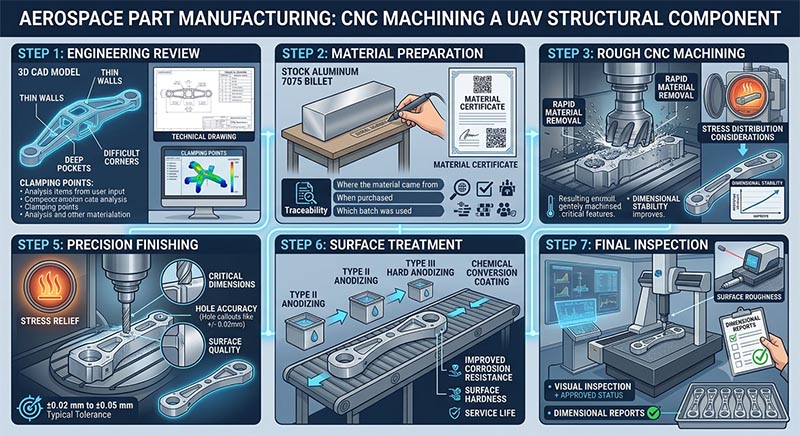
Aerospace Part Manufacturing Example: CNC Machining a UAV Structural Component
To better understand the entire process, let us look at a typical UAV aluminum structural component.
Assume a customer requires a lightweight 7075 aluminum drone arm.
Requirements:
- High strength
- Low weight
- Precise mounting holes
- Corrosion resistance
- Repeat production
The manufacturing process may include:
Step 1: Engineering Review
The supplier analyzes:
- 3D model
- Technical drawing
- Material specification
- Tolerance requirements
Engineers check:
- Thin wall sections
- Deep pockets
- Difficult corners
- Clamping points
Step 2: Material Preparation
The supplier verifies:
- Aluminum alloy grade
- Material certificate
- Heat treatment condition
For aerospace applications, material traceability is essential.
A qualified supplier should know:
- Where the material came from
- When it was purchased
- Which batch was used
Step 3: Rough CNC Machining
The purpose is rapid material removal.
During rough machining:
- Larger tools are used
- Higher material removal rates are preferred
- Stress distribution is considered
The supplier avoids removing too much material in one pass because thin structures may deform.
Step 4: Stress Relief and Semi-Finishing
Aluminum components can develop internal stress after machining.
Especially when removing large amounts of material.
Stress relief helps:
- Reduce deformation
- Improve dimensional stability
- Increase repeatability
Step 5: Precision Finishing
Final machining focuses on:
- Critical dimensions
- Hole accuracy
- Surface quality
- Assembly areas
Typical tolerance:
±0.02 mm to ±0.05 mm depending on function.
Step 6: Surface Treatment
Aerospace aluminum parts commonly require:
- Type II anodizing
- Type III hard anodizing
- Chemical conversion coating
These improve:
- Corrosion resistance
- Surface hardness
- Service life
Step 7: Final Inspection
Inspection may include:
- CMM measurement
- Surface roughness testing
- Visual inspection
- Dimensional reports
Only approved parts enter assembly.
Machining Time and Cost Analysis of Aerospace CNC Parts
Many customers ask:
“Why are aerospace CNC parts expensive?”
The answer is that cost is determined by many factors.
A simple formula is:
Total Cost = Material + Machining Time + Tool Cost + Programming + Inspection + Finishing + Certification
Example Machining Cost Structure
For a titanium aerospace component:
| Cost Factor | Approximate Influence |
|---|---|
| Material | 20–35% |
| CNC machining time | 30–50% |
| Tool consumption | 5–15% |
| Programming | 5–10% |
| Inspection | 5–15% |
| Surface treatment | 5–10% |
The machining time depends heavily on:
- Material hardness
- Geometry complexity
- Tolerance requirements
- Machine type
Why Aerospace CNC Parts Take Longer Than Normal Industrial Parts
A normal mechanical part may require:
- CNC machining
- Basic inspection
An aerospace part may require:
- Engineering review
- Material verification
- CNC programming
- Prototype testing
- First article inspection
- Dimensional reporting
- Surface treatment certification
This additional process ensures reliability.
In aerospace manufacturing, saving two hours of machining time is meaningless if the part fails during operation.
Common Mistakes When Purchasing Aerospace Precision Machined Parts
Choosing the lowest price supplier
Low price often creates hidden risks.
Common problems include:
- Unknown material sources
- Insufficient inspection
- Poor process control
- Unstable quality
For aerospace applications, the cheapest supplier is rarely the lowest-cost option.
A failed component can create:
- Production delays
- Aircraft downtime
- Replacement costs
Ignoring supplier communication ability
Precision machining requires constant communication.
A good supplier should be able to discuss:
- Tolerance feasibility
- Design improvements
- Material alternatives
- Production risks
For example:
A customer may design a titanium component with a sharp internal corner.
An experienced supplier may suggest:
- Adding a small fillet
- Changing machining direction
- Adjusting wall thickness
This can significantly improve manufacturing reliability.
Future Trends in Aerospace Precision Machining
The aerospace manufacturing industry continues moving toward:
- Lightweight structures
- Complex geometries
- Digital manufacturing
- Automation
- High-performance materials
Several technologies are becoming increasingly important.
Intelligent CNC Manufacturing
Modern factories are adopting:
- Automated tool monitoring
- Digital production tracking
- Real-time quality monitoring
These technologies help improve:
- Production consistency
- Machine utilization
- Quality control
Hybrid Manufacturing
Some aerospace components combine:
- Additive manufacturing
- CNC finishing
3D printing creates complex near-net shapes.
CNC machining then provides:
- Accurate surfaces
- Precision holes
- Critical dimensions
This combination reduces material waste.
More Difficult Materials
Future aircraft engines require materials that survive higher temperatures.
Machining challenges will increase for:
- Titanium aluminides
- Ceramic composites
- Nickel superalloys
Suppliers with advanced machining experience will have significant advantages.
Why Choose Xavier for Precision Machining Aerospace Components?
In aerospace manufacturing, precision is not simply a measurement value.
It represents:
- Flight safety
- Engineering confidence
- Production reliability
At Xavier, precision machining is built around a complete manufacturing approach, including advanced CNC machining capability, strict material control, professional inspection processes, and experience producing complex metal components.
From lightweight UAV structural parts to high-strength aerospace components, Xavier focuses on delivering precision-machined solutions that meet demanding requirements for accuracy, repeatability, and reliability.
Whether customers require:
- Aluminum aerospace parts
- Titanium CNC components
- Stainless steel precision parts
- Inconel machining
- Complex 5-axis machined components
Xavier provides engineering support from prototype development to production manufacturing.
For aerospace and UAV manufacturers looking for a dependable precision machining partner, selecting a supplier with machining knowledge, quality control capability, and manufacturing experience is the key to long-term success.
We are an integrated CNC manufacturing company specializing in custom CNC machining services and the production of various metal components. We provide precision machining solutions for industries such as robotics, aerospace, marine, automotive, medical equipment, and high-precision applications. Our capabilities include CNC machining titanium, CNC machining PEEK, and CNC machining stainless steel, covering a wide range of materials including alloy steel, aluminum, brass, bronze, copper, Inconel alloys, Invar 36, low carbon steel, tool steel, ABS, FR4, G-10, nylon, PEI, PET, PMMA (acrylic), polycarbonate, polyethylene, polypropylene, POM (acetal), PPSU, PTFE, and PVC.
As a professional CNC machining manufacturer, we offer reliable bulk CNC machining services and provide competitive CNC machining prices for customers worldwide. Contact us today for high-quality custom machining solutions.
Some of the images and text in this article are collected and compiled from the internet. If there is anything inappropriate, please contact us for processing.