
Key takeaways from this article:
- What Alloy Steel and Carbon Steel Actually Are
- Chemical Composition and Alloying Elements
- Mechanical Strength and Hardness Comparison
- Toughness and Impact Resistance
- Corrosion Resistance and Surface Protection
- Heat Treatment and Hardenability
- Machinability in CNC Manufacturing
- Weldability and Fabrication Performance
- Wear Resistance and Fatigue Life
- Common Grades and Real-World Applications
- Cost Comparison and Lifecycle Economics
- Surface Finishing and Coating Options
- Industry Standards and Material Specifications
- Selection Guidelines for Engineers
- Which Material Is Better for CNC Machined Parts?
Alloy Steel vs Carbon Steel: Complete Engineering Guide for CNC Machining
When engineers compare alloy steel vs carbon steel, they are usually balancing four key factors:
- Strength
- Cost
- Machinability
- Environmental durability
Both materials are based on iron and carbon, but alloy steel contains intentionally added elements such as chromium, molybdenum, nickel, vanadium, and manganese to improve specific properties like hardenability, wear resistance, and toughness. Carbon steel, by contrast, derives most of its properties from carbon content alone.
In CNC machining, carbon steel is widely used for low-cost structural and general-purpose parts, while alloy steel is selected for demanding applications such as gears, shafts, aerospace components, and heavy-duty tooling.
This guide provides a detailed comparison using engineering data, tables, examples, and manufacturing insights.
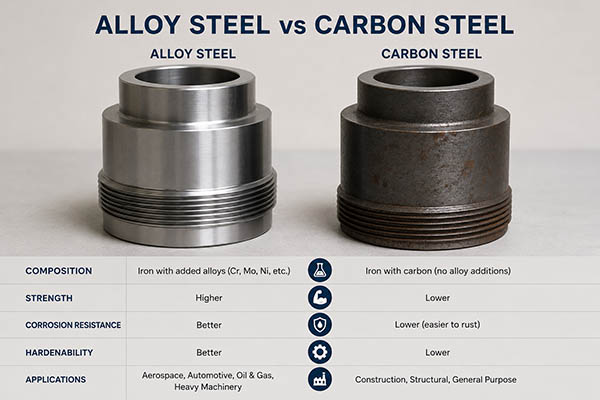
What Alloy Steel and Carbon Steel Actually Are
Carbon Steel
Carbon steel contains:
- Iron (Fe)
- Carbon (typically 0.05% to 1.0%+)
- Small residual amounts of manganese, sulfur, and phosphorus
Its properties depend primarily on carbon content.
Alloy Steel
Alloy steel contains iron and carbon plus intentionally added alloying elements such as:
- Chromium (Cr)
- Molybdenum (Mo)
- Nickel (Ni)
- Vanadium (V)
- Manganese (Mn)
These additions improve strength, toughness, wear resistance, and heat treatment response.
Chemical Composition and Alloying Elements
| Element | Carbon Steel | Alloy Steel |
|---|---|---|
| Iron (Fe) | Balance | Balance |
| Carbon (C) | 0.05–2.1% | 0.1–1.0% typical |
| Chromium (Cr) | Minimal | 0.5–5.0% typical |
| Molybdenum (Mo) | Usually none | 0.15–0.6% |
| Nickel (Ni) | Usually none | 0.5–3.5% |
| Vanadium (V) | Rare | 0.05–0.2% |
Common Grades
| Material Type | Representative Grades |
|---|---|
| Carbon Steel | 1018, 1020, 1045 |
| Alloy Steel | 4140, 4340, 8620 |
Mechanical Strength and Hardness Comparison
Alloy steels are generally stronger and more versatile after heat treatment.
| Property | 1018 | 1045 | 4140 Q&T | 4340 Q&T |
|---|---|---|---|---|
| Tensile Strength (MPa) | 440–470 | 620–760 | 950–1,100 | 1,100–1,400 |
| Yield Strength (MPa) | 370 | 530 | 655–900 | 950–1,150 |
| Hardness | ~120 HB | ~170–220 HB | 28–50 HRC | Up to 55 HRC |
Engineering Insight
- 1018 is easy to machine and weld.
- 1045 provides better strength and wear resistance.
- 4140 is a workhorse engineering alloy.
- 4340 is used where extreme strength is required.
Toughness and Impact Resistance
Strength alone is not enough. Components subjected to shock loading need high toughness.
| Material | Relative Toughness |
|---|---|
| 1018 | Good |
| 1045 | Moderate |
| 4140 | Very Good |
| 4340 | Excellent |
Nickel-containing alloy steels such as 4340 retain toughness even at very high strength levels, making them ideal for aerospace landing gear and racing drivetrain components.
Corrosion Resistance and Surface Protection
Neither carbon steel nor standard alloy steel is naturally corrosion resistant.
| Environment | Carbon Steel | Alloy Steel |
|---|---|---|
| Dry indoor use | Good | Good |
| Humid atmosphere | Poor | Fair |
| Outdoor exposure | Poor | Fair |
| Saltwater | Very Poor | Poor |
Alloying elements may slightly improve corrosion resistance, but most grades still require coatings.
Common Protective Finishes
- Black oxide
- Zinc plating
- Electroless nickel
- Powder coating
- Phosphate coating
- Hard chrome
Heat Treatment and Hardenability
Hardenability refers to how deeply steel can harden during quenching.
Carbon Steel
1045 can harden effectively, but through-hardening is limited in thick sections.
Alloy Steel
4140 and 4340 harden much more uniformly because chromium and molybdenum slow transformation during cooling.
Higher Hardenability→Deeper Uniform Hardness
Example
A 75 mm diameter shaft:
- 1045 may harden only near the surface.
- 4140 can harden through most of the cross section.
Machinability in CNC Manufacturing
| Material | Relative Machinability (1212 = 100%) |
|---|---|
| 1018 | 75–80% |
| 1045 | 55–65% |
| 4140 Annealed | 65–70% |
| 4340 Annealed | 55–60% |
| 4140 Hardened | 35–50% |
Practical CNC Insights
Carbon steels generally produce predictable chips and lower tool wear.
Alloy steels require:
- Rigid setups
- High-performance carbide tooling
- Optimized cutting parameters
Despite this, 4140 remains one of the most popular CNC materials because of its excellent property-to-cost ratio.
Weldability and Fabrication Performance
| Material | Weldability |
|---|---|
| 1018 | Excellent |
| 1020 | Excellent |
| 1045 | Moderate |
| 4140 | Moderate; preheat recommended |
| 4340 | Difficult |
Low-carbon steel is the easiest to weld. High-strength alloy steels often need:
- Preheating
- Controlled cooling
- Post-weld stress relief
Wear Resistance and Fatigue Life
Alloy steels significantly outperform carbon steels under cyclic and abrasive conditions.
Typical Fatigue-Critical Components
- Crankshafts
- Connecting rods
- Gear shafts
- Hydraulic rods
- Suspension components
4140 and 4340 are commonly nitrided or induction hardened to create extremely durable surfaces.
Common Grades and Real-World Applications
| Grade | Type | Typical Applications |
|---|---|---|
| 1018 | Low Carbon Steel | Brackets, fixtures, shafts |
| 1020 | Low Carbon Steel | Structural components |
| 1045 | Medium Carbon Steel | Gears, axles, pins |
| 4140 | Alloy Steel | Spindles, crankshafts |
| 4340 | Alloy Steel | Aerospace and motorsports |
| 8620 | Alloy Steel | Carburized gears |
Cost Comparison and Lifecycle Economics
Relative Material Cost
| Material | Relative Cost |
|---|---|
| 1018 | 1.0× |
| 1045 | 1.1–1.3× |
| 4140 | 1.5–2.0× |
| 4340 | 2.0–3.0× |
| 8620 | 1.8–2.5× |
Carbon steel is less expensive initially, but alloy steel often reduces lifecycle costs by increasing service life and reducing failures.
Surface Finishing and Coating Options
Carbon Steel Finishes
- Galvanizing
- Painting
- Black oxide
- Zinc plating
Alloy Steel Finishes
- Nitriding
- Carburizing
- Hard chrome
- Phosphate coating
- Black oxide
Alloy steels are frequently paired with advanced heat treatment and finishing to maximize durability.
Industry Standards and Material Specifications
| Standard | Description |
|---|---|
| AISI 1018 | Low-carbon steel |
| AISI 1045 | Medium-carbon steel |
| AISI 4140 | Chromium-molybdenum alloy steel |
| AISI 4340 | Nickel-chromium-molybdenum steel |
| ASTM A29 | General steel bars |
Using exact material specifications ensures consistent mechanical properties and heat treatment results.
Selection Guidelines for Engineers
Choose Carbon Steel When You Need
- Lowest material cost
- Excellent weldability
- Simple machining
- General structural performance
Choose Alloy Steel When You Need
- Higher tensile strength
- Better fatigue life
- Superior hardenability
- Improved wear resistance
Which Material Is Better for CNC Machined Parts?
The answer depends on application demands.
Carbon Steel Is Ideal For
- Welded structures
- Low-cost brackets
- Fixtures
- General-purpose shafts
Alloy Steel Is Ideal For
- High-load gears
- Hardened shafts
- Tooling
- Aerospace components
Real-World Example: Gear Shaft Selection
A gearbox shaft requires:
- Tensile strength above 950 MPa
- High fatigue resistance
- Surface hardness above 55 HRC
- Long service life
Material Options
| Material | Suitable? | Reason |
|---|---|---|
| 1045 | Limited | Lower hardenability |
| 4140 | Excellent | Strong and heat treatable |
| 4340 | Outstanding | Maximum toughness |
| 1018 | No | Insufficient strength |
Most engineers choose 4140 because it offers excellent performance at moderate cost.
Quick Decision Matrix
| Priority | Best Choice |
|---|---|
| Lowest cost | Carbon Steel |
| Best weldability | Low Carbon Steel |
| Highest strength | Alloy Steel |
| Best fatigue resistance | Alloy Steel |
| Simplest fabrication | Carbon Steel |
| Best heat treatment response | Alloy Steel |
| Longest service life | Alloy Steel |
Frequently Asked Questions
Is alloy steel stronger than carbon steel?
In most engineering applications, yes. Grades such as 4140 and 4340 significantly exceed the strength of 1018 and 1045.
Does carbon steel rust more easily?
Yes. Carbon steel generally corrodes quickly unless protected.
Which material is easier to machine?
Low-carbon steels like 1018 are among the easiest steels to machine.
Which is better for gears?
4140 and 8620 are preferred because of their heat treatment capabilities.
Which is cheaper?
Carbon steel is usually less expensive.
Why Xavier Recommends the Right Steel for Every CNC Project
At Xavier, we manufacture precision CNC components in both carbon steel and alloy steel for customers in automotive, aerospace, industrial automation, robotics, and heavy machinery.
Our engineering team helps customers evaluate:
- Mechanical loads
- Heat treatment requirements
- Corrosion conditions
- Machining cost
- Surface finishing
- Expected service life
Whether you need cost-effective 1018 brackets, durable 1045 pins, hardened 4140 shafts, or aerospace-grade 4340 components, Xavier provides precision machining and expert material selection to ensure your parts deliver maximum value and performance.
If you are unsure whether alloy steel or carbon steel is the better choice for your project, Xavier can recommend the optimal material based on engineering requirements, manufacturability, and lifecycle cost.
As a full-service CNC machining manufacturer and trading company, we focus on custom CNC machining and the production of high-precision metal and plastic parts. Our capabilities include CNC machining stainless steel, CNC machining ABS, and CNC machining brass for robotics, aerospace, marine, automotive, medical, and other demanding precision applications. As a trusted CNC machining stainless steel manufacturer, we offer large-volume CNC machining ABS services. Contact us today to get the best CNC machining brass price.
Some of the images and text in this article are collected and compiled from the internet. If there is anything inappropriate, please contact us for processing.