
316 Stainless Steel Machinability: Complete CNC Machining Guide for Engineers and Manufacturers
316 stainless steel is one of the most widely used austenitic stainless steels in industries requiring excellent corrosion resistance, including marine equipment, medical devices, food processing systems, chemical machinery, and aerospace components. However, machinists often consider 316 stainless steel one of the more challenging materials to cut efficiently.
Compared with carbon steel, aluminum, and even 304 stainless steel, 316 stainless steel exhibits higher toughness, stronger work-hardening tendencies, lower thermal conductivity, and greater tool wear. Understanding these characteristics is critical for optimizing CNC machining costs, improving tool life, and achieving superior surface finishes.
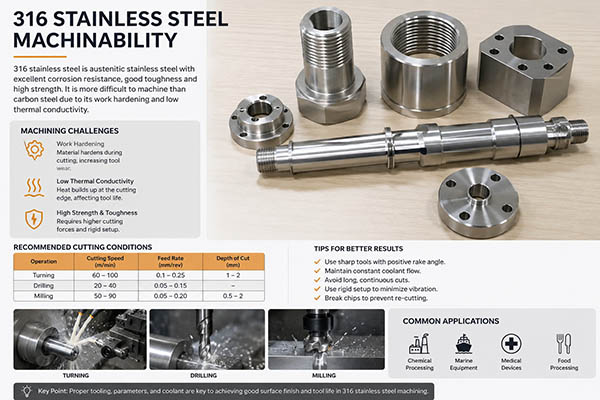
What Is 316 Stainless Steel?
316 stainless steel is an austenitic chromium-nickel stainless steel containing approximately:
| Element | Typical Content (%) |
|---|---|
| Chromium (Cr) | 16–18 |
| Nickel (Ni) | 10–14 |
| Molybdenum (Mo) | 2–3 |
| Carbon (C) | ≤0.08 |
The addition of molybdenum significantly improves corrosion resistance against chlorides, seawater, and aggressive chemicals, making 316 the preferred material for harsh environments.
Understanding the Machinability of 316 Stainless Steel
Machinability refers to how easily a material can be cut while maintaining acceptable:
- Tool life
- Surface finish
- Chip control
- Dimensional accuracy
- Production efficiency
When compared against free-machining steel (Machinability Rating = 100%), 316 stainless steel typically scores only 35–45%.
| Material | Relative Machinability (%) |
|---|---|
| Free-Cutting Steel (B1112) | 100 |
| Brass | 150 |
| 1018 Carbon Steel | 100 |
| 303 Stainless Steel | 78 |
| 304 Stainless Steel | 45–50 |
| 316 Stainless Steel | 35–45 |
| Titanium Grade 5 | 20–30 |
This means machining 316 can require significantly more tooling investment and longer cycle times than common engineering materials.
Why Is 316 Stainless Steel Difficult to Machine?
Several metallurgical characteristics contribute to its machining challenges.
High Work-Hardening Rate
The biggest challenge when machining 316 stainless steel is work hardening.
As cutting tools deform the material, the surface layer becomes harder than the base material. If the cutter rubs rather than cuts, the next pass encounters an even harder surface. This increases cutting forces and accelerates tool wear dramatically.
Example:
A milling operation using insufficient feed may initially produce acceptable chips. However, after several passes, spindle load can increase by 15–30% due to localized work hardening.
Symptoms include:
- Rapid insert failure
- Surface discoloration
- Poor dimensional accuracy
- Chatter marks
Low Thermal Conductivity
316 stainless steel conducts heat poorly.
| Material | Thermal Conductivity (W/m·K) |
|---|---|
| Aluminum 6061 | 167 |
| Carbon Steel | 50 |
| 316 Stainless Steel | 16 |
Because heat cannot dissipate effectively into the workpiece or chips, it concentrates at the cutting edge. This causes:
- Edge softening
- Built-up edge formation
- Tool chipping
- Reduced tool life
Heat management becomes a major factor in successful machining.
Tough and Ductile Material Structure
Unlike brittle materials that produce short chips, 316 stainless steel produces long, continuous chips.
These chips can:
- Wrap around tooling
- Damage workpiece surfaces
- Cause machine stoppages
- Increase operator intervention
Many machinists describe 316 as “gummy” because of its tendency to smear rather than shear cleanly.
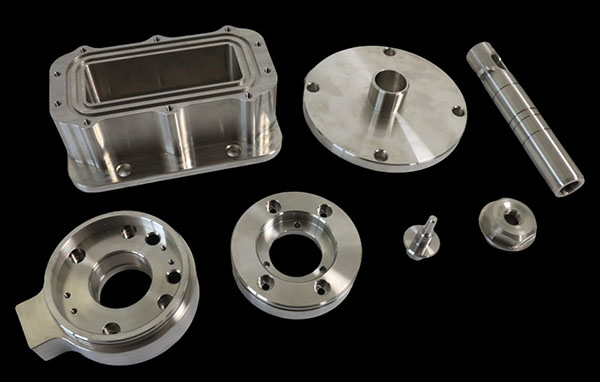
316 vs 304 Stainless Steel Machinability
Many engineers ask whether 304 or 316 is easier to machine.
The answer is generally 304.
| Factor | 304 SS | 316 SS |
|---|---|---|
| Machinability Rating | 45–50% | 35–45% |
| Tool Wear | Moderate | High |
| Work Hardening | Moderate | High |
| Chip Control | Better | More Difficult |
| Cutting Speed | Higher | Lower |
| Coolant Demand | Moderate | High |
The molybdenum content that improves corrosion resistance in 316 also increases toughness and cutting difficulty. Machining costs may be 15–30% higher than comparable 304 parts.
Best Cutting Tools for 316 Stainless Steel
Tool selection is critical.
Solid Carbide Tools
For most CNC applications, solid carbide remains the preferred solution.
Advantages:
- High hot hardness
- Better wear resistance
- Higher cutting speeds
- Improved dimensional stability
Recommended coatings include:
- TiAlN
- AlTiN
- TiCN
These coatings reduce heat transfer into the tool and improve wear resistance.
Positive Rake Geometry
Positive rake angles reduce cutting forces.
Benefits:
- Lower heat generation
- Better chip evacuation
- Reduced work hardening
- Improved surface finish
Aggressive chip-breaker geometries are particularly beneficial when roughing 316.
Recommended Cutting Speeds for 316 Stainless Steel
Actual values depend on machine rigidity, tooling manufacturer, and coolant conditions.
| Tool Material | Cutting Speed (SFM) |
|---|---|
| HSS | 50–80 |
| Cobalt HSS | 60–100 |
| Uncoated Carbide | 100–150 |
| TiAlN Coated Carbide | 150–200 |
For high-performance roughing operations, many manufacturers successfully run between 150–300 SFM with coated carbide tooling.
Feed Rates Matter More Than Speed
One of the most common mistakes when machining 316 is using overly conservative feeds.
Many operators reduce feed to protect tooling.
Unfortunately, this often creates rubbing instead of cutting.
Result:
- Severe work hardening
- Higher temperatures
- Shorter tool life
A properly loaded cutter generally performs better than one operating below its optimal chip load.
CNC Milling Strategies for 316 Stainless Steel
Use Constant Tool Engagement
Adaptive milling and dynamic toolpaths help maintain consistent cutter loading.
Benefits:
- Reduced heat spikes
- Improved tool life
- Better chip evacuation
- Faster cycle times
Modern CAM systems often achieve 20–40% productivity improvements using adaptive strategies.
Avoid Dwelling
Never allow tools to pause while engaged in the cut.
Even a short dwell can create:
- Work-hardened zones
- Built-up edge
- Surface defects
Continuous motion is critical.
Multiple Light Passes
Instead of one aggressive cut:
Poor Strategy
- 5 mm depth of cut
- Low feed
Better Strategy
- Multiple 1.5–2 mm passes
- Proper chip load
This reduces stress on both the tool and machine spindle.
CNC Turning Best Practices
Turning 316 stainless steel presents unique challenges.
Recommendations:
Use Sharp Inserts
Dull inserts generate excessive heat.
Replace inserts before catastrophic failure occurs.
Maintain Continuous Feed
Interrupted cuts often worsen work hardening.
Employ High-Pressure Coolant
Coolant pressures above 300 PSI can significantly improve chip breaking and heat removal.
Benefits include:
- Better surface finish
- Longer insert life
- Improved chip control
Drilling 316 Stainless Steel
Drilling is often where machinists encounter the greatest difficulty.
Common issues:
- Drill walking
- Hole glazing
- Rapid wear
- Chip packing
Best practices:
| Recommendation | Benefit |
|---|---|
| Split-point drills | Better centering |
| Through-coolant drills | Improved chip evacuation |
| Peck cycles | Reduced heat |
| Carbide drills | Longer life |
If work hardening occurs inside the hole, recovery becomes extremely difficult without carbide tooling.
Coolant Selection for 316 Stainless Steel
Coolant plays a larger role in 316 machining than in many other materials.
Recommended options:
Flood Coolant
Most common production solution.
Advantages:
- Excellent heat removal
- Good lubrication
- Cost effective
High-Pressure Coolant
Preferred for:
- Deep-hole drilling
- Turning
- High-feed machining
Minimum Quantity Lubrication (MQL)
Useful for:
- Finishing operations
- Environmental compliance
However, flood coolant remains the most common choice in high-volume production.
Surface Finish Expectations
With proper tooling and machining parameters, 316 stainless steel can achieve excellent finishes.
| Process | Typical Surface Finish |
|---|---|
| Rough Milling | Ra 3.2–6.3 μm |
| Finish Milling | Ra 0.8–1.6 μm |
| Precision Turning | Ra 0.4–1.2 μm |
| Grinding | Ra <0.2 μm |
Medical, aerospace, and food-grade applications often require Ra values below 0.8 μm.
Common Machining Problems and Solutions
| Problem | Cause | Solution |
|---|---|---|
| Rapid Tool Wear | Excessive heat | Use coated carbide |
| Poor Surface Finish | Built-up edge | Increase feed rate |
| Long Stringy Chips | High ductility | Use chip-breakers |
| Work Hardening | Tool rubbing | Maintain chip load |
| Chatter | Poor rigidity | Improve fixturing |
| Burr Formation | Dull tools | Replace tooling sooner |
Cost Implications of Machining 316 Stainless Steel
Several factors increase manufacturing costs:
- Higher material price
- Shorter tool life
- Longer cycle times
- Increased coolant consumption
- Additional finishing requirements
For example, a marine-grade valve body machined from 316 may cost 20–40% more than an equivalent carbon steel component due to machining complexity alone.
Typical Applications Requiring 316 Stainless Steel
Despite its machining challenges, 316 remains indispensable in many industries.
Examples include:
- Marine fittings
- Offshore equipment
- Medical implants
- Pharmaceutical machinery
- Food processing systems
- Chemical pumps
- Heat exchangers
- Aerospace fluid systems
Its superior corrosion resistance often justifies the additional machining cost.
Why Manufacturers Still Choose 316 Stainless Steel
Although machinists often prefer easier-cutting materials such as 303 stainless steel or aluminum, engineers continue specifying 316 because failure due to corrosion can be far more expensive than additional machining time.
In coastal, marine, chemical, and sanitary environments, the longevity of 316 often outweighs its manufacturing challenges. Proper tooling, optimized feeds and speeds, and effective coolant management allow manufacturers to achieve reliable and repeatable production results.
Why Xavier Is a Reliable Partner for 316 Stainless Steel Machining
When machining 316 stainless steel, success depends on more than just owning CNC machines. It requires deep knowledge of work hardening behavior, chip control, tooling selection, and process optimization.
At Xavier, we specialize in precision CNC machining of stainless steel components, including 316, 316L, 304, 303, and other corrosion-resistant alloys. Our engineering team utilizes advanced carbide tooling, optimized cutting strategies, and rigorous quality control systems to deliver high-precision parts with excellent surface finishes and consistent dimensional accuracy.
Whether you need prototypes, low-volume production, or large-scale manufacturing, Xavier can help reduce machining costs while maintaining the performance advantages that make 316 stainless steel the material of choice for demanding applications.
We are an integrated manufacturer and supplier specializing in CNC machining services, focusing on custom CNC machining and precision fabrication of various metal components. We also provide advanced surface finishing solutions, including CNC Electroless Nickel Plating Surface Finishing, CNC Zinc Plating Surface Finishing, and CNC Electropolishing Surface Finishing.
As a professional CNC Electroless Nickel Plating Surface Finishing Manufacturer, we offer high-volume CNC Zinc Plating Surface Finishing Services. Contact us today to get competitive CNC Electropolishing Surface Finishing Pricing and expert support for your next project.
Some of the images and text in this article are collected and compiled from the internet. If there is anything inappropriate, please contact us for processing.