
4041 Aluminum: Properties, Machining, Applications and Material Selection Guide
Although 6061 and 7075 aluminum receive most of the attention in CNC machining, 4041 aluminum plays a unique role in manufacturing where excellent weldability, silicon-rich chemistry, dimensional stability, and moderate mechanical strength are required.
As a member of the 4xxx aluminum family, Alloy 4041 contains significantly more silicon than many structural aluminum alloys. This increased silicon content improves molten metal flow during welding, minimizes hot cracking, and produces cleaner weld beads. For this reason, it is frequently selected as both a base alloy for certain fabricated components and as a welding filler material.
For CNC manufacturers, understanding where 4041 fits compared with 4043, 4047, 6061, or 5052 helps engineers avoid overengineering parts while reducing production costs.
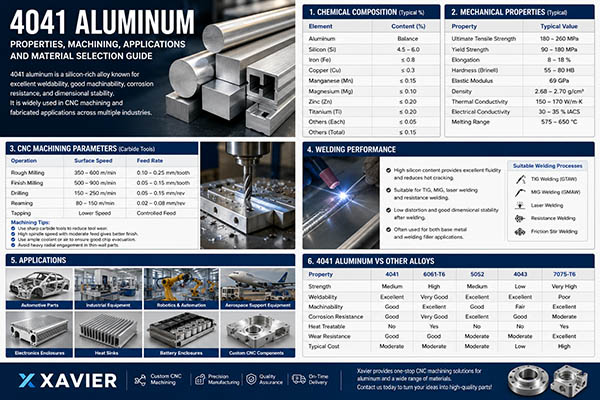
Composition and Material Characteristics of 4041 Aluminum
The defining feature of Alloy 4041 is its relatively high silicon content. Silicon changes both the manufacturing behavior and the final performance of the alloy.
Instead of maximizing strength like 7075, or balancing strength and corrosion resistance like 6061, 4041 focuses on fabrication efficiency.
Typical Chemical Composition
| Element | Typical Content |
|---|---|
| Aluminum | Balance |
| Silicon | 4.5–6.0% |
| Iron | ≤0.8% |
| Copper | ≤0.3% |
| Manganese | ≤0.15% |
| Magnesium | Low |
| Zinc | ≤0.2% |
| Titanium | Trace |
Values may vary slightly depending on specification and supplier.
Why Silicon Matters
Silicon is one of the most influential alloying elements in aluminum metallurgy.
Adding silicon provides several manufacturing advantages:
- Lower melting temperature
- Improved fluidity during welding
- Reduced solidification shrinkage
- Better resistance to hot cracking
- Enhanced dimensional stability
- More consistent weld penetration
For welding applications, these characteristics are often more valuable than simply increasing tensile strength.
For example:
If a manufacturer welds an aluminum enclosure with multiple thin-wall joints, a conventional alloy may suffer from weld cracking or distortion. A silicon-rich alloy such as 4041 allows the weld pool to flow more smoothly while reducing residual stress after cooling.
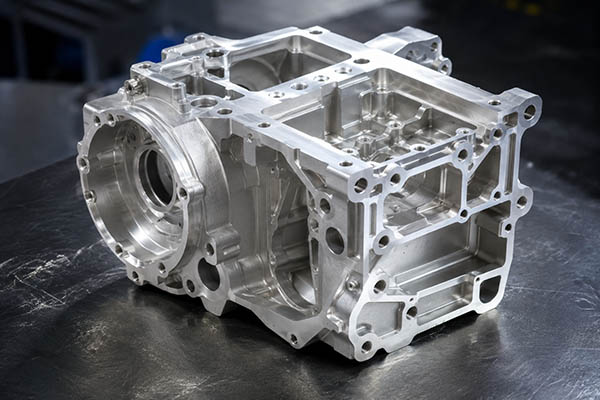
Microstructure Characteristics
Compared with 6000-series aluminum, the microstructure of 4041 contains more silicon particles distributed throughout the aluminum matrix.
These silicon particles provide several benefits:
- Better wear resistance
- Lower thermal expansion during localized heating
- More stable dimensions after welding
- Improved resistance to deformation
However, the increased silicon also introduces slightly higher tool wear during machining because silicon is considerably harder than pure aluminum. Manufacturers typically compensate by using carbide tooling and optimized cutting parameters.
Corrosion Performance
4041 naturally develops a thin aluminum oxide layer when exposed to air.
This oxide film protects the substrate against:
- Atmospheric corrosion
- Industrial environments
- Mild chemical exposure
- General humidity
Compared with marine-grade alloys such as 5052 or 5083, however, 4041 is somewhat less resistant to chloride-rich environments.
| Environment | Performance |
|---|---|
| Indoor industrial | Excellent |
| Dry outdoor | Excellent |
| Humid climate | Very Good |
| Marine atmosphere | Moderate |
| Salt spray | Moderate |
| Strong alkaline solution | Poor |
When additional protection is required, manufacturers often apply:
- Anodizing
- Powder coating
- Electroless nickel plating
- Chemical conversion coating
Heat Treatment Characteristics
Unlike precipitation-hardening aluminum alloys, 4041 is generally classified as a non-heat-treatable alloy.
Its strength is primarily influenced by:
- Cold working
- Material temper
- Manufacturing process
- Grain refinement
Instead of relying on solution heat treatment like 6061-T6, engineers usually improve performance through optimized fabrication methods.
This also means manufacturers experience fewer property variations after welding, since there is less precipitation hardening to lose inside the heat-affected zone.
Advantages Summary
| Advantage | Benefit |
|---|---|
| High silicon | Excellent weldability |
| Good fluidity | Cleaner weld beads |
| Stable dimensions | Reduced distortion |
| Moderate strength | Suitable for fabricated assemblies |
| Good corrosion resistance | Long service life |
| Easy fabrication | Lower manufacturing cost |
For projects where welding quality is more important than maximum structural strength, 4041 is often a practical and economical material choice.
Mechanical & Physical Properties
Selecting an aluminum alloy is rarely based on a single property. Engineers typically evaluate a combination of strength, hardness, density, thermal conductivity, electrical conductivity, fatigue performance, and service temperature. While 4041 aluminum is not designed to compete with high-strength aerospace alloys such as 7075, it provides a balanced set of mechanical and physical characteristics that make it an excellent choice for welded fabrications, automotive assemblies, and precision-machined components.
Typical Mechanical Properties
The following values represent common ranges for 4041 aluminum. Actual properties may vary depending on temper, manufacturing process, and supplier specifications.
| Property | Typical Value |
|---|---|
| Density | 2.68–2.70 g/cm³ |
| Ultimate Tensile Strength | 180–260 MPa |
| Yield Strength | 90–180 MPa |
| Elongation | 8–18% |
| Hardness | 55–80 HB |
| Elastic Modulus | 69 GPa |
| Thermal Conductivity | 150–170 W/m·K |
| Electrical Conductivity | Moderate |
| Melting Range | Approximately 575–650°C |
These values illustrate that 4041 aluminum offers moderate strength with good ductility, making it suitable for components that experience repeated loading but do not require the extreme strength of aerospace-grade alloys.
Tensile Strength vs. Ductility
A common misconception is that the strongest alloy is always the best choice. In reality, many industrial components fail due to cracking, distortion, or poor weld quality rather than insufficient tensile strength.
4041 aluminum strikes a practical balance:
- Strong enough for many structural and semi-structural applications
- Flexible enough to absorb localized stress
- Less prone to brittle fracture
- Better suited for welded assemblies
For example, consider an aluminum machine enclosure with multiple welded corners. A higher-strength alloy may develop cracks around the heat-affected zone after welding. In contrast, 4041 maintains better integrity because its silicon-rich composition reduces solidification stress during the welding process.
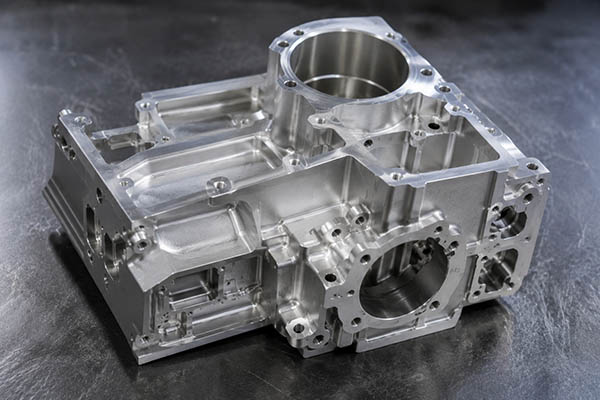
Density and Weight Advantages
Like most aluminum alloys, 4041 has a density of approximately 2.7 g/cm³, making it significantly lighter than steel.
| Material | Density |
|---|---|
| Carbon Steel | 7.85 g/cm³ |
| Stainless Steel 304 | 8.00 g/cm³ |
| Brass | 8.50 g/cm³ |
| Titanium Grade 5 | 4.43 g/cm³ |
| 4041 Aluminum | 2.70 g/cm³ |
This means a component manufactured from 4041 aluminum weighs roughly:
- 65% less than steel
- 68% less than stainless steel
- 35–40% less than titanium
Weight reduction directly benefits applications such as:
- Automotive structures
- Robotics
- Pneumatic systems
- Industrial automation
- Consumer electronics
- Portable equipment
Lower component weight also reduces transportation costs and improves energy efficiency in moving systems.
Thermal Conductivity
4041 aluminum transfers heat efficiently, making it suitable for components exposed to varying temperatures.
Typical applications benefiting from thermal conductivity include:
- Heat sinks
- Electronic housings
- Cooling plates
- Heat exchangers
- Battery enclosures
- LED lighting systems
Compared with steel, aluminum dissipates heat much faster, helping prevent localized overheating.
For example, a CNC-machined battery housing made from 4041 aluminum can distribute heat more evenly across its surface, reducing thermal hotspots and improving the overall lifespan of electronic components.
Wear Resistance
One advantage of silicon-containing aluminum alloys is improved wear resistance.
Silicon particles are considerably harder than the surrounding aluminum matrix, providing:
- Better abrasion resistance
- Reduced galling
- Improved sliding performance
- Longer service life in moving assemblies
Applications include:
- Pump housings
- Valve bodies
- Compressor components
- Mechanical guides
- Sliding fixtures
However, increased silicon content also makes the alloy slightly more abrasive to cutting tools, which is why carbide tooling is generally recommended for CNC machining.
Fatigue Performance
Many industrial components experience cyclic loading rather than constant static loads.
Examples include:
- Robotic arms
- Pneumatic actuators
- Conveyor equipment
- Industrial fixtures
- Automotive brackets
4041 aluminum provides stable fatigue resistance for moderate-duty applications. While it cannot match the fatigue strength of some heat-treated alloys, it performs reliably when components are properly designed with smooth transitions and generous fillet radii.
Engineers can further improve fatigue life by:
- Avoiding sharp internal corners
- Reducing stress concentrations
- Using appropriate surface finishes
- Maintaining consistent wall thickness
- Minimizing machining marks
Performance at Elevated Temperatures
Because of its silicon-rich composition, 4041 aluminum exhibits good dimensional stability during heating.
Compared with certain heat-treatable alloys, it experiences:
- Lower distortion during welding
- More uniform thermal expansion
- Reduced residual stress
- Better dimensional consistency after fabrication
These characteristics are particularly valuable in precision assemblies where maintaining alignment is critical.
For example, a laser-cut aluminum frame welded from 4041 is less likely to require extensive post-weld straightening than a comparable structure made from a more distortion-prone alloy.
Mechanical Property Comparison
The following table compares 4041 with several commonly used aluminum alloys.
| Property | 4041 | 4043 | 6061-T6 | 5052 |
|---|---|---|---|---|
| Strength | Medium | Low | High | Medium |
| Weldability | Excellent | Excellent | Very Good | Excellent |
| Machinability | Good | Fair | Excellent | Good |
| Corrosion Resistance | Good | Good | Very Good | Excellent |
| Wear Resistance | Good | Moderate | Good | Moderate |
| Heat Treatment | No | No | Yes | No |
This comparison shows that 4041 occupies a unique position. It provides better overall mechanical performance than 4043 while maintaining exceptional weldability, making it a versatile choice for fabricated components.
Design Considerations for Engineers
When designing parts with 4041 aluminum, engineers should consider the following best practices:
- Use generous radii to reduce stress concentration.
- Avoid unnecessary thin-wall sections near welds.
- Specify appropriate surface treatments for harsh environments.
- Optimize machining strategies to account for silicon-induced tool wear.
- Select carbide or coated cutting tools for improved tool life.
By understanding these material characteristics during the design phase, manufacturers can reduce production costs, improve component reliability, and achieve more consistent quality throughout the manufacturing process.
Machinability, Welding and Fabrication Performance
For CNC manufacturers, a material’s performance on the machine shop floor is often more important than its laboratory mechanical properties. Cycle time, tool life, chip control, dimensional accuracy, and post-processing requirements all have a direct impact on production costs.
Although 4041 aluminum is primarily recognized for its excellent welding characteristics, it also offers reliable machinability when the proper cutting tools and machining parameters are used. Its relatively high silicon content improves wear resistance but also increases tool abrasion compared with alloys such as 6061.
Understanding these manufacturing characteristics allows engineers to maximize productivity while maintaining consistent part quality.
CNC Machinability of 4041 Aluminum
4041 aluminum is generally considered to have good machinability, though it is slightly more challenging to machine than 6061-T6 because the dispersed silicon particles are considerably harder than the surrounding aluminum matrix.
During cutting, these hard particles can gradually wear the cutting edge, especially in long production runs.
However, compared with many stainless steels or titanium alloys, 4041 remains an easy material to machine and supports high spindle speeds and feed rates.
Machining Characteristics
| Characteristic | Performance |
|---|---|
| Chip Formation | Good |
| Surface Finish | Excellent |
| Tool Wear | Moderate |
| Burr Formation | Low |
| Cutting Force | Low |
| Heat Generation | Low |
| Dimensional Stability | Excellent |
The alloy’s relatively low cutting force makes it suitable for machining thin-wall components with minimal deformation.
Recommended Cutting Tools
Selecting the appropriate cutting tool has a significant impact on machining efficiency.
For most CNC milling operations, solid carbide tools provide the best combination of wear resistance and surface quality.
Recommended tooling includes:
| Operation | Recommended Tool |
|---|---|
| Face Milling | Carbide Face Mill |
| Pocket Milling | 3-Flute Carbide End Mill |
| High-Speed Milling | DLC-Coated Carbide |
| Drilling | Carbide Drill |
| Reaming | Carbide Reamer |
| Thread Milling | Carbide Thread Mill |
Compared with high-speed steel tools, carbide tooling generally offers:
- Longer tool life
- Higher cutting speeds
- Better dimensional consistency
- Improved surface finish
- Lower production cost in high-volume manufacturing
For mirror-finish components, polished-flute carbide end mills are often preferred because they reduce aluminum adhesion on the cutting edge.
Suggested CNC Cutting Parameters
The optimal machining parameters depend on machine rigidity, tool geometry, coolant strategy, and workpiece configuration. The following values provide a useful starting point for carbide tooling.
| Operation | Surface Speed | Feed Rate |
|---|---|---|
| Rough Milling | 350–600 m/min | Medium–High |
| Finish Milling | 500–900 m/min | Medium |
| Drilling | 150–250 m/min | Moderate |
| Reaming | 80–150 m/min | Low |
| Tapping | Lower Speed | Controlled Feed |
When machining thin-wall parts, reducing radial engagement while maintaining higher spindle speeds helps minimize vibration and deformation.
Chip Control
One advantage of 4041 aluminum is its ability to produce relatively manageable chips.
Good chip evacuation contributes to:
- Better surface finish
- Lower tool temperature
- Reduced recutting
- Improved dimensional accuracy
To optimize chip control:
- Use sharp cutting tools.
- Maintain adequate coolant flow.
- Avoid excessive depth of cut in finishing operations.
- Apply high-pressure air or coolant to clear chips from deep pockets.
Proper chip evacuation becomes especially important when machining deep cavities or narrow slots.
Surface Finish Capability
With optimized machining parameters, 4041 aluminum can achieve excellent cosmetic finishes suitable for visible components.
Typical achievable surface roughness values include:
| Process | Typical Ra |
|---|---|
| Rough Milling | 3.2–6.3 μm |
| Finish Milling | 0.8–1.6 μm |
| Fine Finishing | 0.4–0.8 μm |
| Polishing | Below 0.2 μm |
Applications requiring attractive cosmetic surfaces include:
- Consumer electronics
- Medical equipment
- Instrument panels
- Decorative housings
- Precision mechanical assemblies
Welding Performance
The outstanding welding behavior of 4041 aluminum is one of the primary reasons it is widely used in fabricated assemblies.
Its elevated silicon content lowers the melting range and improves molten metal fluidity, producing smooth, uniform weld beads with a reduced tendency for hot cracking.
Compared with many other aluminum alloys, 4041 offers:
- Excellent weld pool flow
- Stable arc characteristics
- Reduced weld shrinkage
- Lower crack sensitivity
- Minimal distortion
- Good appearance after welding
These characteristics make it especially suitable for complex welded structures and precision fabrications.
Suitable Welding Processes
4041 aluminum is compatible with several common welding methods.
| Welding Process | Suitability |
|---|---|
| TIG Welding (GTAW) | Excellent |
| MIG Welding (GMAW) | Excellent |
| Laser Welding | Good |
| Resistance Welding | Good |
| Friction Stir Welding | Very Good |
Among these, TIG welding is often selected for thin-wall or high-precision components because it provides excellent control over heat input and weld quality. MIG welding is generally preferred for thicker sections and higher production rates.
Fabrication Performance
In addition to machining and welding, 4041 aluminum performs well in a variety of secondary fabrication processes.
Typical fabrication capabilities include:
- CNC milling
- CNC turning
- Precision drilling
- Tapping
- Saw cutting
- Waterjet cutting
- Laser cutting
- Grinding
- Deburring
Because of its balanced mechanical properties and good dimensional stability, manufacturers can often complete multiple operations with minimal risk of distortion.
Formability
4041 aluminum offers moderate formability.
Although it is not intended for severe deep-drawing operations, it performs well in:
- Simple bending
- Roll forming
- Light stamping
- Press brake operations
- Flanging
Engineers should avoid extremely small bend radii, as the silicon-rich microstructure may reduce ductility compared with alloys specifically designed for forming.
Heat-Affected Zone (HAZ) Performance
A common challenge in welded aluminum structures is the reduction of mechanical properties in the heat-affected zone.
Because 4041 is not heavily dependent on precipitation hardening, the loss of strength after welding is generally less dramatic than in alloys such as 6061-T6.
Benefits include:
- Better dimensional stability
- Reduced post-weld correction
- More predictable mechanical performance
- Lower residual stress
- Improved production consistency
This makes 4041 a practical material for assemblies that require both machining and extensive welding.
Post-Machining Surface Treatments
To further enhance appearance, durability, and corrosion resistance, manufacturers often apply one or more surface finishing processes after machining.
| Surface Treatment | Primary Benefit |
|---|---|
| Anodizing | Improved corrosion resistance and wear resistance |
| Powder Coating | Decorative finish and environmental protection |
| Chemical Conversion Coating | Enhanced paint adhesion and corrosion protection |
| Electroless Nickel Plating | Increased hardness and wear resistance |
| Polishing | Smooth cosmetic appearance |
| Sand Blasting | Uniform matte texture |
The choice of finish depends on the application’s environmental conditions, appearance requirements, and functional needs. For example, anodizing is commonly selected for industrial equipment and consumer products, while electroless nickel plating is preferred for components requiring enhanced wear resistance.
Manufacturing Best Practices
To achieve consistent, high-quality results when machining and fabricating 4041 aluminum, experienced manufacturers typically follow these guidelines:
- Use sharp carbide tools to minimize wear caused by silicon particles.
- Maintain high spindle speeds with moderate feed rates to achieve a superior surface finish.
- Ensure effective chip evacuation through adequate coolant or compressed air.
- Control heat input during welding to reduce distortion.
- Design components with smooth transitions and generous radii to minimize stress concentration.
- Select the most appropriate surface treatment based on the part’s operating environment.
By combining proper machining strategies with suitable welding and finishing processes, manufacturers can fully leverage the advantages of 4041 aluminum while reducing production costs and improving long-term component performance.
Applications Across Different Industries
Although 4041 aluminum is not as universally recognized as 6061 or 7075, it occupies an important position in industries where excellent weldability, good machinability, dimensional stability, and moderate mechanical strength are required. Its silicon-rich composition makes it particularly suitable for fabricated structures and precision components that combine CNC machining with welding operations.
Rather than serving as a high-strength structural alloy, 4041 is often selected because it simplifies manufacturing while maintaining reliable long-term performance.
Automotive Industry
The automotive industry continuously seeks materials that reduce vehicle weight without compromising manufacturability. 4041 aluminum helps manufacturers achieve this balance.
Common automotive applications include:
- Transmission housings
- Sensor brackets
- Engine mounting components
- Cooling system fittings
- Battery enclosures
- Structural reinforcement brackets
- Custom prototype parts
Why Automotive Engineers Choose 4041
Compared with steel components, 4041 aluminum offers significant weight savings while allowing manufacturers to produce complex welded assemblies with reduced distortion.
| Requirement | Benefit of 4041 Aluminum |
|---|---|
| Weight reduction | Excellent |
| Weldability | Excellent |
| Dimensional stability | Very Good |
| Corrosion resistance | Good |
| Production efficiency | High |
Example
A manufacturer producing electric vehicle battery trays may CNC machine multiple aluminum panels before joining them through TIG welding. Because 4041 exhibits excellent weld fluidity and low crack sensitivity, post-weld rework is minimized, reducing production time and improving dimensional accuracy.
Industrial Equipment Manufacturing
Industrial automation equipment often contains hundreds of precision-machined aluminum components.
Typical applications include:
- Machine frames
- Pneumatic manifolds
- Positioning fixtures
- Robotic end effectors
- Guide plates
- Automation brackets
- Conveyor components
These parts require:
- Tight machining tolerances
- Stable dimensions after welding
- Good corrosion resistance
- Reliable fatigue performance
4041 aluminum satisfies these requirements while remaining relatively economical compared with specialty aluminum alloys.
Robotics and Automation
Modern robots rely on lightweight yet rigid components to maximize speed and positioning accuracy.
Typical CNC-machined robotic parts include:
- Joint housings
- Servo motor brackets
- Camera mounts
- Sensor supports
- End-of-arm tooling
- Precision adapter plates
Because robotic systems undergo repeated acceleration and deceleration, minimizing weight directly reduces inertia and energy consumption.
For example, replacing a steel robot bracket with a 4041 aluminum component can reduce weight by approximately 65%, enabling faster movement and lower motor loads without sacrificing manufacturing precision.
Aerospace Support Equipment
Although aircraft primary structures generally use high-strength alloys such as 7075 or 2024, 4041 aluminum is often employed in aerospace support equipment and non-critical components.
Typical examples include:
- Ground support fixtures
- Inspection tools
- Equipment housings
- Instrument brackets
- Maintenance jigs
- Alignment fixtures
The alloy’s excellent weldability and dimensional stability help manufacturers produce lightweight assemblies with consistent quality.
Electronics and Thermal Management
Electronic devices continue to become smaller while generating more heat, making thermal management increasingly important.
4041 aluminum’s good thermal conductivity makes it suitable for:
- Heat sinks
- LED lighting housings
- Power supply enclosures
- Battery cooling plates
- Communication equipment
- Electronic chassis
Benefits for Electronics
| Property | Value to Electronics |
|---|---|
| Lightweight | Easier installation |
| Thermal conductivity | Efficient heat dissipation |
| Corrosion resistance | Longer service life |
| Machinability | Complex housing designs |
| Surface finish | Attractive appearance |
For instance, a CNC-machined control box made from 4041 aluminum can efficiently transfer heat away from sensitive electronics while maintaining an attractive anodized finish.
Custom CNC Manufacturing
For companies specializing in custom machining, 4041 aluminum is a practical choice for low- to medium-volume production where parts require both precision machining and welding.
Typical custom-manufactured components include:
- Prototype parts
- Medical device housings
- Industrial connectors
- Valve bodies
- Fixture plates
- Custom brackets
- Specialized mechanical assemblies
Its versatility allows manufacturers to complete multiple operations—milling, turning, drilling, tapping, welding, and finishing—using a single material, reducing inventory complexity.
4041 Aluminum vs. Other Common Aluminum Alloys
Selecting the appropriate aluminum alloy requires understanding the trade-offs between strength, weldability, machinability, corrosion resistance, and cost.
The following comparison highlights where 4041 fits among several widely used aluminum alloys.
Comparison Table
| Property | 4041 | 6061-T6 | 5052 | 4043 | 7075-T6 |
|---|---|---|---|---|---|
| Strength | Medium | High | Medium | Low | Very High |
| Weldability | Excellent | Very Good | Excellent | Excellent | Poor |
| Machinability | Good | Excellent | Good | Fair | Excellent |
| Corrosion Resistance | Good | Very Good | Excellent | Good | Moderate |
| Heat Treatable | No | Yes | No | No | Yes |
| Wear Resistance | Good | Good | Moderate | Moderate | Excellent |
| Cost | Moderate | Moderate | Moderate | Low | High |
4041 vs. 6061
6061-T6 is one of the most commonly used aluminum alloys in CNC machining due to its excellent balance of strength, machinability, and corrosion resistance.
However, 4041 offers several advantages in fabrication:
4041 Advantages
- Better weld fluidity
- Lower risk of hot cracking
- Reduced weld distortion
- More stable post-weld dimensions
6061 Advantages
- Higher tensile strength
- Better structural performance
- Wider availability
- Greater design familiarity
When to choose 4041: Components involving extensive welding where dimensional stability is critical.
When to choose 6061: Structural parts requiring higher mechanical strength with limited welding.
4041 vs. 5052
5052 is well known for its exceptional corrosion resistance, particularly in marine environments.
Compared with 5052:
- 4041 provides better wear resistance because of its silicon content.
- 5052 performs better in saltwater exposure.
- Both alloys offer excellent weldability.
- 5052 is easier to form into complex sheet-metal components.
For outdoor marine equipment, 5052 is often preferred. For machined and welded assemblies, 4041 may provide better overall manufacturing efficiency.
4041 vs. 4043
These two alloys are frequently compared because both belong to the 4xxx series and contain elevated silicon levels.
| Feature | 4041 | 4043 |
|---|---|---|
| Strength | Higher | Lower |
| Machining | Better | Fair |
| Structural Components | Yes | Limited |
| Welding Filler | Sometimes | Widely Used |
4043 is primarily recognized as a welding filler alloy, while 4041 is more suitable for machined and fabricated components requiring greater mechanical performance.
4041 vs. 7075
7075 is one of the strongest commercially available aluminum alloys and is widely used in aerospace and high-performance applications.
Compared with 7075:
- 4041 is much easier to weld.
- 4041 offers better fabrication flexibility.
- 7075 delivers significantly higher strength.
- 7075 is considerably more expensive.
- 7075 is more susceptible to stress corrosion cracking.
For highly loaded aerospace structures, 7075 remains the preferred choice. For precision welded fabrications, 4041 is often the more practical and cost-effective solution.
Choosing the Right Alloy
The best aluminum alloy depends on the priorities of the application.
| Design Priority | Recommended Alloy |
|---|---|
| Maximum Strength | 7075 |
| General CNC Machining | 6061 |
| Marine Environment | 5052 |
| Precision Welding | 4041 |
| Welding Filler Material | 4043 |
Rather than asking, “Which alloy is the best?”, engineers should ask, “Which alloy best matches the manufacturing process and service conditions?”
A careful evaluation of mechanical requirements, fabrication methods, environmental exposure, and budget will lead to a more efficient and reliable design.
Conclusion
4041 aluminum occupies a valuable niche in modern manufacturing by combining good machinability, excellent weldability, reliable corrosion resistance, and stable mechanical performance. While it may not match the strength of aerospace-grade alloys like 7075 or the widespread popularity of 6061, it excels in applications where fabrication quality and dimensional stability are the primary concerns.
For manufacturers producing precision-machined and welded aluminum components, selecting the right material is only part of the equation. Equally important is partnering with an experienced CNC machining supplier capable of delivering tight tolerances, consistent quality, and dependable lead times.
Xavier specializes in custom CNC machining services for aluminum, stainless steel, titanium, brass, copper, engineering plastics, and other advanced materials. Whether you need rapid prototypes, low-volume production, or high-volume precision manufacturing, our experienced engineering team provides comprehensive support—from material selection and design optimization to machining, surface finishing, and quality inspection—to help bring your projects to market efficiently and cost-effectively.
We are an integrated manufacturer specializing in CNC machining services, providing custom CNC machining solutions for a wide variety of precision metal and plastic components. Our expertise includes CNC Titanium Machining, CNC PEEK Machining, and CNC Brass Machining. We manufacture high-precision parts for robotics, aerospace, marine, automotive, medical, and other demanding industrial applications.
As a professional CNC Titanium Machining Manufacturer, we provide high-volume CNC PEEK Machining Services. Contact us today for competitive CNC Brass Machining Prices, or learn more about 4041 Aluminum. Feel free to get in touch with us for your next custom machining project.
Some of the images and text in this article are collected and compiled from the internet. If there is anything inappropriate, please contact us for processing.