
This article summarizes five key points:
- Why Aluminum Is the Preferred Material for Heat Sinks
- Comparison of Aluminum Alloys (6063 vs 6061 vs 1050 vs Copper)
- Manufacturing Methods for Aluminum Heat Sinks
- Heat Sink Design Factors That Affect Thermal Performance
- Applications and Material Selection Guide for Different Industries
Why Aluminum Is the Most Popular Heat Sink Material
Modern electronic equipment continues to become smaller while generating more heat. Whether it is an industrial controller, LED lighting system, automotive ECU, telecom equipment, or power inverter, excessive temperature reduces efficiency and significantly shortens component lifespan.
Among all thermal management materials available today, aluminum has become the industry’s preferred choice because it offers an excellent balance between thermal performance, weight, cost, machinability, and corrosion resistance.
Unlike copper, which provides extremely high thermal conductivity but comes with higher cost and weight, aluminum provides enough heat dissipation for the majority of commercial and industrial applications while remaining economical to manufacture.
The combination of extrusion technology and CNC machining further allows manufacturers to produce intricate fin structures that maximize cooling efficiency without dramatically increasing production costs.
Main Advantages of Aluminum Heat Sink Materials
| Property | Aluminum | Copper | Engineering Impact |
|---|---|---|---|
| Thermal Conductivity | 150–230 W/m·K | 390–400 W/m·K | Fast heat transfer |
| Density | 2.70 g/cm³ | 8.96 g/cm³ | Aluminum is about 70% lighter |
| Corrosion Resistance | Excellent | Good | Longer outdoor life |
| CNC Machinability | Excellent | Moderate | Lower machining cost |
| Extrudability | Excellent | Poor | Complex fin structures possible |
| Material Cost | Low | High | Better overall value |
Although copper conducts heat nearly twice as efficiently, aluminum’s low density means engineers can build larger heat sinks with more surface area while keeping the overall product lightweight.
For example, an industrial LED driver producing 120W of heat generally performs very well with an extruded aluminum heat sink, while using copper would increase both manufacturing cost and shipping weight without providing proportional performance improvements.
Why Surface Area Often Matters More Than Thermal Conductivity
Many beginners assume that selecting the material with the highest thermal conductivity automatically produces the best heat sink.
In reality, thermal conductivity represents only one part of the cooling process.
Heat must first travel from the electronic component into the base plate, then spread throughout the fins before finally transferring into surrounding air through convection.
If airflow is poor or fin spacing is incorrect, even copper cannot compensate for inadequate design.
A properly designed aluminum heat sink with optimized fin geometry frequently outperforms a heavier copper heat sink of similar size because aluminum can be extruded into thinner, taller, and more numerous fins that dramatically increase total cooling surface area.
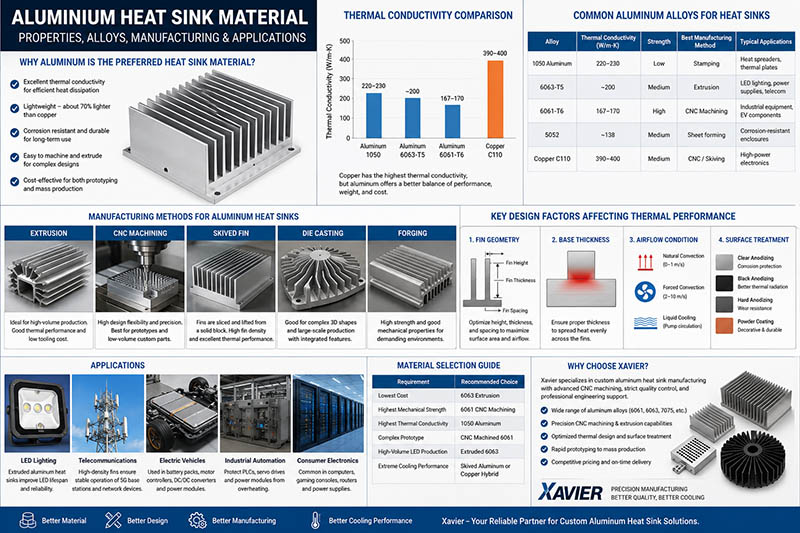
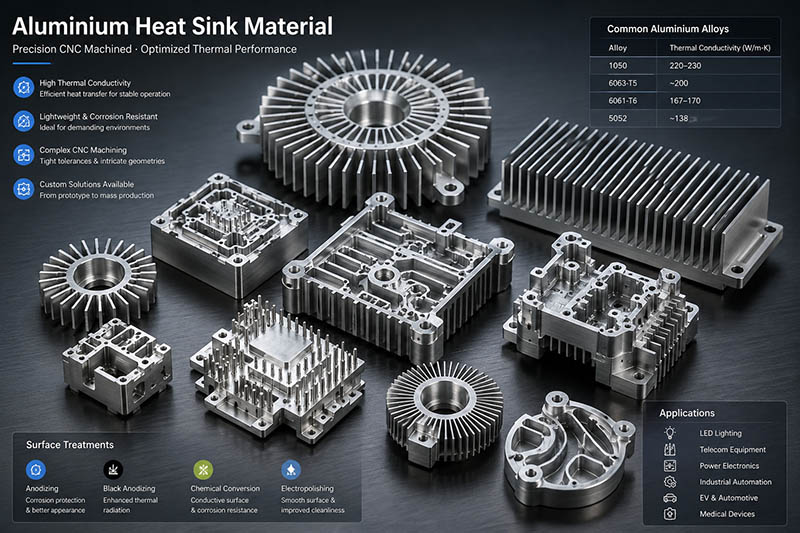
Comparison of Common Aluminum Alloys for Heat Sink Manufacturing
Not all aluminum alloys deliver the same balance of thermal conductivity, strength, or manufacturability. Selecting the appropriate grade depends on the cooling requirement, production process, and mechanical demands of the final application.
The most frequently used alloys include 6063, 6061, and 1050, while copper remains an option for extreme thermal requirements.
Thermal Performance Comparison
| Material | Thermal Conductivity (W/m·K) | Strength | Best Manufacturing Method | Typical Applications |
|---|---|---|---|---|
| 1050 Aluminum | 220–230 | Low | Stamping | Heat spreaders |
| 6063-T5 | ~200 | Medium | Extrusion | LED heat sinks |
| 6061-T6 | 167–170 | High | CNC Machining | Industrial equipment |
| 5052 | ~138 | Medium | Sheet forming | Corrosion-resistant enclosures |
| Copper C110 | 390–400 | Medium | CNC/Skiving | High-power electronics |
6063 Aluminum — The Industry Standard
Approximately the majority of extruded heat sinks are manufactured from 6063 aluminum because it combines:
- Excellent extrusion capability
- Smooth surface finish
- High corrosion resistance
- Good anodizing response
- Thermal conductivity around 200 W/m·K
Its relatively soft composition allows manufacturers to create thin fins with high aspect ratios, increasing cooling surface area while maintaining structural stability.
Common applications include:
- LED lighting
- Communication equipment
- Consumer electronics
- Power adapters
- Power supplies
6061 Aluminum — Better for CNC Machining
6061 aluminum sacrifices a small amount of thermal conductivity in exchange for significantly higher mechanical strength.
It is commonly selected when the heat sink also functions as a structural component.
Examples include:
- Aerospace electronics
- Robotics
- EV battery cooling plates
- Industrial automation
- CNC-machined custom heat sinks
Compared with 6063, 6061 machines exceptionally well, making it ideal for prototypes and low-volume custom production.
1050 Pure Aluminum — Highest Conductivity but Limited Strength
Pure aluminum grades such as 1050 offer thermal conductivity exceeding 220 W/m·K.
However, their relatively low strength limits their use to:
- Thin thermal spreaders
- Battery tabs
- Electronic shielding
- Lightweight thermal plates
Complex fins are rarely manufactured from pure aluminum because deformation can occur during production.
Manufacturing Methods for Aluminum Heat Sink Materials
Selecting the right aluminum alloy is only half of the equation. The manufacturing process has an equally significant impact on thermal performance, production cost, dimensional accuracy, and scalability. Depending on the complexity of the heat sink and production volume, manufacturers typically choose from extrusion, CNC machining, skiving, die casting, forging, or bonded-fin assembly.
Each method offers unique advantages, making it suitable for different industries and applications.
Extruded Aluminum Heat Sinks
Extrusion is by far the most common manufacturing method for aluminum heat sinks. A heated aluminum billet—typically 6063 alloy—is forced through a precision die to create a continuous profile with integrated fins. The profile is then cut to the desired length, machined if necessary, and surface finished.
Because the fins are formed directly from the base material, there is no thermal interface between the base and fins, allowing heat to flow efficiently throughout the structure.
Advantages of extrusion include:
- Low tooling cost compared with die casting
- Excellent thermal performance
- Suitable for medium to high production volumes
- Consistent dimensional accuracy
- Lightweight construction
- Easy anodizing after machining
Typical applications include:
- LED street lights
- Power supplies
- Communication equipment
- Solar inverters
- Industrial control systems
Example:
An LED floodlight generating approximately 80 W of thermal energy often uses a 6063 extruded heat sink with 25–40 fins. The large surface area allows natural convection to dissipate heat without requiring a cooling fan, reducing maintenance while extending LED lifespan.
CNC Machined Heat Sinks
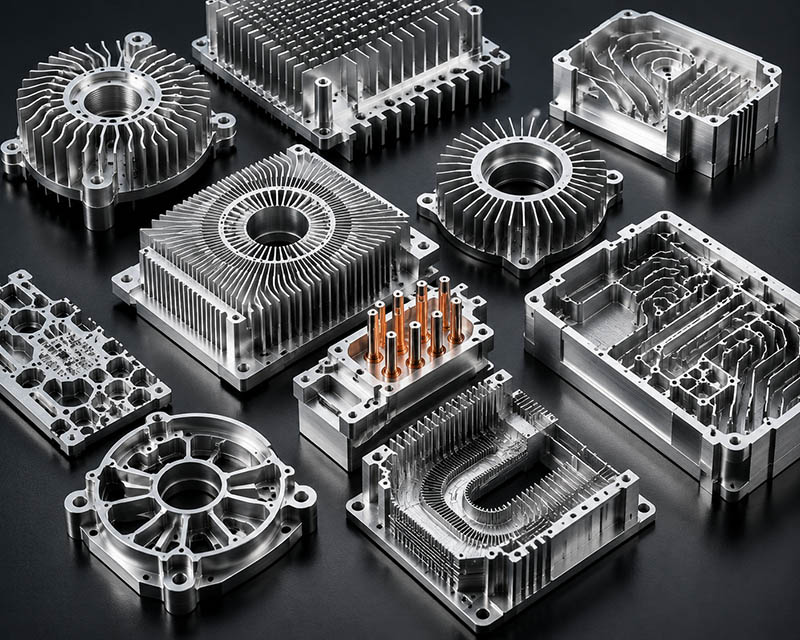
When standard extrusions cannot meet design requirements, CNC machining provides maximum flexibility. Heat sinks are milled from solid aluminum blocks, usually 6061-T6 or 6063.
Unlike extrusion, CNC machining allows engineers to create complex geometries such as:
- Circular fin arrays
- Irregular contours
- Deep pockets
- Multi-level cooling structures
- Precision mounting features
- Integrated channels for liquid cooling
Although CNC machining generates more material waste and requires longer production times, it is the preferred solution for prototypes, custom projects, and low-volume production.
| Feature | Extrusion | CNC Machining |
|---|---|---|
| Design Flexibility | Moderate | Excellent |
| Production Volume | High | Low to Medium |
| Tooling Cost | Moderate | Low |
| Material Utilization | Excellent | Moderate |
| Surface Finish | Good | Excellent |
| Precision | ±0.2 mm | ±0.01 mm or better |
For aerospace electronics or high-performance robotics, CNC machining often becomes the only practical solution because every cooling structure can be optimized around surrounding components.
Skived Fin Heat Sinks
Skiving is a specialized manufacturing process in which thin fins are sliced and lifted directly from a solid aluminum block.
Since the fins remain connected to the base, thermal resistance is extremely low.
Compared with traditional extrusion, skived fins can achieve:
- Higher fin density
- Taller fins
- Thinner fin thickness
- Better airflow efficiency
These characteristics make skived heat sinks suitable for applications requiring high heat dissipation in limited installation space.
Typical products include:
- CPU coolers
- GPU modules
- High-power laser equipment
- Telecom base stations
- Medical imaging devices
Die Casting and Forged Heat Sinks
Although less common than extrusion, die casting and forging are valuable for certain designs.
Die Casting
Die casting enables manufacturers to produce highly detailed three-dimensional shapes that would be difficult or impossible to extrude.
Advantages include:
- Complex geometry
- Integrated mounting features
- High-volume production
- Reduced secondary machining
However, cast aluminum generally has lower thermal conductivity due to internal porosity.
Forging
Forged aluminum heat sinks exhibit excellent mechanical strength because the metal grain structure is compressed during forming.
Forged heat sinks are commonly found in:
- Military electronics
- Automotive power modules
- Heavy-duty industrial equipment
Heat Sink Design Factors That Affect Thermal Performance
Material selection alone cannot determine cooling performance. Two heat sinks made from the same aluminum alloy can exhibit dramatically different temperatures depending on their design.
Engineers evaluate several structural parameters during thermal design.
Fin Geometry
Fins increase the total surface area exposed to air.
The following variables significantly affect cooling efficiency:
- Fin height
- Fin thickness
- Fin spacing
- Fin quantity
- Fin orientation
Increasing fin height generally improves cooling, but excessively tall fins may restrict airflow.
Likewise, placing fins too close together can trap hot air, reducing convection efficiency.
The following table illustrates a simplified relationship.
| Design Parameter | Effect on Cooling |
|---|---|
| Higher fins | Increased surface area |
| Thinner fins | Better heat transfer but reduced strength |
| Proper spacing | Improved airflow |
| More fins | Greater surface area until airflow becomes restricted |
For natural convection, fin spacing between approximately 6 mm and 10 mm is often effective for medium-sized heat sinks, although the optimal value depends on operating conditions.
Base Thickness
The base of a heat sink acts as the primary pathway that spreads heat from the electronic component into the fins.
If the base is too thin:
- Heat concentrates near the center.
- Outer fins remain underutilized.
If the base is excessively thick:
- Material cost increases.
- Overall weight rises.
- Additional thickness contributes little to performance.
Engineers typically use thermal simulation software to determine the optimal base thickness based on heat load and contact area.
Airflow Conditions
Heat sinks rely on either natural convection or forced convection.
| Cooling Method | Air Velocity | Typical Applications |
|---|---|---|
| Natural Convection | 0–1 m/s | LED lighting, passive electronics |
| Forced Convection | 2–10 m/s | Servers, industrial PCs |
| Liquid Cooling | Pump circulation | EV batteries, high-power electronics |
Introducing even a modest cooling fan can significantly improve heat dissipation by increasing airflow between fins.
For example, a passive aluminum heat sink operating at 85°C under natural convection may see its temperature reduced to around 60°C when paired with an appropriately sized fan, depending on the system design and ambient conditions.
Surface Treatment
Surface finishing not only improves appearance but also affects thermal radiation and corrosion resistance.
Common treatments include:
| Surface Finish | Benefits |
|---|---|
| Clear Anodizing | Corrosion protection |
| Black Anodizing | Improved thermal radiation |
| Hard Anodizing | Increased wear resistance |
| Chemical Conversion Coating | Electrical conductivity retained |
| Powder Coating | Decorative appearance |
Black anodizing is widely used because the darker surface emits thermal radiation more effectively than untreated aluminum, particularly in passive cooling environments.
Applications and Material Selection Guide
Aluminum heat sinks are used across virtually every industry where electronic components generate heat.
The required alloy, manufacturing process, and design vary according to operating conditions.
Consumer Electronics
Examples include:
- Desktop computers
- Gaming consoles
- Wi-Fi routers
- Television power supplies
- Laptop docking stations
Most consumer products prioritize low manufacturing cost while maintaining acceptable thermal performance. Extruded 6063 aluminum is usually sufficient.
LED Lighting
LED chips convert only part of the electrical energy into visible light, with the remainder becoming heat.
Poor thermal management can result in:
- Reduced brightness
- Color shift
- Shortened service life
- Premature driver failure
Extruded aluminum heat sinks with black anodized surfaces are widely used to maximize passive cooling efficiency in indoor and outdoor lighting.
Electric Vehicles
Electric vehicles generate substantial heat in:
- Battery packs
- Motor controllers
- DC/DC converters
- On-board chargers
- Power distribution units
These systems often require CNC-machined or liquid-cooled aluminum heat sinks featuring integrated cooling channels and precision mounting surfaces.
Telecommunications
5G base stations, network switches, and communication servers operate continuously under high electrical loads.
Reliable cooling is essential to prevent overheating and maintain uninterrupted operation.
Many telecom heat sinks combine:
- Extruded aluminum
- CNC finishing
- Precision flatness
- Black anodizing
- High-density fins
This combination balances thermal efficiency with large-scale production.
Industrial Automation
Industrial control cabinets frequently contain:
- PLC controllers
- Servo drives
- Variable frequency drives
- Industrial PCs
- Power modules
These systems often operate in dusty or high-temperature environments where passive cooling is preferred to reduce maintenance.
Aluminum heat sinks offer an excellent combination of durability, corrosion resistance, and ease of customization for these demanding applications.
Choosing the Right Aluminum Heat Sink Material
The optimal aluminum heat sink depends on the specific application rather than a single “best” alloy.
| Requirement | Recommended Choice |
|---|---|
| Lowest Cost | 6063 Extrusion |
| Highest Mechanical Strength | 6061 CNC Machining |
| Highest Thermal Conductivity | 1050 Aluminum |
| Complex Prototype | CNC Machined 6061 |
| High-Volume LED Production | Extruded 6063 |
| Lightweight Industrial Equipment | 6063-T5 |
| Extreme Cooling Performance | Skived Aluminum or Copper Hybrid |
By evaluating heat load, available space, airflow conditions, production volume, and budget together, engineers can select the most effective thermal management solution for their products.
Why Work with Xavier for Custom Aluminum Heat Sinks
Selecting the right aluminum alloy is only the first step in building an effective thermal management solution. Precision manufacturing, optimized fin geometry, tight machining tolerances, and consistent surface finishing all contribute to long-term cooling performance.
At Xavier, we specialize in custom CNC machining and aluminum component manufacturing for customers across industries such as electronics, industrial automation, robotics, telecommunications, medical devices, and renewable energy. Whether you require a simple extruded heat sink or a highly complex CNC-machined cooling solution with intricate fins and mounting features, our engineering team can help transform your design into production-ready parts.
With advanced CNC machining centers, strict quality control, and extensive experience machining aluminum alloys including 6061, 6063, 7075, and other engineering materials, Xavier delivers precision heat sink components that meet demanding thermal and mechanical requirements. From rapid prototyping to high-volume manufacturing, we are committed to providing reliable quality, competitive pricing, and on-time delivery for every project.
We are an integrated manufacturer and supplier specializing in CNC machining services, providing custom CNC machining solutions for a wide range of precision metal and engineering plastic components. Our manufacturing capabilities include CNC Titanium Machining, CNC PEEK Machining, and CNC Brass Machining. We support projects for robotics, aerospace, marine, automotive, medical devices, and other high-precision industrial applications. Learn more about aluminium heat sink material.
As a professional CNC Titanium Machining Manufacturer, we provide high-volume CNC PEEK Machining Services. Contact us today to request competitive CNC Brass Machining Prices and discuss your custom manufacturing requirements.
Some of the images and text in this article are collected and compiled from the internet. If there is anything inappropriate, please contact us for processing.