
Titanium Colouring: The Complete Guide to Titanium Anodizing Colors, Voltage Charts, Applications, and CNC Manufacturing
Titanium colouring is one of the most fascinating surface treatment technologies used in modern manufacturing. Unlike paint, powder coating, or dyeing, titanium develops colors naturally through a controlled oxide layer formed during anodizing. This process is widely used in aerospace, medical devices, consumer products, watches, bicycles, jewelry, and precision CNC-machined components.
For engineers, designers, and buyers sourcing titanium parts, understanding how titanium colouring works can help optimize aesthetics, corrosion resistance, identification systems, and product value.
What Is Titanium Colouring?
Titanium colouring refers to the process of creating different colors on titanium surfaces by controlling the thickness of the titanium oxide layer. The most common method is titanium anodizing.
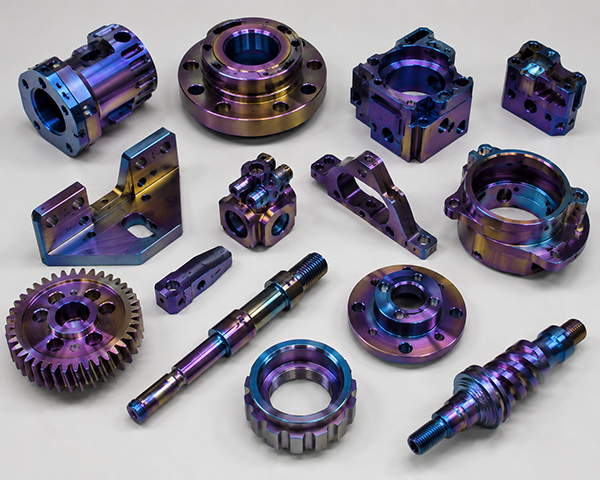
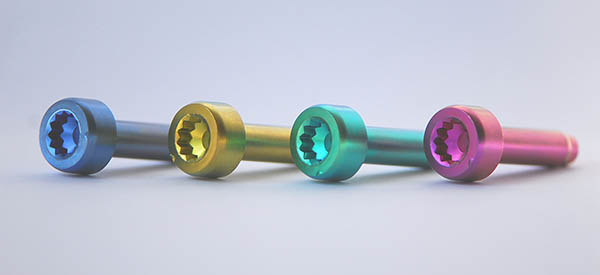
Unlike aluminum anodizing, titanium colors are not created with dyes. Instead, colors result from light interference within the oxide layer. Different oxide thicknesses reflect different wavelengths of visible light, producing colors such as:
- Gold
- Purple
- Blue
- Cyan
- Green
- Magenta
- Bronze
The resulting color depends primarily on the anodizing voltage applied during processing.
Example
A CNC-machined titanium bicycle stem may appear blue at 35V, while the same part anodized at 90V can appear green.
The Science Behind Titanium Colors
Titanium naturally forms a thin oxide layer when exposed to oxygen.
During anodizing:
- Titanium becomes the anode.
- Electric current passes through an electrolyte.
- Oxide thickness increases.
- Light interacts with the oxide layer.
- Optical interference creates visible color.
This phenomenon is similar to the colors seen in:
- Soap bubbles
- Oil films on water
- Butterfly wings
The color is not a pigment. It is an optical effect generated by oxide thickness measured in nanometers.
Titanium Anodizing vs Traditional Coloring Methods
| Method | Color Source | Wear Resistance | Environmental Impact | Thickness |
|---|---|---|---|---|
| Titanium Anodizing | Oxide interference | Excellent | Very low | Nanometer scale |
| Painting | Pigment | Moderate | Medium | 20–100 μm |
| Powder Coating | Polymer coating | High | Medium | 60–150 μm |
| Electroplating | Deposited metal | High | Higher | Variable |
| Dyeing | Organic dyes | Low | Medium | Surface only |
One major advantage is that anodized titanium colors cannot peel because there is no coating layer sitting on top of the material.
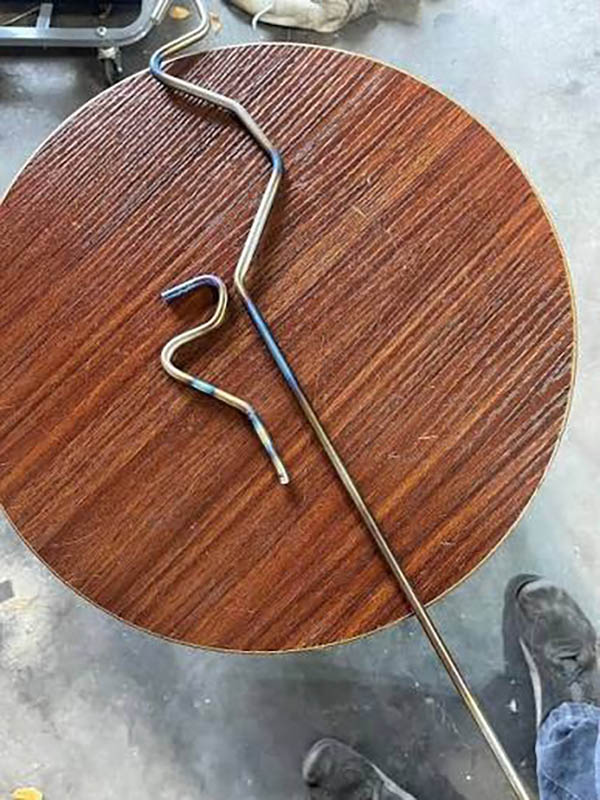
Titanium Anodizing Voltage and Color Chart
The relationship between voltage and color is one of the most important aspects of titanium colouring.
Typical Industry Color Chart
| Voltage (DC) | Typical Color |
|---|---|
| 10–15V | Bronze |
| 20–25V | Purple |
| 30–40V | Dark Blue |
| 40–50V | Light Blue |
| 50–60V | Gold |
| 60–70V | Pink / Magenta |
| 80–90V | Teal |
| 90–100V | Green |
Actual results vary based on:
- Surface finish
- Titanium grade
- Electrolyte composition
- Part geometry
- Light conditions
Real Manufacturing Example
A Grade 5 Titanium aerospace bracket polished to Ra 0.4 μm may produce a vibrant blue at 35V, while the same bracket with a bead-blasted finish may appear darker and less saturated.
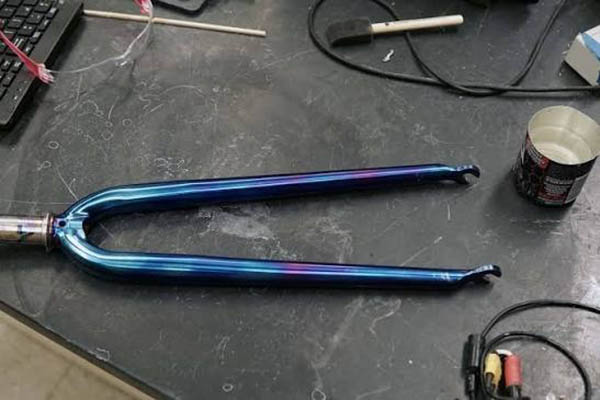
Why Surface Finish Affects Titanium Colouring
Many people assume voltage alone determines color.
In reality, surface preparation plays a critical role.
Surface Finish Comparison
| Finish Type | Appearance After Anodizing |
|---|---|
| Mirror Polish | Brightest colors |
| Satin Finish | Balanced appearance |
| Bead Blasted | Matte colors |
| CNC Machined | Directional reflection |
| Brushed Finish | Industrial appearance |
A highly polished titanium watch case can appear dramatically more vivid than a rough-machined component anodized at the same voltage.
This is because reflected light interacts differently with microscopic surface textures.
Titanium Grades Used for Colouring
Not all titanium alloys behave identically during anodizing.
Common Grades
| Titanium Grade | Application |
|---|---|
| Grade 1 | Chemical industry |
| Grade 2 | Industrial parts |
| Grade 5 (Ti-6Al-4V) | Aerospace & CNC parts |
| Grade 23 | Medical implants |
| Grade 9 | Bicycle components |
Grade 5 titanium is the most commonly anodized alloy because of its excellent strength-to-weight ratio and widespread use in CNC machining.
Colors That Cannot Be Achieved
One common misconception is that titanium can produce any color.
This is incorrect.
Difficult or Impossible Colors
- True red
- Pure black (through standard decorative anodizing)
- White
- Bright orange
The physics of thin-film interference prevents certain wavelengths from being generated consistently.
Red is particularly difficult because the oxide thickness required exceeds practical anodizing ranges.
Titanium Colouring in Aerospace Manufacturing
Aerospace companies use anodized titanium for more than aesthetics.
Functional Advantages
- Component identification
- Assembly differentiation
- Corrosion resistance
- Weight reduction
- Long-term durability
For example:
| Component | Color |
|---|---|
| Hydraulic fitting | Blue |
| Fastener group A | Gold |
| Fastener group B | Purple |
| Inspection-approved part | Green |
Color coding reduces assembly mistakes and improves maintenance efficiency.
Titanium Colouring for Medical Devices
Medical manufacturers often use titanium anodizing because it is biocompatible.
Applications include:
- Bone screws
- Dental implants
- Surgical instruments
- Orthopedic plates
- Trauma fixation systems
Benefits
- Easy surgical identification
- Excellent corrosion resistance
- No dye contamination
- Improved traceability
Hospitals frequently use color-coded implant systems to distinguish sizes during surgical procedures.
Titanium Colouring in Consumer Products
Many premium products use anodized titanium to enhance visual appeal.
Examples include:
Everyday Products
- Luxury watches
- EDC tools
- Folding knives
- Smartphone accessories
- Eyeglass frames
- Bicycle parts
- Flashlights
Because the colors originate from the oxide layer itself, they do not chip like paint.
This makes titanium particularly attractive for products exposed to daily wear.
CNC Machining Considerations Before Titanium Anodizing
Titanium colouring starts long before anodizing.
The machining process significantly influences final results.
Recommended CNC Practices
Sharp Tooling
Reduces surface tearing and improves finish consistency.
Controlled Feed Rates
Minimizes chatter marks.
Fine Surface Finish
Produces more uniform anodized colors.
Thorough Cleaning
Removes oils and contaminants before anodizing.
Example
A precision aerospace housing machined to Ra 0.8 μm will produce significantly more consistent coloration than a rough-machined part with visible tool marks.
Common Problems in Titanium Colouring
Manufacturers occasionally encounter defects.
Color Inconsistency
Causes:
- Voltage fluctuation
- Poor cleaning
- Surface contamination
Uneven Color
Causes:
- Complex geometry
- Current density variations
- Improper fixturing
Dull Appearance
Causes:
- Surface oils
- Fingerprints
- Poor polishing
In many cases, cleaning with isopropyl alcohol restores the original brightness because the oxide layer remains intact.
Future Trends in Titanium Colouring
As CNC manufacturing becomes more advanced, titanium colouring is expanding into new industries.
Emerging applications include:
- Electric vehicles
- Robotics
- Medical robotics
- Aerospace interiors
- Wearable technology
- High-performance sporting goods
Automation and digital voltage control systems are enabling manufacturers to achieve increasingly precise and repeatable color matching.
Future developments may include:
- Automated multi-color anodizing
- Gradient color effects
- Laser-assisted anodizing
- Smart manufacturing integration
Why Titanium Colouring Is Valuable for Custom CNC Parts
For OEM manufacturers and product designers, titanium colouring provides several advantages simultaneously.
| Benefit | Value |
|---|---|
| Lightweight | Titanium advantage |
| Corrosion resistance | Enhanced durability |
| Identification | Functional color coding |
| Appearance | Premium aesthetics |
| Biocompatibility | Medical suitability |
| No paint required | Cleaner process |
When combined with precision CNC machining, anodized titanium can transform ordinary components into premium, high-value products.
Why Choose Xavier for Titanium Machining and Colouring
At Xavier, we specialize in precision CNC machining and custom manufacturing of titanium components for aerospace, medical, industrial, robotics, automotive, and consumer applications.
Our capabilities include:
- CNC milling of titanium parts
- CNC turning of titanium components
- Multi-axis machining
- Titanium anodizing and colouring
- Surface finishing services
- Rapid prototyping
- Low-volume and mass production
Whether you need a single prototype or thousands of production parts, Xavier can provide precise machining tolerances, consistent anodized colors, and comprehensive quality control to ensure your titanium components meet the highest industry standards.
By combining advanced CNC manufacturing with professional titanium colouring processes, Xavier helps customers create lightweight, durable, and visually distinctive titanium products that stand out in competitive markets.
As an integrated manufacturer specializing in CNC machining services, we focus on custom CNC machining and precision manufacturing of various metal components. We support CNC anodizing surface finishing, CNC electroless nickel plating surface finishing, and CNC passivation surface finishing to meet diverse industry requirements.
As a leading CNC anodizing surface finishing manufacturer, we provide high-volume CNC electroless nickel plating surface finishing services. Contact us today for competitive CNC passivation surface finishing pricing and professional support.
Some of the images and text in this article are collected and compiled from the internet. If there is anything inappropriate, please contact us for processing.