
How to Find the Right Metal Stamping Company Near You
When searching for metal stamping companies near me, proximity is useful, but it should not be the only factor used to select a supplier. A stamping company may be located only a few miles away and still be a poor fit if its presses, tooling capabilities, material range, or production volume do not match your part.
For example, a manufacturer producing 5,000 stainless steel brackets per month has very different requirements from an automotive supplier producing 500,000 steel components per month. The first project may be suitable for a short-run stamping shop using simple dies, while the second may require progressive die stamping, coil-fed automation, in-house tool maintenance, and automated inspection.
A practical supplier evaluation should look at the following:
| Evaluation Factor | What to Check | Why It Matters |
|---|---|---|
| Press capacity | Tons and available press sizes | Determines whether your part can be formed safely |
| Material capability | Steel, stainless steel, aluminum, brass, copper, titanium, etc. | Prevents material/process limitations |
| Material thickness | Minimum and maximum gauge | Directly affects tooling and forming |
| Stamping process | Progressive, compound, deep draw, single-hit | Determines suitable part geometry |
| Tooling | In-house die design and manufacturing | Improves development and maintenance control |
| Production volume | Prototype, low, medium, or high volume | Determines process economics |
| Secondary operations | CNC machining, tapping, welding, plating, deburring | Reduces supplier handoffs |
| Quality system | Inspection equipment and certifications | Important for repeatability and regulated industries |
Current supplier information shows how widely capabilities can vary. For example, published stamping capabilities range from small precision components to heavy industrial production, while some manufacturers combine stamping with tooling, assembly, machining, and finishing.
Local Does Not Always Mean Better
A local supplier can reduce freight distance, simplify communication, and make engineering meetings or factory visits easier. However, these advantages become less important if the company cannot manufacture the part to specification.
Suppose you need a 304 stainless steel stamped housing with a wall thickness of 0.8 mm, several pierced holes, a drawn cylindrical section, and a production requirement of 100,000 pieces per year. A nearby company specializing only in basic flat blanking may not be able to produce it efficiently.
In this situation, a supplier located farther away but equipped with progressive dies, deep drawing, automated feeding, and inspection capability may actually provide a lower total manufacturing cost.
What Information Should You Send for a Stamping Quote?
A serious metal stamping supplier should be able to evaluate your project based on engineering information rather than simply giving a price based on part size.
Ideally, provide:
- 2D engineering drawing
- 3D CAD model
- Material specification and grade
- Material thickness
- Annual or monthly quantity
- Critical dimensions
- GD&T requirements
- Surface finish requirements
- Heat treatment requirements
- Plating or coating requirements
- Packaging requirements
- Target production schedule
For example, instead of asking:
“How much does it cost to stamp this bracket?”
a much more useful RFQ would specify:
Material: 5052-H32 aluminum
Thickness: 1.5 mm
Annual quantity: 120,000 pcs
Operation: blanking + piercing + bending
Critical hole tolerance: ±0.05 mm
Finish: clear anodizing
Application: industrial enclosure
This allows the supplier to determine tooling, press requirements, material utilization, secondary processing, and inspection requirements much more accurately.
Progressive Die Stamping vs. Single-Hit Stamping
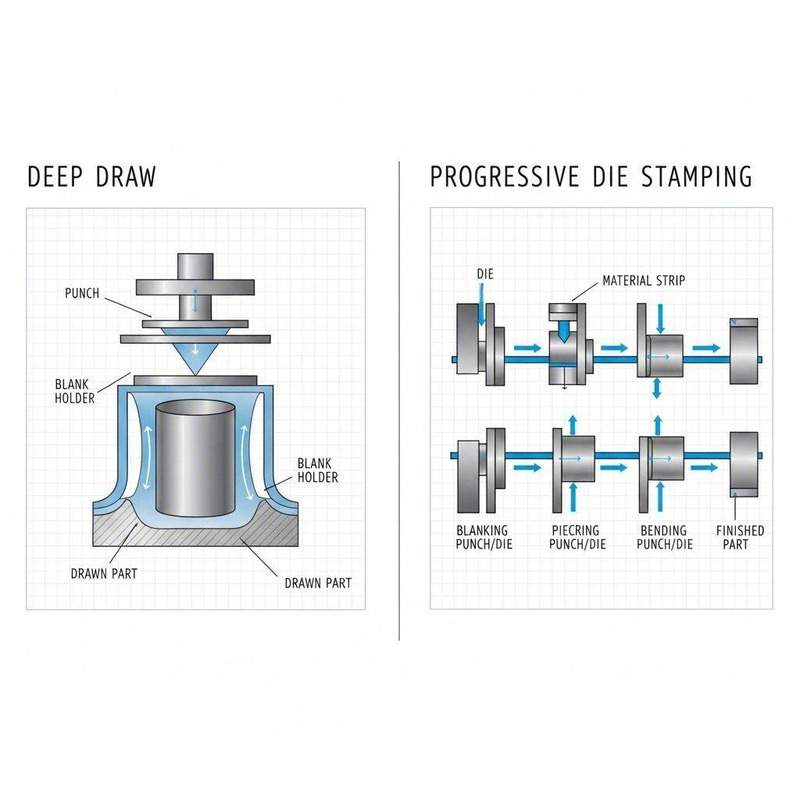
Progressive die stamping is one of the most important processes to understand when comparing metal stamping companies. It is particularly valuable for medium- and high-volume production where multiple operations must be performed repeatedly and consistently.
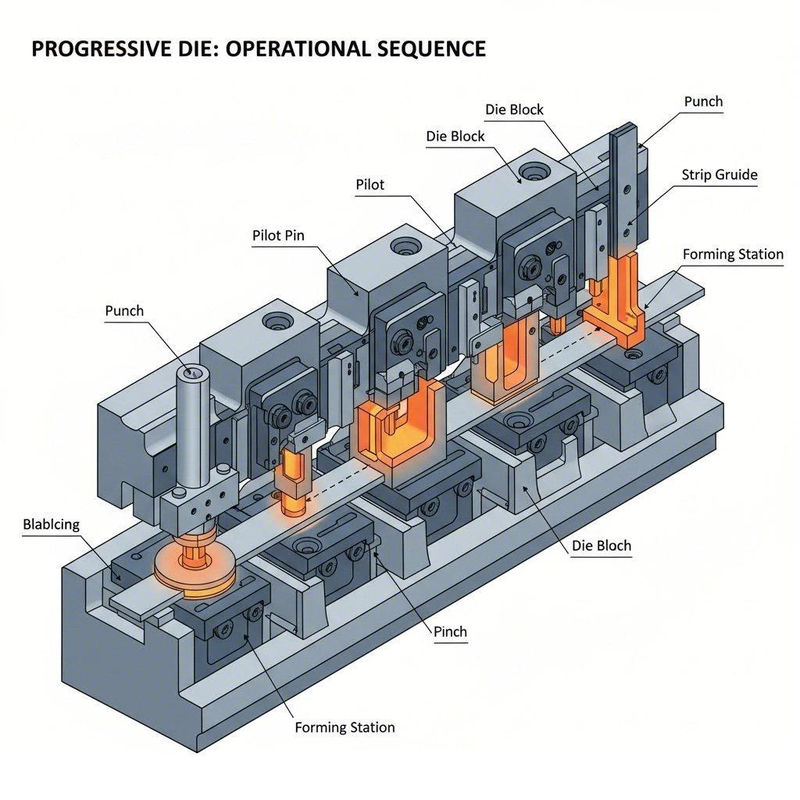
A progressive die contains multiple stations. A strip of sheet metal moves through the die, and each station performs a specific operation such as piercing, blanking, bending, forming, or coining.
For example, a simple stamped bracket might use a sequence such as:
Station 1 → Pilot Hole
Station 2 → Piercing
Station 3 → Forming
Station 4 → Bending
Station 5 → Final Cutoff
Instead of manually transferring the workpiece between machines, the material progresses through the tooling in a controlled sequence.
Industry suppliers commonly position progressive stamping as a high-speed, repeatable solution for complex production components. Some published examples include press ranges from tens of tons to several hundred tons, with production speeds reaching well over 100 strokes per minute depending on the equipment and part.
When Is Progressive Stamping More Economical?
The major disadvantage of progressive stamping is the initial tooling investment.
Imagine two production scenarios:
| Production Requirement | Conventional Stamping | Progressive Die |
|---|---|---|
| Prototype quantity | 100 pcs | Usually excessive |
| Annual volume | 2,000 pcs | Usually excessive |
| Annual volume | 20,000 pcs | Depends on geometry |
| Annual volume | 100,000 pcs | Often attractive |
| Annual volume | 500,000 pcs | Highly suitable |
| Annual volume | 1,000,000+ pcs | Often highly economical |
These are not universal break-even points because tooling complexity, material cost, cycle time, and part geometry can change the economics substantially. The important principle is that higher production volume gives the tooling investment more opportunities to be amortized across individual parts.
For instance, if progressive tooling costs $20,000:
- 1,000 parts → $20.00 tooling cost per part
- 10,000 parts → $2.00 per part
- 100,000 parts → $0.20 per part
- 500,000 parts → $0.04 per part
This is why a higher upfront tooling cost can sometimes produce a significantly lower long-term piece price.
Single-Hit Stamping Can Still Be the Better Choice
Progressive stamping is not automatically the best solution.
If you need only 2,000 parts, developing an expensive multi-station progressive die may not make financial sense. A single-hit press operation or simpler compound die may provide a lower overall project cost.
The correct process depends on:
Part geometry + quantity + material + tolerances + tooling cost + cycle time.
A qualified stamping manufacturer should evaluate these factors together rather than recommending progressive stamping simply because it is a more advanced process.
Deep Draw Stamping for Complex 3D Metal Parts
If your part is deeper than a conventional stamping operation can efficiently produce, deep draw stamping becomes an important option.
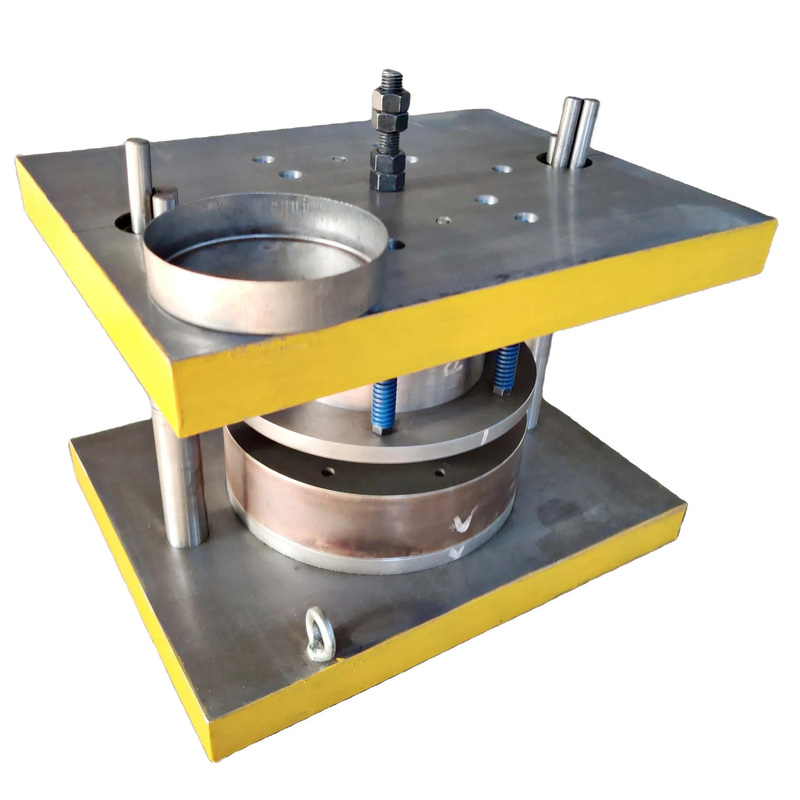
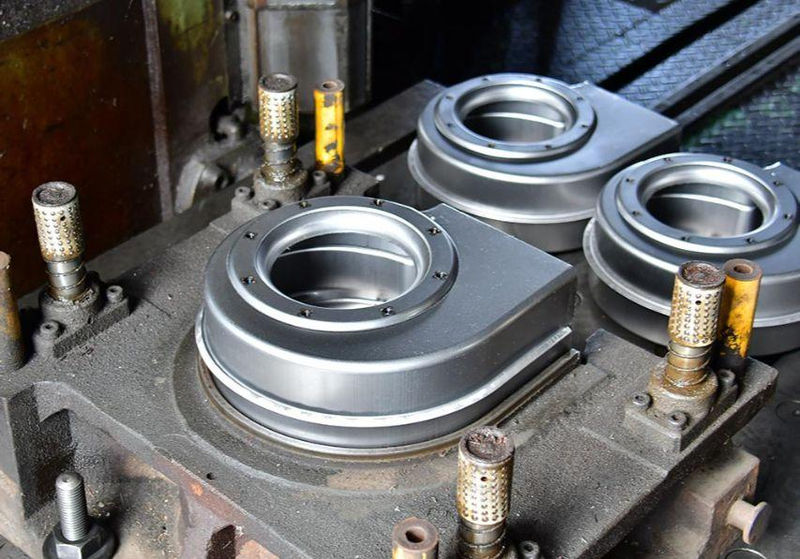
Deep drawing transforms a flat metal blank into a three-dimensional component by forcing the material into a die cavity with a punch. Typical products include cups, sleeves, housings, containers, automotive components, electrical components, and other cylindrical or box-like parts.
A deep-drawn component can look deceptively simple, but the manufacturing process requires careful control of material flow.
Why Material Flow Matters
During deep drawing, the material is not simply being cut. It is being plastically deformed.
If the blank holder force is too low, wrinkles can develop.
If the force is too high, material flow can become restricted and tearing may occur.
If the punch radius or die radius is poorly selected, stress concentration can increase.
If the material has insufficient ductility, cracks may appear during forming.
This is why deep drawing requires more than simply selecting a press with enough tonnage.
For example, two stainless steel sheets with the same thickness can behave differently because of differences in grade, temper, elongation, yield strength, and forming characteristics.
Multi-Stage Deep Drawing
Very deep components may require multiple drawing operations instead of being formed to final depth in one stroke.
A simplified process could be:
Flat Blank → First Draw → Redraw → Second Redraw → Final Form → Trimming → Piercing
Each stage gradually changes the geometry while controlling deformation.
This approach is particularly important for deep cylindrical housings, sleeves, cans, and other components with a high depth-to-diameter relationship.
Published industry examples show deep-draw manufacturers supporting complex forming with dedicated transfer presses and engineering/simulation capabilities. One supplier, for example, reports press capabilities from 25 to 600 tons and material thickness from approximately 0.025 to 4.8 mm.
Example: Choosing Deep Draw for a Metal Housing
Consider a stainless steel housing with:
- Outside diameter: 50 mm
- Final depth: 80 mm
- Material: 304 stainless steel
- Thickness: 1.0 mm
- Quantity: 150,000 pcs/year
Producing this geometry entirely through CNC machining could generate substantial material waste and machining time.
Starting from a tube could reduce some machining, but it may still require cutting, turning, and additional operations.
Deep drawing, however, can form the basic cylindrical geometry from sheet material at production scale, followed by trimming, piercing, machining, or finishing where required.
This is one reason experienced manufacturers often combine stamping + secondary machining instead of treating stamping as an isolated operation.
Materials, Thickness, Press Tonnage, and Production Volume
The material you select directly affects stamping force, tool wear, springback, dimensional stability, surface quality, and overall production cost.
Common stamping materials include:
| Material | Typical Advantage | Common Applications |
|---|---|---|
| Low-carbon steel | Good formability and cost | Brackets, structural parts |
| Stainless steel | Corrosion resistance | Housings, medical/industrial parts |
| Aluminum | Lightweight | Automotive, electronics |
| Brass | Conductivity and formability | Electrical components |
| Copper | Excellent conductivity | Terminals, connectors |
| Titanium | High strength-to-weight ratio | Aerospace |
| Nickel alloys | High-temperature performance | Specialized industrial parts |
Supplier capability pages commonly identify aluminum, steel, stainless steel, brass, copper, titanium, and nickel-based materials among stamping applications.
Material Thickness Changes the Entire Process
A stamping supplier should know the thickness before estimating press requirements.
For example:
0.5 mm aluminum sheet and 3.0 mm stainless steel sheet may have completely different forming characteristics even if the final part dimensions are identical.
Thickness affects:
- Required press tonnage
- Punch and die clearance
- Tool strength
- Forming force
- Bend radius
- Springback
- Cutting edge wear
- Material utilization
- Part weight
Some industrial stamping manufacturers publish thickness ranges extending from extremely thin sheet to several millimeters, demonstrating how equipment capabilities can differ considerably between suppliers.
Press Tonnage Is Not the Only Equipment Specification
A company advertising a “400-ton press” does not automatically mean it can manufacture every 400-ton stamping application.
You should also ask about:
- Bed size
- Stroke length
- Shut height
- Press speed
- Feed system
- Coil width
- Maximum material thickness
- Servo or mechanical press type
- Die dimensions
- Automation capability
For high-volume work, production speed can have a major influence on piece price.
For example, if one process produces 30 parts per minute and another produces 120 parts per minute, the difference becomes substantial over hundreds of thousands of components.
At 100,000 pieces:
30 parts/minute ≈ 3,333 minutes of theoretical press time
120 parts/minute ≈ 833 minutes of theoretical press time
Actual production time will be higher because of setup, coil changes, inspection, downtime, maintenance, and other production factors, but the example illustrates why press speed matters when comparing high-volume suppliers.
Tooling, DFM, Quality Control, and Secondary Operations
For many stamped parts, the tooling is the heart of the manufacturing process.
A good stamping company should not simply receive a CAD file and manufacture the die exactly as drawn. Experienced suppliers review the design before tooling begins.
This process is commonly called Design for Manufacturability (DFM).
What Does DFM Review Look For?
A stamping engineer may examine:
- Bend radii
- Hole-to-edge distance
- Material thickness
- Draw depth
- Forming direction
- Part orientation
- Burr direction
- Springback
- Die clearance
- Pilot hole positioning
- Strip layout
- Scrap percentage
- Critical dimensions
For example, placing a hole too close to a bend can create deformation during forming. Increasing the distance between the hole and bend may improve dimensional stability without changing the part’s functional purpose.
Similarly, changing the orientation of a part within the strip can sometimes improve material utilization.
If a stamping blank consumes 100 mm × 50 mm of material but an optimized strip layout reduces the requirement to 90 mm × 50 mm, the material savings can become significant at high production volumes.
At 500,000 parts, even a $0.02 reduction in material consumption represents:
500,000 × $0.02 = $10,000 annual savings.
This is why experienced stamping manufacturers evaluate material utilization before production begins.
Quality Control Should Match the Part’s Critical Features
A professional supplier should have a measurement strategy based on the actual function of the component.
Typical inspection equipment may include:
- Calipers
- Micrometers
- Height gauges
- Optical comparators
- CMM systems
- Pin gauges
- Thread gauges
- Hardness testing
- Material identification equipment
For critical aerospace, medical, automotive, or electronic components, inspection documentation may also become part of the supplier qualification process.
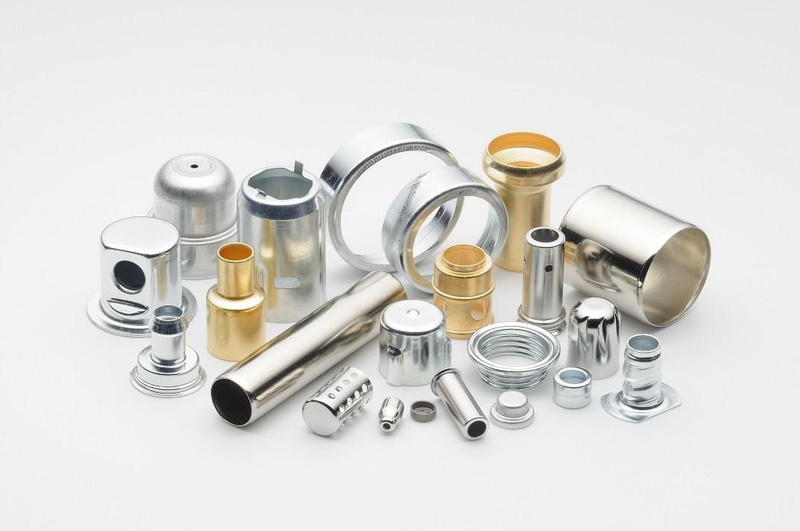
The current supplier landscape shows that some stamping manufacturers combine stamping with formal quality systems and industry-specific certifications such as ISO 9001, IATF 16949, AS9100, and ISO 13485.
Secondary Operations Can Reduce Your Supply Chain Complexity
Your stamped component may not be finished when it exits the press.
Depending on the design, you may also require:
- CNC machining
- Tapping
- Threading
- Deburring
- Tumbling
- Heat treatment
- Plating
- Powder coating
- Anodizing
- Welding
- Riveting
- Hardware insertion
- Assembly
- Laser marking
A supplier capable of handling several of these processes can reduce the number of vendors involved in your project.
For example:
Stamping → Deburring → CNC machining → Plating → Inspection → Assembly
can potentially be managed through one coordinated manufacturing supply chain instead of five separate suppliers.
This reduces transportation between vendors and can also simplify quality responsibility.
A Practical Example of Selecting a Metal Stamping Supplier
Imagine you need 200,000 aluminum brackets per year.
The part has:
- 2.0 mm aluminum sheet
- 4 pierced holes
- 2 bends
- One embossed feature
- ±0.10 mm critical hole location
- Powder-coated finish
- Monthly releases of approximately 16,700 pieces
A sensible supplier-selection process would look like this:
| Requirement | Preferred Capability |
|---|---|
| Material | Aluminum stamping |
| Thickness | 2.0 mm |
| Volume | 200,000 pcs/year |
| Process | Progressive or multi-operation stamping |
| Tooling | In-house die engineering |
| Critical tolerance | ±0.10 mm |
| Secondary operation | Deburring + coating |
| Quality | Documented dimensional inspection |
| Logistics | Stable monthly production |
The closest stamping company is not necessarily the best supplier. The better choice is the company whose press capacity, tooling expertise, material experience, quality controls, and secondary operations match the actual project.
Why Consider Xavier for Custom Metal Components?
For companies searching for metal stamping companies near me, the most important question should ultimately be: Can this supplier manufacture my part consistently, economically, and to specification?
Xavier approaches custom manufacturing from that perspective. For projects that combine stamped sheet-metal components with CNC machining, precision metal parts, secondary finishing, and custom production requirements, having manufacturing capabilities coordinated under one supplier can simplify sourcing and engineering communication.
Whether your project involves a simple stamped bracket, precision aluminum component, stainless steel housing, custom metal hardware, or a more complex production part, the right manufacturing process should be selected according to geometry, material, tolerance, quantity, tooling investment, and final application rather than simply choosing the closest company.
For buyers comparing local and overseas suppliers, Xavier can also be considered when the project requires a combination of custom CNC machining and metal manufacturing expertise, especially when stamped parts need secondary machining or other value-added processes before becoming finished components.
We are an integrated CNC machining manufacturer specializing in custom CNC machining and the production of various precision metal parts. We also support CNC anodizing surface finishing, CNC electroless nickel surface finishing, and CNC chemical conversion coating surface finishing to meet different part performance and appearance requirements.
We are an CNC anodizing surface finishing manufacturer, offering CNC electroless nickel surface finishing services in batches. Feel free to contact us to discuss CNC chemical conversion coating surface finishing pricing.
Some of the images and text in this article are collected and compiled from the internet. If there is anything inappropriate, please contact us for processing.