
Delrin vs Acetal: What Is the Real Difference?
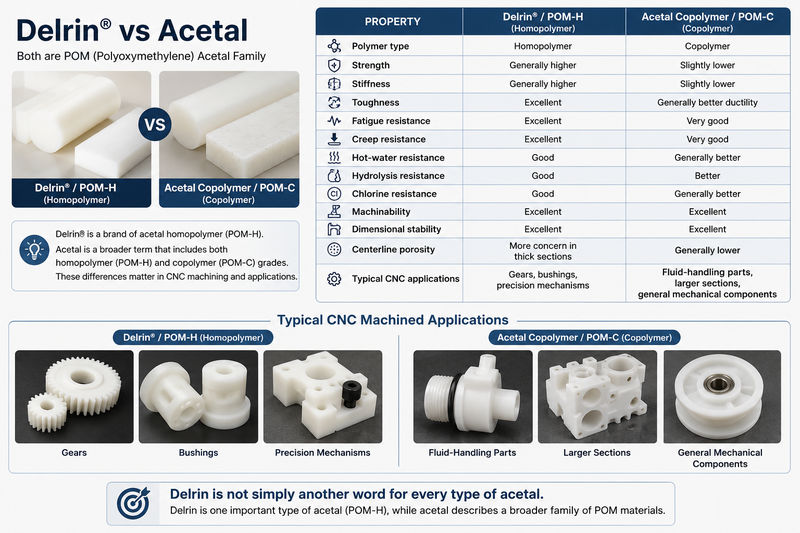
When engineers compare Delrin vs Acetal, the first thing to understand is that these names do not describe two completely different families of plastics. Both belong to the POM (polyoxymethylene) acetal family, a group of semi-crystalline engineering thermoplastics widely used for precision mechanical components.
The important distinction is that Delrin® is a registered brand associated with acetal homopolymer, commonly referred to as POM-H, while “acetal” is a broader material term that can refer to both homopolymer and copolymer grades. Acetal copolymer is commonly designated as POM-C.
This distinction matters in CNC machining because two materials that look almost identical on a material list can behave differently when a component requires high stiffness, tight dimensional tolerances, long-term loading, exposure to hot water, or machining from a large-diameter stock shape.
| Property | Delrin® / POM-H | Acetal Copolymer / POM-C |
|---|---|---|
| Polymer type | Homopolymer | Copolymer |
| Strength | Generally higher | Slightly lower |
| Stiffness | Generally higher | Slightly lower |
| Toughness | Excellent | Generally better ductility |
| Fatigue resistance | Excellent | Very good |
| Creep resistance | Excellent | Very good |
| Hot-water resistance | Good | Generally better |
| Hydrolysis resistance | Good | Better |
| Chlorine resistance | Good | Generally better |
| Machinability | Excellent | Excellent |
| Dimensional stability | Excellent | Excellent |
| Centerline porosity | More concern in thick sections | Generally lower |
| Typical CNC applications | Gears, bushings, precision mechanisms | Fluid-handling parts, larger sections, general mechanical components |
The practical conclusion is simple: Delrin is not simply another word for every type of acetal. Instead, Delrin is one important type of acetal, while acetal itself describes a broader family of POM materials.
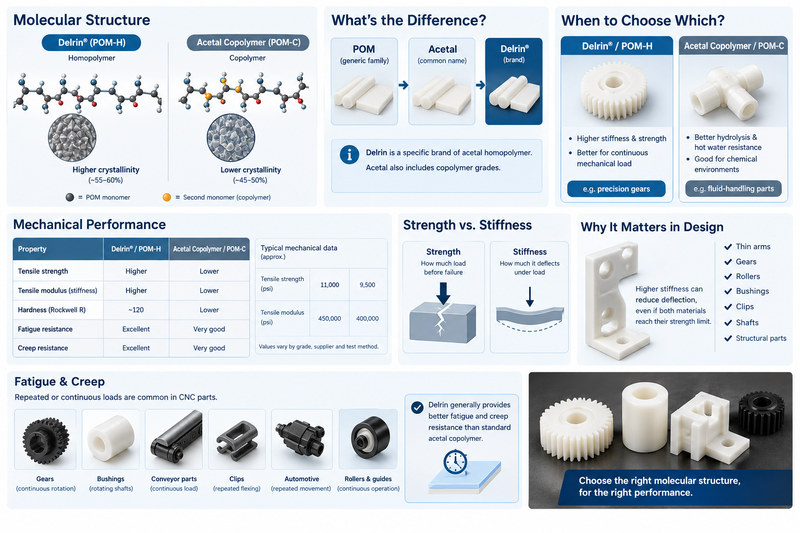
The difference comes from molecular structure. Delrin homopolymer has a more uniform polymer backbone and a higher degree of crystallinity. Delrin’s technical documentation describes typical crystallinity around 55–60%, while acetal copolymer is generally around 45–50%. This more ordered structure contributes to the higher strength and stiffness associated with Delrin homopolymer.
Acetal copolymer introduces a second monomer into the polymer chain. This disrupts some of the regularity of the structure, but that change also provides useful benefits, particularly improved resistance to hydrolysis, hot water and certain chemical environments.
Therefore, choosing between Delrin and acetal copolymer is not simply a question of which material is “better.” It is a question of which molecular structure better matches the mechanical and environmental requirements of the part.
No.
POM is the generic engineering-plastic family. Acetal is another commonly used name for POM. Delrin® is a specific commercial brand of acetal homopolymer.
This distinction becomes especially important when requesting CNC machined plastic parts. If a drawing simply states “POM” or “acetal,” the CNC manufacturer may need to confirm whether the customer requires POM-H or POM-C, because the material choice can influence mechanical performance, machining behavior, stock availability and final part performance.
For example, a precision gear carrying a continuous mechanical load may benefit from the higher stiffness of Delrin, while a fluid-handling component exposed to hot water may be better suited to an appropriate acetal copolymer grade.
For CNC-machined mechanical components, mechanical performance is often the most important reason engineers consider Delrin over standard acetal copolymer.
Delrin’s higher crystallinity gives unfilled homopolymer grades an advantage in tensile strength and stiffness. A commonly cited Delrin 150 data set lists a tensile yield strength of approximately 75.8 MPa (11,000 psi), a tensile modulus of approximately 3.10 GPa (450 ksi), and a Rockwell R hardness of approximately 120.
A representative comparison published by Boedeker lists approximately 9,500 psi tensile strength for general-purpose acetal copolymer versus approximately 11,000 psi for Delrin 150, while tensile modulus is listed at approximately 400,000 psi and 450,000 psi respectively. Actual values vary significantly by grade, supplier and test method, so engineering decisions should always be based on the exact material datasheet.
For a CNC component, strength and stiffness are not the same thing.
Strength determines how much load the material can withstand before permanent deformation or failure. Stiffness describes how much the component deflects under a given load.
This distinction is important when designing thin arms, gears, rollers, bushings, clips, shafts and structural plastic components.
Consider a simple CNC-machined support bracket made from a 10 mm thick plastic plate. If the bracket experiences a constant mechanical load, a material with higher stiffness can reduce deflection even if neither material reaches its tensile limit.
This is one reason Delrin is attractive for precision mechanical components. Its combination of high stiffness, strength and fatigue performance can allow designers to reduce wall thickness or component weight without sacrificing the required mechanical behavior. Delrin’s own technical documentation specifically highlights its suitability for high-load mechanical and precision parts.
CNC-machined plastic components frequently operate under repeated or continuous loads rather than a single static load.
Examples include:
- Gears rotating thousands or millions of cycles
- Bushings supporting rotating shafts
- Conveyor components carrying continuous loads
- Spring-like clips repeatedly flexing
- Automotive mechanisms exposed to repeated movement
- Rollers and guides operating continuously
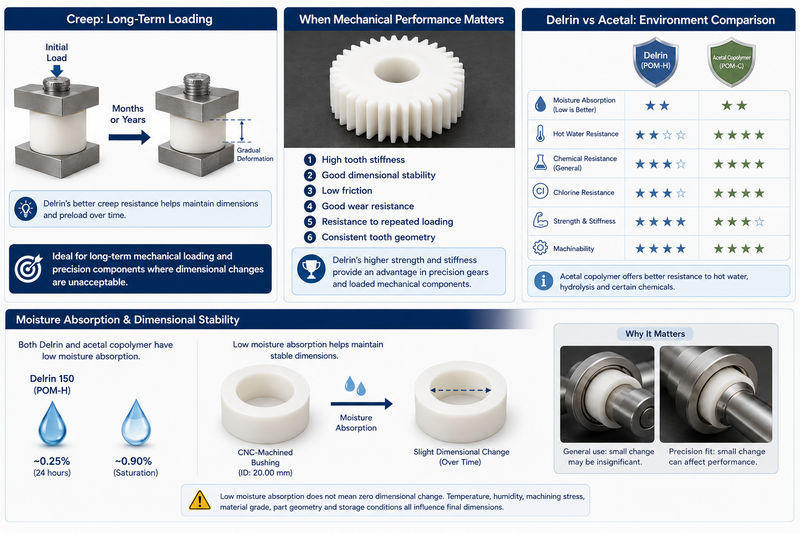
Delrin homopolymer generally provides an advantage in fatigue and creep resistance compared with standard acetal copolymer. Creep is particularly important because plastics can slowly deform when exposed to constant stress for extended periods.
For example, imagine a plastic spacer compressed between two metal components. Even if the initial compressive stress is well below the material’s short-term strength, the spacer can gradually deform over months or years. A material with better creep resistance can maintain its dimensions and preload more effectively.
This makes Delrin particularly attractive for long-term mechanical loading and precision components where dimensional changes over time are unacceptable.
If the primary requirement is mechanical performance, Delrin is often a strong candidate.
A practical example would be a small CNC-machined gear used in an automated mechanism. The gear needs:
- High tooth stiffness
- Good dimensional stability
- Low friction
- Good wear resistance
- Resistance to repeated loading
- Consistent tooth geometry
In this situation, the higher strength and stiffness of Delrin can be more valuable than the additional chemical resistance of an acetal copolymer.
Mechanical properties are only one side of the Delrin vs Acetal comparison. The surrounding environment can completely change which material is the better choice.
Both Delrin and acetal copolymer have relatively low moisture absorption compared with many other engineering plastics. For example, Delrin 150 is reported at approximately 0.25% water absorption after 24 hours and approximately 0.90% at saturation under the cited test conditions.
Low moisture absorption is particularly valuable for CNC-machined parts because absorbed moisture can cause dimensional changes.
Suppose a CNC-machined plastic bushing is manufactured with a 20.00 mm internal diameter.
If the material absorbs moisture after machining, the dimensions may change slightly. For a general plastic component this may be insignificant, but for a precision sliding fit, bearing seat or mating assembly, even a small dimensional change can affect performance.
POM materials are therefore popular in precision applications because their moisture absorption is relatively low and their dimensional stability is generally better than many moisture-sensitive plastics.
However, low moisture absorption does not mean “zero dimensional change.” Temperature, humidity, machining stress, material grade, part geometry and storage conditions can all influence the final dimensions.
One of the more meaningful differences between Delrin homopolymer and acetal copolymer appears in hot water, steam and hydrolysis resistance.
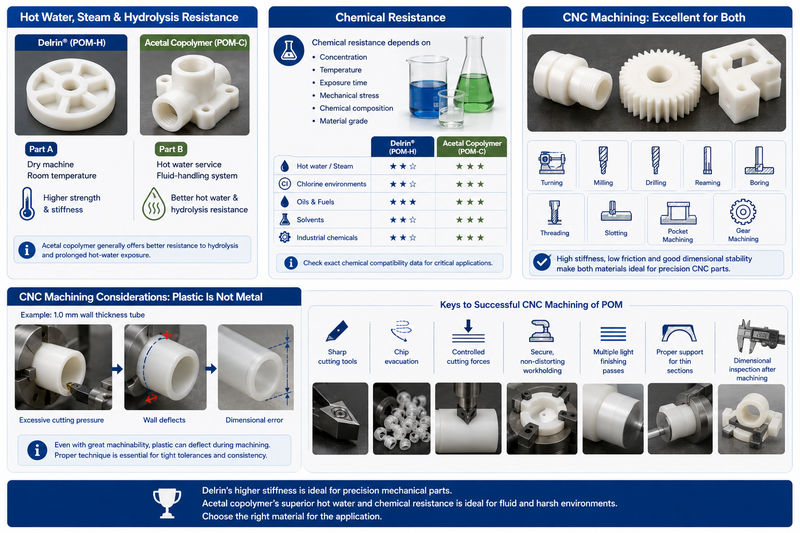
Acetal copolymer generally offers better resistance to hydrolysis and prolonged hot-water exposure. This is particularly relevant for plumbing components, valves, pump components, fluid-handling parts and mechanical components that operate in humid or aqueous environments.
For example, consider two CNC-machined valve components:
Part A: operates inside a dry automated machine at room temperature.
Part B: continuously contacts hot water in a fluid-handling system.
Part A may benefit more from Delrin’s higher strength and stiffness. Part B may justify the use of acetal copolymer because long-term resistance to hot water and hydrolysis becomes more important.
It would be misleading to say that one material is universally more chemically resistant.
Chemical compatibility depends on:
- Chemical concentration
- Temperature
- Exposure time
- Mechanical stress
- Chemical composition
- Material grade
Acetal copolymer is generally favored when exposure involves hot water or chlorine-containing environments, while both POM-H and POM-C provide useful resistance to many common fuels, oils, solvents and industrial chemicals.
For a critical chemical-processing application, the correct approach is to check the exact chemical compatibility data rather than selecting Delrin or acetal based only on the generic material name.
Both Delrin and acetal copolymer are excellent materials for CNC machining. Their relatively high stiffness, low friction and good dimensional stability make them suitable for turning, milling, drilling, boring and other subtractive manufacturing operations.
However, there are several details that matter when producing precision CNC parts.
POM materials generally machine cleanly and can produce smooth surfaces when appropriate cutting tools, feeds, speeds and workholding methods are used.
Typical CNC operations include:
- CNC turning
- CNC milling
- CNC drilling
- Reaming
- Boring
- Threading
- Slotting
- Pocket machining
- Gear machining
For small-diameter turned parts and thin-wall components, Delrin’s higher stiffness can be advantageous. Technical sources specifically note that Delrin homopolymer can be particularly suitable for small-diameter parts, thin sections and high-speed CNC turning applications.
Plastic is not metal. Even when a material has excellent machinability, it can deflect during machining.
Imagine machining a Delrin tube with a 1.0 mm wall thickness. If excessive cutting pressure is applied, the wall can flex away from the cutting tool. The resulting part may measure correctly after the tool is removed in one location but show dimensional error in another location.
This is why CNC machining of POM often requires:
- Sharp cutting tools
- Appropriate chip evacuation
- Controlled cutting forces
- Secure but non-distorting workholding
- Multiple light finishing passes
- Proper support for thin sections
- Dimensional inspection after machining
Delrin’s higher stiffness can help, but it does not eliminate the need for proper machining strategy.
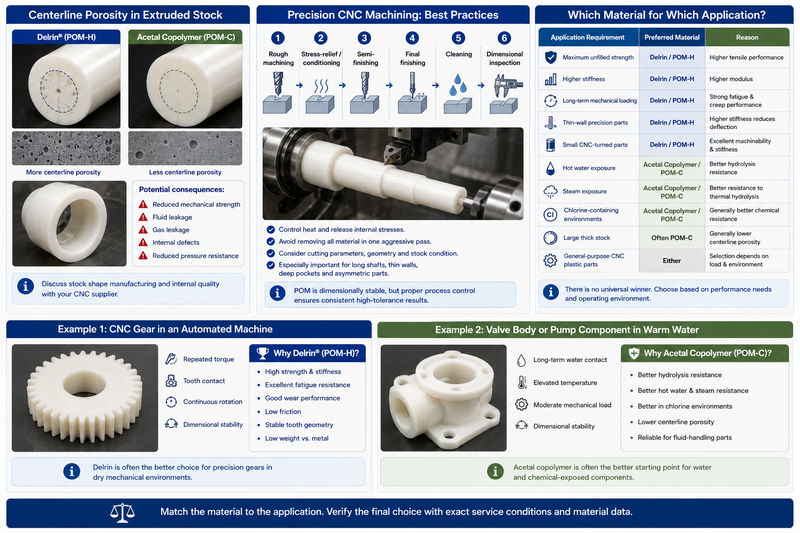
One of the less obvious differences between Delrin and acetal copolymer involves centerline porosity in extruded stock shapes.
Certain extruded acetal materials can contain microscopic voids or porosity near the centerline of rods and plates. Copolymer acetal generally exhibits less centerline porosity than homopolymer acetal, although the actual behavior depends on the material manufacturer and extrusion process.
This matters when CNC machining a large solid component.
For example, imagine a 100 mm diameter POM rod being turned into a thick mechanical sleeve. If the finished part depends on the integrity of the material near the center of the stock, the material’s centerline quality becomes an engineering consideration.
Potential consequences of internal porosity can include:
- Reduced mechanical strength
- Fluid leakage
- Gas leakage
- Internal defects revealed during machining
- Reduced pressure resistance
For critical components, it is therefore worth discussing the stock-shape manufacturing method and internal quality with the CNC supplier before production.
POM is dimensionally stable compared with many other plastics, but CNC machining still generates heat and releases internal stresses.
A practical machining sequence for a precision component may involve:
- Rough machining
- Stress-relief or controlled conditioning where appropriate
- Semi-finishing
- Final finishing
- Cleaning
- Dimensional inspection
For high-tolerance parts, the manufacturer should not simply machine everything to the final dimension in one aggressive pass.
The cutting parameters, part geometry and stock condition should be considered together. This is especially important for long shafts, thin walls, deep pockets and asymmetric components.
There is no universal winner between Delrin and acetal copolymer. The correct choice depends on what the component needs to do.
A useful engineering decision can be summarized as follows:
| Application Requirement | Preferred Material | Reason |
|---|---|---|
| Maximum unfilled strength | Delrin / POM-H | Higher tensile performance |
| Higher stiffness | Delrin / POM-H | Higher modulus |
| Long-term mechanical loading | Delrin / POM-H | Strong fatigue and creep performance |
| Thin-wall precision parts | Delrin / POM-H | Higher stiffness can reduce deflection |
| Small CNC-turned parts | Delrin / POM-H | Excellent machinability and stiffness |
| Hot water exposure | Acetal Copolymer / POM-C | Better hydrolysis resistance |
| Steam exposure | Acetal Copolymer / POM-C | Better resistance to thermal hydrolysis |
| Chlorine-containing environments | Acetal Copolymer / POM-C | Generally better chemical resistance |
| Large thick stock | Often POM-C | Generally lower centerline porosity |
| General-purpose CNC plastic parts | Either | Selection depends on load and environment |
Consider a CNC-machined gear used inside an automated machine.
The gear is exposed to repeated torque, tooth contact and continuous rotation. It needs good dimensional stability because even small changes in tooth geometry can influence backlash and noise.
In this case, Delrin homopolymer is often an attractive choice because strength, stiffness, fatigue resistance, wear performance and low friction are important.
A Delrin gear can also provide a useful combination of low weight and mechanical performance compared with a metal gear in applications where the load requirements permit an engineering plastic.
Now consider a CNC-machined valve body or pump component exposed to warm water.
The mechanical load may be moderate, but the part can experience long-term contact with water and elevated temperatures.
Here, acetal copolymer may be the better starting point, particularly when hydrolysis resistance and reduced centerline porosity are important.
The final selection should still be verified against the exact temperature, pressure, chemical composition and service life.
Consider a 25 mm outside-diameter, 20 mm inside-diameter bushing used on a rotating shaft.
The most important properties may include:
- Low friction
- Wear resistance
- Dimensional stability
- Good surface finish
- Tight bore tolerance
- Resistance to repeated loading
Both Delrin and acetal copolymer can be viable.
If the bushing operates primarily under mechanical load in a dry environment, Delrin may provide a useful performance advantage. If the bushing operates in a wet or chemically aggressive environment, a suitable acetal copolymer grade may become more attractive.
For a large POM plate containing deep pockets and precision mounting holes, material selection should consider more than tensile strength.
The manufacturer should evaluate:
- Plate thickness
- Internal stress
- Stock manufacturing process
- Centerline porosity
- Machining sequence
- Thermal expansion
- Required flatness
- Hole tolerances
For large cross-sections, acetal copolymer can have an advantage because centerline porosity is generally less of a concern than with conventional homopolymer stock shapes.
The most important point is that Delrin and acetal should not be treated as interchangeable material names.
Both belong to the POM family and both are highly machinable engineering plastics. However, Delrin homopolymer generally emphasizes strength, stiffness, fatigue performance and creep resistance, while acetal copolymer generally provides advantages in hot-water resistance, hydrolysis resistance, certain chemical environments and reduced centerline porosity.
For CNC machining, the best material should therefore be selected according to the actual working conditions rather than simply choosing the material with the highest strength.
If the part is a precision gear, bushing, roller, bearing component, small shaft, spring component or mechanical linkage subjected to repeated loads, Delrin can be an excellent engineering choice.
If the component is exposed to hot water, steam, chlorine-containing solutions or requires a large cross-section with reduced concern about internal porosity, a suitable acetal copolymer may be more appropriate.
At Xavier, material selection is treated as part of the CNC manufacturing process rather than an afterthought. For custom Delrin and acetal CNC machining, the material grade, part geometry, tolerance requirements, machining strategy and application environment should be considered together before production begins. This approach helps ensure that the finished component is not only dimensionally accurate but also appropriate for the conditions in which it will actually operate.
Whether you need a prototype, low-volume precision component or production batch, choosing the correct POM grade at the beginning can help prevent unnecessary redesign, machining problems and premature component failure.
We are an integrated trading and manufacturing company specializing in CNC machining services, with a strong focus on custom CNC machining and the production of various metal components. Our capabilities cover CNC machining of alloy steel, aluminum, brass, bronze, copper, Inconel, Invar 36, low carbon steel, stainless steel, titanium, tool steel, ABS, FR4, G-10, nylon, PEEK, PEI, PET, PMMA (acrylic), polycarbonate, polyethylene, polypropylene, POM (acetal), PPSU, PTFE (Teflon), PVC, as well as components for robotics, aerospace, marine, automotive, medical, and other precision applications. We also provide CNC machining nylon, CNC machining titanium, and CNC machining POM to meet different project requirements.
We are a CNC machining nylon manufacturer, providing bulk CNC machining titanium services, and you can consult CNC machining POM pricing with us. Feel free to contact us for your custom CNC machining requirements.
Some of the images and text in this article are collected and compiled from the internet. If there is anything inappropriate, please contact us for processing.