
What Is Difference Between Ferrous and Non-Ferrous Metal?
Selecting the right material is one of the most important decisions in manufacturing. Whether you are producing aerospace components, automotive parts, medical devices, or industrial equipment, the choice between ferrous and non-ferrous metals directly affects machining efficiency, product performance, service life, and manufacturing cost.
For CNC machining, material selection influences cutting speed, tool wear, surface finish, corrosion resistance, strength, and dimensional stability. Engineers often compare steel, stainless steel, aluminum, brass, copper, and titanium before deciding which material best suits a specific application.
This guide explains the fundamental differences between ferrous and non-ferrous metals, compares their properties in detail, and discusses how each material performs in CNC machining.
Table of Contents
- Understanding Ferrous and Non-Ferrous Metals
- Physical and Mechanical Differences
- Common Examples and Industrial Applications
- CNC Machining Considerations
- How to Choose the Right Metal for Your Project
Understanding Ferrous and Non-Ferrous Metals
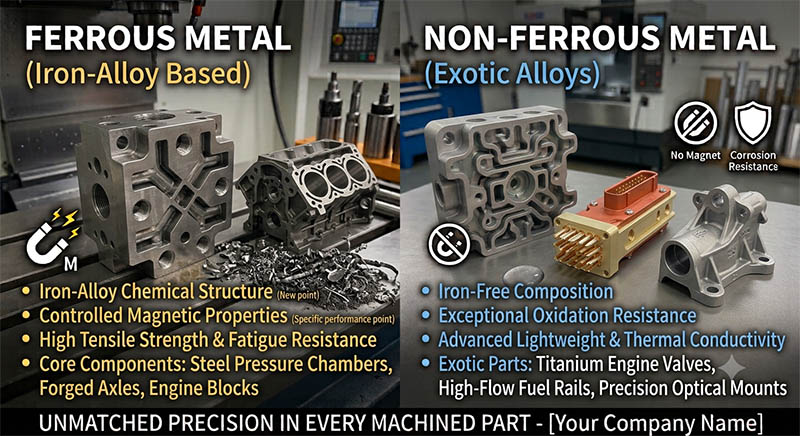
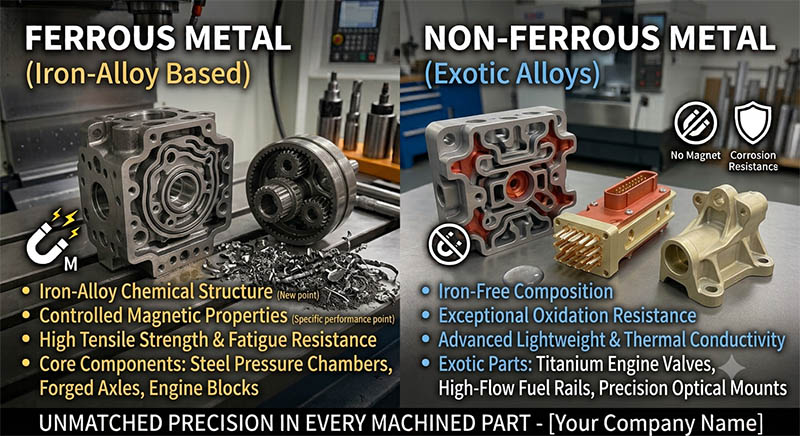
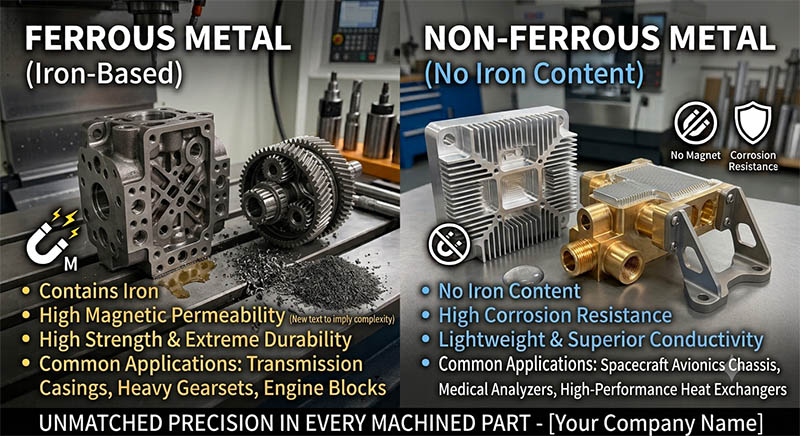
The primary distinction between ferrous and non-ferrous metals lies in their iron content.
- Ferrous metals contain iron (Fe) as the main alloying element.
- Non-ferrous metals contain little or no iron.
Although this definition appears simple, the presence or absence of iron dramatically changes the material’s physical, chemical, and mechanical properties.
What Are Ferrous Metals?
Ferrous metals are widely recognized for their high strength, durability, and wear resistance. Because iron is their primary component, these materials generally possess excellent structural performance.
Typical ferrous metals include:
| Ferrous Metal | Main Elements | Typical Uses |
|---|---|---|
| Carbon Steel | Iron + Carbon | Machinery, shafts, gears |
| Alloy Steel | Iron + Chromium, Nickel, Molybdenum | Heavy equipment |
| Stainless Steel | Iron + Chromium | Medical, food processing |
| Tool Steel | Iron + Carbon + Tungsten/Vanadium | Cutting tools |
| Cast Iron | Iron + Carbon (2–4%) | Machine bases, engine blocks |
Ferrous alloys are commonly selected where mechanical strength is the highest priority.
Examples include:
- Industrial machinery
- Construction equipment
- Bridges
- Automotive frames
- Transmission components
- Heavy-duty brackets
Many ferrous alloys can also be heat treated, allowing engineers to tailor hardness, tensile strength, and toughness according to application requirements.
What Are Non-Ferrous Metals?
Non-ferrous metals contain little or no iron and are generally known for their excellent corrosion resistance, lightweight characteristics, electrical conductivity, and thermal conductivity.
Common non-ferrous metals include:
| Non-Ferrous Metal | Major Characteristics | Typical Industries |
|---|---|---|
| Aluminum | Lightweight, corrosion resistant | Aerospace, automotive |
| Copper | Excellent electrical conductivity | Electronics |
| Brass | Easy machining | Plumbing, fittings |
| Bronze | Wear resistance | Bearings |
| Titanium | High strength-to-weight ratio | Aerospace, medical |
| Magnesium | Extremely lightweight | Automotive |
| Zinc | Corrosion protection | Hardware |
| Nickel | Heat resistance | Chemical processing |
Unlike many steels, most non-ferrous metals naturally resist rust because they form protective oxide layers instead of iron oxide.
For example:
- Aluminum forms aluminum oxide.
- Titanium forms titanium oxide.
- Copper develops a protective patina.
- Brass naturally resists corrosion in many environments.
This makes non-ferrous materials particularly suitable for outdoor equipment, marine environments, medical devices, and precision electronic products.
Why Iron Makes Such a Big Difference
Iron significantly influences a metal’s behavior.
Adding iron generally increases:
- Mechanical strength
- Hardness
- Structural rigidity
- Load-bearing capability
However, iron also introduces several disadvantages:
- Increased susceptibility to rust
- Higher density
- Greater weight
- Reduced electrical conductivity
- More maintenance in corrosive environments
By contrast, eliminating iron often improves:
- Corrosion resistance
- Thermal conductivity
- Electrical conductivity
- Weight reduction
- Machinability (for many alloys)
This is why aluminum has become one of the fastest-growing materials in industries seeking lightweight designs, while steel remains the preferred option for high-load structural applications.
Comparison at a Glance
| Feature | Ferrous Metals | Non-Ferrous Metals |
|---|---|---|
| Contains Iron | Yes | No or very little |
| Magnetic | Usually | Usually not |
| Rust Resistance | Lower | Higher |
| Density | Higher | Lower |
| Weight | Heavy | Lightweight |
| Electrical Conductivity | Moderate to Low | Excellent |
| Thermal Conductivity | Moderate | High |
| Strength | Very High | Moderate to High |
| Cost | Generally Lower | Often Higher |
| CNC Machining | Depends on alloy | Usually easier (except titanium) |
From a manufacturing perspective, neither category is inherently superior. Instead, each excels in different applications depending on the balance between strength, weight, corrosion resistance, conductivity, and cost.
Physical and Mechanical Differences Between Ferrous and Non-Ferrous Metals
Although the presence of iron defines whether a metal is ferrous or non-ferrous, the practical differences extend much further. Mechanical properties, corrosion resistance, magnetic behavior, thermal performance, machinability, and cost all influence material selection.
For engineers and CNC manufacturers, understanding these differences helps optimize part performance while reducing manufacturing costs.
Strength and Load-Bearing Capacity
One of the biggest advantages of ferrous metals is their outstanding mechanical strength.
Carbon steels and alloy steels offer:
- High tensile strength
- Excellent yield strength
- Superior fatigue resistance
- Outstanding wear resistance
These characteristics make ferrous alloys ideal for components subjected to repeated mechanical stress.
Typical examples include:
| Component | Preferred Material | Reason |
|---|---|---|
| Gear | Alloy Steel | High wear resistance |
| Drive Shaft | Carbon Steel | High torsional strength |
| Hydraulic Cylinder | Stainless Steel | Strength + corrosion resistance |
| Machine Frame | Structural Steel | Rigidity |
In contrast, many non-ferrous metals sacrifice some strength for lower weight. Aluminum, for example, has only about one-third the density of steel, yet high-strength alloys such as 7075 aluminum can still achieve tensile strengths exceeding 500 MPa, making them suitable for aerospace structures where weight savings are critical.
Titanium offers an even better strength-to-weight ratio, combining exceptional strength with significantly lower density than steel, though at a much higher material and machining cost.
Corrosion Resistance
Corrosion behavior is another major distinction.
Ordinary carbon steel reacts with moisture and oxygen to form iron oxide (rust), which gradually weakens the material if left unprotected.
To improve corrosion resistance, manufacturers often apply surface treatments such as:
- Zinc plating
- Powder coating
- Black oxide
- Painting
- Galvanizing
Stainless steel performs much better because its chromium content forms a thin, self-healing chromium oxide layer that protects the surface from further oxidation.
Non-ferrous metals often offer even greater natural corrosion resistance:
| Material | Corrosion Resistance |
|---|---|
| Aluminum | Excellent |
| Titanium | Outstanding |
| Brass | Excellent |
| Bronze | Excellent |
| Copper | Very Good |
| Carbon Steel | Poor |
| Cast Iron | Poor |
| Stainless Steel 304 | Very Good |
| Stainless Steel 316 | Excellent |
For marine equipment, offshore structures, and chemical processing components, non-ferrous alloys are often chosen because they require less maintenance and provide longer service life in harsh environments.
Physical and Mechanical Differences Between Ferrous and Non-Ferrous Metals (Continued)
Magnetic Properties: Why Ferrous Metals Are Usually Magnetic
Magnetism is one of the easiest ways to distinguish ferrous and non-ferrous metals, although it is not a perfect identification method.
Most ferrous metals contain iron, which has a unique atomic structure that allows magnetic domains to align and create magnetic attraction.
Common magnetic ferrous materials include:
- Carbon steel
- Low alloy steel
- Tool steel
- Cast iron
These materials are widely used in applications requiring magnetic properties, such as:
- Electric motors
- Transformers
- Magnetic clamps
- Industrial sensors
- Magnetic separation equipment
For example, CNC machined steel fixtures often use carbon steel because the material provides both mechanical strength and magnetic compatibility.
However, not every ferrous metal is strongly magnetic.
Stainless Steel Magnetism Example
Stainless steel demonstrates why material selection cannot rely only on magnet testing.
| Stainless Steel Grade | Magnetic Behavior | Reason |
|---|---|---|
| 304 Stainless Steel | Usually weakly magnetic or non-magnetic | Austenitic structure |
| 316 Stainless Steel | Mostly non-magnetic | Austenitic structure |
| 410 Stainless Steel | Magnetic | Martensitic structure |
| 430 Stainless Steel | Magnetic | Ferritic structure |
The crystal structure of the alloy determines magnetic behavior more than simply the presence of iron.
Non-ferrous metals are generally non-magnetic:
| Material | Magnetic Property |
|---|---|
| Aluminum | Non-magnetic |
| Copper | Non-magnetic |
| Brass | Non-magnetic |
| Bronze | Non-magnetic |
| Titanium | Non-magnetic |
This makes non-ferrous materials especially valuable in industries where electromagnetic interference must be minimized.
Examples include:
- MRI equipment
- Semiconductor manufacturing equipment
- Aerospace electronics
- Precision instruments
Density and Weight: Why Non-Ferrous Metals Are Popular for Lightweight Design
Weight reduction has become a major engineering goal in industries such as aerospace, automotive, robotics, and transportation.
The density difference between ferrous and non-ferrous metals is one of their most important characteristics.
| Material | Density (g/cm³) |
|---|---|
| Steel | 7.85 |
| Stainless Steel 304 | 8.00 |
| Cast Iron | 7.20 |
| Titanium | 4.50 |
| Aluminum | 2.70 |
| Magnesium | 1.74 |
| Copper | 8.96 |
| Brass | 8.50 |
Aluminum weighs approximately 65% less than steel, making it one of the most widely used lightweight engineering materials.
For example:
A CNC machined aluminum aerospace bracket may weigh only one-third of an equivalent steel component while still providing enough structural strength.
This weight advantage creates several benefits:
- Lower fuel consumption
- Higher energy efficiency
- Faster movement
- Reduced transportation cost
- Improved product performance
Example: Automotive Weight Reduction
Traditional vehicles rely heavily on steel because of its strength and affordability. However, modern electric vehicles increasingly use aluminum components because battery packs significantly increase vehicle weight.
Common aluminum automotive applications include:
- Battery housings
- Motor brackets
- Suspension components
- Structural panels
- Heat sinks
A 10 kg reduction in vehicle weight can improve efficiency, especially for electric vehicles where battery range is highly sensitive to mass.
Electrical and Thermal Conductivity Differences
Non-ferrous metals generally outperform ferrous metals in electrical and thermal conductivity.
This difference comes from their atomic structure and electron mobility.
Electrical Conductivity Comparison
| Material | Electrical Conductivity (% IACS) |
|---|---|
| Copper | 100–102% |
| Aluminum | 61% |
| Brass | 26–37% |
| Bronze | 15% |
| Stainless Steel | 2–4% |
| Carbon Steel | 5–10% |
Copper remains the industry standard for electrical applications because it combines:
- Extremely high conductivity
- Good corrosion resistance
- Excellent ductility
Typical copper applications:
- Electrical connectors
- Busbars
- Motor windings
- Circuit components
Aluminum is also widely used because it provides good conductivity while being much lighter than copper.
Applications include:
- Power transmission cables
- Heat exchangers
- Electronic cooling systems
Thermal Conductivity Comparison
Heat transfer capability is another important difference.
| Material | Thermal Conductivity (W/m·K) |
|---|---|
| Copper | ~390 |
| Aluminum | ~205 |
| Brass | ~110 |
| Bronze | ~60 |
| Stainless Steel | ~16 |
| Carbon Steel | ~50 |
Because aluminum and copper transfer heat efficiently, they are commonly selected for:
- Heat sinks
- Cooling plates
- Electronic housings
- Thermal management systems
For example, a CNC machined aluminum heat sink can quickly transfer heat away from electronic components, preventing overheating and improving product reliability.
In contrast, stainless steel provides excellent strength but poor thermal conductivity, making it unsuitable for many heat dissipation applications.
Common Examples and Industrial Applications of Ferrous and Non-Ferrous Metals
Different industries choose materials based on performance requirements rather than simply cost.
A manufacturer producing a high-load mechanical component may select steel, while a company developing lightweight electronic equipment may prefer aluminum or copper.
Ferrous Metals Commonly Used in Manufacturing
Carbon Steel
Carbon steel is one of the most widely used ferrous materials because it offers an excellent balance between strength and cost.
Carbon content determines its characteristics.
| Carbon Steel Type | Carbon Content | Characteristics |
|---|---|---|
| Low Carbon Steel | <0.3% | Easy machining, ductile |
| Medium Carbon Steel | 0.3–0.6% | Higher strength |
| High Carbon Steel | 0.6–1.0% | High hardness |
Applications:
- Shafts
- Fasteners
- Machine frames
- Automotive components
Low-carbon steel is especially popular in CNC machining because it provides:
- Good machinability
- Stable dimensions
- Low material cost
Stainless Steel
Stainless steel is one of the most important engineering materials because it combines strength with corrosion resistance.
Common grades:
| Grade | Main Characteristics | Applications |
|---|---|---|
| 304 | General corrosion resistance | Food equipment, brackets |
| 316 | Better chemical resistance | Marine, medical |
| 17-4 PH | High strength | Aerospace components |
CNC machining stainless steel requires careful control because:
- It generates high cutting temperatures
- It can work harden
- Tool wear can increase
Proper cutting parameters and carbide tooling are important for achieving good surface finishes.
Non-Ferrous Metals Commonly Used in Manufacturing
Aluminum
Aluminum is one of the most frequently CNC machined non-ferrous metals.
Popular grades include:
| Aluminum Grade | Characteristics |
|---|---|
| 6061 | Balanced strength and machinability |
| 7075 | High strength aerospace alloy |
| 5052 | Excellent corrosion resistance |
| 2024 | High fatigue resistance |
Applications:
- Aircraft parts
- Automotive components
- Robot parts
- Electronic housings
- Precision brackets
Advantages in CNC machining:
- High machining speed
- Excellent surface finish
- Low cutting force
- Easy anodizing
For example, a CNC aluminum enclosure can be machined quickly, anodized for protection, and used in industrial electronics.
Copper and Brass
Copper and brass are selected when conductivity and machinability are priorities.
Brass is especially popular for CNC machining because it offers:
- Excellent chip control
- Low cutting resistance
- High dimensional accuracy
Applications:
- Valves
- Connectors
- Bushings
- Electrical terminals
- Decorative components
Copper requires more attention during machining because:
- It is softer
- It produces long chips
- It can deform under cutting pressure
However, its excellent electrical and thermal properties make it irreplaceable in many industries.
CNC Machining Considerations: Ferrous vs Non-Ferrous Metals
Material selection plays a critical role in CNC machining performance. The same machining strategy cannot be applied to every metal because different materials behave differently during cutting, drilling, milling, and turning processes.
For CNC manufacturers, understanding the machining characteristics of ferrous and non-ferrous metals helps determine:
- Cutting speed
- Feed rate
- Tool selection
- Coolant requirements
- Surface finishing methods
- Production cost
- Final part quality
Machinability Comparison Between Ferrous and Non-Ferrous Metals
Machinability refers to how easily a material can be cut, shaped, and finished using machining processes.
A material with good machinability usually provides:
- Lower tool wear
- Faster cutting speed
- Better surface finish
- Reduced production cost
However, machinability is not determined only by hardness. Factors such as alloy composition, thermal conductivity, chip formation, and work hardening behavior also affect machining performance.
| Material | Machinability Level | CNC Machining Characteristics |
|---|---|---|
| Aluminum 6061 | Excellent | High cutting speed, easy chip removal |
| Brass C360 | Excellent | Produces clean chips, high accuracy |
| Mild Steel | Good | Stable machining performance |
| 304 Stainless Steel | Moderate | Work hardening tendency |
| Titanium | Difficult | Low thermal conductivity, high tool wear |
| Inconel | Very Difficult | High cutting temperature |
CNC Machining Ferrous Metals
Ferrous metals are widely used in CNC machining because of their excellent mechanical strength and availability.
However, machining difficulty varies significantly depending on alloy type.
Machining Carbon Steel
Carbon steel is one of the easiest ferrous metals to machine.
Advantages:
- Stable cutting performance
- Good dimensional accuracy
- Affordable raw material cost
- Wide availability
Typical CNC processes include:
- CNC milling
- CNC turning
- Drilling
- Threading
- Grinding
Common CNC carbon steel parts:
- Shafts
- Bushings
- Mounting plates
- Mechanical brackets
- Gear components
For example, a CNC machined AISI 1045 steel shaft can achieve excellent wear resistance after heat treatment while maintaining reasonable machining costs.
Machining Stainless Steel
Stainless steel requires more machining experience compared with ordinary steel.
The main challenges include:
Work Hardening
Stainless steel can become harder during machining if cutting conditions are incorrect.
This happens because:
- Excessive tool rubbing occurs
- Cutting depth is too shallow
- Cutting speed is incorrect
The hardened surface increases tool wear and reduces machining efficiency.
Recommended practices:
| Problem | Solution |
|---|---|
| Work hardening | Use sharp cutting tools |
| High heat generation | Apply proper coolant |
| Poor chip evacuation | Optimize feed rate |
| Surface defects | Maintain stable cutting parameters |
Common CNC stainless steel components:
- Medical instruments
- Food processing parts
- Marine components
- Aerospace brackets
CNC Machining Non-Ferrous Metals
Non-ferrous metals are often preferred in precision manufacturing because many alloys offer excellent machinability.
Machining Aluminum
Aluminum is considered one of the most CNC-friendly materials.
Advantages:
- High cutting speeds
- Low cutting force
- Excellent surface finish
- Easy post-processing
Typical machining parameters:
| Feature | Aluminum | Steel |
|---|---|---|
| Cutting Speed | High | Moderate |
| Tool Wear | Low | Higher |
| Heat Generation | Low | Higher |
| Machining Time | Short | Longer |
A CNC aluminum component can often be manufactured significantly faster than an equivalent steel part.
Common aluminum CNC applications:
- Aerospace brackets
- Drone frames
- Automotive housings
- Robot components
- Heat sinks
Surface treatments:
- Clear anodizing
- Hard anodizing
- Powder coating
- Chemical conversion coating
Anodizing is especially popular because it improves:
- Corrosion resistance
- Surface hardness
- Appearance
Machining Titanium
Titanium is a special non-ferrous metal with exceptional performance but challenging machining characteristics.
Titanium advantages:
- Extremely high strength-to-weight ratio
- Excellent corrosion resistance
- High temperature performance
- Biocompatibility
Applications:
- Aircraft structures
- Medical implants
- Racing components
- Chemical equipment
However, titanium machining is difficult because:
- Titanium has low thermal conductivity.
Heat remains concentrated near the cutting edge instead of being carried away through chips.
- Titanium reacts with cutting tools at high temperatures.
- Titanium has strong elastic recovery.
This can cause:
- Tool deflection
- Dimensional errors
- Poor surface quality
CNC titanium machining requires:
- High-quality carbide tools
- Stable machine rigidity
- Optimized cutting parameters
- Proper coolant flow
Surface Finishing Differences Between Ferrous and Non-Ferrous Metals
After CNC machining, many components require additional surface treatments to improve appearance, corrosion resistance, hardness, or service life.
The suitable finishing method depends heavily on material type.
Surface Finishing for Ferrous Metals
Common treatments include:
| Treatment | Suitable Materials | Purpose |
|---|---|---|
| Black Oxide | Steel | Improve appearance and corrosion resistance |
| Zinc Plating | Carbon Steel | Prevent rust |
| Powder Coating | Steel | Protective coating |
| Passivation | Stainless Steel | Improve corrosion resistance |
| Heat Treatment | Steel Alloys | Increase hardness |
Example:
A carbon steel mechanical bracket may receive zinc plating because untreated steel can quickly develop rust in humid environments.
Surface Finishing for Non-Ferrous Metals
Non-ferrous metals usually use different finishing methods.
| Treatment | Suitable Materials | Benefits |
|---|---|---|
| Anodizing | Aluminum | Corrosion protection and color |
| Electropolishing | Stainless Steel, Copper | Smooth surface |
| Nickel Plating | Copper, Brass | Wear resistance |
| Chemical Conversion Coating | Aluminum | Paint adhesion |
Example:
A CNC aluminum electronic enclosure may be anodized after machining to create a durable surface layer while maintaining lightweight characteristics.
Cost Comparison: Ferrous vs Non-Ferrous Metals
Material cost is another important factor when selecting metals for manufacturing.
Generally:
- Ferrous metals are cheaper and more widely available.
- Non-ferrous metals often have higher material costs but provide special performance advantages.
Approximate raw material price comparison:
| Material | Relative Material Cost |
|---|---|
| Mild Steel | Low |
| Carbon Steel | Low-Medium |
| Stainless Steel | Medium |
| Aluminum | Medium |
| Brass | Medium-High |
| Copper | High |
| Titanium | Very High |
However, material price is only part of total manufacturing cost.
A cheaper material may require:
- More machining time
- Additional corrosion protection
- More maintenance
A more expensive material may reduce:
- Product weight
- Maintenance cost
- Failure risk
Example: Choosing Material for a CNC Aerospace Bracket
Aerospace engineers often compare steel and aluminum.
| Requirement | Steel | Aluminum |
|---|---|---|
| Strength | Excellent | Good |
| Weight | Heavy | Excellent |
| Corrosion Resistance | Moderate | Excellent |
| Machining Speed | Moderate | Fast |
| Fuel Efficiency Impact | Poor | Excellent |
For aircraft components, aluminum or titanium is often preferred because reducing weight directly improves operating efficiency.
How to Choose Between Ferrous and Non-Ferrous Metals
The correct material depends on the application’s specific requirements.
Engineers should consider:
1. Required Strength
Choose ferrous metals when:
- High loads exist
- Heavy impact occurs
- Wear resistance is critical
Examples:
- Gears
- Shafts
- Machine structures
Choose non-ferrous metals when:
- Weight reduction is important
- Moderate strength is enough
Examples:
- Aerospace brackets
- Electronic housings
2. Operating Environment
For harsh environments:
| Environment | Recommended Materials |
|---|---|
| Marine | Stainless Steel 316, Titanium, Bronze |
| Outdoor | Aluminum, Stainless Steel |
| Chemical Processing | Titanium, Nickel Alloys |
| Indoor Machinery | Carbon Steel |
3. Weight Requirements
Industries focusing on lightweight design usually choose:
- Aluminum
- Magnesium
- Titanium
Industries requiring maximum strength often choose:
- Steel
- Stainless Steel
- Alloy Steel
4. Electrical or Thermal Requirements
Choose:
Copper or Aluminum when:
- Electrical conductivity matters
- Heat dissipation is required
Choose:
Steel when:
- Mechanical strength matters more than conductivity
Xavier CNC Machining Solutions for Ferrous and Non-Ferrous Metal Parts
Choosing the right metal is only the first step. Achieving high-quality precision components requires professional machining experience, advanced CNC equipment, and strict manufacturing control.
Xavier specializes in custom CNC machining services for a wide range of ferrous and non-ferrous materials, including:
- Stainless steel
- Carbon steel
- Alloy steel
- Aluminum alloys
- Brass
- Copper
- Titanium
- Engineering plastics
With experience in precision milling, CNC turning, surface finishing, and complex component manufacturing, Xavier helps customers select the most suitable material according to:
- Mechanical requirements
- Production volume
- Budget
- Operating environment
- Final application
Whether you need lightweight aluminum aerospace parts, durable stainless steel components, or high-precision copper and brass parts, Xavier provides reliable CNC machining solutions from prototype development to mass production.
We are an integrated CNC machining manufacturer specializing in custom CNC machining services and precision metal parts production. Our capabilities cover CNC machining for various metal components, including prototypes and high-volume manufacturing. We also provide professional CNC anodizing surface finishing, CNC electroless nickel surface finishing, and CNC chemical conversion coating surface finishing to improve corrosion resistance, durability, and appearance for different industrial applications.
As a reliable CNC anodizing surface finishing manufacturer, we offer customized production solutions and provide electroless nickel surface finishing services for customers requiring consistent quality and precision. Contact us to get competitive chemical conversion coating surface finishing prices and professional CNC machining support.
For more technical knowledge about metal materials and machining applications, you can also learn more about what is difference between ferrous and non ferrous metal.
Some of the images and text in this article are collected and compiled from the internet. If there is anything inappropriate, please contact us for processing.