
Cost to Anodize Aluminum: 10 Essential Topics for Buyers and CNC Machining Projects
The cost to anodize aluminum depends on more than the size of a part. Anodizing type, alloy, coating thickness, color, surface preparation, masking requirements, order quantity, and inspection standards can all change the final price.
For CNC-machined aluminum components, the finishing cost can be relatively small on a large production order but surprisingly high for a single prototype. Buyers should therefore evaluate anodizing cost alongside dimensional accuracy, corrosion resistance, appearance, and the total cost of manufacturing.
10 Key Topics Covered
- How much does it cost to anodize aluminum?
- Type II vs. Type III anodizing cost
- How part size and surface area affect pricing
- How order quantity changes the cost per part
- How anodizing colors affect the final price
- How aluminum alloy and surface preparation influence cost
- How coating thickness and dimensional tolerances affect pricing
- Masking, fixturing, and other additional charges
- Realistic cost calculations and quotation examples
- Practical ways to reduce anodizing costs without compromising quality
The following article is written for direct use on a CNC machining website. All prices are illustrative USD budgeting ranges, not guaranteed supplier quotations. Actual costs depend on location, specifications, quantity, and finishing requirements.
1. How Much Does It Cost to Anodize Aluminum?
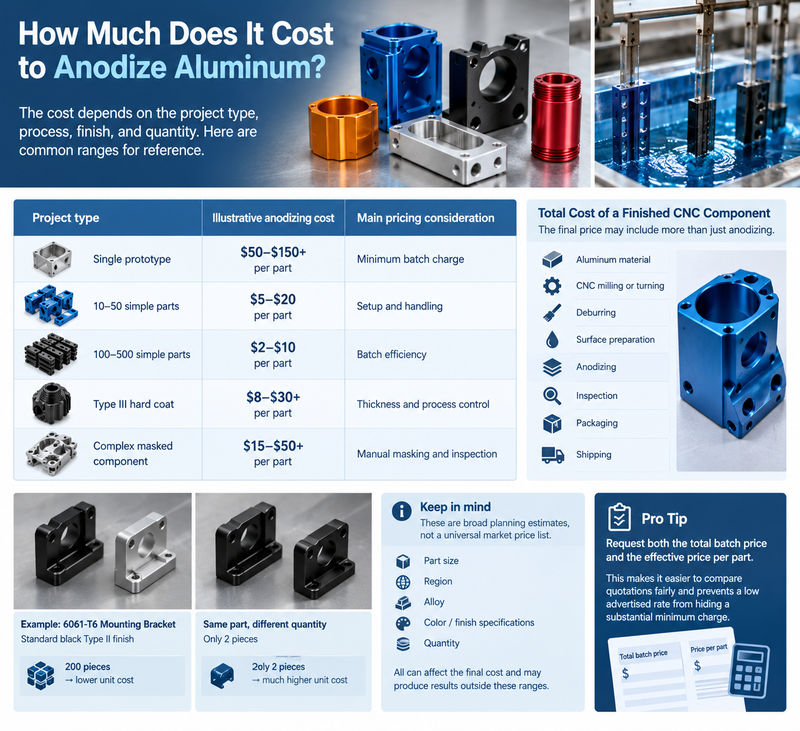
The cost to anodize aluminum varies considerably between a single prototype, a small CNC batch, and a large production order. For preliminary budgeting, a simple Type II anodized part may cost around $3–$10 per piece in a small production batch, while a one-off part can cost $50–$150 or more because of minimum batch charges. Type III hard anodizing, custom colors, and extensive masking can push the price higher.
The important distinction is between the price of anodizing alone and the total price of a finished CNC component. The latter may include aluminum material, CNC milling or turning, deburring, surface preparation, anodizing, inspection, packaging, and shipping.
| Project type | Illustrative anodizing cost | Main pricing consideration |
|---|---|---|
| Single prototype | $50–$150+ per part | Minimum batch charge |
| 10–50 simple parts | $5–$20 per part | Setup and handling |
| 100–500 simple parts | $2–$10 per part | Batch efficiency |
| Type III hard coat | $8–$30+ per part | Thickness and process control |
| Complex masked component | $15–$50+ per part | Manual masking and inspection |
These are broad planning estimates, not a universal market price list. Part size, region, alloy, color, finish specifications, and quantity can produce results outside these ranges.
For example, a small 6061-T6 aluminum mounting bracket with a standard black Type II finish may be inexpensive to process when 200 pieces are anodized together. Ordering only two brackets with the same requirements may produce a much higher unit cost, even though the physical parts are identical.
Buyers should request both the total batch price and the effective price per part. This makes it easier to compare quotations fairly and prevents a low advertised rate from hiding a substantial minimum charge.
2. Type II vs. Type III Anodizing Cost
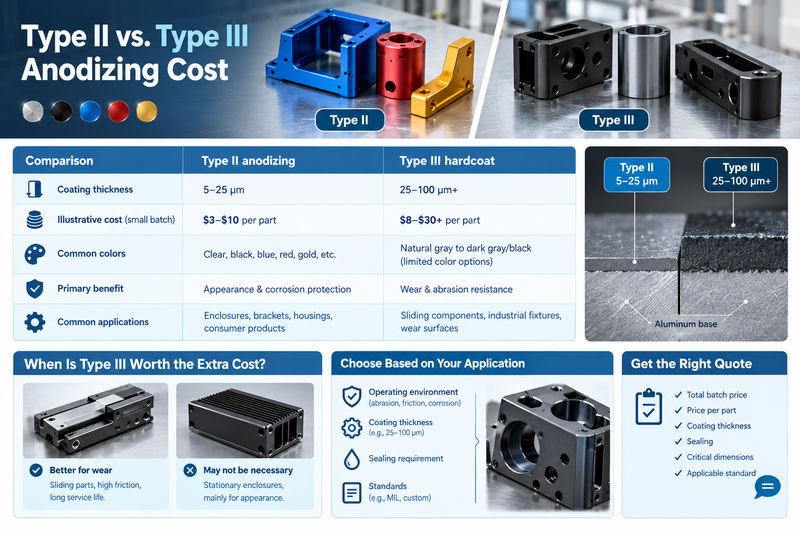
The anodizing process is one of the largest cost drivers. Type II sulfuric acid anodizing is commonly used for decorative finishes and general corrosion protection. Type III hardcoat anodizing creates a thicker, harder oxide layer for components exposed to abrasion, friction, or demanding industrial conditions.
Type III usually costs more because it requires more intensive process control, different operating conditions, and longer processing in many applications. The correct choice, however, depends on the component’s actual operating environment rather than the price difference alone.
| Comparison | Type II anodizing | Type III hardcoat |
|---|---|---|
| Typical coating thickness | Approximately 5–25 μm, depending on specification | Approximately 25–100 μm or more |
| Illustrative small-batch cost | $3–$10 per simple part | $8–$30+ per part |
| Common colors | Clear, black, blue, red, gold, and others | Natural gray to dark gray or black; color options are more limited |
| Primary benefit | Appearance and corrosion protection | Wear and abrasion resistance |
| Common applications | Enclosures, brackets, housings, consumer products | Sliding components, industrial fixtures, wear surfaces |
These thickness ranges are practical examples, not substitutes for a drawing requirement or a specified coating standard.
When Is Type III Worth the Extra Cost?
Consider an aluminum guide block that repeatedly slides against another component. Standard Type II anodizing may provide adequate corrosion protection, but it may not deliver the wear performance needed for continuous sliding contact. A properly specified hardcoat can improve surface durability, making the extra finishing expense worthwhile if it extends service life.
Conversely, a stationary electronics enclosure that primarily needs a consistent black appearance may not benefit enough from hardcoat to justify its higher price.
For purchasing teams, the best practice is to specify the required performance first. If the part needs hardcoat, define the coating thickness, sealing requirements, critical dimensions, and applicable standard before requesting quotations.
3. How Part Size and Surface Area Affect Pricing
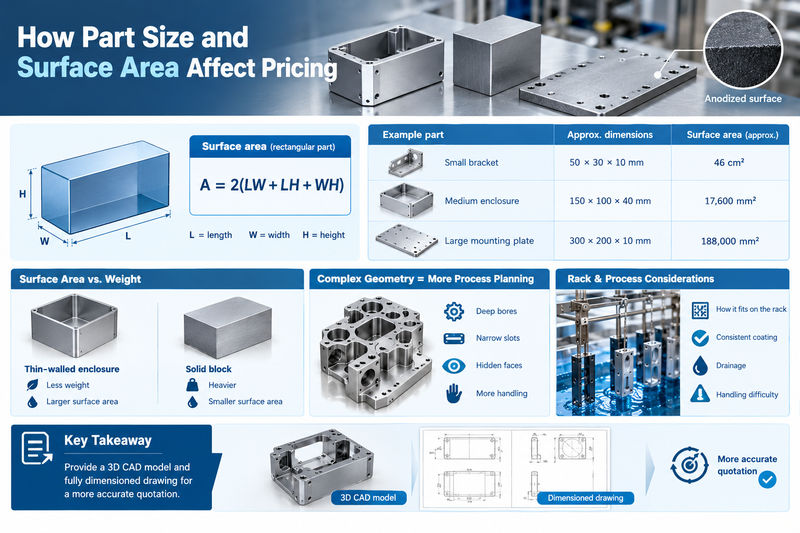
Aluminum anodizing cost is often influenced by the amount of exposed surface area rather than the part’s weight alone. A thin-walled enclosure may weigh less than a solid aluminum block but have a much larger surface area that needs finishing.
A supplier must also consider how the part fits on the rack, whether the entire surface can be treated consistently, and whether the geometry creates handling or drainage difficulties.
For an approximate rectangular part, the total surface area can be calculated as:
[ A=2(LW+LH+WH) ]
Here, (L), (W), and (H) are the part’s length, width, and height. For CNC components with pockets, slots, bores, and complex contours, the actual exposed area can be considerably different from the simple rectangular estimate.
| Example part | Approximate dimensions | Basic external surface area |
|---|---|---|
| Small bracket | 50 × 30 × 10 mm | 46 cm² |
| Medium enclosure | 150 × 100 × 40 mm | 17,600 mm² |
| Large mounting plate | 300 × 200 × 10 mm | 188,000 mm² |
The examples use simplified external geometry. Actual anodizing area can include accessible internal faces, pockets, and holes; rack contact points may remain uncoated.
A large flat plate can have a high total surface area but still be relatively easy to rack and process. A compact component with numerous deep bores, narrow slots, and concealed faces may require more handling and process planning per unit.
For this reason, providing a 3D CAD model and a fully dimensioned drawing generally produces a more reliable quotation than providing only the overall dimensions and weight.
4. How Order Quantity Changes the Cost per Part
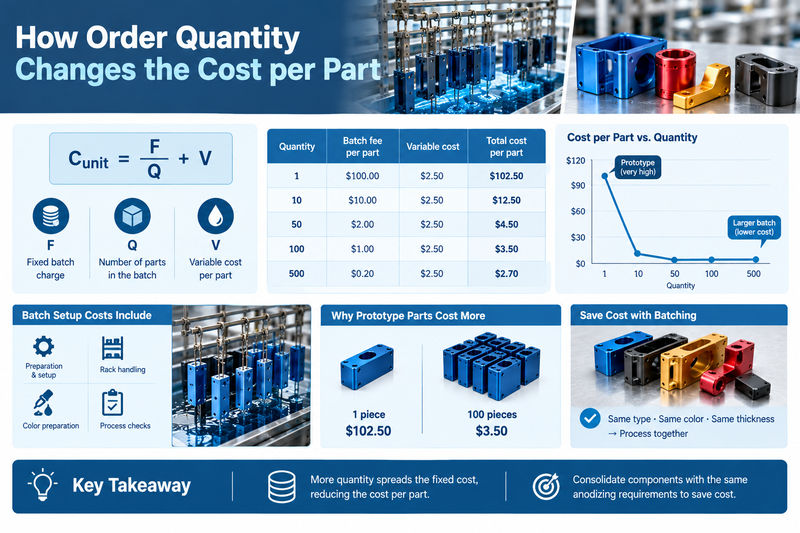
Anodizing suppliers often have minimum charges for preparing a batch, setting up racks, preparing the required color, and carrying out basic process checks. These costs are distributed across the number of parts being processed.
A simplified pricing model is:
[ C_{\text{unit}}=\frac{F}{Q}+V ]
Where:
- (F) = fixed batch charge
- (Q) = number of parts in the batch
- (V) = variable finishing cost per part
Suppose a supplier charges a hypothetical $100 batch fee plus $2.50 per part for a straightforward finish.
| Quantity | Batch fee per part | Variable cost | Total cost per part |
|---|---|---|---|
| 1 | $100.00 | $2.50 | $102.50 |
| 10 | $10.00 | $2.50 | $12.50 |
| 50 | $2.00 | $2.50 | $4.50 |
| 100 | $1.00 | $2.50 | $3.50 |
| 500 | $0.20 | $2.50 | $2.70 |
This is a mathematical illustration, not a supplier price quote. Real batch fees and variable costs differ by process and part geometry.
The example demonstrates why prototype finishing can be disproportionately expensive. Increasing quantity does not necessarily reduce the underlying chemical or processing cost per unit, but it spreads fixed charges across more parts.
One practical cost-saving approach is to consolidate components requiring the same anodizing type, color, and thickness into one production batch. This works best when the supplier can process the parts together without compromising quality or traceability.
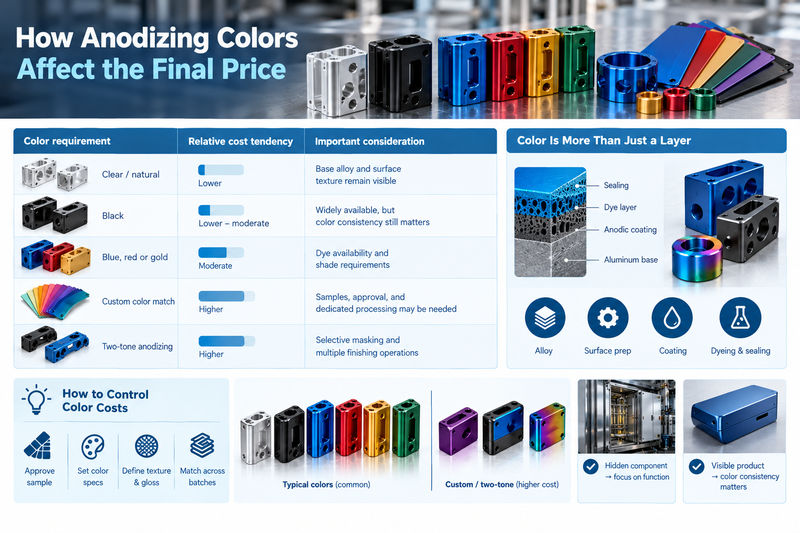
5. How Anodizing Colors Affect the Final Price
Clear and black Type II anodizing are widely used in CNC manufacturing. Suppliers may be able to process these finishes regularly, making them easier to schedule than unusual colors that require a dedicated dye setup or color-matching work.
Blue, red, gold, green, and other dyed finishes are also possible, but their pricing depends on the supplier’s capabilities, part quantity, color requirements, and inspection criteria.
| Color requirement | Relative cost tendency | Important consideration |
|---|---|---|
| Clear or natural | Often lower | Base alloy and surface texture remain visible |
| Black | Often lower to moderate | Widely available, but color consistency still matters |
| Blue, red, or gold | Moderate | Dye availability and shade requirements |
| Custom color match | Higher | Samples, approval, and dedicated processing may be needed |
| Two-tone anodizing | Higher | Selective masking and multiple finishing operations |
A critical issue is that anodized color is not simply a layer of paint. The final appearance depends on the aluminum alloy, surface preparation, coating characteristics, dyeing method, and sealing process. Even two parts with identical nominal dimensions may not produce exactly the same shade if they are made from different alloys or processed in different batches.
How to Control Color Costs
If appearance is important, approve a physical sample before committing to a large order. Define acceptable color variation, surface texture, gloss level, and whether parts from different production batches must match.
For a functional component hidden inside a machine, a custom color may provide little value. For a visible product housing, branded hardware, or premium consumer device, color consistency may be worth the extra expenditure.
The goal is to pay for the appearance the product actually needs, not to assume every anodized component requires a custom finish.
6. How Aluminum Alloy and Surface Preparation Influence Cost
Not all aluminum alloys anodize in the same way. Alloy composition affects coating appearance, uniformity, and achievable performance. CNC manufacturers must consider the alloy before promising a particular color or surface finish.
For example, 6061 aluminum is widely used for CNC-machined brackets, housings, fixtures, and structural components because it offers a practical combination of machinability, strength, and anodizing performance. Some copper-rich alloys, such as 2024, can produce less uniform or more difficult-to-match anodized finishes.
| Aluminum alloy | Typical CNC applications | Anodizing consideration |
|---|---|---|
| 6061-T6 | Brackets, enclosures, precision components | Versatile choice for general-purpose anodizing |
| 6063 | Profiles, housings, decorative components | Often suitable for consistent appearance with appropriate preparation |
| 5052 | Sheet-metal housings and panels | Commonly used for corrosion-resistant applications |
| 7075-T6 | Aerospace and high-strength brackets | Alloy chemistry can affect color and coating uniformity |
| 2024 | Aerospace structural components | Copper content can complicate appearance and coating performance |
The table provides general guidance; the appropriate finish must be confirmed for the exact alloy, temper, and service conditions.
Surface Preparation Before Anodizing
Surface preparation can significantly influence the final cost of anodized CNC parts. A typical finishing sequence may include degreasing, chemical etching or cleaning, deoxidizing, anodizing, optional dyeing, and sealing.
Additional mechanical preparation may be required when a part has visible tool marks or needs a specific texture.
| Preparation method | Effect on appearance | Cost implication |
|---|---|---|
| As-machined preparation | Preserves much of the machining texture | Often economical |
| Bead blasting | Produces a more uniform matte appearance | Adds blasting and handling cost |
| Mechanical polishing | Creates a smoother or brighter surface | Additional labor and process time |
| Fine grinding | Controls selected surfaces and texture | Higher cost when tight finish requirements apply |
| Chemical brightening | Can improve brightness on suitable alloys | Additional processing and alloy-dependent results |
Anodizing does not automatically hide machining defects. Scratches, cutter marks, dents, and inconsistent surface textures may remain visible or become more noticeable after finishing.
For a cosmetic enclosure, it may be more economical to establish the required appearance before machining begins. For example, specifying a uniform bead-blasted texture before black Type II anodizing can be more predictable than machining parts with inconsistent finishes and attempting to correct them afterward.
7. How Coating Thickness and Dimensional Tolerances Affect Pricing
Coating thickness is important because anodizing changes the surface of the aluminum. A thicker coating generally requires more demanding process control and can affect dimensions, especially on precision bores, threads, mating surfaces, and bearing seats.
Type II coatings commonly range from several microns to approximately 25 μm, while Type III hardcoat can extend considerably thicker. The actual requirement should be selected according to the application’s corrosion, wear, and dimensional needs.
One important distinction is the difference between total oxide thickness and dimensional buildup. The oxide layer grows partly into the original aluminum and partly outward from the original surface. A useful engineering approximation is that about half the coating thickness may contribute to outward growth, although the actual ratio varies with the process and alloy.
For example, a nominal 25 μm coating could produce approximately 12.5 μm of outward growth per surface under a simplified 50/50 assumption. On a cylindrical bore, coating growth from opposing surfaces reduces the bore diameter by approximately 25 μm in total.
| Requirement | Potential cost effect | Recommended action |
|---|---|---|
| Standard Type II thickness | Lower process complexity | Specify the actual thickness requirement |
| Thick Type III hardcoat | Higher process and control demands | Use only where performance requires it |
| Tight bore tolerance | May require masking or post-processing | Identify critical dimensions on the drawing |
| Precision threads | Risk of reduced clearance | Specify whether threads need masking |
| Tight coating-thickness variation | More inspection and process control | Define acceptance limits before production |
A frequent purchasing mistake is specifying a thick coating while leaving the original machined dimensions unchanged. If a bearing bore must retain a precise diameter after anodizing, the machining allowance, coating growth, and masking strategy need to be considered together.
For critical parts, request confirmation that the supplier can achieve both the required coating specification and the finished dimensions. Paying for additional thickness control is justified when it prevents rejected parts, rework, or assembly problems.
8. Masking, Fixturing, and Additional Charges
Masking protects selected areas from anodizing. This is especially important when a component needs electrical conductivity at a contact point, precise dimensions in a bore, or an uncoated surface for a particular assembly requirement.
Masking may involve plugs, caps, tapes, or specialized protective materials. Each feature adds handling time, and the cost increases when the component has many small holes or irregular surfaces.
| Additional operation | Why it may be required | Cost impact |
|---|---|---|
| Thread masking | Maintains thread dimensions or specified surface condition | Additional labor per feature |
| Bore masking | Protects precision fits and bearing seats | Higher for numerous or deep bores |
| Contact-point masking | Preserves electrical contact areas | Depends on access and location |
| Special fixturing | Holds complex parts securely during processing | Setup or tooling charge |
| Bead blasting | Establishes a specified surface texture | Additional processing |
| Special inspection | Verifies thickness, color, or performance | Depends on test method and sample quantity |
Not every threaded hole needs to be masked, and masking should not be specified automatically. The decision depends on thread clearance, the required coating, and whether the finished assembly can accommodate the coating buildup.
A Practical Design Example
Imagine a CNC-machined aluminum bracket with eight threaded holes and two precision dowel bores. If every feature requires individual masking, the labor can become a significant part of the finishing bill.
A design review may identify which holes can be anodized normally, which require protection, and whether the mating geometry can be adjusted to accommodate the coating. Any change must preserve the engineering requirements; reducing cost is not a reason to compromise a critical fit or electrical function.
Before production, provide a drawing that clearly identifies surfaces to be anodized, surfaces to remain uncoated, and dimensions that must be maintained after finishing. This avoids assumptions that can lead to additional charges or rejected parts.
9. Realistic Cost Calculations and Quotation Examples
To compare aluminum anodizing quotations accurately, separate the basic processing charge from additional operations. A quotation that appears more expensive may include blasting, masking, sealing, and inspection that another supplier lists separately.
Consider a hypothetical order of 100 CNC-machined aluminum brackets requiring Type II black anodizing.
| Cost component | Illustrative batch cost |
|---|---|
| Anodizing process | $250 |
| Surface preparation | $80 |
| Masking critical features | $100 |
| Inspection and handling | $50 |
| Total finishing cost | $480 |
| Finishing cost per part | $4.80 |
These figures are examples for demonstrating the calculation, not verified market averages or a quotation for a specific part.
If the same design required Type III hardcoat, specialized thickness verification, or more extensive masking, the total could increase substantially. Conversely, a simple component processed in a larger batch may achieve a lower finishing cost per unit.
Compare the Complete Manufacturing Cost
For CNC buyers, the more useful calculation is:
[ C{\text{finished}}=C{\text{machining}}+C{\text{anodizing}}+C{\text{other}} ]
Suppose the CNC machining cost is $18 per bracket, anodizing is $4.80, and packaging and other operations add $1.20. The total finished manufacturing cost is $24 per bracket, excluding any additional freight, taxes, or duties.
This distinction matters when comparing suppliers. A low machining price does not necessarily produce the lowest finished-part cost if the quotation excludes surface preparation, masking, inspection, or other required operations.
What to Include in a Request for Quotation
To obtain a useful price, provide:
- Aluminum alloy and temper, such as 6061-T6.
- Part drawing and, where possible, a 3D CAD model.
- Anodizing type, color, coating thickness, and applicable standard.
- Required surface texture and cosmetic acceptance criteria.
- Dimensions or features that must be masked.
- Order quantity and expected repeat-order volume.
- Inspection requirements and delivery destination.
The more complete the specification, the easier it is for suppliers to provide comparable quotations without unexpected finishing charges.
10. How to Reduce Anodizing Costs Without Compromising Quality
Reducing anodizing cost is primarily a matter of eliminating unnecessary processing, simplifying the design, and choosing a specification appropriate for the application.
Choose the right anodizing type. Use Type II for suitable decorative and general-purpose components. Specify Type III where the wear resistance or other engineering requirements justify hardcoat processing.
Standardize colors. Clear and black are often easier to source than custom-matched colors. If several components can share the same finish specification, they may be processed in a common batch.
Review masking requirements early. Identify only the surfaces that genuinely require protection. Avoid leaving critical masking decisions until after machining is complete.
Consolidate production quantities. When practical, group compatible parts into the same finishing batch. Confirm that alloy, color, thickness, and quality requirements are compatible before combining orders.
Specify achievable tolerances. Do not demand extremely tight coating-thickness variation or unnecessary dimensional precision. Define the actual functional requirements and agree on suitable inspection methods.
Prevent cosmetic defects before finishing. Consistent machining, deburring, and surface preparation reduce the risk of paying for rework or replacement parts.
Compare itemized quotations. Ask whether the price includes cleaning, pretreatment, dyeing, sealing, masking, inspection, and packaging. Also confirm minimum lot charges and any separate setup fees.
The cheapest finishing quotation is not necessarily the lowest-cost solution. Inconsistent color, inadequate coating performance, or dimensional problems can create expenses that exceed the original savings. The best approach balances a competitive price with documented requirements and repeatable quality.
Xavier CNC Machining: Get the Right Anodizing Specification for Your Parts
Choosing the right anodizing process is an important part of manufacturing reliable, cost-effective aluminum components. A suitable specification helps control surface appearance, corrosion resistance, wear performance, dimensional accuracy, and total production cost.
At Xavier, we provide CNC machining services for international B2B customers, supporting custom aluminum parts from prototype development to production orders. Our approach focuses on selecting materials, machining methods, finishing requirements, and inspection criteria that match the actual application.
Whether you need 6061-T6 aluminum brackets with a black Type II finish, precision-machined housings with controlled cosmetic requirements, or industrial components requiring Type III hardcoat, defining the finishing requirements early helps avoid unnecessary processing and costly dimensional issues.
When requesting a quotation, share your part drawings, material specifications, target quantity, anodizing type, color, and critical dimensions. Our team can review the manufacturing requirements and help you evaluate a practical balance between finishing quality and cost.
Contact Xavier today to discuss your custom CNC aluminum parts and request a manufacturing quotation. From prototype quantities to repeat production, we aim to help you achieve the required finish, dimensional consistency, and cost efficiency.
We are an integrated CNC machining manufacturer and trading supplier specializing in custom CNC machining services and precision metal component production. Our surface finishing capabilities include CNC zinc electroplating surface finishing, CNC anodizing surface finishing, and CNC chemical conversion coating surface finishing, helping meet different requirements for corrosion resistance, appearance, and component performance.
As an experienced CNC zinc electroplating surface finishing manufacturer, we provide bulk CNC anodizing surface finishing services for various metal components. Contact us to inquire about CNC chemical conversion coating surface finishing prices and discuss your project requirements.
Some of the images and text in this article are collected and compiled from the internet. If there is anything inappropriate, please contact us for processing.