
Medical Applications and Common Machined Components
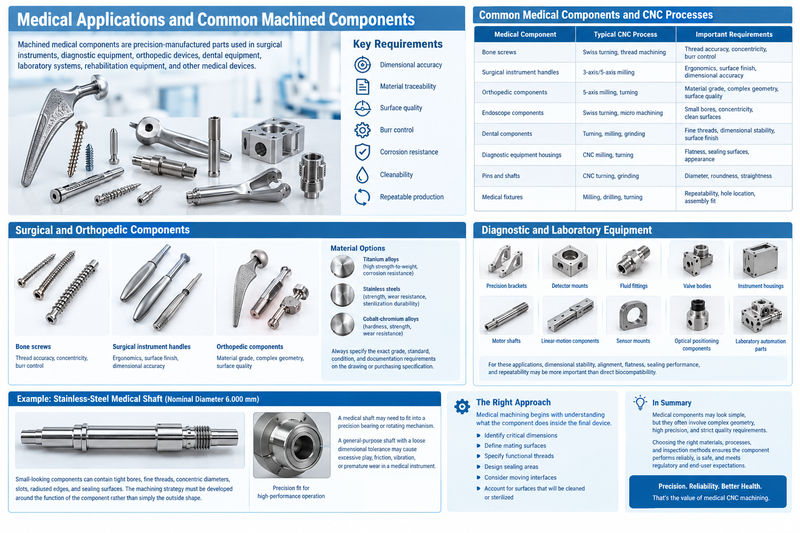
Machined medical components are precision-manufactured parts used in surgical instruments, diagnostic equipment, orthopedic devices, dental equipment, laboratory systems, rehabilitation equipment, and other medical devices. Unlike a general industrial component, a medical part may need to satisfy several requirements simultaneously: dimensional accuracy, material traceability, surface quality, burr control, corrosion resistance, cleanability, and repeatable production.
The geometry of a medical component can be surprisingly small. A simple-looking pin, sleeve, connector, or screw may contain a combination of tight bores, fine threads, concentric diameters, slots, radiused edges, and sealing surfaces. For this reason, the machining strategy must be developed around the function of the component rather than simply the outside shape.
| Medical Component | Typical CNC Process | Important Requirements |
|---|---|---|
| Bone screws | Swiss turning, thread machining | Thread accuracy, concentricity, burr control |
| Surgical instrument handles | 3-axis/5-axis milling | Ergonomics, surface finish, dimensional accuracy |
| Orthopedic components | 5-axis milling, turning | Material grade, complex geometry, surface quality |
| Endoscope components | Swiss turning, micro machining | Small bores, concentricity, clean surfaces |
| Dental components | Turning, milling, grinding | Fine threads, dimensional stability, surface finish |
| Diagnostic equipment housings | CNC milling, turning | Flatness, sealing surfaces, appearance |
| Pins and shafts | CNC turning, grinding | Diameter, roundness, straightness |
| Medical fixtures | Milling, drilling, turning | Repeatability, hole location, assembly fit |
For example, consider a stainless-steel medical shaft with a nominal diameter of 6.000 mm. The shaft may need to fit into a precision bearing or rotating mechanism. A general-purpose shaft with a loose dimensional tolerance may be acceptable in ordinary machinery, but the same approach may cause excessive play, friction, vibration, or premature wear in a medical instrument.
Medical machining therefore begins with understanding what the component does inside the final device. A manufacturer should identify critical dimensions, mating surfaces, functional threads, sealing areas, moving interfaces, and surfaces that will be cleaned or sterilized.
Surgical and Orthopedic Components
Orthopedic components often combine complex three-dimensional geometry with demanding material requirements. CNC machining is suitable for components such as fixation parts, instrument components, bone-related hardware, and custom orthopedic structures because multi-axis machining can produce curved surfaces and multiple orientations without repeatedly repositioning the workpiece.
Titanium alloys are frequently considered when high strength-to-weight ratio, corrosion resistance, and appropriate biological performance are important. Stainless steels and cobalt-chromium alloys may be selected when higher hardness, strength, wear resistance, or sterilization durability is required.
The final material specification should never be reduced to a generic description such as “titanium” or “stainless steel.” The exact grade, applicable specification, condition, and documentation requirements should be identified on the engineering drawing or purchasing specification.
Diagnostic and Laboratory Equipment
Not every machined medical component contacts the human body. Many parts are used inside diagnostic instruments, laboratory automation systems, imaging equipment, fluid-handling systems, and analytical equipment.
These components can include:
- Precision brackets
- Detector mounts
- Fluid fittings
- Valve bodies
- Instrument housings
- Motor shafts
- Linear-motion components
- Sensor mounts
- Optical positioning components
- Laboratory automation parts
For these applications, dimensional stability, alignment, flatness, sealing performance, and repeatability may be more important than direct biocompatibility.
This distinction is important because the material and finishing requirements for an external diagnostic equipment bracket should not automatically be treated the same way as those for an implantable component.
Materials for Machined Medical Components
Material selection is one of the first technical decisions in medical CNC machining. The material affects cutting parameters, tool wear, dimensional stability, surface finish, corrosion resistance, sterilization behavior, and ultimately the performance of the finished component.
Recent technical references consistently identify materials such as 316L stainless steel, titanium alloys, PEEK, cobalt-chromium alloys, and other engineering polymers as important material families for medical machining.
316L Stainless Steel
316L stainless steel is widely used for medical equipment components and surgical applications because it provides a useful combination of corrosion resistance, strength, toughness, and machinability.
For medical projects, however, “316L” alone may not be enough information. The purchaser may require a specific medical or implant-related specification, material certificate, heat/lot identification, and controlled material source.
Typical applications include:
- Surgical instrument components
- Shafts and pins
- Medical housings
- Precision fittings
- Surgical hardware
- Fluid-handling components
- Corrosion-resistant mechanisms
Passivation, polishing, or electropolishing may be specified depending on the application. These processes can improve corrosion resistance and surface condition, but they should be selected according to the engineering specification rather than simply added because a component is intended for medical use.
Titanium Alloys
Titanium is particularly attractive for applications where low weight and high strength are important. Ti-6Al-4V is a commonly encountered titanium alloy in medical applications, while specific implant applications may require particular material standards such as ASTM F136.
Titanium is also more demanding to machine than many aluminum alloys. It has relatively low thermal conductivity, so heat can remain concentrated near the cutting zone. Tool selection, cutting parameters, workholding, coolant strategy, and tool condition therefore have a direct effect on tool life and dimensional consistency.
For a thin titanium component, for example, excessive cutting force can cause deformation during machining. A theoretically correct CAD model does not guarantee a dimensionally correct finished part if the workholding strategy is inadequate.
PEEK and Engineering Plastics
PEEK is an important engineering polymer for medical components because it combines high chemical resistance, low density, electrical insulation, and useful mechanical performance. Certain medical-grade PEEK materials are also used for applications requiring radiolucency or specific implant-related properties. ASTM F2026 is associated with PEEK polymers for certain intracorporeal medical applications.
PEEK should not simply be machined using the same strategy used for aluminum or stainless steel.
Thin PEEK walls can deform under clamping pressure, and excessive heat can affect dimensional stability. Sharp tooling, controlled cutting conditions, appropriate fixturing, and careful deburring are important.
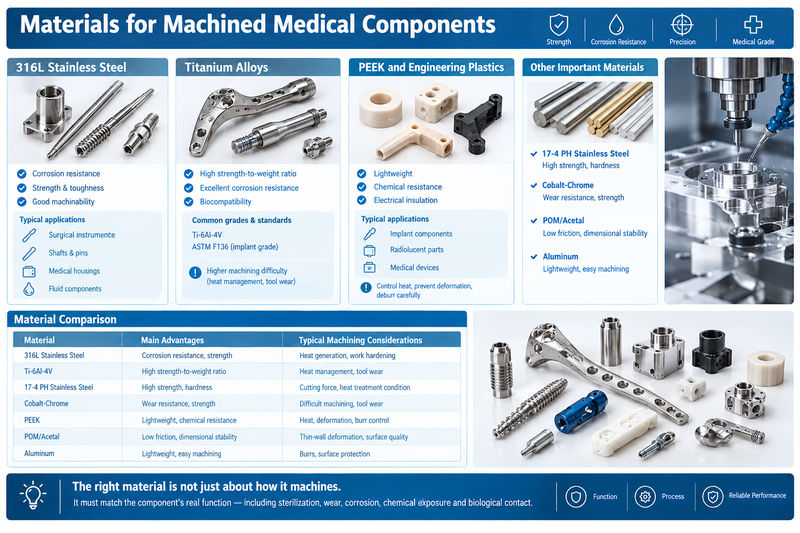
| Material | Main Advantages | Typical Machining Considerations |
|---|---|---|
| 316L Stainless Steel | Corrosion resistance, strength | Heat generation, work hardening |
| Ti-6Al-4V | High strength-to-weight ratio | Heat management, tool wear |
| 17-4 PH Stainless Steel | High strength, hardness | Cutting force, heat treatment condition |
| Cobalt-Chrome | Wear resistance, strength | Difficult machining, tool wear |
| PEEK | Lightweight, chemical resistance | Heat, deformation, burr control |
| POM/Acetal | Low friction, dimensional stability | Thin-wall deformation, surface quality |
| Aluminum | Lightweight, easy machining | Burrs, surface protection |
The important point is that the material grade should be selected according to the component’s actual function. A material that machines easily may not be suitable for sterilization, wear, corrosion, chemical exposure, or biological contact.
CNC Machining Processes, Tolerances, and Complex Features
Medical components can range from relatively simple turned pins to miniature parts containing multiple diameters, internal threads, cross-holes, slots, curved surfaces, and complex three-dimensional profiles.
The machining process must therefore be selected according to feature size, geometry, tolerance, production quantity, and material.
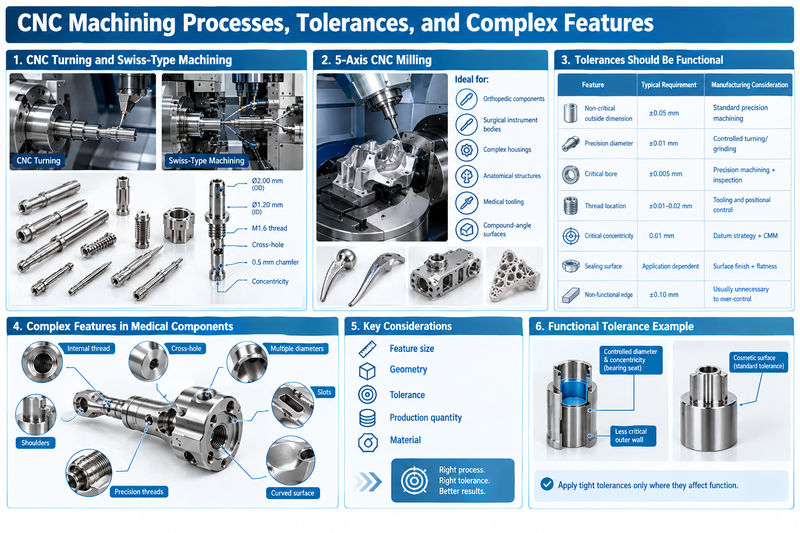
CNC Turning and Swiss-Type Machining
CNC turning is particularly effective for cylindrical medical components such as shafts, pins, bushings, screws, connectors, and sleeves.
Swiss-type machining becomes especially useful when the component is small and contains multiple precision features close together. The workpiece is supported close to the cutting tool, which helps reduce deflection during machining.
A small component might contain:
- Ø2.00 mm external diameter
- Ø1.20 mm internal bore
- M1.6 thread
- Cross-hole
- Multiple shoulders
- 0.5 mm chamfer
- Controlled concentricity
Trying to produce all these features with a conventional setup may increase the number of operations and opportunities for accumulated positioning error. Swiss machining can reduce some of these problems by completing multiple features in a controlled sequence.
5-Axis CNC Milling
5-axis machining is useful for medical components containing curved surfaces, angled features, deep cavities, and complex anatomical geometry.
A conventional 3-axis setup may require multiple workholding operations. Every additional setup introduces another opportunity for positional variation.
With 5-axis machining, the cutting tool can approach the workpiece from different orientations while maintaining controlled relationships between features.
This is particularly useful for:
- Orthopedic components
- Surgical instrument bodies
- Complex housings
- Anatomical structures
- Medical tooling
- Components with compound-angle surfaces
Tolerances Should Be Functional
One common mistake in medical component design is applying extremely tight tolerances to every dimension.
For example:
| Feature | Example Requirement | Manufacturing Consideration |
|---|---|---|
| Non-critical outside dimension | ±0.05 mm | Standard precision machining |
| Precision diameter | ±0.01 mm | Controlled turning/grinding |
| Critical bore | ±0.005 mm | Precision machining + inspection |
| Thread location | ±0.01–0.02 mm | Tooling and positional control |
| Critical concentricity | 0.01 mm | Datum strategy + CMM |
| Sealing surface | Application dependent | Surface finish + flatness |
| Non-functional edge | ±0.10 mm | Usually unnecessary to over-control |
Some medical machining sources cite ±0.005 mm as achievable for selected critical features, but this should not be interpreted as a universal tolerance for every CNC medical part. Actual capability depends on material, geometry, machine condition, feature size, environmental stability, inspection method, and production volume.
A better engineering approach is to apply tight tolerances only where they affect function.
For example, if a bearing seat requires a controlled diameter and concentricity, those features deserve tighter controls. A nearby cosmetic outer wall may not need the same tolerance.
Micro Features and Thin Walls
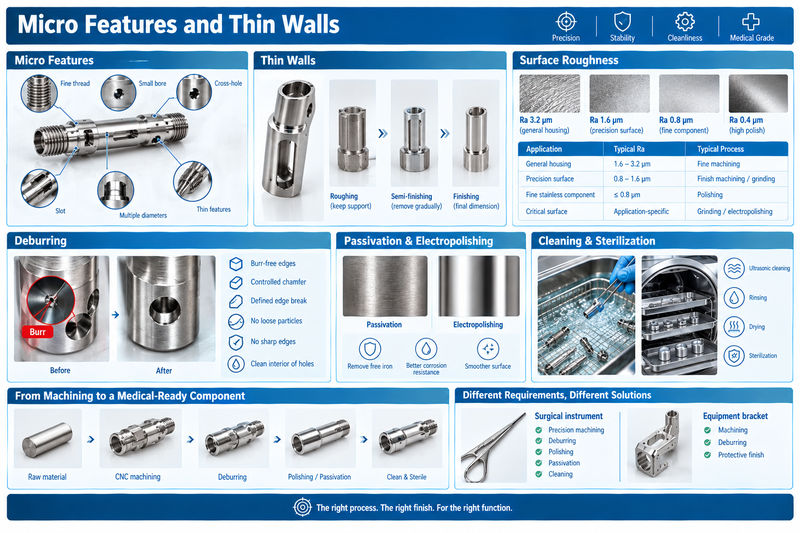
Miniature medical components create another challenge: the smaller the feature, the more sensitive it becomes to tool runout, vibration, workpiece deflection, burr formation, and measurement uncertainty.
A 10 mm diameter component and a 1 mm diameter component cannot simply be treated as scaled versions of one another.
For a thin-wall component, the machining sequence may need to leave additional supporting material during roughing and remove it gradually during finishing. This reduces deformation and makes the final dimension more predictable.
Surface Finish, Deburring, Cleaning, and Sterilization
A dimensionally accurate component can still be unsuitable if its surface condition is poorly controlled.
Surface finish affects friction, cleanability, corrosion behavior, wear, sealing, and appearance. Medical machining references commonly emphasize controlled surface roughness, burr removal, polishing, passivation, electropolishing, and cleaning.
Surface Roughness
Ra is one of the most common parameters used to describe surface roughness.
| Application Example | Possible Surface Requirement | Typical Process Direction |
|---|---|---|
| General machined housing | Ra 1.6–3.2 µm | Fine CNC machining |
| Precision mechanical surface | Ra around 0.8–1.6 µm | Finish machining/grinding |
| Fine stainless-steel component | Ra ≤0.8 µm | Fine machining/polishing |
| Highly polished critical surface | Application-specific | Grinding/polishing/electropolishing |
Values such as Ra 0.4 µm are sometimes specified for particular medical applications, but the required value must come from the actual drawing or device specification rather than being treated as a universal “medical standard.”
Deburring Is a Functional Requirement
Burrs are particularly problematic around holes, threads, slots, intersecting surfaces, and sharp machined edges.
Imagine a small stainless-steel component with a 1.5 mm cross-hole. The drilling operation may leave a tiny burr at the intersection. Even if the hole diameter is correct, that burr can affect assembly, cleaning, fluid flow, or handling.
Therefore, deburring should be included in the manufacturing process instead of being treated as a final cosmetic operation.
Typical requirements may include:
- Burr-free edges
- Controlled edge break
- Defined chamfer
- No loose particles
- No sharp edges on handling surfaces
- No machining residue inside small holes
Passivation and Electropolishing
For stainless-steel medical components, passivation can be used to improve corrosion resistance by removing free iron and improving the condition of the surface.
Electropolishing goes further by removing a controlled amount of material from the surface and can produce a smoother, cleaner stainless-steel surface when correctly specified.
The choice depends on the component.
A precision surgical instrument may require a combination of controlled machining, deburring, polishing, passivation, and cleaning. A non-contact equipment bracket may require only machining, deburring, and a conventional protective finish.
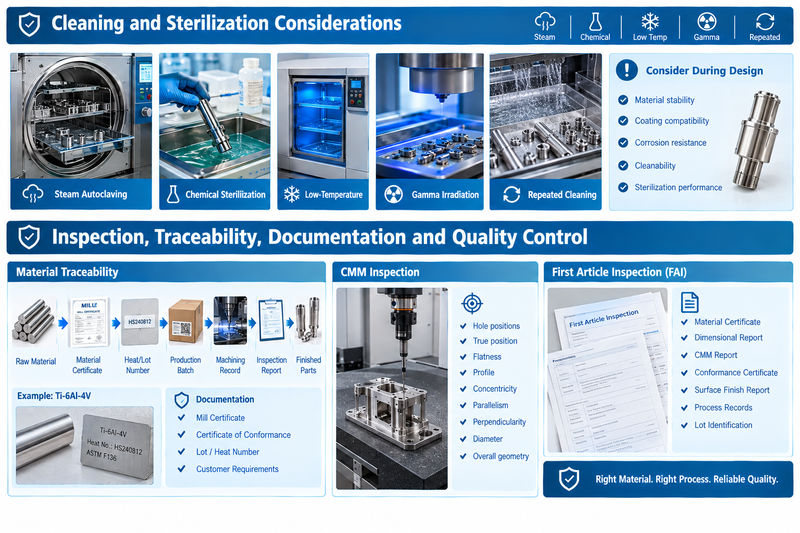
Cleaning and Sterilization Considerations
The cleaning and sterilization method should be considered during component design.
Medical devices may encounter processes such as:
- Steam autoclaving
- Chemical sterilization
- Low-temperature sterilization
- Gamma irradiation
- Repeated cleaning cycles
A material or coating that performs well in normal factory conditions may behave differently under repeated exposure to heat, chemicals, moisture, or radiation.
This is why the machining supplier should understand the customer’s downstream process before recommending a material or finish.
Inspection, Traceability, Documentation, and Quality Control
For machined medical components, inspection is not simply the final step of checking whether the part looks correct. The inspection strategy should be connected to the drawing, critical features, manufacturing process, and customer’s documentation requirements.
Current medical machining references repeatedly emphasize material traceability, inspection reports, first article inspection, documented processes, and quality-system controls.
Material Traceability
A typical traceability chain may look like:
Raw Material → Material Certificate → Heat/Lot Number → Production Batch → Machining Record → Inspection Report → Finished Parts
For example, if a customer specifies Ti-6Al-4V for a medical component, the manufacturer should not simply purchase generic titanium and machine the part.
The material identification needs to correspond to the required grade and purchasing specification. Depending on the project, the customer may request mill certificates, heat numbers, certificates of conformity, or other documentation.
CMM Inspection
Coordinate Measuring Machines are useful for verifying complex dimensional relationships that are difficult to measure reliably with hand tools.
A CMM can inspect:
- Hole positions
- True position
- Flatness
- Profile
- Concentricity
- Parallelism
- Perpendicularity
- Diameter
- Overall geometry
For example, a medical housing may have six mounting holes and one precision bore. Measuring each hole individually with calipers does not establish the complete positional relationship between the holes and the primary datum.
A CMM inspection can establish these relationships against the drawing’s datum structure.
First Article Inspection
First Article Inspection, or FAI, is especially valuable when a new medical component moves from engineering into production.
A typical FAI package may include:
| Document | Purpose |
|---|---|
| Material Certificate | Confirms material specification |
| Dimensional Inspection Report | Verifies drawing dimensions |
| CMM Report | Documents critical geometric features |
| Certificate of Conformance | Confirms conformity to requirements |
| Surface Finish Report | Verifies specified finish |
| Process Records | Documents controlled manufacturing |
| Lot Identification | Maintains traceability |
The exact documentation package depends on the customer’s quality system and the regulatory status of the final medical device.
ISO 13485 and Supplier Responsibilities
ISO 13485 is a quality management standard specifically associated with medical devices. However, it is important to distinguish between machining a component for a medical-device manufacturer and manufacturing a complete regulated medical device.
The legal manufacturer remains responsible for the finished device’s regulatory strategy and applicable submissions. A machining supplier may instead be responsible for manufacturing the component according to approved drawings, specifications, purchasing requirements, and agreed quality procedures.
For this reason, medical OEMs should clarify at the beginning of a project:
- Which quality standard applies?
- What material certificates are required?
- What dimensions require 100% inspection?
- Is FAI required?
- What surface treatment documentation is needed?
- What cleaning standard applies?
- How should lots be identified?
- What records must be retained?
- Who is responsible for process validation?
This prevents an otherwise technically correct CNC part from becoming unusable because the documentation does not match the customer’s quality requirements.
Choosing a CNC Manufacturing Approach for Medical Components
A practical medical CNC project should begin with the engineering drawing rather than with a generic machining process.
A useful workflow is:
Drawing Review → Material Verification → DFM Review → Process Selection → CNC Machining → Deburring → Surface Treatment → Cleaning → Inspection → Documentation → Packaging
Consider a hypothetical 316L stainless-steel medical connector.
The drawing specifies:
- Material: 316L stainless steel
- Main diameter: Ø12.00 mm
- Critical bore: Ø8.000 ±0.005 mm
- Thread: M10 × 1.0
- Concentricity: 0.01 mm
- Surface finish on bore: Ra 0.8 µm
- Burr-free internal passage
- Material certificate required
- Dimensional inspection required
A suitable production strategy could use CNC turning for the external diameter and thread, precision boring for the internal diameter, controlled deburring, surface finishing where specified, followed by dimensional inspection.
The important point is that the process is built around the critical features, not simply around the machine available in the factory.
Machined Medical Components from Xavier
Xavier approaches machined medical components as precision manufacturing projects rather than simply standard CNC orders. From material selection and machining strategy to surface finishing and dimensional inspection, each stage should be matched to the actual requirements of the component.
For prototypes, low-volume development parts, and production components, Xavier can support CNC milling, CNC turning, precision machining, and complex component manufacturing across materials such as stainless steel, titanium, aluminum, brass, copper, engineering plastics, and other specified materials.
For medical OEMs, the most useful starting point is a complete drawing or 3D model containing the material grade, critical dimensions, tolerances, GD&T requirements, surface finish, quantity, and required documentation. With those details available, the manufacturing process can be evaluated before production begins.
The goal is not to make every dimension unnecessarily tight or every surface unnecessarily polished. The goal is to manufacture the right material, to the right geometry, with the right surface condition, and with inspection evidence that demonstrates conformity to the drawing.
For machined medical components, that combination of engineering accuracy, manufacturing consistency, surface control, and traceability is what turns a CNC-machined part into a dependable component for a demanding medical application.
At Xavier, we provide professional CNC machining services for customers worldwide, specializing in custom CNC machined parts made from metal and engineering plastics. Our capabilities include CNC milling, turning, drilling, boring, grinding, and other precision machining processes for prototypes, small batches, and production runs.
For medical and healthcare applications, we manufacture machined medical components such as shafts, pins, bushings, housings, brackets, connectors, and custom instrument parts. Materials can include stainless steel, aluminum, titanium, copper alloys, and engineering plastics, with surface treatments available according to project requirements.
Whether you need precision CNC machining, custom CNC machining, or other CNC machined components, Xavier can manufacture parts according to your drawings, CAD files, tolerances, quantities, and finishing specifications. Contact us to discuss your CNC machining project and manufacturing requirements.
Some of the images and text in this article are collected and compiled from the internet. If there is anything inappropriate, please contact us for processing.