
Aluminum Anodized Colors: Color Chart, Type II vs Type III and More
What Colors Can Aluminum Be Anodized?
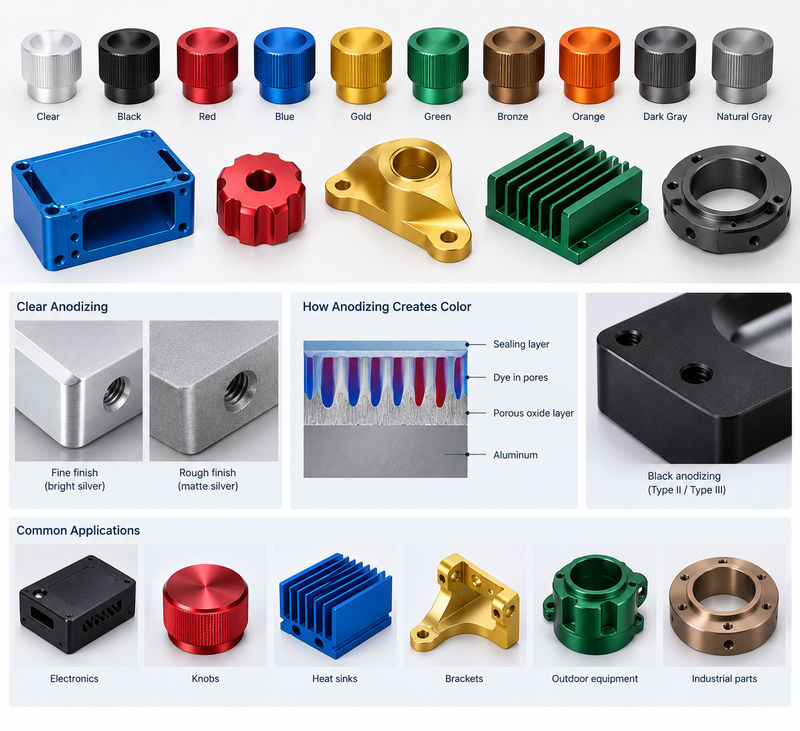
Aluminum anodizing is widely used on CNC machined parts because it can provide both a controlled appearance and improved surface performance. Unlike paint, anodizing creates an aluminum oxide layer through an electrochemical process. In Type II anodizing, the porous oxide layer can absorb dyes, allowing aluminum parts to be produced in colors such as black, red, blue, gold, green, bronze, orange, and other shades.
However, “any color” should not be interpreted literally. Anodizing is not the same as applying an opaque paint layer. The final appearance is affected by the aluminum alloy, machining texture, oxide thickness, dye concentration, sealing process, and lighting conditions. This is why two aluminum parts specified with the same nominal color can still show visible differences.
A practical color range for Type II anodized aluminum is shown below:
| Anodized Color | Typical Type | Common Applications | Color Consistency |
|---|---|---|---|
| Clear / Natural | Type II | Housings, brackets, industrial parts | High |
| Black | Type II / Type III | Electronics, machinery, optical components | High |
| Red | Type II | Automotive, consumer products, identification | Medium–High |
| Blue | Type II | Electronics, sporting products, machinery | Medium–High |
| Gold | Type II | Decorative hardware, consumer products | Medium |
| Green | Type II | Equipment, identification, outdoor components | Medium |
| Bronze | Type II / Type III | Architectural and industrial parts | Medium |
| Orange | Type II | Identification and consumer products | Medium |
| Dark Gray | Type III | Wear-resistant mechanical components | High |
| Natural Gray | Type III | Aerospace and industrial components | Medium–High |
Type II sulfuric anodizing is normally the preferred process when color is an important requirement. Commercial anodizing suppliers commonly offer clear, black, red, blue, orange, and gold, while additional colors depend on the anodizer’s dye system and process control.
Clear or Natural Anodized Aluminum
Clear anodizing does not mean that the aluminum becomes completely transparent. The oxide layer remains visually influenced by the underlying metal, machining marks, alloy composition, and surface roughness.
For example, a machined 6061-T6 aluminum component with a fine surface finish can appear bright silver or satin silver after clear anodizing. A rougher surface may appear more matte because the surface scatters light.
Clear anodizing is useful when the customer wants to retain the metallic appearance of aluminum while adding corrosion resistance and a harder oxide surface.
Black Anodized Aluminum
Black is one of the most widely used anodized aluminum colors. It is common for CNC machined housings, brackets, knobs, camera components, optical equipment, heat sinks, and industrial equipment.
Type II black anodizing can provide a relatively deep cosmetic black, while Type III hardcoat commonly produces black or dark shades because the oxide layer is substantially thicker and denser.
Black is also relatively forgiving visually. Small variations in surface texture can be less noticeable than they would be on bright colors such as red, blue, or gold.
Red, Blue, Gold, Green, and Other Colors
Bright colors are generally associated with Type II anodizing because its porous oxide structure allows dye to penetrate the surface.
For example, a CNC-machined 6061-T6 aluminum knob may be anodized red for product identification. A machined electronic enclosure may use blue anodizing for branding, while gold anodizing may be selected for a decorative appearance.
The important point is that the color is produced through the anodizing process rather than simply sprayed onto the finished part. Consequently, the visual result retains some of the underlying metallic character of the aluminum.
How Type II and Type III Anodizing Affect Color
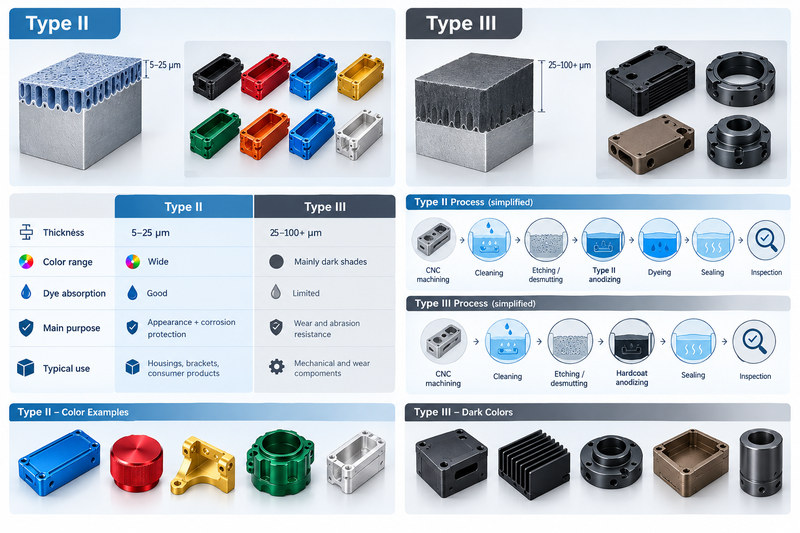
The anodizing type is one of the first decisions that should be made before selecting a color. Type II and Type III have significantly different oxide structures, thicknesses, and typical applications.
| Characteristic | Type II Anodizing | Type III Hardcoat |
|---|---|---|
| Typical process | Sulfuric acid anodizing | Hardcoat anodizing |
| Typical thickness | About 5–25 µm | About 25–100+ µm |
| Color range | Wide | Mainly dark shades |
| Dye absorption | Good | Limited |
| Typical appearance | Clear, black, red, blue, gold, etc. | Natural, dark gray, black |
| Main purpose | Appearance + corrosion protection | Wear and abrasion resistance |
| Typical use | Housings, brackets, consumer products | Mechanical and wear components |
| Dimensional effect | Relatively small but important | More significant |
These ranges are commonly cited in current anodizing references, although the actual achievable thickness depends on alloy, process parameters, geometry, and specification.
Type II Anodizing for Color
Type II creates a relatively thin porous oxide layer. After anodizing, the pores can accept dye before the part is sealed.
A simplified production sequence is:
CNC machining → Cleaning → Etching/desmutting → Type II anodizing → Dyeing → Sealing → Inspection
This process makes Type II particularly suitable for visible CNC components where appearance matters.
For example, suppose a customer orders 500 CNC-machined 6061 aluminum covers with a blue anodized finish. The machining process may produce consistent geometry, but the finishing department must also control the alloy, surface preparation, anodizing thickness, dye bath, temperature, dye concentration, and sealing conditions.
If one production batch has a different surface preparation or oxide thickness, the blue may appear lighter, darker, or slightly different in saturation.
Type III Hardcoat and Dark Colors
Type III hardcoat produces a much thicker oxide layer and is normally selected when wear resistance is more important than a wide choice of decorative colors.
Natural hardcoat may appear gray, dark gray, bronze, brownish-gray, or other dark tones depending on the alloy and process. Black hardcoat is also widely used.
A key limitation is that bright decorative colors are generally not the main purpose of Type III. The thicker oxide layer has a different structure and dyeing behavior, so customers requiring bright red, blue, orange, or gold normally consider Type II instead.
If a part requires both a decorative color and substantial wear resistance, the engineering team should discuss the actual operating requirements rather than automatically selecting Type III.
How Aluminum Alloy and Surface Preparation Change Color
One of the most important facts about aluminum anodized colors is that the dye is not the only thing determining the final color.
The aluminum alloy itself remains visually important because different alloying elements respond differently during anodizing.
| Aluminum Alloy | General Anodizing Behavior | Typical Color Consideration |
|---|---|---|
| 6061 | Very widely used for anodizing | Generally consistent |
| 6063 | Excellent cosmetic anodizing behavior | Often bright and uniform |
| 5052 | Generally suitable | Good for many decorative applications |
| 5083 | Can be anodized | Appearance depends on surface condition |
| 7075 | More challenging for cosmetic matching | Can produce darker/warm undertones |
| 2024 | More difficult for consistent appearance | Copper content can affect appearance |
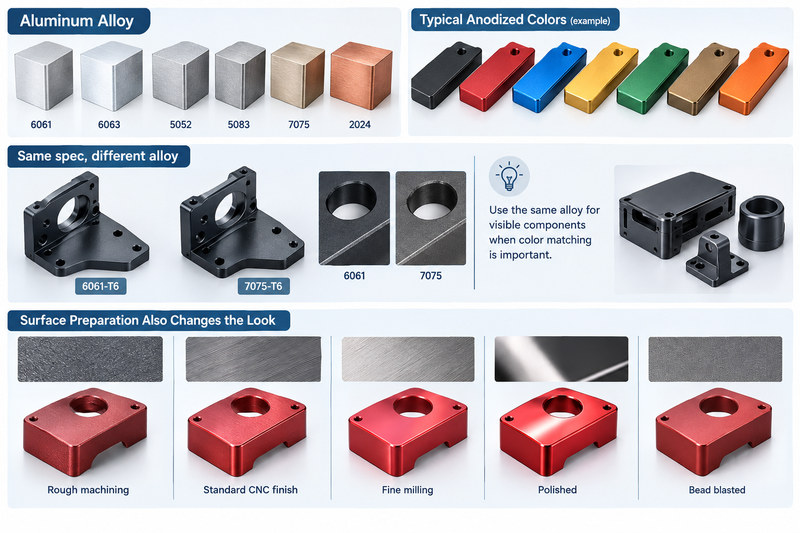
6061 and 6063 are commonly favored when consistent cosmetic anodizing is required. Higher-alloy materials such as 2024 and 7075 can produce more variation because alloying elements influence the oxide formation and resulting optical appearance.
Example: 6061 vs. 7075
Imagine two CNC-machined brackets with identical dimensions and the same black anodizing specification.
Part A is manufactured from 6061-T6.
Part B is manufactured from 7075-T6.
Even if both parts are processed in the same anodizing tank, their final appearance may not be identical. The different alloy chemistry can cause differences in tone, reflectivity, and color depth.
This becomes particularly important when a product contains several components that must visually match.
A practical rule is to use the same aluminum alloy for all externally visible components whenever color matching is important.
Machining Finish Also Matters
Surface texture affects the way light reflects from anodized aluminum.
Consider these two surfaces:
| Machined Surface | Visual Effect After Anodizing |
|---|---|
| Rough machining | Matte, less reflective |
| Standard CNC finish | Satin metallic appearance |
| Fine milling | Smoother and more uniform |
| Polished | Brighter, more reflective |
| Bead blasted | Uniform matte appearance |
A red anodized part with a polished surface can look significantly brighter than a red anodized part with a bead-blasted surface, even when both use the same dye.
For this reason, a drawing should not simply state “red anodized” if appearance is critical. The required surface preparation should also be defined.
Why Anodized Colors Vary and How to Improve Color Consistency
Color variation is one of the most common practical issues when producing anodized aluminum parts in volume.
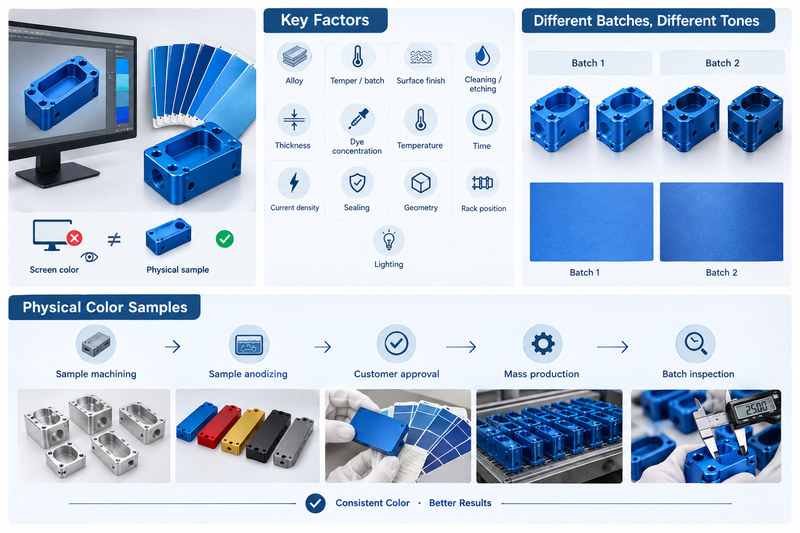
A digital color displayed on a computer monitor is not an appropriate production acceptance standard because screen brightness, monitor calibration, viewing angle, and surrounding light all affect perceived color. Current industry guidance therefore emphasizes physical samples or agreed inspection conditions for cosmetic anodized parts.
Major Factors Affecting Color
Several variables can influence the final appearance:
- Aluminum alloy
- Material temper and batch
- Machining surface finish
- Cleaning and etching
- Anodizing thickness
- Dye concentration
- Bath temperature
- Processing time
- Current density
- Sealing conditions
- Part geometry
- Rack position
- Lighting during inspection
Not all factors have the same effect. For a CNC machining supplier, material consistency and surface preparation are especially important.
Why Parts from Different Batches May Look Different
Suppose a customer orders 1,000 blue anodized parts in four production batches.
The first 250 parts are produced using aluminum from one material lot. The second batch uses a different material lot with slightly different alloy characteristics.
The machining dimensions may remain completely within tolerance, but the two groups can have a slightly different visual tone after anodizing.
This is why high-volume cosmetic projects should establish an approved reference sample and define acceptable variation before mass production.
Physical Color Samples
For demanding applications, a useful process is:
Sample machining → Sample anodizing → Customer approval → Mass production → Batch inspection
The sample should use the same:
- Aluminum alloy
- Surface finish
- Anodizing type
- Approximate coating thickness
- Color process
- Sealing method
This makes the approved sample much more meaningful than a generic online color chart.
How to Specify Aluminum Anodized Colors for CNC Machined Parts
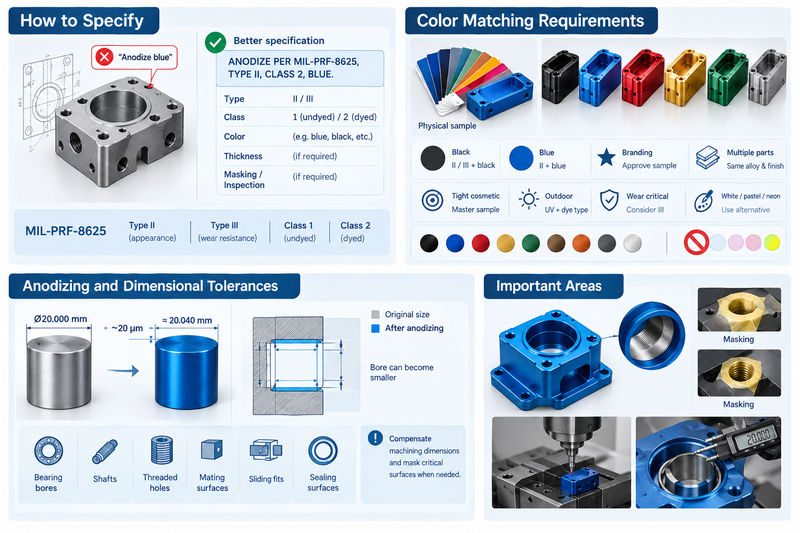
A vague drawing note such as “anodize blue” leaves several important engineering questions unanswered.
A better specification identifies the anodizing type, class, color, thickness where necessary, and any critical masking or inspection requirements.
For example:
ANODIZE PER MIL-PRF-8625, TYPE II, CLASS 2, BLUE.
For black:
ANODIZE PER MIL-PRF-8625, TYPE II, CLASS 2, BLACK.
For hardcoat:
HARDCOAT ANODIZE PER MIL-PRF-8625, TYPE III.
MIL-PRF-8625 distinguishes Type II and Type III anodizing and uses Class 1 for undyed finishes and Class 2 for dyed finishes.
Color Matching Requirements
If the customer needs a specific commercial color, it is better to communicate the target using a physical reference or an agreed color standard while recognizing that anodizing is translucent rather than an opaque paint system.
For example:
| Requirement | Recommended Approach |
|---|---|
| General black | Specify Type II/III + black |
| General blue | Specify Type II + blue |
| Product branding | Approve physical sample |
| Multiple visible parts | Use same alloy and finish |
| Tight cosmetic requirement | Define master sample |
| Outdoor application | Discuss UV exposure and dye type |
| Wear-critical component | Consider Type III |
| Exact bright white | Consider an alternative coating |
Anodizing generally cannot reproduce every paint or printed color exactly. White, pastel, and neon appearances are particularly problematic because anodizing relies on a translucent oxide layer rather than an opaque coating.
Anodizing and Dimensional Tolerances
Color is not the only consideration when specifying anodizing on CNC parts. The oxide layer also affects dimensions.
For example, assume a machined external diameter is:
Ø20.000 mm
If a 20 µm anodizing layer is applied, approximately part of the oxide growth occurs outward from the original surface. Therefore, the finished dimension can increase.
Similarly, a precision bore can become smaller after anodizing.
This is especially important for:
- Bearing bores
- Shafts
- Threaded holes
- Precision mating surfaces
- Sliding fits
- Sealing surfaces
For example, if a bearing bore must maintain a tight final tolerance, simply machining the bore to its nominal finished dimension before anodizing may result in an undersized bore after finishing.
A CNC supplier should therefore compensate the machining dimensions when necessary and mask critical surfaces.
Choosing the Right Aluminum Anodized Color for Your Application
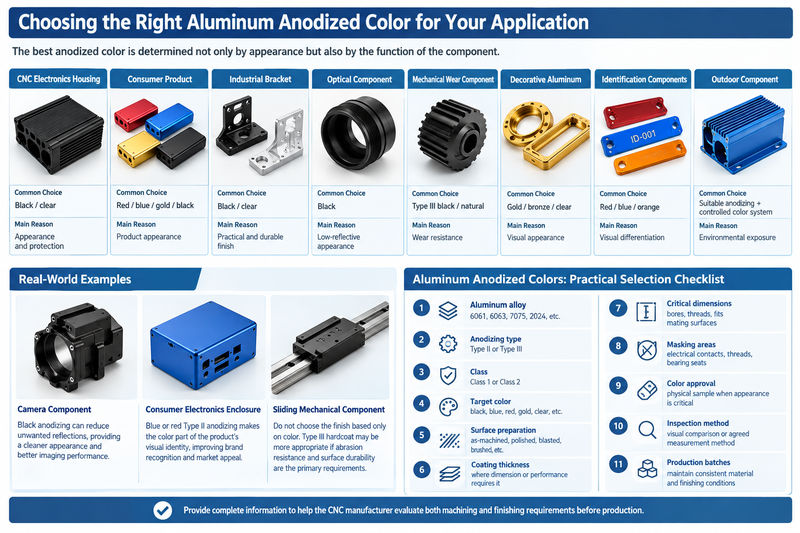
The best anodized color is determined not only by appearance but also by the function of the component.
| Application | Common Choice | Main Reason |
|---|---|---|
| CNC electronics housing | Black / clear | Appearance and protection |
| Consumer product | Red / blue / gold / black | Product appearance |
| Industrial bracket | Black / clear | Practical and durable finish |
| Optical component | Black | Low-reflective appearance |
| Mechanical wear component | Type III black/natural | Wear resistance |
| Decorative aluminum | Gold / bronze / clear | Visual appearance |
| Identification components | Red / blue / orange | Visual differentiation |
| Outdoor component | Suitable anodizing + controlled color system | Environmental exposure |
For example, a CNC-machined aluminum camera component may benefit from black anodizing because the dark surface can reduce unwanted reflections. A consumer electronics enclosure may use blue or red Type II anodizing because the color becomes part of the product’s visual identity.
A sliding mechanical component, however, should not select its finish purely based on color. Type III hardcoat may be more appropriate if abrasion resistance and surface durability are the primary requirements.
Aluminum Anodized Colors: Practical Selection Checklist
Before ordering colored anodized CNC parts, confirm the following:
- Aluminum alloy: 6061, 6063, 7075, 2024, etc.
- Anodizing type: Type II or Type III
- Class: Class 1 or Class 2
- Target color: black, blue, red, gold, clear, etc.
- Surface preparation: as-machined, polished, blasted, brushed, etc.
- Coating thickness: where dimension or performance requires it
- Critical dimensions: bores, threads, fits, mating surfaces
- Masking areas: electrical contacts, threads, bearing seats
- Color approval: physical sample when appearance is critical
- Inspection method: visual comparison or agreed measurement method
- Production batches: maintain consistent material and finishing conditions
This information gives the CNC manufacturer enough information to evaluate both machining and finishing requirements before production begins.
Xavier CNC Machining and Aluminum Anodized Colors
For CNC machined aluminum parts, anodizing should be considered as part of the complete manufacturing process rather than as an isolated finishing operation. The aluminum alloy, machining strategy, surface roughness, dimensional tolerances, anodizing type, color, and masking requirements can all influence the final component.
Xavier provides CNC machining and aluminum part manufacturing with anodizing and other surface-finishing options for customers who need both precision machining and controlled cosmetic finishes. When a project requires colored anodized aluminum, we can evaluate the material, geometry, surface requirements, tolerances, and desired color together before production.
For simple applications, specifications such as Type II black anodizing may be sufficient. For appearance-critical products, a physical color sample and consistent aluminum material are more appropriate. For wear-critical components, Type III hardcoat may be a better engineering solution than choosing a decorative Type II color.
The key is to select the anodizing process according to the actual application instead of choosing a color first and considering the engineering requirements afterward.
If you are sourcing CNC machined aluminum parts with clear, black, red, blue, gold, or other anodized finishes, Xavier can help evaluate the machining and finishing requirements from the drawing or 3D model through production.
We are an integrated CNC machining manufacturer and trading company specializing in CNC outsourcing and the machining of various metal parts. Our capabilities include CNC anodizing surface finishing, CNC electrogalvanizing surface finishing, and CNC chemical conversion coating surface finishing.
As an CNC anodizing manufacturer, we provide electrogalvanizing services in batches and can also help you check chemical conversion coating prices. Feel free to contact us for your CNC machining and metal finishing requirements.
Some of the images and text in this article are collected and compiled from the internet. If there is anything inappropriate, please contact us for processing.