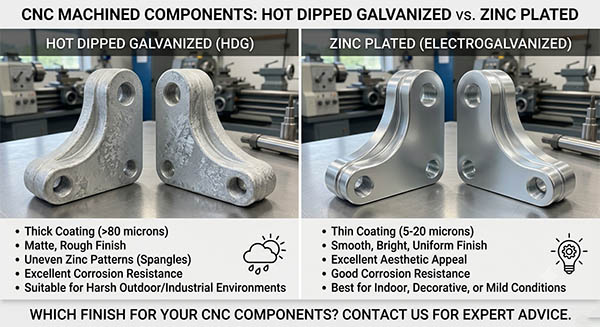
Hot Dipped Galvanized vs Zinc Plated: Which Zinc Coating Is Better?
Steel components are highly susceptible to corrosion when exposed to moisture, oxygen, industrial pollutants, and salt. To extend service life, manufacturers commonly apply zinc-based protective coatings. The two most widely used options are hot-dip galvanizing (HDG) and zinc plating (electro-galvanizing).
Although both processes use zinc as a sacrificial protective layer, their manufacturing methods, coating thicknesses, durability, costs, and applications differ significantly.
This guide provides an in-depth comparison to help engineers, buyers, and manufacturers choose the most suitable surface treatment for CNC machined parts, fasteners, structural steel, and industrial equipment.
What Is Hot-Dip Galvanizing?
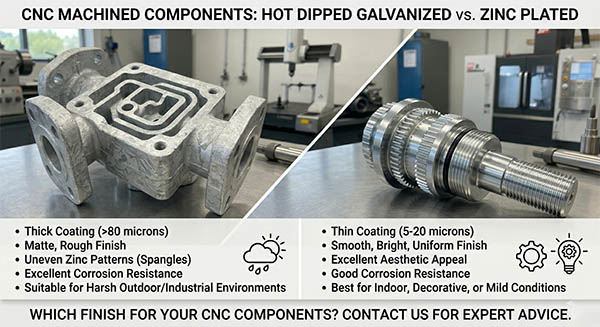
Hot-dip galvanizing is a process in which steel components are immersed into molten zinc at approximately 450°C (842°F). During immersion, zinc reacts metallurgically with iron, creating several zinc-iron alloy layers and an outer pure zinc layer.
The resulting coating becomes an integral part of the steel rather than simply sitting on the surface.
Key characteristics include:
- Thick zinc coating
- Strong metallurgical bond
- Excellent outdoor corrosion protection
- Self-healing sacrificial protection
Common HDG products include:
- Structural steel beams
- Highway guardrails
- Transmission towers
- Outdoor fasteners
- Agricultural equipment
What Is Zinc Plating (Electro-Galvanizing)?
Zinc plating uses an electrolytic process to deposit zinc ions onto a steel surface.
The steel component acts as a cathode while zinc serves as the anode. Electric current transfers zinc ions from the solution onto the part surface.
Characteristics include:
- Thin, uniform coating
- Bright appearance
- Lower cost
- Suitable for indoor environments
Common applications include:
- Automotive hardware
- Electronic enclosures
- Indoor machinery
- Consumer products
- Small precision fasteners
Manufacturing Process Comparison
The manufacturing route significantly affects coating performance.
| Feature | Hot-Dip Galvanized | Zinc Plated |
|---|---|---|
| Coating Method | Molten zinc immersion | Electroplating |
| Process Temperature | ~450°C | Room temperature |
| Bond Type | Metallurgical alloy bond | Mechanical adhesion |
| Surface Structure | Zinc-iron alloy layers | Pure zinc layer |
| Coating Uniformity | Moderate | Excellent |
| Production Speed | Slower | Faster |
Because HDG creates alloy layers beneath the zinc surface, it provides stronger adhesion and longer protection. Zinc plating primarily relies on surface adhesion.
Coating Thickness Differences
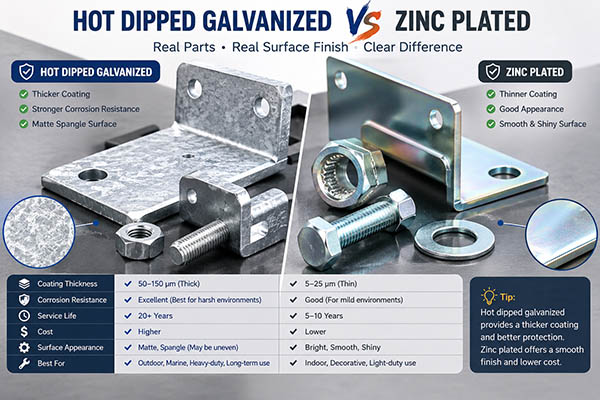
Coating thickness is one of the most important factors affecting corrosion resistance.
| Coating Type | Typical Thickness |
|---|---|
| Zinc Plating | 5–25 μm |
| Hot-Dip Galvanizing | 50–150+ μm |
Several industrial sources report that HDG coatings are typically three to ten times thicker than electroplated zinc coatings.
Example:
A zinc-plated bolt may have a 10 μm coating.
The same bolt hot-dip galvanized may exceed 80 μm.
This additional zinc acts as a larger corrosion reservoir, dramatically increasing service life.
Corrosion Resistance Performance
The primary purpose of both coatings is corrosion protection.
However, performance differs greatly.
| Environment | Zinc Plated | Hot-Dip Galvanized |
|---|---|---|
| Indoor Dry | Excellent | Excellent |
| Humid Indoor | Good | Excellent |
| Outdoor Urban | Moderate | Excellent |
| Industrial Area | Fair | Excellent |
| Coastal Environment | Poor to Moderate | Excellent |
HDG provides superior corrosion resistance because:
- The coating is thicker.
- Zinc-iron alloy layers resist abrasion.
- Zinc provides sacrificial protection when scratched.
Even if a small area becomes damaged, surrounding zinc continues protecting exposed steel.
Expected Service Life
One of the most searched questions on Google is:
“How long does galvanized steel last?”
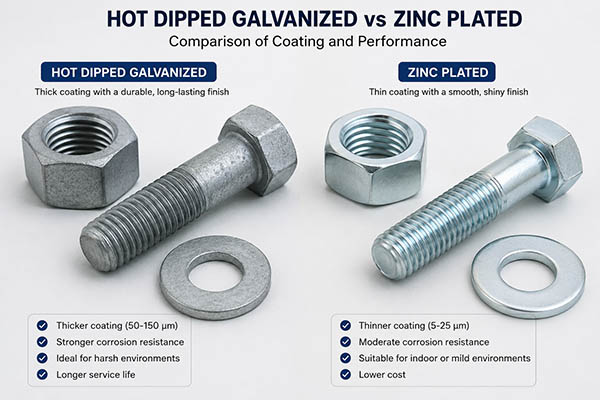
The answer depends heavily on coating thickness and environmental exposure.
| Coating Type | Typical Service Life |
|---|---|
| Zinc Plated | 1–10 Years |
| Hot-Dip Galvanized | 20–80+ Years |
Studies and industry data indicate that heavy HDG coatings can remain effective for decades in many outdoor environments. Some zinc-coated sheet products with thicker coatings can achieve service lives approaching 80 years.
For infrastructure projects, this difference often justifies the higher initial cost.
Adhesion Strength and Mechanical Durability
Coating adhesion determines how well a finish survives handling, transportation, and abrasion.
Hot-dip galvanizing forms zinc-iron alloy layers bonded metallurgically to the steel substrate.
Advantages:
- Better impact resistance
- Better abrasion resistance
- Reduced flaking
- Improved long-term durability
Electroplated zinc coatings are thinner and may wear through more quickly in high-friction environments.
For example:
A zinc-plated warehouse bracket may perform perfectly indoors.
The same bracket used on construction equipment would likely benefit from HDG.
Surface Appearance and Cosmetic Quality
Appearance often influences coating selection.
| Feature | Zinc Plated | Hot-Dip Galvanized |
|---|---|---|
| Brightness | High | Moderate |
| Smoothness | Excellent | Moderate |
| Dimensional Accuracy | Excellent | Moderate |
| Decorative Appeal | Better | Lower |
Zinc plating creates a smooth, bright, attractive finish.
HDG often produces:
- Zinc spangle patterns
- Rougher texture
- Visible drainage marks
As a result, zinc plating is preferred when aesthetics matter.
Cost Comparison
Initial cost often drives purchasing decisions.
| Cost Factor | Zinc Plated | Hot-Dip Galvanized |
|---|---|---|
| Processing Cost | Lower | Higher |
| Material Consumption | Lower | Higher |
| Maintenance Cost | Higher | Lower |
| Lifecycle Cost | Higher | Lower |
For short-term indoor applications, zinc plating is usually more economical.
For long-term outdoor installations, HDG often delivers lower lifecycle costs because replacement and maintenance requirements are greatly reduced.
Impact on Threaded Fasteners
Fasteners present unique challenges.
Hot-dip galvanized bolts often require:
- Oversized nuts
- Thread tapping after coating
- Dimensional adjustments
Because the coating is thick, thread tolerances can change.
Zinc plating is often preferred for:
- Precision screws
- Machine bolts
- Electronic hardware
HDG remains preferred for:
- Bridge bolts
- Solar mounting systems
- Utility structures
Performance in Outdoor and Marine Environments
Marine environments are among the harshest corrosion conditions.
Salt accelerates electrochemical corrosion dramatically.
Example applications requiring HDG:
- Coastal fences
- Offshore platforms
- Marine docks
- Solar farms
- Wind turbine structures
Hot-dip galvanized coatings provide a significantly larger sacrificial zinc reserve, making them far more suitable for long-term outdoor exposure.
Repairability and Maintenance
Neither coating is indestructible.
However, maintenance requirements differ.
Zinc Plated Components
Typically require:
- Regular inspection
- Re-plating
- Paint touch-ups
Hot-Dip Galvanized Components
Usually require:
- Minimal maintenance
- Periodic inspection
- Local zinc-rich repair coating if damaged
Because HDG coatings start much thicker, they retain protection even after years of weathering.
Industry Standards and Specifications
When specifying zinc coatings, engineers often reference international standards.
Common HDG standards include:
| Standard | Description |
|---|---|
| ASTM A123 | Hot-dip galvanized steel products |
| ASTM A153 | Hot-dip galvanized hardware |
| ISO 1461 | General hot-dip galvanized coatings |
| EN ISO 1461 | European galvanizing standard |
ASTM A123 and ASTM A153 define coating thickness, adhesion requirements, inspection criteria, and quality requirements for galvanized products.
Typical Applications for Each Coating
Zinc Plated Applications
- Consumer electronics
- Indoor brackets
- Appliance components
- Automotive interior hardware
- CNC machined indoor parts
Hot-Dip Galvanized Applications
- Structural steel
- Transmission towers
- Utility poles
- Highway barriers
- Agricultural machinery
- Outdoor fasteners
- Solar energy mounting systems
The environmental exposure level should always guide coating selection.
How to Choose Between Hot-Dip Galvanized and Zinc Plated Parts
Use the following decision guide:
| Requirement | Recommended Finish |
|---|---|
| Lowest Cost | Zinc Plated |
| Decorative Appearance | Zinc Plated |
| Precision Threads | Zinc Plated |
| Outdoor Exposure | Hot-Dip Galvanized |
| Coastal Environment | Hot-Dip Galvanized |
| Long Service Life | Hot-Dip Galvanized |
| Structural Steel | Hot-Dip Galvanized |
| Heavy Industrial Use | Hot-Dip Galvanized |
A simple rule is:
Indoor = Zinc Plated
Outdoor = Hot-Dip Galvanized
This guideline covers most engineering situations.
Real-World Example: CNC Machined Steel Bracket
Consider a CNC-machined carbon steel mounting bracket.
Scenario 1: Indoor Factory Equipment
Conditions:
- Low humidity
- Controlled temperature
- Limited exposure to water
Recommended finish:
Zinc Plating
Expected benefits:
- Lower cost
- Attractive appearance
- Adequate corrosion protection
Scenario 2: Solar Panel Mounting System
Conditions:
- Rain exposure
- UV exposure
- Temperature cycling
- 25-year design life
Recommended finish:
Hot-Dip Galvanizing
Expected benefits:
- Long-term corrosion protection
- Lower maintenance costs
- Improved lifecycle economics
Final Thoughts: Which Is Better?
Neither coating is universally better.
The correct answer depends on the application.
Choose zinc plating when:
- Appearance matters
- Tight tolerances are required
- Indoor use is expected
- Cost must be minimized
Choose hot-dip galvanizing when:
- Corrosion resistance is critical
- Outdoor exposure is expected
- Long service life is required
- Structural integrity must be protected
For CNC machined steel parts used in demanding industrial environments, hot-dip galvanizing often delivers the best long-term value despite its higher upfront cost.
Why Choose Xavier for CNC Machined and Surface-Finished Parts?
At Xavier, we specialize in precision CNC machining and custom metal component manufacturing for global industries. Whether your project requires zinc-plated fasteners, hot-dip galvanized structural components, stainless steel machining, aluminum parts, or complex multi-axis CNC machining, our engineering team helps select the most cost-effective and performance-driven surface finish for your application.
From prototype development to high-volume production, Xavier provides:
- Precision CNC milling and turning
- Carbon steel and stainless steel machining
- Custom zinc plating services
- Hot-dip galvanizing solutions
- Strict quality control
- Fast global delivery
If you are unsure whether hot-dip galvanizing or zinc plating is the better choice for your project, Xavier’s manufacturing experts can help evaluate environmental conditions, service life requirements, and total lifecycle costs to ensure optimal performance.
As an integrated manufacturer specializing in CNC machining services, we focus on custom CNC machining and precision manufacturing of various metal components. We offer a wide range of surface finishing options, including CNC Anodizing Surface Finishing, CNC Electroless Nickel Plating Surface Finishing, and CNC Chemical Conversion Coating Surface Finishing to meet different application requirements.
As a professional CNC Anodizing Surface Finishing Manufacturer, we provide high-volume CNC Electroless Nickel Plating Surface Finishing Services. Contact us today for competitive CNC Chemical Conversion Coating Surface Finishing Prices.
Some of the images and text in this article are collected and compiled from the internet. If there is anything inappropriate, please contact us for processing.