The following are the main points of this article:
- What Alloy Steel and Stainless Steel Really Mean
- Chemical Composition and Chromium Content
- Mechanical Strength and Hardness Comparison
- Corrosion Resistance in Real Environments
- Heat Resistance and High-Temperature Performance
- Wear Resistance and Fatigue Strength
- Machinability in CNC Manufacturing
- Weldability and Fabrication Characteristics
- Heat Treatment and Hardening Response
- Common Grades and Their Applications
- Cost Comparison and Lifecycle Economics
- Magnetic Properties and Electrical Behavior
- Surface Finishing and Coating Options
- Typical Industry Applications
- How to Choose the Right Material for Your CNC Parts
Alloy Steel vs Stainless Steel: Complete Engineering Guide for CNC Machining and Manufacturing
When engineers compare alloy steel vs stainless steel, they are often trying to balance three competing priorities: strength, corrosion resistance, and cost.
A common misconception is that these are two completely unrelated materials. In fact, stainless steel is technically a subset of alloy steel. The defining difference is that stainless steel contains at least 10.5% chromium, which forms a self-healing chromium oxide layer that dramatically improves corrosion resistance.
In CNC machining, alloy steel is frequently selected for gears, shafts, and high-load structural components, while stainless steel is preferred for medical, marine, food-grade, and outdoor applications.
This guide explains the practical engineering differences using data, tables, examples, and machining insights.
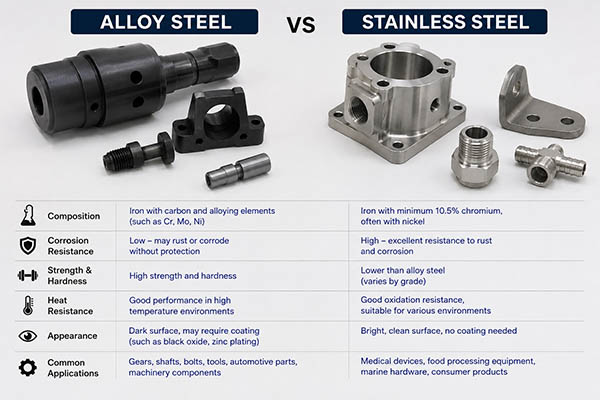
What Alloy Steel and Stainless Steel Really Mean
Alloy Steel
Alloy steel is carbon steel with intentionally added elements such as:
- Chromium (Cr)
- Nickel (Ni)
- Molybdenum (Mo)
- Vanadium (V)
- Manganese (Mn)
These additions improve:
- Strength
- Hardenability
- Wear resistance
- Toughness
- Heat resistance
Stainless Steel
Stainless steel is an alloy steel that contains ≥10.5% chromium, allowing the material to form a passive oxide film that resists rust and chemical attack.
Chemical Composition and Chromium Content
| Element | Alloy Steel | Stainless Steel |
|---|---|---|
| Iron (Fe) | Balance | Balance |
| Carbon (C) | 0.15–1.0% | Usually <0.08% in common grades |
| Chromium (Cr) | 0–5% typical | 10.5–30% |
| Nickel (Ni) | Optional | Common in 304 and 316 |
| Molybdenum (Mo) | Often used | Added in 316, duplex grades |
Typical Grades
| Material | Key Composition |
|---|---|
| 4140 Alloy Steel | Cr-Mo steel |
| 4340 Alloy Steel | Ni-Cr-Mo steel |
| 304 Stainless | 18% Cr, 8% Ni |
| 316 Stainless | 16–18% Cr, 10–14% Ni, 2–3% Mo |
Mechanical Strength and Hardness Comparison
Alloy steel is usually stronger after heat treatment.
| Property | 4140 Q&T | 304 Stainless | 17-4 PH Stainless |
|---|---|---|---|
| Tensile Strength | 950–1,100 MPa | 515–750 MPa | 1,000–1,300 MPa |
| Yield Strength | 655–900 MPa | 205–310 MPa | 860–1,170 MPa |
| Hardness | 28–50 HRC | ~70–95 HRB | Up to 44 HRC |
Engineering Conclusion
- For shafts, gears, and axles: alloy steel often wins.
- For corrosion plus strength: precipitation-hardening stainless (17-4 PH) is excellent.
Corrosion Resistance in Real Environments
This is the most significant practical difference.
Corrosion Resistance Ranking
| Environment | Alloy Steel | Stainless Steel |
|---|---|---|
| Indoor dry conditions | Good with oil/paint | Excellent |
| Humid atmosphere | Fair | Excellent |
| Saltwater exposure | Poor | Very Good to Excellent |
| Chemical processing | Limited | Excellent |
Stainless steel’s chromium oxide film repairs itself after minor scratches.
Heat Resistance and High-Temperature Performance
Alloy steels containing chromium and molybdenum maintain strength under elevated temperatures. Stainless grades such as 310 and 321 are also used in hot environments.
| Material | Typical Temperature Capability |
|---|---|
| 4140 | Up to ~500°C depending on load |
| 304 Stainless | Up to ~870°C intermittent |
| 310 Stainless | Up to ~1,100°C |
Choose based on both oxidation resistance and mechanical load.
Wear Resistance and Fatigue Strength
Alloy steels are preferred where repeated loading and surface wear dominate.
Typical Uses
- Transmission gears
- Crankshafts
- Roller bearings
- Tool holders
4140 and 4340 can be induction hardened or nitrided for exceptional surface durability.
Stainless steels generally offer lower wear resistance unless specially hardened.
Machinability in CNC Manufacturing
Machining cost can vary significantly.
| Material | Relative Machinability (1212 = 100%) |
|---|---|
| 4140 Annealed | 65–70% |
| 4340 Annealed | 55–60% |
| 303 Stainless | 75–80% |
| 304 Stainless | 45–50% |
| 316 Stainless | 35–45% |
Practical CNC Insight
304 and 316 work harden quickly, requiring:
- Lower cutting speed
- Sharp tooling
- Aggressive feed rates
- Consistent chip evacuation
303 stainless is much easier to machine but slightly less corrosion resistant.
Weldability and Fabrication Characteristics
| Material | Weldability |
|---|---|
| 4140 | Moderate; often requires preheat |
| 4340 | Difficult; heat control required |
| 304 Stainless | Excellent |
| 316 Stainless | Excellent |
Example
A welded frame exposed to outdoor weather is often built from 304 stainless rather than alloy steel because it avoids painting and long-term rust maintenance.
Heat Treatment and Hardening Response
Alloy steels are highly responsive to quenching and tempering.
Quench+Temper→High Strength and Toughness
Alloy Steel Treatments
- Quenching and tempering
- Induction hardening
- Nitriding
- Carburizing
Stainless Steel Treatments
- Austenitic grades (304, 316): not hardenable by heat treatment
- Martensitic grades (420, 440C): heat treatable
- 17-4 PH: age hardenable
Common Grades and Their Applications
| Grade | Material Type | Typical Uses |
|---|---|---|
| 4140 | Alloy Steel | Shafts, gears, spindles |
| 4340 | Alloy Steel | Aerospace components |
| 8620 | Alloy Steel | Carburized gears |
| 304 | Stainless Steel | Food equipment |
| 316 | Stainless Steel | Marine and chemical parts |
| 420 | Stainless Steel | Surgical instruments |
| 17-4 PH | Stainless Steel | Aerospace and medical |
Cost Comparison and Lifecycle Economics
Raw Material Cost (Relative)
| Material | Relative Cost |
|---|---|
| 4140 | 1.0× |
| 4340 | 1.4× |
| 304 Stainless | 1.8–2.5× |
| 316 Stainless | 2.5–3.5× |
| 17-4 PH | 3.0–4.5× |
Although stainless steel costs more upfront, it often lowers total ownership cost by eliminating coatings and reducing maintenance.
Magnetic Properties and Electrical Behavior
| Grade | Magnetic? |
|---|---|
| 4140 | Yes |
| 4340 | Yes |
| 304 | Mostly non-magnetic after annealing |
| 316 | Mostly non-magnetic |
| 420 | Yes |
| 17-4 PH | Yes |
This matters for sensors, motors, and electronic assemblies.
Surface Finishing and Coating Options
Alloy Steel Finishes
- Black oxide
- Zinc plating
- Nickel plating
- Powder coating
- Nitriding
Stainless Steel Finishes
- Passivation
- Electropolishing
- Bead blasting
- Brushing
- PVD coating
Alloy steel usually requires protective coating; stainless often performs well with only passivation.
Typical Industry Applications
| Industry | Alloy Steel | Stainless Steel |
|---|---|---|
| Automotive | Gears, axles | Exhaust and trim |
| Aerospace | Landing gear | Hydraulic fittings |
| Medical | Limited | Instruments and implants |
| Food Processing | Rare | Tanks and conveyors |
| Marine | Coated shafts | 316 hardware |
| Oil & Gas | Drill components | Corrosion-critical parts |
How to Choose the Right Material for Your CNC Parts
Choose Alloy Steel When You Need
- Maximum strength
- Better wear resistance
- Lower raw material cost
- Heat-treat capability
- Coating is acceptable
Choose Stainless Steel When You Need
- Corrosion resistance
- Hygiene and cleanability
- Attractive appearance
- Reduced maintenance
- Exposure to chemicals or saltwater
Real-World Example: Hydraulic Shaft Design
A hydraulic cylinder rod requires:
- Tensile strength > 900 MPa
- Tight tolerance ±0.01 mm
- Indoor industrial use
Best choice: 4140 alloy steel, quenched and tempered, then hard chrome plated.
A marine sensor bracket requires:
- Constant salt spray exposure
- No coating maintenance
- Excellent appearance
Best choice: 316 stainless steel.
Quick Decision Matrix
| Priority | Best Material |
|---|---|
| Lowest initial cost | Alloy Steel |
| Highest corrosion resistance | Stainless Steel |
| Best wear resistance | Alloy Steel |
| Food-safe equipment | Stainless Steel |
| Heat-treated hardness | Alloy Steel |
| Marine service | 316 Stainless |
| Balanced strength + corrosion | 17-4 PH Stainless |
Frequently Asked Questions
Is stainless steel stronger than alloy steel?
Usually no. Heat-treated alloy steels such as 4140 and 4340 often exceed common stainless grades like 304 and 316.
Does alloy steel rust?
Yes. Most alloy steels require coatings, oil, or plating for corrosion protection.
Is stainless steel harder to machine?
304 and 316 are typically harder to machine because they work harden rapidly.
Which is cheaper?
Alloy steel is generally much less expensive.
What is the best material for CNC shafts?
4140 is a standard choice when corrosion resistance is not the main concern.
Why Xavier Helps Customers Choose the Right Steel
At Xavier, we machine both alloy steel and stainless steel components for aerospace, medical, automotive, robotics, and industrial automation customers worldwide.
Our engineering team helps customers evaluate:
- Mechanical load requirements
- Corrosion environment
- Heat treatment needs
- Machining cost
- Surface finishing options
- Long-term maintenance expectations
Whether you need hardened 4140 shafts, carburized 8620 gears, or corrosion-resistant 316 and 17-4 PH parts, Xavier delivers precision CNC machining with reliable quality and competitive lead times.
If you are unsure whether alloy steel or stainless steel is the better fit for your application, Xavier can recommend the optimal material based on performance, manufacturability, and total lifecycle cost.
Some of the images and text in this article are collected and compiled from the internet. If there is anything inappropriate, please contact us for processing.