1. Zinc Die Casting Alloys: Choosing the Right Material for Precision Parts
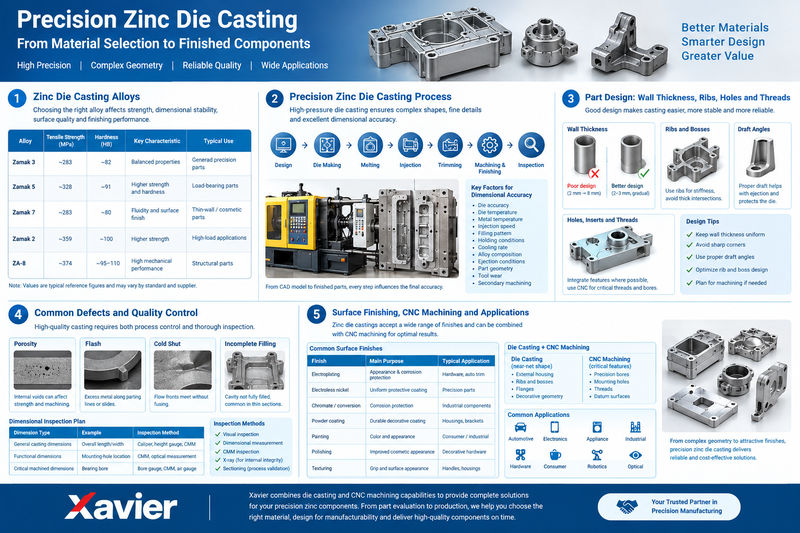
Precision zinc die casting starts with the alloy, because alloy composition affects fluidity, strength, dimensional stability, surface quality, machinability and finishing performance. The most common zinc die casting materials are Zamak 3, Zamak 5 and Zamak 7, while ZA alloys such as ZA-8, ZA-12 and ZA-27 are used when different mechanical properties are required.
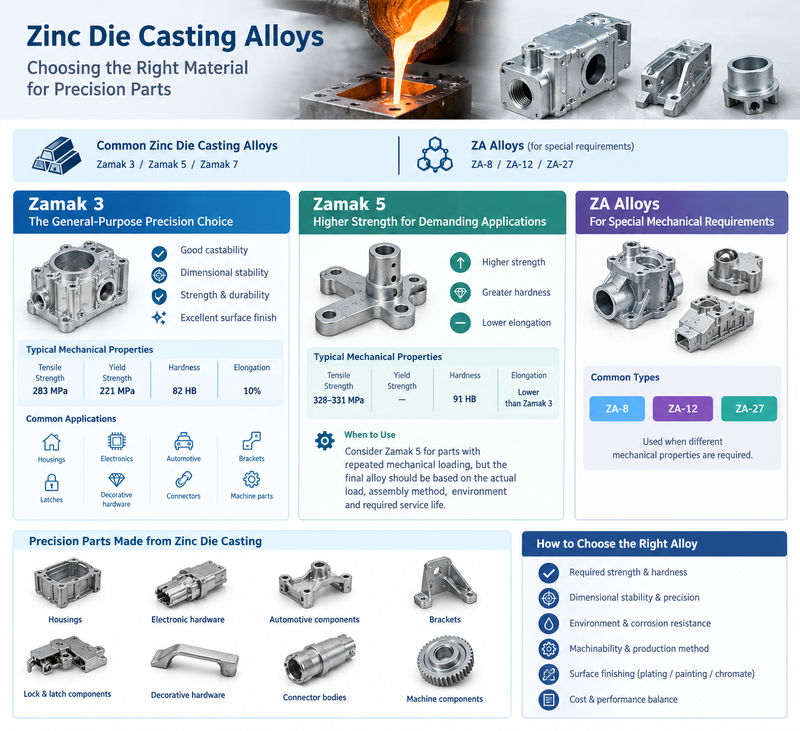
Zamak 3: The General-Purpose Precision Choice
Zamak 3 is widely used because it provides a balanced combination of castability, dimensional stability, strength and surface finishing performance. The Zinc Die Casting Association identifies Alloy 3 as the most widely used zinc alloy in North America and notes its excellent finishing characteristics for plating, painting and chromate treatments.
Typical published values for Zamak 3 include a tensile strength around 283 MPa, yield strength around 221 MPa, hardness around 82 HB, and elongation around 10%, although actual values depend on the test method, casting location and production conditions.
This makes Zamak 3 suitable for parts such as:
- Precision housings
- Electronic hardware
- Automotive components
- Small brackets
- Lock and latch components
- Decorative hardware
- Connector bodies
- Machine components
Zamak 5: When More Strength Is Required
Zamak 5 contains more copper than Zamak 3 and generally provides higher strength and hardness. Published reference data lists tensile strength around 328–331 MPa and hardness around 91 HB. The trade-off is reduced elongation compared with Zamak 3.
For example, if a zinc die cast bracket experiences repeated mechanical loading, a design engineer may investigate Zamak 5 instead of automatically using Zamak 3. However, the alloy should be selected based on the actual load, assembly method, environment and required service life rather than simply choosing the alloy with the highest tensile strength.
Zamak 7: Thin Walls and Surface Quality
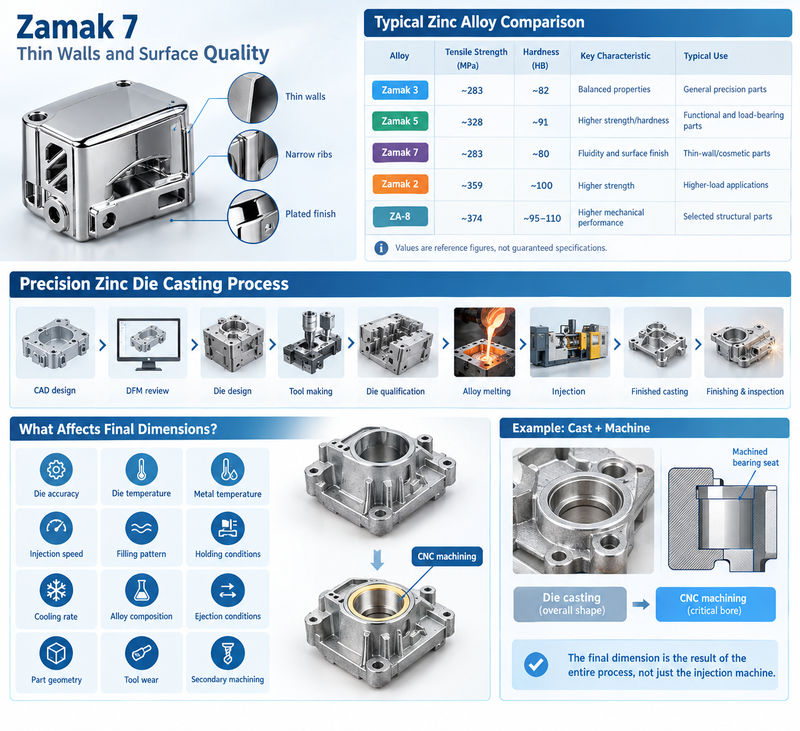
Zamak 7 is a modified version of Zamak 3 with tighter impurity control and lower magnesium content. Its improved fluidity, ductility and surface-finish characteristics make it useful for thin-wall and appearance-critical components.
A useful example is a small decorative housing with thin walls, narrow ribs and a plated exterior. If the casting contains many fine details, filling behavior and surface appearance may be more important than simply maximizing tensile strength.
Typical Zinc Alloy Comparison
| Alloy | Tensile Strength, Typical Reference | Hardness | Key Characteristic | Typical Use |
|---|---|---|---|---|
| Zamak 3 | ~283 MPa | ~82 HB | Balanced properties | General precision parts |
| Zamak 5 | ~328 MPa | ~91 HB | Higher strength/hardness | Functional and load-bearing parts |
| Zamak 7 | ~283 MPa | ~80 HB | Fluidity and surface finish | Thin-wall/cosmetic parts |
| Zamak 2 | ~359 MPa | ~100 HB | Higher strength | Higher-load applications |
| ZA-8 | ~374 MPa | ~95–110 HB | Higher mechanical performance | Selected structural parts |
These values are reference figures rather than guaranteed production specifications; the applicable material standard and supplier’s certificate should control a production program.
2. Precision Zinc Die Casting Process and Dimensional Accuracy
Precision zinc die casting is normally based on high-pressure die casting, where molten zinc alloy is injected into a hardened steel die under controlled pressure and velocity. Zinc is particularly suitable for this process because its casting characteristics allow complex shapes, fine details and relatively thin sections to be produced efficiently. Current industry guides also emphasize its suitability for high-volume precision components.
From CAD Model to Finished Zinc Casting
A typical production sequence is:
CAD design → DFM review → die design → tool manufacturing → die qualification → alloy melting → injection → solidification → ejection → trimming → secondary machining → surface finishing → inspection → packaging
The important point is that dimensional accuracy is not created by the injection machine alone.
The final dimension is influenced by:
- Die manufacturing accuracy
- Die temperature
- Metal temperature
- Injection speed
- Filling pattern
- Holding conditions
- Cooling rate
- Alloy composition
- Ejection conditions
- Part geometry
- Tool wear
- Secondary machining
For example, suppose a zinc housing contains a bearing seat with a tight dimensional requirement. It may be inefficient to expect the die-casting operation alone to produce the final bearing-fit dimension. A better manufacturing strategy can be to cast the general geometry and then CNC machine the critical bore.
Why Zinc Is Suitable for Complex Precision Components
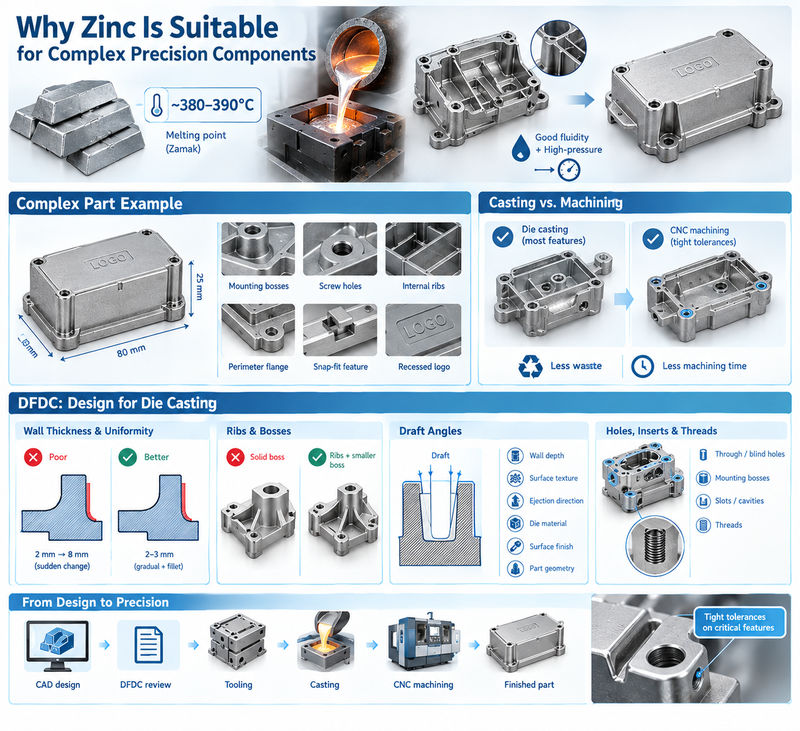
Zinc has a relatively low melting temperature compared with many engineering metals. Published data places the melting point of common Zamak alloys at approximately 380–390°C, depending on the alloy.
The combination of good fluidity and high-pressure filling allows zinc to reproduce small features that would be difficult to produce economically using some other casting processes.
Consider a small electronic enclosure measuring approximately 80 × 50 × 25 mm. The part may include:
- Four mounting bosses
- Multiple screw holes
- Internal ribs
- A perimeter flange
- A snap-fit feature
- A recessed logo area
Producing all of these features as separate machined operations from a solid block could generate significant material waste and machining time. A precision zinc die casting can form much of the geometry directly in the die, with CNC machining reserved for the surfaces where tighter tolerances are required.
3. Part Design: Wall Thickness, Draft, Ribs, Holes and Threads
Good zinc die casting does not begin at the casting machine. It begins during product design.
A part that is difficult to fill, eject or cool will remain difficult to manufacture regardless of how sophisticated the machine is. This is why a detailed design-for-die-casting (DFDC) review should take place before the production tooling is released.
Wall Thickness and Uniformity
Thin walls can reduce material consumption and part weight, but excessively thin sections may create filling problems depending on alloy, flow length, gate location and die design.
More importantly, sudden changes in wall thickness should be avoided where possible.
For example:
Poor design:
2 mm wall → sudden transition → 8 mm boss
This creates a significant difference in solidification behavior.
Improved design:
2–3 mm wall → gradual transition → reinforced boss with proper fillet
The second configuration provides a more controlled material flow and reduces the risk of localized shrinkage or other casting-related problems.
Ribs and Bosses
Ribs are commonly used to increase stiffness without making the entire wall substantially thicker.
A rib can support a large flat wall while keeping the basic wall section relatively thin. However, excessively thick intersections between ribs, walls and bosses can create localized thermal masses.
For example, rather than creating a massive solid boss, the design can use a smaller boss supported by ribs. This can improve casting consistency while maintaining the required mechanical function.
Draft Angles
Draft is required so that the solidified casting can be removed from the die without damaging either the component or the tooling.
The required draft depends on:
- Wall depth
- Surface texture
- Direction of ejection
- Die material
- Surface finish
- Part geometry
- Whether the surface is internal or external
A deep textured cavity generally needs more attention to draft than a shallow polished cavity.
The exact draft value should therefore be established during tooling design rather than copied blindly from a generic chart.
Holes, Inserts and Threads
One major advantage of zinc die casting is the ability to integrate functional features into the casting.
Depending on diameter, depth, location and die design, features can include:
- Through holes
- Blind holes
- Mounting bosses
- Locating features
- Slots
- Internal cavities
- Thread-related features
However, extremely critical threads or precision bores may still benefit from secondary CNC machining.
For example, a zinc housing could be die cast with the majority of its geometry completed, followed by CNC drilling and tapping of four mounting holes. This approach combines the productivity of die casting with the dimensional control of CNC machining.
4. Common Zinc Die Casting Defects and Quality Control
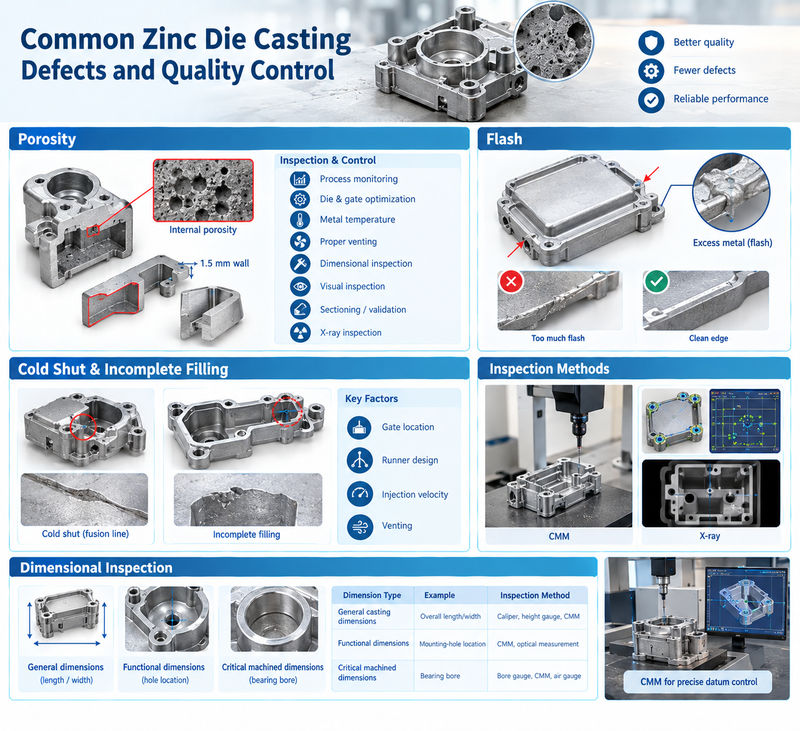
Precision casting is not simply about producing a visually attractive part. A component can look acceptable while containing dimensional or internal problems that affect assembly and service life.
Porosity
Porosity refers to voids inside the casting. Gas porosity and shrinkage-related defects can be particularly important when a component requires pressure tightness, structural strength or subsequent machining.
For example, imagine a zinc casting with a machined wall only 1.5 mm thick. If significant internal porosity exists behind the machining zone, CNC machining may expose the void and create a visible defect.
Therefore, the inspection method should be matched to the function of the part.
Possible controls include:
- Process parameter monitoring
- Die and gate optimization
- Controlled metal temperature
- Proper venting
- Dimensional inspection
- Visual inspection
- Sectioning for process validation
- X-ray inspection where internal integrity is critical
Flash
Flash is excess metal formed along parting lines or around slides and inserts.
A small amount may be removed during trimming, but excessive flash can indicate issues involving die alignment, locking conditions, tool wear or process parameters.
For a precision zinc casting used as an enclosure, flash along the sealing surface could interfere with assembly even if the rest of the part is dimensionally correct.
Cold Shut and Incomplete Filling
A cold shut can occur when separate metal flow fronts meet without properly fusing. Incomplete filling occurs when the cavity is not completely filled.
These problems become more important as geometry becomes thinner and more complicated.
Suppose a 100 mm-long decorative zinc housing has a very narrow section at the far end of the cavity. If the metal loses sufficient temperature before reaching that area, the resulting surface defect may appear only in that specific region.
This is why gate location, runner design, injection velocity and venting must be considered together.
Dimensional Inspection
A practical inspection plan may divide dimensions into three categories:
| Dimension Type | Example | Inspection Method |
|---|---|---|
| General casting dimensions | Overall length/width | Caliper, height gauge, CMM |
| Functional dimensions | Mounting-hole location | CMM, optical measurement |
| Critical machined dimensions | Bearing bore | Bore gauge, CMM, air gauge |
A CMM inspection becomes especially useful when multiple datum relationships must be verified simultaneously.
For example, checking whether four mounting holes are individually within tolerance is different from checking whether the entire four-hole pattern is correctly positioned relative to the primary datum. A CMM can evaluate these geometric relationships more systematically.
5. Surface Finishing, CNC Machining and Applications of Precision Zinc Parts
Zinc die castings are often selected not only for their dimensional characteristics but also for their ability to accept attractive and functional surface finishes.
The Zinc Die Casting Association specifically identifies Zamak 3 as having good characteristics for plating, painting and chromate treatments.
Common Surface Finishing Options
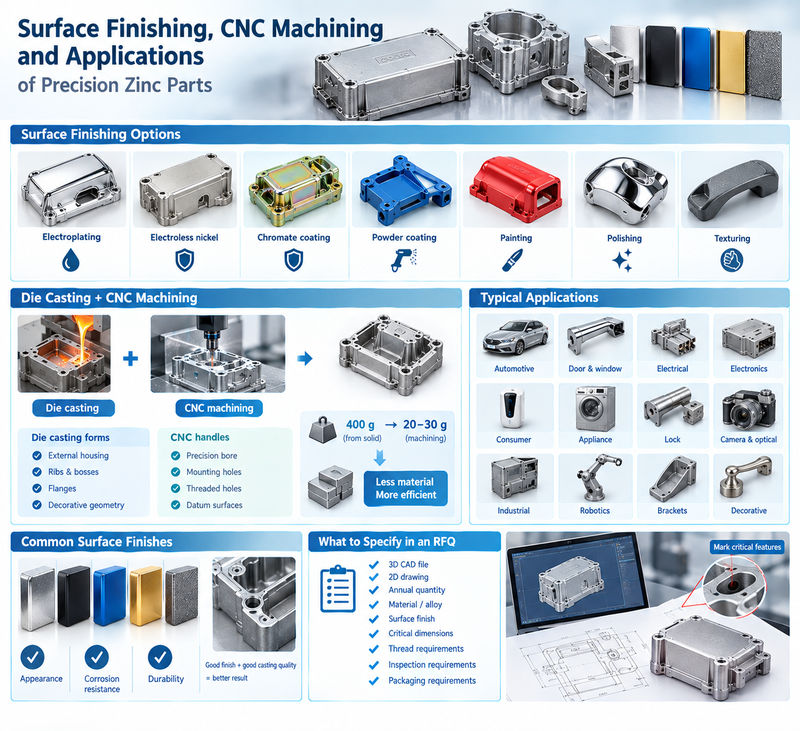
Depending on the application, zinc die cast parts can receive:
| Finish | Main Purpose | Typical Application |
|---|---|---|
| Electroplating | Appearance and corrosion protection | Hardware, automotive trim |
| Electroless nickel | Uniform protective coating | Precision functional parts |
| Chromate/conversion coating | Corrosion protection | Industrial components |
| Powder coating | Durable decorative coating | Housings and brackets |
| Painting | Color and appearance | Consumer/industrial products |
| Polishing | Improved cosmetic appearance | Decorative hardware |
| Texturing | Surface appearance and grip | Handles and housings |
The correct finish should be considered together with the alloy and casting quality. A high-quality plating finish cannot completely hide poor casting defects, deep porosity or excessive surface irregularities.
When CNC Machining Is Added
One of the most practical production strategies is die casting plus selective CNC machining.
Instead of machining the entire component from a zinc or aluminum block, the casting produces the complex external and internal geometry, while CNC equipment handles only the critical areas.
For example:
Die casting:
- External housing
- Ribs
- Bosses
- Flanges
- Decorative geometry
CNC machining:
- Precision bore
- Critical mounting holes
- Threaded holes
- Datum surfaces
- Tight-tolerance locating features
This hybrid approach can substantially reduce machining volume.
Imagine a 250 g finished component that would require removing 400 g of material from a solid billet. If the casting produces a near-net-shape component and only 20–30 g requires machining, the manufacturing process is fundamentally different from machining the complete geometry from solid stock.
The actual savings depend on tooling cost, annual quantity, geometry, alloy price, machining time and finishing requirements, so production economics should be calculated from the complete process rather than material price alone.
Typical Applications
Precision zinc die casting is used across many industries because the process can combine complex geometry, repeatability, mechanical performance and attractive surface finishing.
Common applications include:
- Automotive hardware
- Door and window hardware
- Electrical connectors
- Electronic housings
- Consumer-product components
- Appliance hardware
- Lock components
- Camera and optical hardware
- Industrial equipment
- Robotics components
- Small mechanical brackets
- Decorative metal components
A useful application example is an electronic equipment housing.
The housing may require a relatively complex external shape, internal mounting bosses, ventilation features, screw locations and a decorative plated exterior. Producing the complete geometry through CNC machining could require many setups and substantial material removal. Zinc die casting can form most of the geometry in one production cycle, while CNC machining can be used only where the assembly requires tighter dimensional control.
Precision Zinc Die Casting: What Buyers Should Specify
When requesting a quotation for precision zinc die casting, providing only a 3D CAD file is usually not enough for an accurate production evaluation.
A complete RFQ should ideally include:
| Information | Why It Matters |
|---|---|
| 3D CAD file | Defines overall geometry |
| 2D engineering drawing | Defines critical dimensions and tolerances |
| Annual quantity | Determines tooling and production economics |
| Material/alloy | Determines mechanical and casting characteristics |
| Surface finish | Determines secondary processing |
| Critical dimensions | Identifies where CNC machining may be required |
| Thread requirements | Determines casting versus machining strategy |
| Inspection requirements | Defines quality-control process |
| Packaging requirements | Prevents damage after finishing |
For example, if a drawing specifies a tight bore tolerance but does not identify it as a critical functional feature, the supplier may interpret the dimension differently from the engineer’s intention. Marking critical dimensions, datums and functional interfaces clearly helps prevent this problem.
Why Precision Zinc Die Casting Can Be Combined With CNC Manufacturing
Precision zinc die casting and CNC machining should not necessarily be viewed as competing technologies.
They can complement each other.
Die casting is efficient for creating complex near-net-shape geometry at production volume, while CNC machining provides additional control over selected functional features.
For a production part containing complex ribs, bosses and external geometry but only three critical bores, it may make little economic sense to CNC machine every surface. Casting can create the majority of the component, followed by CNC machining of those three bores.
This manufacturing strategy is particularly useful when the customer needs a repeatable component rather than simply a one-off prototype.
Final Thoughts on Precision Zinc Die Casting
Precision zinc die casting is most effective when material selection, casting design, tooling, dimensional control, machining and finishing are considered as one manufacturing system.
Zamak 3 provides a balanced starting point for many precision applications, while Zamak 5 can be considered when higher strength and hardness are required. Zamak 7 can be useful for thin-wall or surface-quality-sensitive designs, while higher-aluminum ZA alloys may be appropriate for selected applications requiring different mechanical characteristics.
For customers who need complex zinc components, the key is not simply finding a supplier that can make a zinc casting. The supplier should be able to evaluate the relationship between die design, alloy selection, casting parameters, CNC machining, surface finishing and inspection.
At Xavier, we combine CNC machining capabilities with manufacturing experience in metal components to support customers from part evaluation through production. For precision zinc components requiring casting followed by CNC machining, critical-hole processing, threads, finishing or dimensional inspection, our engineering team can review the drawing and 3D model and determine which features should be cast directly and which are better produced through secondary machining. This approach helps customers obtain a practical manufacturing solution rather than treating casting and machining as isolated processes.
For projects that require both casting efficiency and precise secondary machining, choosing the right manufacturing partner can make a significant difference. Precision zinc die casting is a practical solution for producing complex metal components with fine details, thin walls, and consistent dimensions, while CNC machining can be used to further process critical holes, threads, slots, mounting surfaces, and other features that require tighter control. At Xavier, we provide CNC machining services for customers who need reliable production of custom components based on 2D drawings, 3D CAD files, or samples. Our capabilities cover CNC milling, CNC turning, drilling, tapping, boring, grinding, and other precision machining processes, allowing us to manufacture a wide range of CNC machining parts for industrial equipment, automotive applications, robotics, electronics, medical equipment, and other industries. In addition to machining individual components, we can also support customers looking for custom metal parts with specific dimensional tolerances, material requirements, and surface finishes. For zinc alloy castings that need additional machining after the casting process, combining die casting with precision CNC machining can help achieve more accurate functional features while keeping production efficient for repeat orders. Whether you are developing prototypes, ordering small batches, or planning volume production, our CNC machining parts manufacturing service is designed to provide a practical production route from drawing review and material selection to machining, finishing, inspection, and delivery.
Some of the images and text in this article are collected and compiled from the internet. If there is anything inappropriate, please contact us for processing.