
Complete Guide to Fillet vs Chamfer in CNC Machining and Mechanical Design
In CNC machining and product engineering, fillets and chamfers are two of the most commonly used edge treatments. Although they may appear simple, the choice between a fillet and a chamfer directly affects part strength, machining cost, assembly performance, safety, aesthetics, and manufacturability.
Engineers use fillets to reduce stress concentration and improve fatigue resistance, while chamfers are commonly applied for deburring, easier assembly, and simplified machining. Understanding the differences between these two features is essential for producing high-quality CNC machined parts.
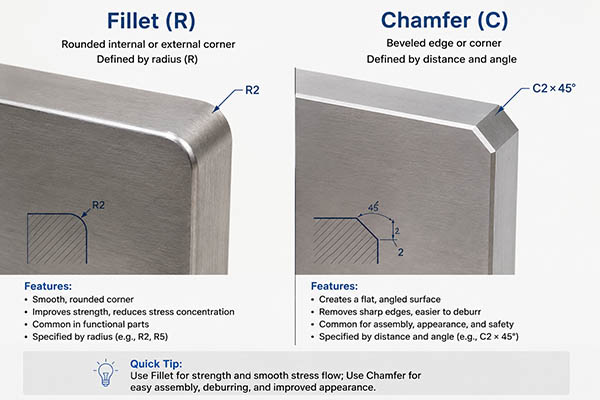
What Is a Fillet in Mechanical Design?
A fillet is a rounded internal or external corner that connects two surfaces with a smooth radius transition.
Typical Fillet Characteristics
| Feature | Description |
|---|---|
| Shape | Rounded radius |
| Purpose | Reduce stress concentration |
| Common Radius | R0.5–R10 mm |
| Typical Tools | Ball end mills, radius cutters |
Example
If a CNC-machined aluminum housing has a sharp 90° corner, adding an R3 fillet distributes the load more evenly across the corner.
Internal vs External Fillet
| Type | Description |
|---|---|
| Internal Fillet | Radius inside a corner |
| External Fillet | Rounded outer edge |
Fillets are heavily used in structural components where fatigue resistance matters.
What Is a Chamfer in CNC Machining?
A chamfer is a beveled edge connecting two surfaces at an angle, usually 45°.
Typical Chamfer Characteristics
| Feature | Description |
|---|---|
| Shape | Angled edge |
| Typical Angle | 30°, 45°, 60° |
| Main Purpose | Deburring and assembly |
| Machining Method | Chamfer mill or countersink |
Example
A 1×45° chamfer removes a sharp edge while helping screws or shafts align during assembly.
Chamfers are extremely common in:
- CNC turned parts
- Threaded holes
- Precision shafts
- Assembly interfaces
Main Differences Between Fillet and Chamfer
Fillet vs Chamfer Comparison Table
| Feature | Fillet | Chamfer |
|---|---|---|
| Geometry | Rounded | Angled |
| Stress Reduction | Excellent | Moderate |
| Machining Speed | Slower | Faster |
| Tool Wear | Higher | Lower |
| Appearance | Smooth | Technical |
| Ease of Inspection | Moderate | Easy |
| Cost | Higher | Lower |
Stress Distribution and Structural Strength
One of the most important engineering reasons for using fillets is stress reduction.
Why Sharp Corners Fail
Sharp internal corners create stress concentration zones where cracks begin.
Example Stress Concentration Factors
| Corner Type | Approximate Stress Concentration Factor |
|---|---|
| Sharp 90° Corner | 2.5–3.0 |
| Small Fillet Radius | 1.5–2.0 |
| Large Fillet Radius | 1.1–1.5 |
A properly designed fillet can dramatically improve fatigue life.
Aerospace Example
Aircraft brackets often use large internal fillets because cyclic vibration can quickly crack sharp corners.
Chamfers generally do not reduce stress as effectively because the transition remains angular.
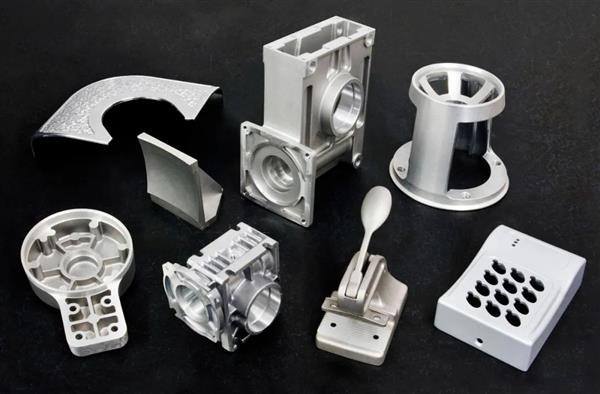
CNC Machining Methods for Fillets and Chamfers
Fillet Machining
Fillets usually require:
- Ball nose end mills
- Radius cutters
- 3-axis or 5-axis contour machining
Chamfer Machining
Chamfers are simpler and faster:
- Chamfer mills
- Spot drills
- Countersinks
- Turning tools
Machining Time Comparison
| Feature | Typical Machining Time |
|---|---|
| 1 mm Chamfer | Very Fast |
| R1 Fillet | Moderate |
| Complex 3D Fillet | Slow |
Complex fillets increase CNC cycle time substantially.
Cost and Machining Time Comparison
From a manufacturing perspective, chamfers are usually cheaper.
Why Chamfers Cost Less
- Easier toolpaths
- Faster cutting speeds
- Simpler programming
- Reduced tool wear
Example Cost Difference
| Feature | Relative Cost |
|---|---|
| Simple Chamfer | 1.0 |
| Standard Fillet | 1.5 |
| Complex Surface Fillet | 2.5–4.0 |
For mass production, reducing unnecessary fillets can significantly lower machining costs.
Tool Selection for Fillet vs Chamfer Features
Fillet Tools
| Tool Type | Application |
|---|---|
| Ball Nose End Mill | 3D fillets |
| Corner Radius Mill | External radii |
| Form Cutter | Repetitive profiles |
Chamfer Tools
| Tool Type | Application |
|---|---|
| 45° Chamfer Mill | Standard chamfers |
| Countersink | Hole chamfers |
| Turning Insert | Lathe chamfers |
Tool selection directly affects:
- Surface finish
- Accuracy
- Cycle time
- Tool life
Fillet vs Chamfer in CAD Modeling
Modern CAD software such as SolidWorks, Fusion 360, and CATIA includes dedicated fillet and chamfer tools.
CAD Modeling Differences
| Feature | Fillet | Chamfer |
|---|---|---|
| Computational Load | Higher | Lower |
| Surface Complexity | Complex | Simple |
| Failure Risk in CAD | Higher | Lower |
Large assemblies with thousands of fillets can slow CAD performance considerably.
Surface Finish and Aesthetic Considerations
Fillets generally create a smoother, premium-looking product.
Visual Differences
| Feature | Visual Style |
|---|---|
| Fillet | Soft and modern |
| Chamfer | Sharp and industrial |
Consumer Electronics Example
Smartphones and laptops often use filleted edges to improve comfort and appearance.
Industrial Equipment Example
Heavy machinery frequently uses chamfers because functionality is prioritized over aesthetics.
Common Applications in Aerospace, Automotive, and Electronics
Aerospace
Fillets are preferred in:
- Structural brackets
- Turbine components
- Aircraft frames
Automotive
Chamfers are common for:
- Gear edges
- Shaft insertion
- Bolt holes
Electronics
Small fillets improve ergonomics and prevent edge cracking in aluminum housings.
Tolerance and Inspection Challenges
Fillets are harder to inspect than chamfers.
Inspection Methods
| Feature | Inspection Method |
|---|---|
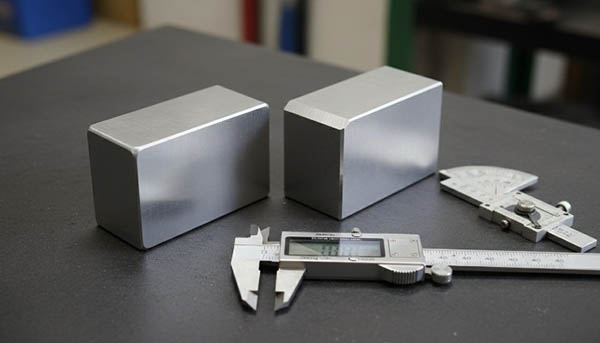
| Chamfer | Calipers, chamfer gauges |
| Fillet | Radius gauges, CMM |
Example
A 0.5×45° chamfer is easier to verify than an R0.5 internal fillet.
This affects quality control cost in precision manufacturing.
Deburring and Edge Safety
Chamfers are widely used for edge safety.
Benefits of Chamfering
- Removes burrs
- Prevents cuts
- Improves assembly
- Protects coatings
Example
Machined stainless steel plates usually receive a small chamfer after cutting to eliminate dangerous sharp edges.
Fillets can also improve safety but require more machining time.
Welding and Assembly Considerations
Fillets and chamfers affect weld penetration and assembly alignment.
Welding Preparation
Chamfers are often used as weld prep edges.
Example
A V-groove chamfer allows deeper weld penetration in thick steel plates.
Assembly Benefits
Chamfers help guide mating parts together during automated assembly.
Industry Standards and Engineering Guidelines
Several engineering standards define fillet and chamfer practices.
Common Standards
| Standard | Purpose |
|---|---|
| ISO 13715 | Edge specification |
| ASME Y14.5 | GD&T requirements |
| ISO 2768 | General tolerances |
Designers should specify:
- Radius size
- Chamfer angle
- Tolerance
- Surface finish
How to Choose Between Fillet and Chamfer for CNC Parts
Choose Fillets When
- Fatigue resistance matters
- Stress concentration is critical
- Appearance is important
- Ergonomics are needed
Choose Chamfers When
- Fast machining is required
- Deburring is the goal
- Assembly alignment matters
- Cost reduction is important
Practical Engineering Rule
If the feature is structural, choose a fillet.
If the feature is functional or manufacturing-related, choose a chamfer.
Xavier Precision CNC Machining Services for Fillets and Chamfers
At Xavier, we specialize in high-precision CNC machining for complex fillet and chamfer geometries across aluminum, stainless steel, titanium, brass, and engineering plastics.
Our machining capabilities include:
- Precision 3-axis and 5-axis CNC milling
- High-accuracy chamfer machining
- Complex radius contouring
- Tight tolerance edge finishing
- Aerospace-grade surface quality
- Full CMM dimensional inspection
Whether your project requires smooth fatigue-resistant fillets or cost-effective production chamfers, Xavier provides engineering support, advanced CNC technology, and consistent manufacturing quality for prototype and mass production parts.
We are an integrated manufacturing and trading company specializing in CNC machining services, focusing on custom CNC machining for a wide range of metal and plastic components. We provide high-precision CNC machining nylon, advanced CNC machining titanium, and custom CNC machining stainless steel solutions for industries such as robotics, aerospace, marine, automotive, medical, and precision engineering parts. As a professional CNC machining nylon manufacturer, we offer bulk CNC machining titanium services and competitive CNC machining stainless steel pricing for global customers.
Some of the images and text in this article are collected and compiled from the internet. If there is anything inappropriate, please contact us for processing.