
5 Key Points About CNC Turning Parts Factories
1. CNC Turning Parts Manufacturing Process and Production Capability
2. Materials Used for CNC Turning Parts
3. Precision Standards and Quality Control in CNC Turning Factories
4. CNC Turning Applications and Industries Served
5. How to Choose a Reliable CNC Turning Parts Factory
CNC Turning Parts Factory: Complete Guide to Precision Custom Turned Components
CNC Turning Parts Manufacturing Process and Production Capability
Understanding How a CNC Turning Parts Factory Produces Precision Components
A professional CNC turning parts factory specializes in manufacturing cylindrical and rotational components by using computer-controlled turning machines. Unlike traditional manual machining, CNC turning uses programmed tool movements to remove material from a rotating workpiece with extremely high consistency.
The CNC turning process is widely used for producing shafts, pins, bushings, connectors, threaded components, valves, spacers, fasteners, and other precision metal parts.
A typical CNC turning production process includes:
| Manufacturing Step | Description | Typical Equipment |
|---|---|---|
| Engineering Review | Analyze drawings, 3D models, materials, tolerances | CAD/CAM software |
| Material Preparation | Cut raw bars or billets according to requirements | Automatic saw |
| CNC Programming | Generate machining paths and parameters | CNC programming system |
| Rough Turning | Remove excess material quickly | CNC lathe |
| Precision Turning | Achieve final dimensions and surface quality | CNC turning center |
| Secondary Operations | Milling, drilling, tapping, grinding | Multi-axis machines |
| Inspection | Verify dimensions and quality | CMM, micrometer, gauges |
A capable CNC turning factory does not simply operate machines. It combines engineering knowledge, machining experience, and production management to ensure every component meets customer requirements.
For example, when manufacturing a stainless steel shaft with a diameter tolerance of ±0.01 mm, the factory must consider:
- Material hardness
- Cutting speed
- Tool wear
- Machine vibration
- Temperature variation
- Inspection frequency
Small changes in machining conditions can influence final accuracy, especially for high-precision components.
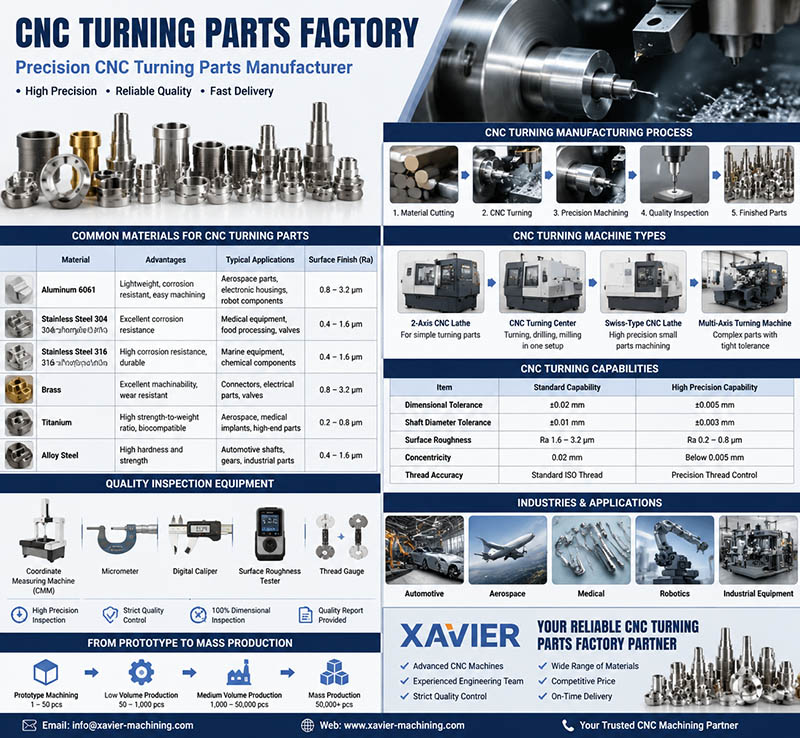
CNC Turning Machine Types Used in Professional Factories
Different CNC turning parts require different machine configurations. A modern factory normally uses multiple types of CNC turning equipment to handle various production requirements.
| Machine Type | Main Features | Suitable Parts |
|---|---|---|
| 2-Axis CNC Lathe | Basic turning operations | Shafts, bushings, pins |
| CNC Turning Center | Turning + drilling + milling capability | Complex components |
| Swiss-Type CNC Lathe | Extremely precise small parts | Medical and electronic parts |
| Multi-Axis Turning Machine | High flexibility and reduced setup | Complex precision parts |
For example:
A simple aluminum spacer may only require a standard CNC lathe.
However, a robotic transmission component with:
- Multiple diameters
- Internal threads
- Cross holes
- Precision grooves
- Tight tolerances
may require a multi-axis CNC turning center.
Advanced equipment helps reduce production time because multiple machining operations can be completed in one setup.
Production Capacity of a CNC Turning Parts Factory
Production capability is one of the most important factors when selecting a CNC turning supplier.
A factory serving prototype customers may focus on low-volume manufacturing, while an industrial supplier must support repeat production with stable quality.
Typical CNC turning production ranges:
| Production Type | Quantity Range | Application |
|---|---|---|
| Prototype machining | 1-10 pieces | Product development |
| Small batch production | 10-500 pieces | Testing and customized products |
| Medium production | 500-10,000 pieces | Industrial components |
| Mass production | 10,000+ pieces | Automotive and electronics |
A professional CNC turning parts factory should have flexible production capabilities to support different customer requirements.
For example:
A startup developing a new medical device may need only 20 prototype titanium components.
An automotive supplier may require 50,000 stainless steel shafts every month.
The machining strategy, inspection plan, and production scheduling will be completely different for these two projects.
Materials Used for CNC Turning Parts
Common Metals Processed by CNC Turning Factories
Material selection is a critical factor in CNC turning because different materials have different machining characteristics.
Professional CNC turning manufacturers usually work with aluminum, stainless steel, brass, copper, titanium, alloy steel, and engineering plastics.
The table below shows common CNC turning materials:
| Material | Advantages | Common Applications |
|---|---|---|
| Aluminum 6061 | Lightweight, corrosion resistant, easy machining | Aerospace parts, housings |
| Stainless Steel 304 | Excellent corrosion resistance | Medical, food equipment |
| Stainless Steel 316 | Higher corrosion resistance | Marine and chemical equipment |
| Brass | Excellent machinability | Connectors, valves |
| Copper | High electrical conductivity | Electrical components |
| Titanium | High strength-to-weight ratio | Aerospace, medical implants |
| Alloy Steel | High hardness and strength | Automotive shafts |
Aluminum CNC Turning Parts
Aluminum is one of the most frequently used materials in CNC turning factories because it provides an excellent balance between weight, strength, cost, and machinability.
Common aluminum grades include:
- Aluminum 6061
- Aluminum 7075
- Aluminum 6082
For example, aluminum 6061 CNC turning parts are commonly used for:
- Aerospace brackets
- Electronic housings
- Robot components
- Optical equipment
Advantages include:
- Fast machining speed
- Excellent surface finish
- Low material weight
- Good corrosion resistance
A CNC turning factory can usually achieve surface roughness around:
Ra 0.8 – 3.2 μm
depending on machining conditions and finishing requirements.
Stainless Steel CNC Turning Components
Stainless steel is widely used when components require durability and corrosion resistance.
Common applications include:
- Medical instruments
- Food processing equipment
- Hydraulic components
- Marine hardware
However, stainless steel is more challenging to machine compared with aluminum because:
- Cutting forces are higher
- Heat generation is greater
- Tool wear happens faster
Experienced CNC factories optimize:
- Cutting speed
- Feed rate
- Coolant supply
- Tool selection
to maintain stable production quality.
For example, machining a 316 stainless steel valve body requires different parameters compared with machining an aluminum connector, even if both parts have similar dimensions.
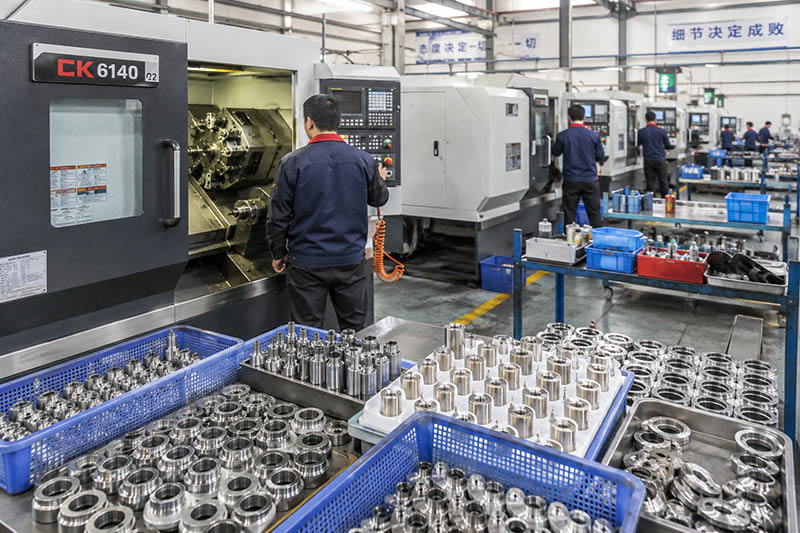
CNC Turning Precision Standards and Quality Control in a Professional Factory
Precision Requirements of CNC Turning Parts
Why Accuracy Control Is Critical in CNC Turning Manufacturing
Precision is one of the most important factors that separates a professional CNC turning parts factory from a general machining supplier.
CNC turning components are often used in mechanical systems where even a small dimensional error can affect assembly performance, vibration, sealing ability, or product lifespan.
For example, a precision shaft used inside an industrial gearbox may require:
- Diameter tolerance: ±0.005 mm
- Roundness: less than 0.003 mm
- Surface roughness: Ra 0.4-0.8 μm
If the shaft diameter is slightly oversized, it may cause assembly failure. If it is undersized, excessive clearance can lead to vibration and premature wear.
A reliable CNC turning manufacturer must control the entire machining process instead of only checking the final product.
Common CNC Turning Tolerances and Surface Finishes
Different applications require different precision levels. The table below shows typical CNC turning capabilities.
| Manufacturing Requirement | Standard Capability | High Precision Capability |
|---|---|---|
| Dimensional tolerance | ±0.02 mm | ±0.005 mm |
| Shaft diameter tolerance | ±0.01 mm | ±0.003 mm |
| Surface roughness | Ra 1.6-3.2 μm | Ra 0.2-0.8 μm |
| Thread accuracy | Standard ISO thread | Precision thread control |
| Concentricity | 0.02 mm | Below 0.005 mm |
Most industrial CNC turning projects can be completed within ±0.01 mm tolerance.
However, aerospace, medical, and optical industries may require much tighter specifications.
For example:
A hydraulic valve component may require extremely accurate internal diameters because leakage performance depends on the clearance between moving parts.
Quality Inspection Methods Used by CNC Turning Factories
Coordinate Measuring Machine (CMM) Inspection
A professional CNC turning parts factory typically uses coordinate measuring machines to inspect complex components.
A CMM measures:
- Diameter
- Length
- Position accuracy
- Hole location
- Geometric tolerances
The machine uses a precision probe to compare the actual manufactured part with the original CAD model.
Example:
A CNC turned aerospace connector may contain:
- External diameter
- Internal bore
- Multiple grooves
- Thread sections
Manual measurement tools may not accurately verify all these features.
A CMM can automatically inspect the complete geometry and generate measurement reports.
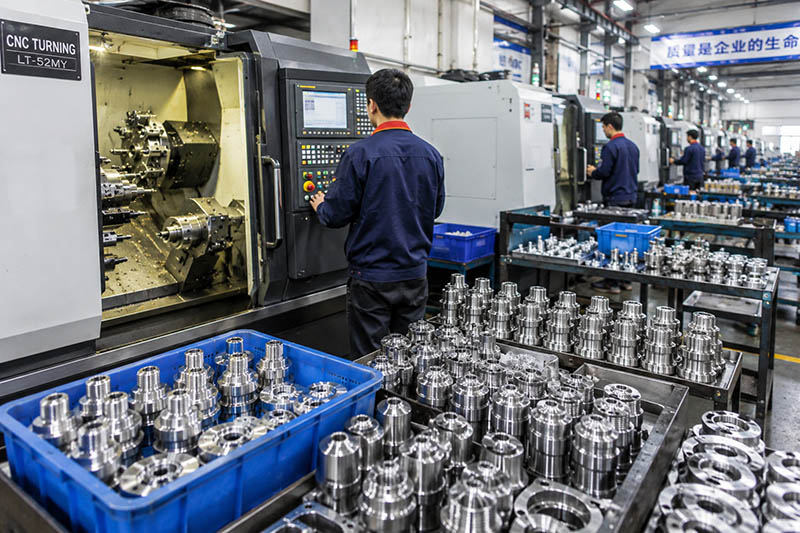
Precision Measuring Tools Used During Production
Besides CMM inspection, CNC factories use various measuring instruments during different production stages.
| Inspection Tool | Measurement Purpose | Accuracy Range |
|---|---|---|
| Digital Caliper | Basic dimensions | 0.01 mm |
| Micrometer | Precision diameter measurement | 0.001 mm |
| Height Gauge | Surface positioning | 0.005 mm |
| Thread Gauge | Thread verification | Depends on standard |
| Surface Roughness Tester | Surface finish analysis | Ra measurement |
In high-volume production, inspection is usually performed at multiple checkpoints:
- First article inspection
- In-process inspection
- Final inspection
- Random sampling inspection
This prevents large quantities of defective parts from being produced.
Quality Control System in CNC Turning Production
A mature CNC turning parts factory normally follows a structured quality management process.
The typical workflow includes:
| Quality Stage | Main Purpose |
|---|---|
| Incoming Material Inspection | Verify material grade and condition |
| First Piece Inspection | Confirm CNC programming accuracy |
| Process Monitoring | Detect machining variations |
| Final Inspection | Confirm product requirements |
| Documentation | Provide quality records |
Material traceability is especially important for industries such as aerospace and medical.
For example, when producing titanium medical components, customers may require:
- Material certificate
- Inspection report
- Batch number tracking
- Manufacturing records
A professional supplier should be able to provide complete documentation.
CNC Turning Applications and Industries Served
Automotive CNC Turning Parts Manufacturing
The automotive industry is one of the largest users of CNC turned components.
Modern vehicles require thousands of precision-machined parts, including:
- Transmission shafts
- Engine components
- Steering system parts
- Sensor housings
- Brake components
- Fasteners
Automotive components usually require:
- High repeatability
- Long-term durability
- Stable mass production capability
For example, a CNC turned transmission shaft may require:
| Requirement | Specification |
|---|---|
| Material | Alloy steel |
| Diameter | 30-80 mm |
| Hardness | Heat treated |
| Tolerance | ±0.01 mm |
| Production Volume | Thousands/month |
Because automotive manufacturers often require large quantities, CNC factories must maintain consistent production efficiency.
Aerospace CNC Turning Components
Aerospace machining requires some of the highest standards in CNC manufacturing.
Aircraft components must achieve excellent strength while minimizing weight.
Common CNC turned aerospace parts include:
- Landing gear components
- Hydraulic fittings
- Engine connectors
- Structural fasteners
- Precision shafts
Frequently used materials include:
- Titanium alloys
- Aluminum 7075
- Inconel alloys
- Stainless steel
Titanium is especially popular because it provides:
- High strength
- Low density
- Excellent corrosion resistance
However, titanium machining requires experienced operators because:
- Cutting temperatures are high
- Tool wear is significant
- Machining parameters must be carefully controlled
A CNC turning factory experienced with aerospace materials can significantly reduce production risks.
Medical CNC Turning Parts Production
Medical devices require extremely accurate and clean components.
Typical CNC turned medical parts include:
- Surgical instruments
- Implant components
- Medical connectors
- Equipment shafts
Common materials:
| Material | Medical Application |
|---|---|
| Titanium | Implants |
| Stainless steel 316L | Surgical tools |
| PEEK | Medical components |
| Cobalt alloys | Specialized implants |
Medical CNC machining requires strict control over:
- Surface finish
- Material quality
- Dimensional accuracy
- Contamination prevention
For example, a titanium implant component may require a very smooth surface because rough surfaces can affect biological compatibility.
Robotics and Automation CNC Turning Parts
The growth of industrial automation has increased demand for precision CNC turning components.
Robot systems often use:
- Precision shafts
- Bearing housings
- Joint connectors
- Motor components
- Transmission parts
Robotics manufacturers require components with:
- Low friction
- High accuracy
- Excellent repeatability
A small dimensional error in robotic joints can reduce positioning accuracy.
For example:
A robotic arm used in electronics assembly may require joint components with micron-level consistency to maintain accurate movement.
How to Choose a Reliable CNC Turning Parts Factory
Evaluating CNC Machining Capability
When selecting a CNC turning supplier, customers should evaluate whether the factory has suitable equipment and technical experience.
Important factors include:
| Evaluation Factor | Why It Matters |
|---|---|
| CNC machine types | Determines manufacturing capability |
| Material experience | Ensures proper machining methods |
| Quality system | Guarantees consistency |
| Engineering support | Helps optimize designs |
| Production capacity | Supports future growth |
A factory that only focuses on basic turning may not be suitable for complex components requiring milling, drilling, or secondary operations.
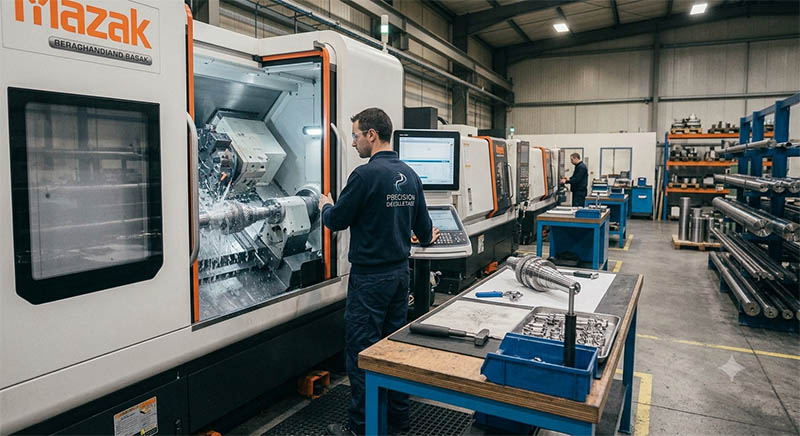
Engineering Support and Design Assistance
A valuable CNC turning factory does more than manufacture parts. It can also help customers improve product designs.
Professional engineers may provide suggestions regarding:
- Material selection
- Machining feasibility
- Tolerance optimization
- Cost reduction
For example:
A customer may design a stainless steel component with unnecessary deep grooves that increase machining difficulty.
An experienced CNC engineer may recommend:
- Adjusting groove dimensions
- Changing tool access
- Modifying tolerance requirements
This can reduce machining time and production cost without affecting product performance.
CNC Turning Factory Production Workflow from Prototype to Mass Production
From CNC Prototype Machining to High-Volume Production
Flexible Manufacturing Capability for Different Project Stages
A professional CNC turning parts factory should be able to support customers throughout the entire product development cycle, from initial prototype manufacturing to large-scale production.
Many companies do not immediately require thousands of parts. New products usually start with prototype production to verify:
- Design feasibility
- Mechanical performance
- Assembly compatibility
- Material selection
- Functional testing
CNC turning is especially suitable for prototype development because it does not require expensive molds or tooling.
For example, a robotics company developing a new actuator system may first require:
- 5 aluminum prototype shafts
- 10 stainless steel connectors
- 20 precision bushings
After testing and design improvement, production may increase to:
- 5,000 pieces/month
- 20,000 pieces/month
A capable CNC turning factory can smoothly transition from prototype machining to repeat production.
Prototype, Low Volume, and Mass Production Comparison
| Production Stage | Quantity | Main Focus | Typical Application |
|---|---|---|---|
| Prototype machining | 1-50 pcs | Design validation | New product development |
| Low volume production | 50-1,000 pcs | Cost optimization | Specialized equipment |
| Medium volume production | 1,000-50,000 pcs | Production stability | Industrial components |
| Mass production | 50,000+ pcs | Automation efficiency | Automotive and electronics |
Different production volumes require different manufacturing strategies.
For prototype machining:
- Engineers focus on speed and design verification.
- Production efficiency is less important.
For mass production:
- Cycle time optimization becomes critical.
- Tool life management becomes important.
- Automated inspection may be introduced.
A professional CNC turning parts factory must have flexible production planning to meet different customer requirements.
CNC Turning Factory Production Process Management
Engineering Review Before Machining
Before production begins, experienced CNC engineers review all technical information, including:
- 2D drawings
- 3D CAD models
- Material requirements
- Surface treatment specifications
- Tolerance requirements
- Quantity requirements
During this stage, engineers identify potential manufacturing problems.
Common issues include:
- Difficult tool access
- Excessive machining depth
- Unrealistic tolerances
- Difficult surface finishes
- Expensive material choices
For example:
A customer may request a precision aluminum turning part with ±0.002 mm tolerance on every dimension.
However, some non-functional dimensions may not require such tight tolerance.
The CNC factory can suggest maintaining:
- Critical dimensions: ±0.005 mm
- General dimensions: ±0.02 mm
This approach maintains product performance while reducing unnecessary manufacturing costs.
CNC Programming and Process Optimization
CNC programming directly affects machining quality and efficiency.
Professional CNC programmers optimize:
- Tool paths
- Cutting speed
- Feed rate
- Tool selection
- Machining sequence
For example, when machining a brass connector, an optimized program can reduce:
- Material waste
- Tool replacement frequency
- Machining cycle time
Typical CNC turning parameters vary depending on materials.
| Material | Cutting Speed Range | Machining Characteristics |
|---|---|---|
| Aluminum | High speed | Excellent machinability |
| Brass | High speed | Good chip control |
| Stainless steel | Medium speed | Requires coolant management |
| Titanium | Lower speed | Requires careful tool control |
Experienced factories continuously improve machining programs based on production data.
Advantages of Working with a Professional CNC Turning Parts Factory
Better Manufacturing Consistency
One major advantage of professional CNC suppliers is production repeatability.
When thousands of identical parts are required, every component must maintain the same:
- Dimensions
- Surface finish
- Mechanical properties
- Assembly performance
For example:
A manufacturer producing 10,000 precision pins cannot manually adjust every component.
Instead, CNC turning factories rely on:
- Automated programming
- Machine calibration
- Statistical process control
- Regular inspection
This ensures stable production quality.
Reduced Manufacturing Cost Through Process Optimization
Although CNC machining requires advanced equipment investment, professional factories can reduce overall costs through efficient production methods.
Cost optimization methods include:
| Method | Cost Reduction Effect |
|---|---|
| Better tool selection | Longer tool life |
| Improved programming | Shorter machining time |
| Material optimization | Reduced waste |
| Automated production | Lower labor cost |
| Process improvement | Higher efficiency |
For example:
A poorly optimized CNC turning process may require 8 minutes to produce one component.
After engineering improvement:
- Improved cutting parameters
- Reduced tool changes
- Better machining sequence
The cycle time may decrease to 5 minutes.
For large orders, this difference can significantly reduce production expenses.
CNC Turning Parts Factory Capabilities Checklist
Before selecting a CNC turning supplier, customers should evaluate the following capabilities:
| Capability | Recommended Requirement |
|---|---|
| CNC equipment | Modern CNC turning centers |
| Materials | Aluminum, steel, stainless steel, brass, titanium, plastics |
| Precision | ±0.01 mm or better |
| Inspection equipment | CMM, micrometer, surface tester |
| Engineering support | Design optimization assistance |
| Production range | Prototype to mass production |
| Surface finishing | Anodizing, plating, polishing, coating |
| Quality documentation | Inspection reports and material certificates |
A supplier with comprehensive capabilities can support more complex projects and reduce communication costs.
Why Choose Xavier as Your CNC Turning Parts Factory Partner
Xavier is a professional CNC machining manufacturer specializing in custom CNC turning parts and precision metal components for global customers.
With advanced CNC turning equipment, experienced engineers, and strict quality control processes, Xavier provides reliable manufacturing solutions from prototype development to volume production.
Our CNC turning capabilities include:
- Precision shafts
- Custom bushings
- Threaded components
- Industrial connectors
- Automotive parts
- Aerospace components
- Medical machining parts
- Robotics components
Xavier works with a wide range of materials, including:
- Aluminum alloys
- Stainless steel
- Brass
- Copper
- Titanium
- Alloy steel
- Engineering plastics
Through professional machining processes, accurate inspection methods, and flexible production management, Xavier helps customers transform designs into high-quality finished components.
Whether you need a small batch prototype or continuous production of thousands of CNC turned parts, Xavier provides customized machining solutions with reliable quality, competitive manufacturing capability, and professional engineering support.
We are an integrated manufacturer specializing in CNC machining services, providing custom CNC machining solutions for a wide range of precision metal and engineering plastic components. Our capabilities include CNC Titanium Machining, CNC PEEK Machining, and CNC Brass Machining. We also manufacture high-quality parts for robotics, aerospace, marine, automotive, medical, and other precision engineering applications.
As a professional CNC Titanium Machining Manufacturer, we provide high-volume CNC PEEK Machining Services. Contact us today for competitive CNC Brass Machining Prices and customized manufacturing solutions.
Some of the images and text in this article are collected and compiled from the internet. If there is anything inappropriate, please contact us for processing.