
What Is the Difference Between Cast Aluminium and Aluminium?
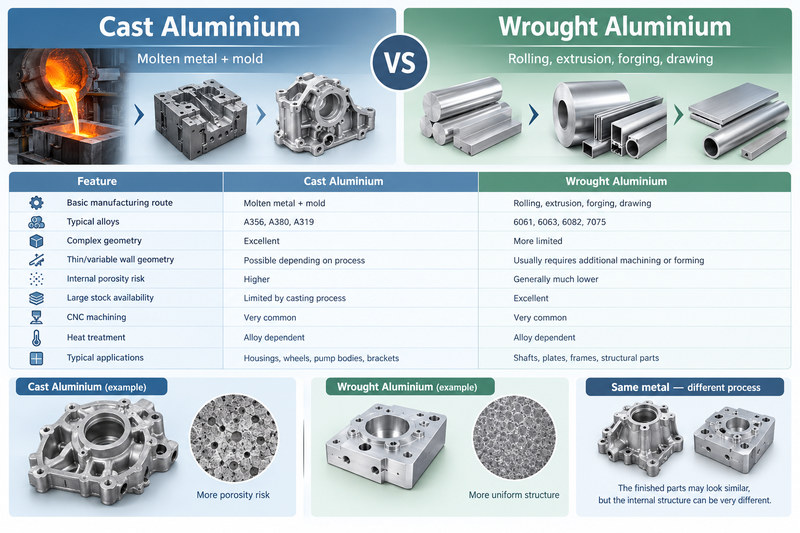
When people search for cast aluminium vs aluminium, there is an important terminology issue to understand first: cast aluminium is not a completely different metal from aluminium. Both are aluminum-based materials. The real difference is usually the manufacturing route and alloy family.
Cast aluminium is produced by melting an aluminum alloy and pouring, injecting, or otherwise filling the molten metal into a mold. The final component obtains much of its shape directly from the mold cavity.
By contrast, what is commonly called “aluminium” in engineering discussions may refer to wrought aluminum, including rolled, extruded, forged, or plate/bar materials. These materials start as aluminum alloys and are mechanically worked in the solid state to produce sheet, plate, tube, bar, extrusion, or forging stock.
This distinction matters because the manufacturing process changes the internal structure, mechanical properties, available geometries, cost structure, and machining behavior.
| Feature | Cast Aluminium | Wrought Aluminium |
|---|---|---|
| Basic manufacturing route | Molten metal + mold | Rolling, extrusion, forging, drawing |
| Typical alloys | A356, A380, A319 | 6061, 6063, 6082, 7075 |
| Complex geometry | Excellent | More limited |
| Thin/variable wall geometry | Possible depending on process | Usually requires additional machining or forming |
| Internal porosity risk | Higher | Generally much lower |
| Large stock availability | Limited by casting process | Excellent |
| CNC machining | Very common | Very common |
| Heat treatment | Alloy dependent | Alloy dependent |
| Typical applications | Housings, wheels, pump bodies, brackets | Shafts, plates, frames, structural parts |
For a CNC machining customer, this difference becomes particularly important when a component is supplied as a casting blank and then machined to its final dimensions. The finished part may look similar to a component machined from 6061 plate, but the internal material structure can be significantly different.
How Manufacturing Changes the Material Structure
The biggest difference is what happens while the aluminum is becoming a solid part.
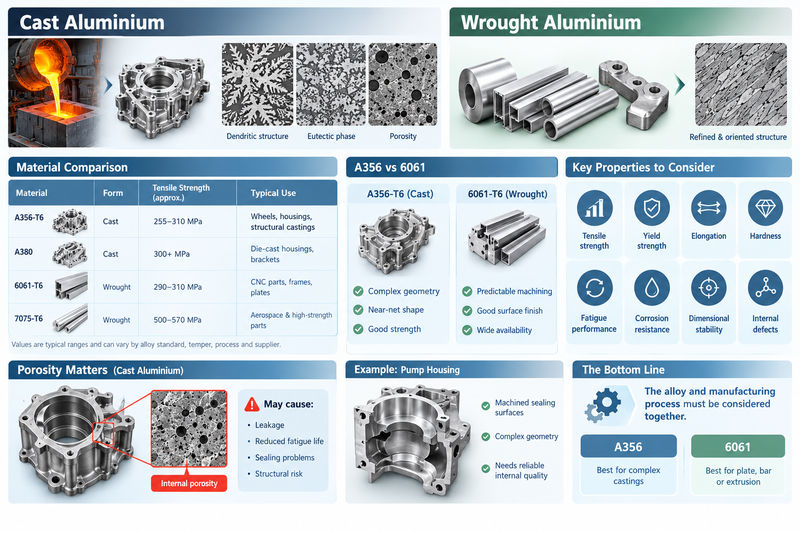
During casting, molten aluminum cools and solidifies inside a mold. The solidification rate varies according to section thickness, mold temperature, alloy composition, and casting method. This can produce dendritic structures, eutectic phases, and, if the process is not properly controlled, shrinkage or gas porosity.
Wrought aluminum follows a different route. Rolling, forging, or extrusion mechanically deforms the material and can refine and orient its microstructure. This is one reason wrought alloys such as 6061-T6 and 7075-T6 are widely used where predictable mechanical performance is important.
This does not mean that cast aluminum is automatically weak. A properly designed and processed A356-T6 casting can provide substantial tensile and yield strength. The important point is that the alloy and manufacturing process must be considered together.
For example, A356 is commonly used for wheels, housings, structural castings, pump bodies, and other components where castability and strength are both required. Published material data for A356-T6 commonly show tensile strength in the approximate 255–310 MPa range, depending on casting process and specification.
Strength, Ductility and Mechanical Properties
Strength is often the first property buyers compare, but tensile strength alone does not tell the complete story.
For a machined aluminum component, engineers may also need to consider yield strength, elongation, hardness, fatigue performance, corrosion resistance, dimensional stability, and the possibility of internal casting defects.
A simplified comparison looks like this:
| Material | Typical Form | Approx. Tensile Strength | Typical Use |
|---|---|---|---|
| A356-T6 | Cast | 255–310 MPa | Structural castings, wheels, housings |
| A380 | Cast | Around 300+ MPa depending on condition | Die-cast housings, brackets |
| 6061-T6 | Wrought | Around 290–310 MPa | CNC parts, frames, plates |
| 7075-T6 | Wrought | Around 500–570 MPa | High-strength aerospace and mechanical parts |
These values should not be treated as universal guarantees because alloy standard, temper, casting method, specimen location, section thickness, and supplier specification can all change the actual result.
The comparison between A356-T6 and 6061-T6 is particularly interesting. Their tensile strengths can be relatively close, but they are produced differently and therefore behave differently in design and manufacturing.
A356 may be a better fit when the component needs a near-net-shape casting with complex geometry. 6061-T6 may be preferable when the part can be efficiently produced from plate, bar, or extrusion and predictable machining behavior is more important.
Why Ductility and Porosity Matter
One major consideration with cast aluminum is porosity.
Porosity can originate from entrapped gas or solidification shrinkage. A small amount may be acceptable for a non-critical housing, but internal voids become more important when a component is subjected to cyclic loading, pressure, sealing requirements, or structural loads.
This is why simply asking for “strong aluminum” is not enough when purchasing a cast component.
For example, imagine a pump housing with several machined sealing surfaces. The exterior may look perfect after CNC machining, but if the casting contains interconnected internal porosity, machining can expose defects or create leakage problems.
For a structural A356 component, the casting method, melt quality, feeding design, heat treatment, and inspection method may therefore be just as important as the nominal alloy designation.
Common Cast Aluminium Alloys: A356, A380 and More
A356 and A380 are two names frequently encountered when purchasing aluminum castings, but they are designed around different performance and process priorities.
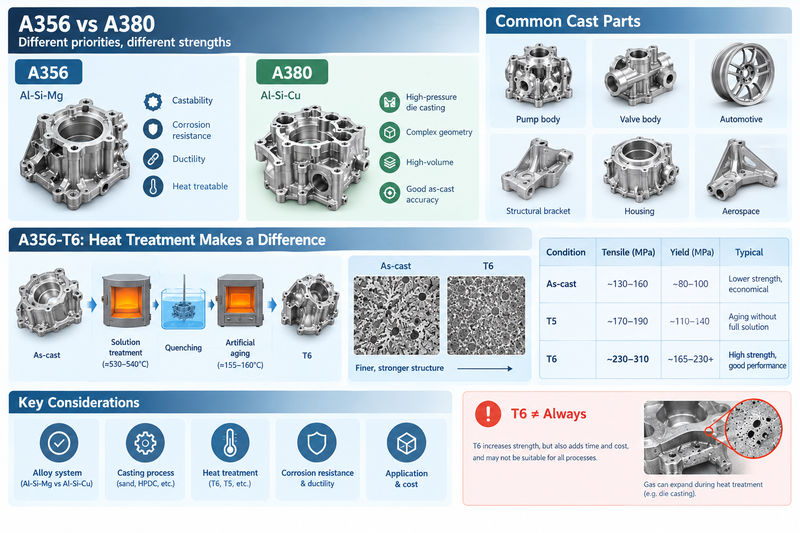
A356 is an aluminum-silicon-magnesium casting alloy. Its silicon content improves castability, while magnesium allows the alloy to respond effectively to heat treatment.
A356 is particularly interesting for CNC manufacturers because many cast A356 components are subsequently machined. Typical examples include pump bodies, valve bodies, automotive components, wheels, structural brackets, and aerospace-related castings.
A380, on the other hand, is strongly associated with high-pressure die casting. It offers good castability and is widely used for complex housings and high-volume components.
| Characteristic | A356 | A380 |
|---|---|---|
| Main alloy system | Al-Si-Mg | Al-Si-Cu |
| Typical casting route | Sand, permanent mold, LPDC | Mainly HPDC |
| Heat-treatment potential | Excellent | More limited depending on process |
| Corrosion resistance | Generally good | Lower than A356 because of Cu |
| Ductility | Generally better | Generally lower |
| Complex thin-wall die casting | Moderate | Excellent |
| Structural applications | Strong candidate | Application dependent |
| Common parts | Wheels, housings, structural castings | Housings, brackets, covers |
A356 is often selected when the customer needs a combination of castability, corrosion resistance, ductility, and heat-treatable strength.
A380 is often attractive when high-volume die casting, complex geometry, and good as-cast dimensional characteristics are more important.
The correct choice therefore depends on the complete part specification rather than the word “aluminum” alone.
A356-T6: Why Heat Treatment Makes a Difference
One of the most important subjects in cast aluminum is T6 heat treatment.
A356 in the as-cast condition has significantly lower mechanical properties than properly heat-treated A356-T6. Published data commonly place as-cast tensile strength around 130–160 MPa in certain conditions, while T6-treated material can reach approximately 228–262 MPa or higher depending on the casting process and specification.
T6 generally consists of solution heat treatment, rapid cooling, and artificial aging.
The basic principle is straightforward:
- The casting is heated to a controlled high temperature.
- Alloying elements such as magnesium and silicon are brought into solid solution.
- The material is quenched.
- Artificial aging creates fine strengthening precipitates.
- The resulting microstructure provides substantially higher strength.
For A356, solution treatment is commonly performed around 530–540°C, followed by quenching and artificial aging around 155–160°C, although exact parameters must follow the applicable material specification and casting geometry.
The improvement can be substantial.
| A356 Condition | Tensile Strength | Yield Strength | Typical Characteristics |
|---|---|---|---|
| As-cast | ~130–160 MPa | ~80–100 MPa | Lower strength, economical |
| T5 | ~170–190 MPa | ~110–140 MPa | Aging without full solution treatment |
| T6 | ~230–310 MPa | ~165–230+ MPa | High strength and good overall performance |
T6 should not simply be added to every aluminum casting automatically. It increases processing time and cost, and certain casting processes have limitations regarding heat treatment.
For example, conventional high-pressure die castings can contain entrapped gas. During solution treatment, this gas can expand and cause blistering or distortion. This is one reason alloy selection and casting process must be considered together rather than specified independently.
Casting Process Has a Direct Effect on Performance
“Cast aluminum” describes a broad category rather than one single process.
Different casting processes produce different combinations of dimensional accuracy, surface quality, production volume, wall thickness, porosity, and mechanical performance.
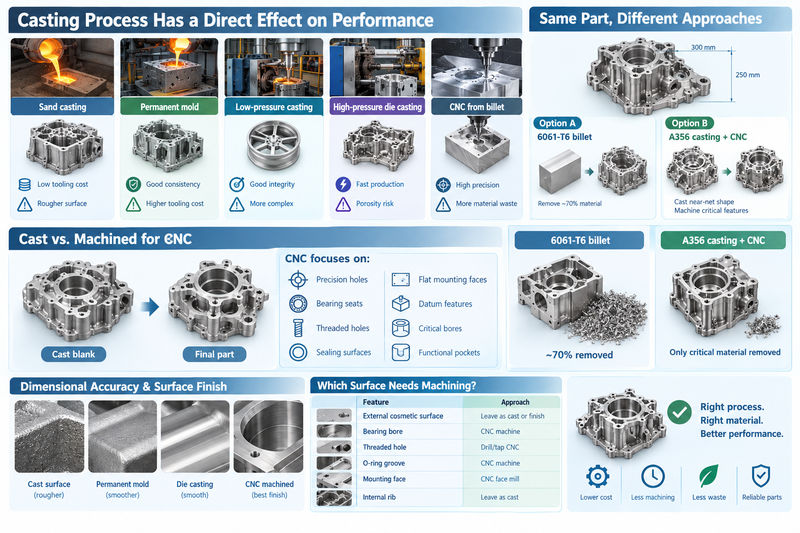
| Process | Best Suited For | Typical Advantage | Main Consideration |
|---|---|---|---|
| Sand casting | Prototypes, large parts, low-medium volume | Low tooling cost | Rougher surface, more machining |
| Permanent mold | Medium-volume structural parts | Better consistency than sand | Higher tooling investment |
| Low-pressure casting | Wheels, structural parts | Controlled filling, good integrity | Higher process complexity |
| High-pressure die casting | High-volume complex parts | Fast production, thin walls | Porosity and heat-treatment limitations |
| CNC machining from billet | Precision low-medium volume parts | Excellent dimensional control | More material waste |
Consider a 300 mm × 250 mm aluminum housing with multiple pockets, ribs, mounting bosses, and internal cavities.
Machining the complete housing from a solid 6061 billet could produce an excellent part, but a large amount of material would be removed. If the annual production quantity is high, casting the basic shape first and CNC machining only the critical surfaces can significantly reduce machining time and material waste.
This is one of the strongest practical reasons to choose cast aluminum.
Cast Aluminium vs Aluminium for CNC Machining
For CNC machining, the decision is not simply about whether aluminum can be cut. Almost all common aluminum alloys can be machined. The more important question is what condition the material is in before machining.
A cast blank may already contain the external geometry required by the final product. CNC machining then focuses on:
- Precision holes
- Bearing seats
- Threaded holes
- Sealing surfaces
- Flat mounting surfaces
- Datum features
- Critical bores
- Functional pockets
A billet or extrusion starts with a much simpler geometry, meaning the CNC machine must remove more material.
For example:
Option A: 6061-T6 billet
A rectangular block is purchased and approximately 70% of the original material is removed to produce a complex housing.
Option B: A356 casting + CNC
The casting supplier produces the external ribs, bosses, and major cavities. CNC machining removes only the material required to achieve final dimensions and functional tolerances.
For a high-volume component, Option B can reduce machining hours considerably. However, tooling and casting development costs must be considered.
Dimensional Accuracy and Surface Finish
Cast surfaces are normally rougher than CNC-machined surfaces.
A sand-cast surface may require substantial machining before it becomes suitable for a sealing face or precision mounting surface. Permanent mold and die-cast surfaces can be considerably smoother, but the exact result depends on tooling, alloy, process control, and release system.
A practical design should therefore identify which surfaces actually require CNC machining.
For example:
| Feature | Suggested Manufacturing Approach |
|---|---|
| External cosmetic casting surface | Leave as cast or finish |
| Bearing bore | CNC machine |
| Threaded mounting hole | Drill/tap CNC |
| O-ring sealing groove | CNC machine |
| Precision mounting face | CNC face mill |
| Non-functional internal rib | Usually leave as cast |
This approach avoids unnecessary machining and keeps production cost under control.
Design Considerations for Cast Aluminium Parts
A casting should not be designed exactly like a machined billet part.
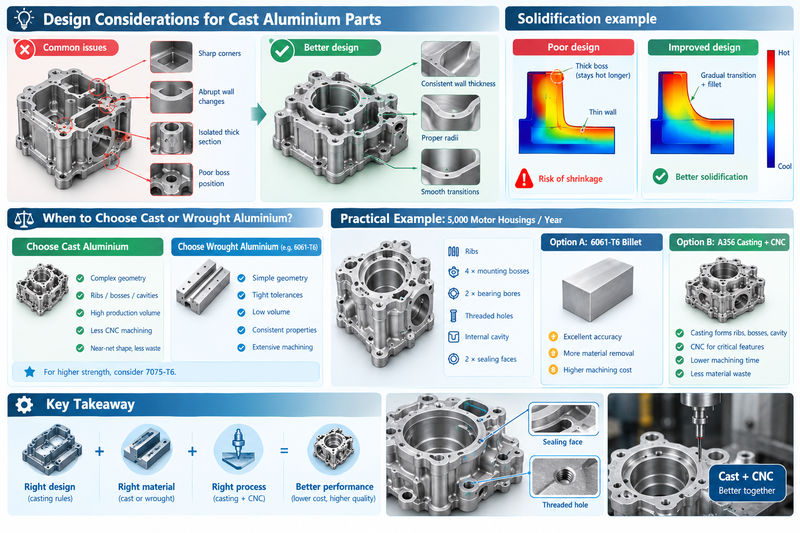
Sharp internal corners, abrupt wall-thickness changes, isolated thick sections, and poorly positioned bosses can increase casting problems such as shrinkage, distortion, or incomplete filling.
A better casting design uses more consistent wall thickness and appropriate radii.
For example, imagine a housing with a 4 mm wall connected directly to a 20 mm solid boss. During solidification, the thick boss remains hot longer than the thin wall. This difference can create localized shrinkage problems.
A redesigned boss with a gradual transition and appropriate fillet can provide a more favorable solidification pattern.
This is why a CNC machining supplier experienced in cast-and-machined components should review the casting design and machining requirements together, rather than treating them as two unrelated processes.
Which One Should You Choose?
There is no universal answer to whether cast aluminum or wrought aluminum is better. The appropriate material depends on the part geometry, production quantity, mechanical requirements, tolerance, tooling budget, and manufacturing route.
Use cast aluminum when:
- The component has complicated geometry.
- Ribs, bosses, cavities, or curved surfaces are required.
- Production volume justifies casting tooling.
- Reducing CNC machining time is important.
- A suitable casting alloy can meet the mechanical requirements.
- Near-net-shape manufacturing can reduce material waste.
Consider wrought aluminum such as 6061-T6 when:
- The component has relatively simple geometry.
- Tight CNC tolerances dominate the design.
- Low-volume production does not justify casting tooling.
- Consistent billet or extrusion properties are important.
- The part requires extensive precision machining.
For higher-strength applications, alloys such as 7075-T6 may also be considered, particularly where strength-to-weight performance is a primary requirement.
Practical Example: Choosing Material for an Aluminum Housing
Suppose a customer needs 5,000 aluminum motor housings per year.
The part contains:
- Multiple external ribs
- Four mounting bosses
- Two bearing bores
- Several threaded holes
- An internal cavity
- Two precision sealing faces
Machining the complete component from 6061-T6 billet would provide excellent dimensional control, but material removal could be high and machining time could become expensive at 5,000 pieces per year.
An A356 casting could create the ribs, bosses, and basic cavity before CNC machining. The CNC process could then concentrate on the bearing bores, mounting faces, holes, and sealing surfaces.
If the mechanical requirements call for increased strength, A356-T6 may be evaluated.
This example illustrates the fundamental point: material selection and manufacturing-process selection should be made together.
Xavier CNC Machining Solutions for Cast and Wrought Aluminium Parts
At Xavier, we approach aluminum components from both the material and manufacturing perspective. A customer does not simply need an aluminum part; they need the right combination of alloy, manufacturing process, dimensional accuracy, surface finish, and production economics.
For cast aluminum components, we can evaluate the casting geometry and identify which areas should remain as-cast and which functional surfaces should receive CNC machining. For wrought aluminum components, CNC milling, turning, drilling, boring, and other precision operations can be used to produce finished parts directly from billet, plate, bar, or other stock forms.
Materials such as A356, A380, 6061, 6063, 6082, and 7075 can serve very different purposes. The appropriate choice depends on the application rather than simply choosing the most expensive or strongest material.
For customers comparing cast aluminium vs aluminium, the most useful starting point is the actual part drawing, material requirement, annual quantity, critical tolerances, surface-finish requirement, and intended operating environment. From there, Xavier can help determine whether a cast-and-machined solution or a fully machined wrought-aluminum solution is more appropriate for the component.
The objective is not simply to produce an aluminum part, but to find a manufacturing route that provides the required performance while keeping machining time, material consumption, tooling investment, and production cost under control.
Choosing between cast aluminium and conventional aluminium for a manufactured component depends on more than material price alone. The final decision should consider alloy grade, part geometry, dimensional tolerances, production volume, surface requirements, and the intended application. Cast aluminium is commonly used for complex shapes and higher-volume production, while CNC machining from aluminium billet, plate, or bar is often preferred when tight tolerances, precise holes, threads, and controlled surface finishes are required. In many projects, a combination of casting and CNC machining can provide an efficient solution, with casting creating the near-net shape and CNC machining completing critical functional features.
As an experienced manufacturer, Xavier provides CNC machining services for customers who need accurately manufactured metal components in prototypes, small batches, and production quantities. Our capabilities include CNC machined parts, aluminum CNC machining, precision CNC machining, and custom metal parts. We can work with common aluminium grades such as 6061 and 7075 as well as a wide range of other metals and engineering plastics. Depending on your drawing and application, we can also support secondary operations such as drilling, tapping, turning, grinding, polishing, anodizing, and other surface treatments.
For projects involving cast aluminium, CNC machining can also be used after casting to improve critical dimensions, sealing surfaces, mounting holes, bores, and threaded features. This combined manufacturing approach allows engineers to balance CNC part manufacturing precision with the geometric advantages of casting. If you are comparing cast aluminium vs aluminium for a new component, send us your drawings, 3D files, material requirements, and estimated quantity. Our team can review the design and recommend a practical manufacturing route based on precision, performance, lead time, and production cost.
Some of the images and text in this article are collected and compiled from the internet. If there is anything inappropriate, please contact us for processing.