
Anodizing Company Near Me: A Complete Guide to Aluminum Anodizing
When searching for an anodizing company near me, it is easy to focus only on location, price, or turnaround time. For CNC machined aluminum parts, however, the closest anodizing shop is not necessarily the best supplier.
Anodizing is an electrochemical surface treatment that changes the surface of aluminum into a controlled aluminum oxide layer. The process can improve corrosion resistance, wear resistance, appearance, and surface durability. More importantly, anodizing changes the dimensions and functional behavior of a precision CNC part, so the finishing supplier needs to understand more than simply how to produce a particular color.
For example, a decorative Type II anodized enclosure and a Type III hardcoat hydraulic component may both be made from aluminum, but they require substantially different process control, coating thickness, and dimensional planning.
A good anodizing company should therefore be evaluated based on several technical factors:
| Evaluation Factor | Why It Matters |
|---|---|
| Anodizing type | Determines thickness, wear resistance, appearance, and application |
| Aluminum alloy | Strongly affects color, coating uniformity, and achievable thickness |
| Coating thickness | Influences corrosion protection and finished dimensions |
| Masking capability | Protects threads, bores, electrical contacts, and mating surfaces |
| Inspection | Confirms coating thickness, appearance, and dimensional requirements |
| Production capability | Determines whether the supplier can handle prototype or production quantities |
| Drawing/specification control | Prevents incorrect Type, Class, color, or thickness |
| CNC integration | Helps control dimensions before and after anodizing |
If you are sourcing anodized CNC parts, understanding these factors will make it much easier to identify an anodizing company near you that can deliver functional, repeatable results rather than simply attractive-looking parts.
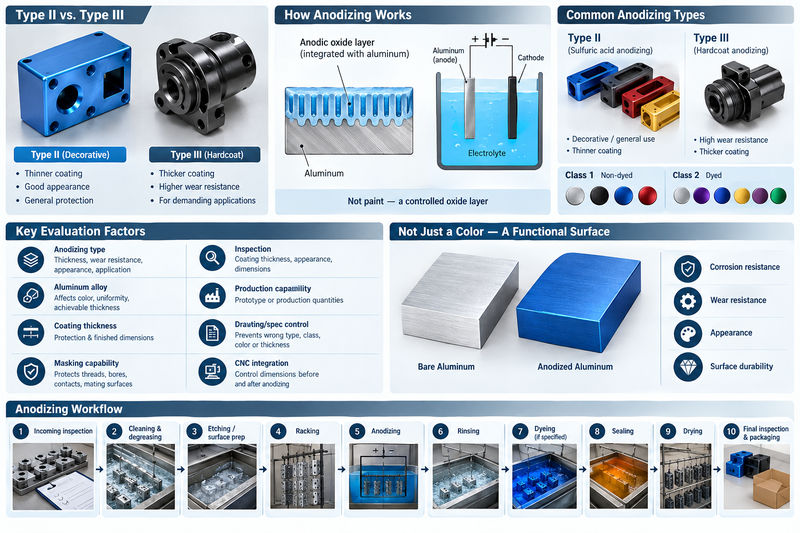
Anodizing is not the same as painting aluminum. During anodizing, aluminum becomes the anode in an electrochemical process. An electrical current passes through an electrolyte and causes a controlled oxide layer to form on the aluminum surface.
The resulting oxide is integrated with the aluminum rather than being a separate paint film sitting on top of the metal. This is one reason anodized aluminum is widely used for CNC components that require both appearance and functional surface protection.
Sulfuric acid anodizing is one of the most common processes. Under MIL-A-8625 terminology, Type II refers to conventional sulfuric acid anodizing, while Type III refers to hard anodizing. The specification also distinguishes Class 1, non-dyed finishes, from Class 2, dyed finishes.
A professional anodizing workflow normally involves several stages:
- Incoming inspection
- Cleaning and degreasing
- Etching or surface preparation when required
- Racking
- Electrochemical anodizing
- Rinsing
- Dyeing when specified
- Sealing
- Drying
- Final inspection and packaging
Each stage can influence the final appearance and performance.
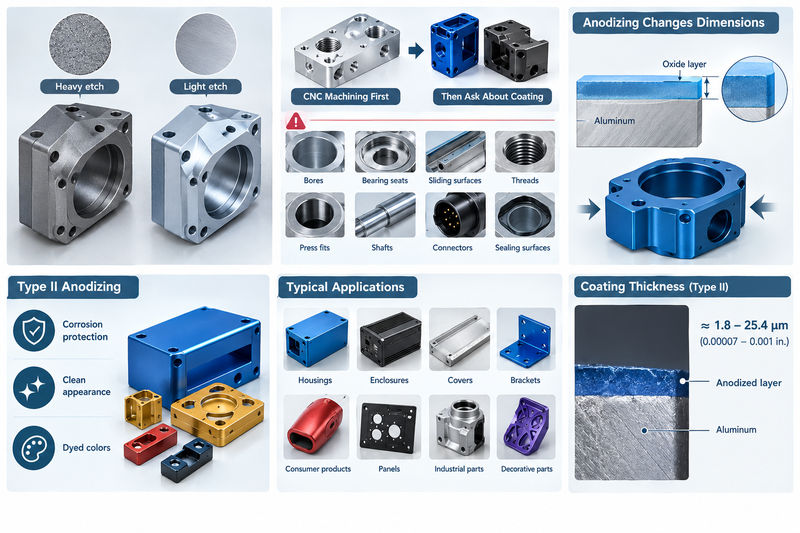
For example, two 6061 aluminum parts machined from the same bar stock can produce different visual results if one part is heavily etched before anodizing and the other receives a lighter surface preparation.
The surface condition before anodizing therefore matters almost as much as the anodizing bath itself.
A common mistake is to finish the CNC machining first and only afterward ask an anodizing company how much material the coating will add.
This approach can create problems with:
- Precision bores
- Bearing seats
- Sliding surfaces
- Threaded holes
- Press-fit dimensions
- Shaft diameters
- Connector interfaces
- Sealing surfaces
Anodizing is a dimensional process. The Aluminum Anodizers Council specifically notes that anodizing changes part dimensions because some aluminum is consumed while oxide is formed.
For this reason, a CNC machining supplier that understands anodizing can often prevent finishing-related problems before the parts are manufactured.
Type II anodizing is commonly selected when a component needs corrosion protection, a clean surface appearance, and the ability to use dyed colors.
Typical Type II applications include:
- CNC aluminum housings
- Electronic enclosures
- Machine covers
- Brackets
- Consumer products
- Instrument panels
- General industrial components
- Decorative aluminum components
Typical Type II coating thickness is approximately 1.8–25.4 µm (0.00007–0.001 in.), depending on the specific specification and process.
For many CNC parts, a practical specification might look like:
MIL-A-8625, Type II, Class 2, Black
This tells the finishing supplier that the component requires conventional sulfuric anodizing, a dyed finish, and a black color.
Type III anodizing, commonly called hardcoat anodizing, is intended for applications where surface wear is a major concern.
Typical applications include:
- Sliding components
- Hydraulic components
- Valve bodies
- Pistons
- Wear surfaces
- Machine fixtures
- Aerospace components
- High-cycle mechanical parts
The Aluminum Anodizers Council reference guide lists Type III as hard coating and gives a broad thickness range extending from approximately 12.7 µm to 115 µm, depending on alloy and process.
Compared with Type II, Type III is considerably thicker and harder. It is therefore not simply a more expensive version of Type II; it serves a different engineering purpose.
| Characteristic | Type II | Type III Hardcoat |
|---|---|---|
| Main purpose | Appearance and general protection | Wear and abrasion resistance |
| Typical chemistry | Sulfuric acid | Hardcoat anodizing process |
| Typical thickness | About 1.8–25.4 µm | About 12.7–115 µm depending on alloy/process |
| Color selection | Broad | More limited |
| Dimensional effect | Moderate | More significant |
| Wear resistance | Good | Excellent |
| Common colors | Clear, black, red, blue and others | Natural gray, bronze, dark gray, black |
| Typical CNC applications | Housings, covers, brackets | Sliding parts, hydraulic parts, wear components |
The exact coating range should always be confirmed against the drawing and applicable specification rather than treating these numbers as universal guarantees.
Imagine a CNC-machined 6061 aluminum sliding rail.
If the drawing simply states:
Finish: Black Anodize
the requirement is incomplete.
A finishing supplier could interpret this as Type II black anodizing. The resulting appearance may be excellent, but the surface may not provide the wear resistance required for repeated sliding contact.
A better specification would identify the anodizing type, class, color, thickness, and any masking requirements.
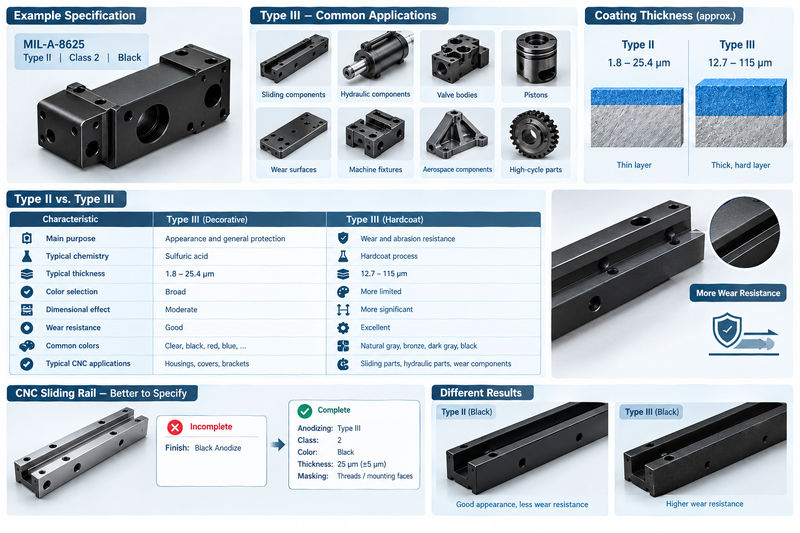
For example:
MIL-A-8625, Type III, Class 2, Black, specified coating thickness
The exact thickness should be determined according to the application and supplier capability.
One of the most important points when choosing an anodizing company near you is whether the supplier understands aluminum metallurgy.
6061, 6063, 7075, 2024, 5052, 5005, and cast aluminum alloys can produce noticeably different anodized appearances.
For example, 6061 is widely used for CNC machining and generally provides predictable anodizing behavior. In contrast, alloys containing higher levels of copper, zinc, or silicon can produce darker, less uniform, or more variable colors.
The Aluminum Anodizers Council reference data specifically identifies alloy-dependent differences in Type III coating thickness and color characteristics. For example, 6061 is listed with a typical dark-gray tendency under hardcoat conditions, while 7075 can show bronze coloration.
Many customers assume that “black anodizing” means every black part should have exactly the same shade.
In practice, final color can be affected by:
- Aluminum alloy
- Material temper
- Surface roughness
- Machining marks
- Etching
- Anodizing thickness
- Dye concentration
- Processing conditions
- Sealing
- Production batch
This becomes especially important when several components are assembled next to one another.
For example, suppose an enclosure uses a 6061 body and a 7075 mounting bracket. Both are specified as black anodized. Even if both suppliers follow their respective processes correctly, the two parts may not visually match perfectly because the alloy compositions differ.
For high-appearance products, it is better to provide a physical color sample or approved reference sample instead of relying only on the word “black.”
Anodizing does not hide poor machining.
If a CNC-machined surface contains visible tool marks, scratches, burrs, deep milling lines, or inconsistent polishing, those characteristics can remain visible after anodizing.
Before anodizing, the part may receive:
- As-machined finishing
- Brushing
- Bead blasting
- Sanding
- Polishing
- Chemical etching
- Brightening
Different surface preparation methods produce different visual effects.
For example:
| Pre-Anodizing Surface | Typical Result |
|---|---|
| Fine machined | Crisp machined appearance |
| Brushed | Directional satin appearance |
| Bead blasted | Uniform matte appearance |
| Polished | Bright reflective appearance |
| Chemical etched | More uniform matte appearance |
This is why an experienced anodizing company should ask about the required appearance rather than simply asking which color you want.
For precision CNC components, this is one of the most important issues to discuss before production.
Anodizing converts aluminum into aluminum oxide, and the oxide layer both consumes some base material and builds outward from the original surface. The Aluminum Anodizers Council gives a useful rule of thumb of approximately 2/3 inward and 1/3 outward for nominal Type II conditions, while Type III hardcoat is approximately 1/2 inward and 1/2 outward. Actual results depend on alloy and process conditions.
Consider a simplified Type III example.
Suppose a surface receives a 50 µm total coating.
Using the approximate 50/50 growth relationship:
- Approximately 25 µm grows inward
- Approximately 25 µm grows outward
For an external diameter, the outward buildup affects the finished diameter.
For a hole, the coating forms on both sides of the hole, so the dimensional effect is approximately doubled across the diameter.
This is why a precision bore should not be treated in the same way as a cosmetic exterior surface.
Suppose a CNC aluminum component requires a finished anodized bore of:
Ø20.000 ±0.020 mm
If the bore is anodized without considering coating buildup, the finished hole could become undersized.
A better approach is to determine:
- Required finished dimension
- Anodizing type
- Target coating thickness
- Expected dimensional change
- Masking requirement
- Final inspection method
The machining dimension can then be adjusted to account for the finishing process.
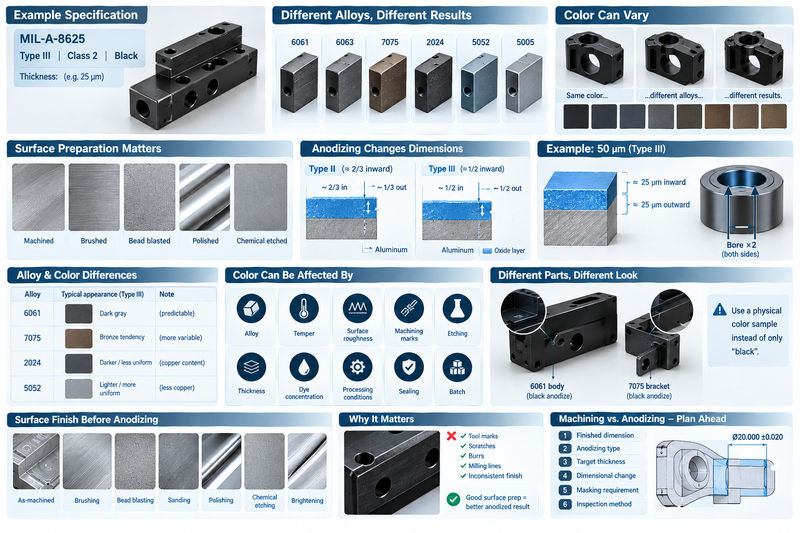
For very tight tolerances, the anodizer and CNC manufacturer should agree on the process allowance before production.
A capable anodizing company should be able to mask selected areas when required.
Common masking requirements include:
- Internal threads
- Precision bores
- Grounding points
- Electrical contact areas
- Bearing seats
- Press-fit surfaces
- Sealing faces
- Sliding surfaces
- Datum surfaces
The Aluminum Anodizers Council notes that sections of an aluminum part can be masked to prevent anodizing coverage, including machined bores and threads.
For example, if a threaded hole must remain electrically conductive, coating the entire thread may create an assembly or electrical-contact problem.
The drawing should clearly identify areas that must remain untreated.
Anodizing requires electrical contact with the component. Parts therefore need to be mounted or racked in a way that allows current to pass through them.
The contact location can leave a small rack mark.
For hidden surfaces, this may not matter.
For a visible consumer product, however, rack marks can become a cosmetic issue.
A good anodizing supplier should therefore discuss rack locations before production, especially when the component has strict cosmetic requirements.
When searching for an anodizing company near me, location is useful because it can reduce transportation time, shipping cost, and logistics complexity.
However, technical capability should come first.
A supplier that is 10 miles away but cannot control Type III thickness may be a worse choice than a supplier 100 miles away that can consistently meet your drawing requirements.
For CNC manufacturers, the ideal supplier should understand both finishing and precision manufacturing.
Before requesting a quotation, ask the anodizing company:
| Question | Why It Matters |
|---|---|
| Do you offer Type II anodizing? | Confirms conventional anodizing capability |
| Do you offer Type III hardcoat? | Important for wear-resistant components |
| Which alloys do you process regularly? | Alloy experience affects consistency |
| Can you provide dyed Class 2 finishes? | Important for colored parts |
| What coating thickness can you control? | Thickness affects performance and dimensions |
| Can you mask bores and threads? | Protects functional features |
| How do you inspect coating thickness? | Confirms process results |
| Can you process prototypes? | Important during product development |
| What batch sizes do you accept? | Prevents production mismatch |
| Can you work from customer drawings? | Important for engineered components |
| Can you provide inspection documentation? | Useful for quality-critical applications |
| Can you anodize CNC-machined parts directly? | Simplifies supplier coordination |
A professional anodizer should be able to discuss these questions in technical terms rather than simply quoting a price per part.
A strong RFQ should contain enough information for the finishing company to understand exactly what is required.
For example:
Material: Aluminum 6061-T6
Process: CNC machining
Finish: Type II anodizing
Class: Class 2
Color: Black
Coating thickness: Specify required range
Masking: Internal Ø10 mm bore and M6 threads
Cosmetic requirement: No visible scratches on designated surfaces
Inspection: Coating thickness and final dimensions
This is much better than:
“Please CNC machine and black anodize.”
The second instruction leaves too many technical decisions open.
For companies purchasing precision CNC parts, one of the most efficient approaches is to work with a manufacturer that can coordinate CNC machining and anodizing as one production process.
This reduces the number of handoffs between:
CNC machine shop → shipping company → anodizing supplier → inspection → shipping → assembly
Instead, the manufacturer can manage:
Material → CNC machining → deburring → anodizing → inspection → packaging
This can be particularly valuable for prototype development and small-to-medium production batches.
It also makes responsibility clearer when a dimensional problem occurs after anodizing.
A professional anodizing supplier should not treat every aluminum part the same way.
A simple decorative bracket, a precision bearing housing, and an aerospace-grade hardcoat component may all require completely different process decisions.
A strong supplier should evaluate:
- Aluminum alloy
- Material temper
- Surface preparation
- Anodizing type
- Class
- Color
- Coating thickness
- Masking
- Dimensional tolerances
- Electrical requirements
- Functional surfaces
- Packaging
- Inspection requirements
The Aluminum Anodizers Council recommends that specifications address factors such as alloy and temper, mechanical finish, chemical preparation, and anodic coating type.
A low anodizing price does not necessarily mean lower total cost.
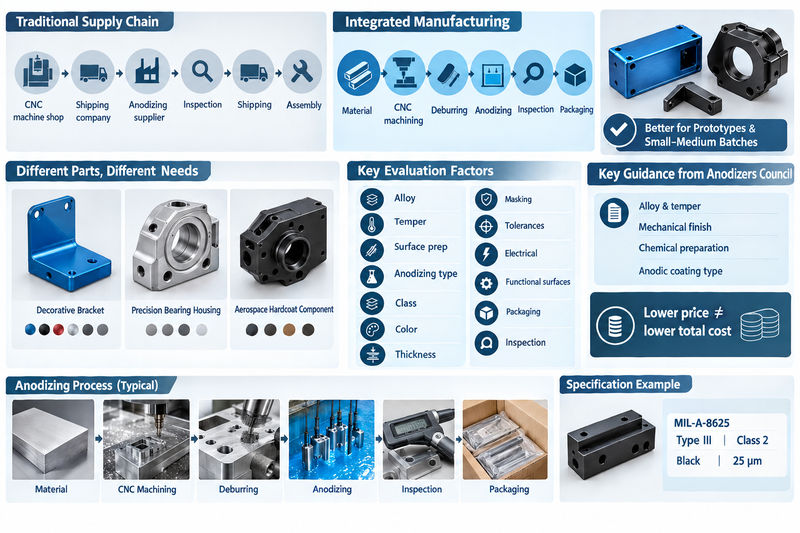
If the wrong coating thickness causes a precision bore to fail inspection, the cost of re-machining, stripping, re-anodizing, and shipping can be much greater than the original finishing charge.
Black is a color, not a complete anodizing specification.
The drawing should identify the anodizing type, class, thickness, and other requirements appropriate to the application.
MIL-A-8625 distinguishes Type II and Type III and also distinguishes Class 1 non-dyed from Class 2 dyed finishes.
Do not assume that black anodizing on 6061 will look identical to black anodizing on 7075.
Alloy chemistry can influence color, coating behavior, and achievable thickness.
Threads, bores, bearing surfaces, grounding areas, and precision mating surfaces may require masking.
If the requirement is not identified before processing, correcting the problem afterward can be expensive.
Anodizing can be a functional engineering treatment.
Depending on the selected process, it can improve corrosion resistance, wear resistance, surface durability, and electrical insulation characteristics.
For a wear-critical component, Type III hardcoat may be much more appropriate than decorative Type II anodizing.
Before placing an order, verify the following:
| Requirement | Check |
|---|---|
| Aluminum alloy confirmed | ✓ |
| Type I, II, or III confirmed | ✓ |
| Class 1 or Class 2 confirmed | ✓ |
| Color specified | ✓ |
| Coating thickness specified | ✓ |
| Critical dimensions reviewed | ✓ |
| Threads and bores reviewed | ✓ |
| Masking locations identified | ✓ |
| Surface preparation specified | ✓ |
| Cosmetic surfaces identified | ✓ |
| Rack-mark locations considered | ✓ |
| Inspection requirements defined | ✓ |
| Packaging requirements defined | ✓ |
| Prototype or production quantity confirmed | ✓ |
This checklist can prevent many of the problems that appear only after finished parts return from anodizing.
When you need more than a basic finishing service, Xavier provides a practical solution by combining CNC machining expertise with aluminum surface finishing knowledge.
For customers searching for an anodizing company near me, the real objective is usually not simply finding a shop that can place aluminum parts into an anodizing tank. The objective is finding a manufacturing partner that understands how anodizing affects material selection, surface appearance, tolerances, masking, and final assembly.
Xavier can help coordinate CNC machining and anodizing requirements from the beginning of the project. This is particularly useful for components made from common CNC aluminum alloys such as 6061 and 7075, where the final appearance and dimensional behavior need to be considered before production.
Whether you need conventional Type II anodizing for an aluminum enclosure, black anodized CNC brackets, or Type III hardcoat for a wear-resistant mechanical component, the finish should be selected according to the actual function of the part.
The best result comes from treating anodizing as part of the complete manufacturing process—not as an afterthought.
If you are sourcing custom CNC aluminum parts with anodizing, provide the drawing, material, required finish, critical dimensions, and quantity to Xavier. The earlier the machining and anodizing requirements are reviewed together, the easier it is to achieve the required appearance, dimensional accuracy, and functional performance.
FAQS
1. What is anodizing?
Anodizing is an electrochemical process that creates a protective aluminum oxide layer on the surface of aluminum parts, improving corrosion resistance, durability, and appearance.
2. What aluminum alloys can be anodized?
Common anodized aluminum alloys include 6061, 6063, 7075, 5052, and 2024. However, different alloys can produce different colors and surface finishes.
3. What is the difference between Type II and Type III anodizing?
Type II anodizing is commonly used for corrosion protection and appearance, while Type III hardcoat anodizing provides a thicker, harder coating for applications requiring better wear resistance.
4. Does anodizing change the dimensions of aluminum parts?
Yes. Anodizing adds an oxide layer and can slightly change part dimensions. Critical holes, threads, and mating surfaces should be considered before anodizing.
5. Can anodized aluminum be customized in different colors?
Yes. Type II anodizing can be dyed in colors such as black, red, blue, gold, and other shades. The final color can vary depending on the aluminum alloy and surface preparation.
We are an integrated CNC machining manufacturer specializing in custom CNC manufacturing and the precision machining of various metal parts. In addition to our machining capabilities, we also support CNC anodizing surface finishing, CNC electroless nickel surface finishing, and CNC electrogalvanizing surface finishing.
We are a CNC anodizing surface finishing manufacturer offering CNC electroless nickel surface finishing services. Contact us to discuss CNC electrogalvanizing surface finishing prices and get a suitable solution for your project.
Some of the images and text in this article are collected and compiled from the internet. If there is anything inappropriate, please contact us for processing.