
Acrylic vs Polycarbonate: Which Transparent Plastic Is Better for CNC Machining and Industrial Applications?
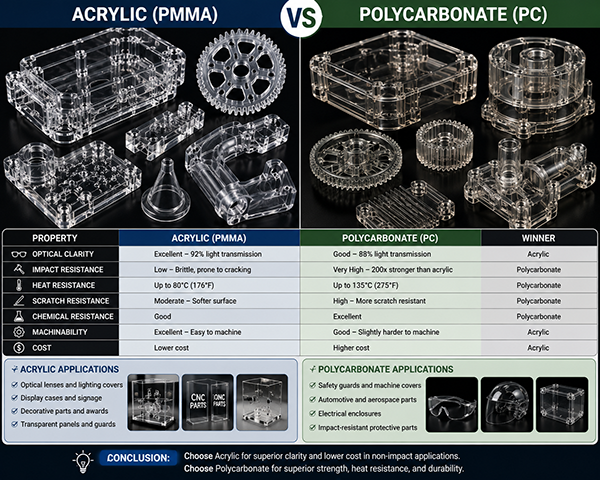
Transparent plastics have become essential materials in modern manufacturing, replacing glass in applications where weight reduction, impact resistance, machinability, and design flexibility are important. Among all transparent engineering plastics, Acrylic (PMMA) and Polycarbonate (PC) are the two most frequently compared materials.
Although they appear similar at first glance, their mechanical properties, machining behavior, durability, and cost differ significantly. Choosing the wrong material can lead to premature failure, increased manufacturing costs, or poor long-term performance.
This comprehensive guide compares Acrylic and Polycarbonate from a CNC machining and engineering perspective.
10 Key Topics Covered
1. Material Overview: What Are Acrylic and Polycarbonate?
2. Optical Clarity and Light Transmission
3. Impact Strength and Durability
4. Temperature Resistance and Heat Performance
5. Scratch Resistance and Surface Hardness
6. UV Resistance and Outdoor Weathering
7. CNC Machining Characteristics
8. Chemical Resistance Comparison
9. Cost Analysis and Total Ownership Cost
10. Best Applications and Material Selection Guide
Material Overview: What Are Acrylic and Polycarbonate?
Acrylic (PMMA)
Acrylic, scientifically known as Polymethyl Methacrylate (PMMA), is a transparent thermoplastic widely used as a lightweight glass substitute. It is known for exceptional optical clarity, weather resistance, and attractive appearance. Common brand names include Plexiglas and Perspex. Acrylic offers approximately 92% light transmission, making it one of the clearest plastics available.
Polycarbonate (PC)
Polycarbonate is a high-performance engineering thermoplastic valued for its exceptional toughness and impact resistance. It is commonly sold under trade names such as Lexan. Unlike acrylic, polycarbonate can absorb significant impact energy without cracking or shattering. It is frequently used in machine guards, safety shields, protective glazing, and aerospace applications.
Quick Material Comparison
| Property | Acrylic (PMMA) | Polycarbonate (PC) |
|---|---|---|
| Transparency | Excellent | Very Good |
| Impact Strength | Moderate | Extremely High |
| UV Resistance | Excellent | Moderate |
| Scratch Resistance | Better | Lower |
| Heat Resistance | Moderate | High |
| Cost | Lower | Higher |
| CNC Machining | Excellent | Good |
Optical Clarity and Light Transmission
Optical performance is often the primary reason engineers choose transparent plastics.
Light Transmission Comparison
| Material | Light Transmission |
|---|---|
| Acrylic | Up to 92% |
| Polycarbonate | 88–90% |
| Standard Glass | Approximately 90% |
Acrylic actually transmits slightly more visible light than glass, creating a crystal-clear appearance that makes it ideal for:
- Retail displays
- Optical covers
- Aquarium panels
- LED light diffusers
- Signage
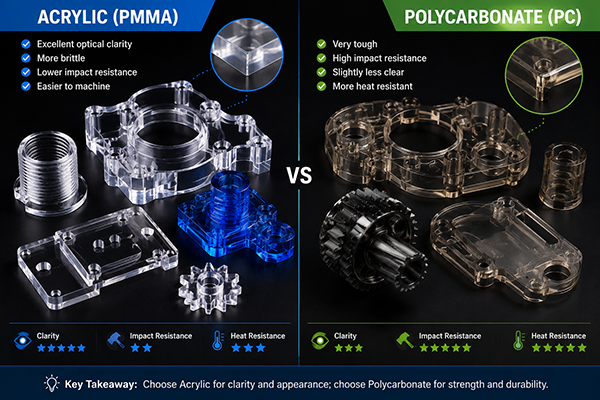
Polycarbonate remains highly transparent but has a slightly lower transmission rate due to its molecular structure. In applications where visual appearance is critical, acrylic is generally preferred.
Example
A luxury retail display case benefits more from acrylic because customers see products through a clearer and glossier surface.
Impact Strength and Durability
This is where the largest difference exists.
Impact Strength Comparison
| Material | Relative Impact Strength |
|---|---|
| Acrylic | Baseline |
| Polycarbonate | Approximately 30× stronger than Acrylic |
| Polycarbonate vs Glass | Up to 250× stronger |
Polycarbonate is often described as “virtually unbreakable.” It absorbs impact energy through deformation instead of fracturing.
Acrylic, while significantly stronger than glass, remains relatively brittle. Under heavy impact, it may crack or shatter.
Real-World Example
Imagine a CNC-machined machine safety guard:
- Acrylic guard → may crack if struck by flying debris.
- Polycarbonate guard → typically withstands impact without failure.
This is why safety shields, riot barriers, and protective machine enclosures almost always use polycarbonate.
Engineering Data
| Property | Acrylic | Polycarbonate |
|---|---|---|
| Izod Impact Strength | 10–20 J/m | 600–850 J/m |
| Elongation at Break | 2–4% | 80–150% |
Polycarbonate is dramatically tougher and more ductile.
Temperature Resistance and Heat Performance
Temperature performance becomes critical in industrial and automotive environments.
Heat Deflection Temperature
| Material | Heat Deflection Temperature |
|---|---|
| Acrylic | 90–100°C |
| Polycarbonate | 130–140°C |
Continuous Service Temperature
| Material | Continuous Service Temperature |
|---|---|
| Acrylic | 70–80°C |
| Polycarbonate | 115–130°C |
Polycarbonate maintains structural integrity at significantly higher temperatures. Acrylic begins softening much earlier and may warp under thermal load.
Example
Applications such as:
- Automotive light covers
- Industrial enclosures
- Aerospace interiors
often favor polycarbonate because of its superior thermal stability.
Scratch Resistance and Surface Hardness
A common misconception is that stronger materials are automatically more scratch resistant.
In reality, acrylic has a harder surface.
Surface Hardness Comparison
| Property | Acrylic | Polycarbonate |
|---|---|---|
| Surface Hardness | Higher | Lower |
| Scratch Resistance | Better | Poorer |
Polycarbonate scratches easily and often requires specialized hard coatings.
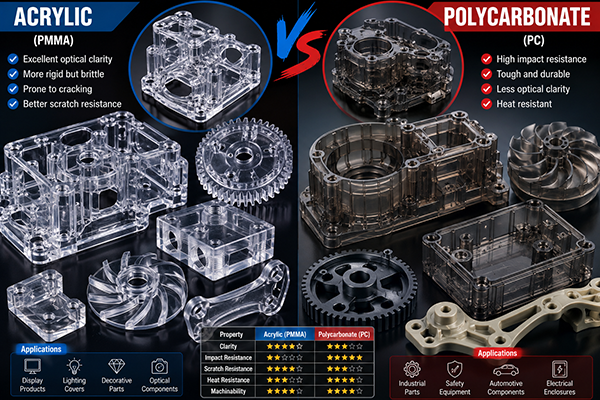
Acrylic naturally resists abrasion and minor scratches better. Small scratches can often be polished out, restoring optical quality.
Example
For showroom displays and museum exhibits where aesthetics matter, acrylic is often the preferred choice.
UV Resistance and Outdoor Weathering
Outdoor exposure can significantly affect transparent plastics.
Acrylic Performance
Acrylic naturally resists UV degradation and yellowing. Some studies indicate only minimal degradation after years of outdoor exposure.
Polycarbonate Performance
Standard polycarbonate tends to:
- Yellow over time
- Lose transparency
- Become surface degraded
unless UV-stabilized coatings are applied.
Outdoor Comparison
| Property | Acrylic | Polycarbonate |
|---|---|---|
| UV Stability | Excellent | Moderate |
| Yellowing Resistance | Excellent | Requires Coating |
| Outdoor Signage | Excellent | Acceptable |
For outdoor signs, skylights, and architectural glazing, acrylic often delivers superior long-term appearance.
CNC Machining Characteristics
For CNC manufacturers, machining behavior is often more important than raw material properties.
Acrylic Machining
Advantages:
- Produces sharp edges
- Excellent surface finish
- High dimensional accuracy
- Easy polishing
Challenges:
- Can crack during drilling
- Sensitive to stress concentrations
Polycarbonate Machining
Advantages:
- Tougher during machining
- Less prone to cracking
- Better for complex geometries
Challenges:
- Generates strings and burrs
- More difficult to achieve optical-quality edges
- More heat-sensitive during cutting
Sharp carbide or diamond tooling is recommended for both materials. Dull tools generate excessive heat and can melt thermoplastics during machining.
CNC Recommendation
| Requirement | Recommended Material |
|---|---|
| Optical Components | Acrylic |
| Protective Covers | Polycarbonate |
| Decorative Parts | Acrylic |
| Impact-Resistant Parts | Polycarbonate |
Chemical Resistance Comparison
Chemical compatibility affects long-term durability.
Acrylic
Good resistance to:
- Water
- Salt solutions
- Many household chemicals
Poor resistance to:
- Acetone
- Ketones
- Strong solvents
Polycarbonate
Good resistance to:
- Oils
- Greases
- Many industrial fluids
Can be attacked by:
- Some hydrocarbons
- Certain solvents
- Alkaline cleaners
Both materials should be tested under actual operating conditions before production deployment.
Cost Analysis and Total Ownership Cost
Material cost is often a major decision factor.
Typical Market Pricing
| Material | Relative Cost |
|---|---|
| Acrylic | Baseline |
| Polycarbonate | 25–60% Higher |
Various industry sources report polycarbonate costing approximately 25%–60% more than comparable acrylic sheets.
Cost Evaluation
Choose Acrylic if:
- Budget is limited
- Appearance matters most
- Impact loads are low
Choose Polycarbonate if:
- Safety is critical
- Breakage would be expensive
- Long-term durability matters
A higher initial material cost may reduce replacement and maintenance expenses over the product lifecycle.
Best Applications and Material Selection Guide
Choose Acrylic When You Need
- Maximum transparency
- UV resistance
- Better scratch resistance
- Lower cost
- Display-quality appearance
Typical applications:
- Retail displays
- Signage
- Aquariums
- Light covers
- Decorative panels
Choose Polycarbonate When You Need
- Extreme impact resistance
- Higher temperature capability
- Safety compliance
- Structural durability
Typical applications:
- Machine guards
- Safety shields
- Aerospace components
- Automotive parts
- Protective glazing
Final Selection Matrix
| Priority | Best Choice |
|---|---|
| Clarity | Acrylic |
| Impact Resistance | Polycarbonate |
| Outdoor Use | Acrylic |
| High Temperature | Polycarbonate |
| Scratch Resistance | Acrylic |
| Safety Equipment | Polycarbonate |
| Cost Efficiency | Acrylic |
| Industrial Durability | Polycarbonate |
Why CNC Manufacturers Often Work With Both Materials
Modern engineering projects rarely rely on a single plastic material.
For example:
- A machine enclosure may use polycarbonate windows for impact protection.
- The control panel display may use acrylic lenses for improved clarity.
- An automotive assembly may combine both materials depending on performance requirements.
Understanding these differences allows engineers to optimize both performance and manufacturing cost.
Xavier Precision Manufacturing Recommendation
At Xavier, we regularly machine both Acrylic (PMMA) and Polycarbonate (PC) for customers in industries including industrial automation, electronics, medical equipment, robotics, aerospace, and consumer products.
Our CNC machining capabilities include:
- Precision milling and turning
- Optical-grade plastic machining
- Tight tolerance manufacturing
- Custom prototypes and production runs
- Surface finishing and polishing
- Rapid turnaround services
If your project requires transparent CNC-machined components, our engineering team can help evaluate whether acrylic or polycarbonate will provide the best balance of optical performance, durability, manufacturability, and cost.
Selecting the correct material at the design stage can significantly improve product reliability while reducing long-term manufacturing expenses.
As an integrated manufacturer specializing in CNC machining services, we focus on custom CNC machining and the production of precision metal and plastic components. Our capabilities include CNC PEEK Machining, CNC Titanium Machining, and CNC Brass Machining. We serve a wide range of industries, including robotics, aerospace, marine, automotive, medical, and other high-precision applications.
As a CNC PEEK Machining Manufacturer, we provide high-volume CNC Titanium Machining Services. Contact us today to get competitive CNC Brass Machining Prices and discuss your project requirements.
Some of the images and text in this article are collected and compiled from the internet. If there is anything inappropriate, please contact us for processing.