
Types of Iron Metals: Properties, Differences, Applications, and CNC Machining
Iron metals are widely used in industrial manufacturing because they offer a broad range of mechanical properties, casting characteristics, wear resistance, and production costs. However, different types of iron metals are not interchangeable. Gray cast iron is valued for vibration damping, ductile iron is suitable for many load-bearing castings, and white cast iron is selected for demanding abrasive environments.
For engineers, product designers, and purchasing managers, choosing the right iron material involves more than comparing hardness or price. Carbon content, graphite structure, manufacturing method, dimensional requirements, and subsequent CNC machining all influence the performance of a finished component.
This guide explains 10 essential topics, from the main types of iron metals and their mechanical properties to material selection, machinability, surface finishing, and practical applications.
10 Key Topics to Understand About Types of Iron Metals
- What iron metals are and how they are classified
- Pig iron and its role in industrial manufacturing
- Gray cast iron: properties and applications
- Ductile iron: strength, toughness, and performance
- White cast iron: hardness and wear resistance
- Malleable cast iron and compacted graphite iron
- Wrought iron and the difference between iron and steel
- Mechanical properties and material comparison
- CNC machining, tolerances, and surface finishing
- How to select the right iron metal for a specific application
1. What Are Iron Metals? Understanding Their Classification
Iron metals are ferrous materials in which iron is the principal constituent. Depending on carbon content, alloying elements, and processing methods, they can range from relatively soft, formable materials to extremely hard, wear-resistant castings. In manufacturing, the term commonly covers pure or commercially pure iron, cast iron, wrought iron, and iron-based alloys such as carbon steel and alloy steel.
Cast iron typically contains approximately 2–4% carbon, together with silicon and other elements. Steel generally contains less carbon, although the exact boundary and composition depend on the classification system. These differences influence whether the material can be cast into complex shapes, forged into components, welded, or efficiently machined.
Main Categories of Iron Metals
| Material category | Key characteristic | Typical applications |
|---|---|---|
| Pig iron | High-carbon intermediate material | Steelmaking and foundry feedstock |
| Gray cast iron | Excellent vibration damping and machinability | Machine beds, engine blocks |
| Ductile cast iron | Higher ductility and tensile strength than gray iron | Pipes, hubs, load-bearing castings |
| White cast iron | High hardness and abrasion resistance | Wear plates, grinding components |
| Malleable cast iron | Improved toughness after heat treatment | Fittings, hardware |
| Compacted graphite iron | Intermediate graphite structure and thermal properties | Selected engine components |
| Wrought iron | Low-carbon material with slag inclusions | Traditional railings and decorative work |
| Steel | Broad range of strength, toughness, and processing options | Shafts, gears, brackets, fasteners |
These categories are not all defined in the same way. Pig iron is primarily an intermediate raw material, while gray, ductile, white, and malleable iron are cast-iron classifications. Steel is a related iron-based material, but it should not be treated as a type of cast iron.
2. Pig Iron: The Starting Material for Many Iron Alloys
Pig iron is produced by smelting iron ore using a carbon-based reducing agent, commonly coke, in a blast furnace. It contains a high proportion of iron and typically around 3.5–4.5% carbon. Silicon, manganese, phosphorus, and sulfur may also be present in varying amounts. Its relatively high carbon content makes pig iron brittle and unsuitable for many precision components in its unrefined state.
Different Types of Pig Iron
Three important commercial categories are basic pig iron, foundry pig iron, and high-purity or nodular pig iron.
- Basic pig iron: Primarily used as a feedstock for steelmaking, including electric arc furnace operations.
- Foundry pig iron: Used in producing castings, including gray cast iron, where silicon content and other chemical characteristics influence solidification.
- High-purity pig iron: Used in producing ductile iron, where controlling unwanted elements helps the foundry achieve the required graphite structure.
For example, a foundry manufacturing ductile iron pump housings cannot simply choose any available pig iron based on price. The charge composition must support the required final grade and treatment process. Magnesium treatment, inoculation, melt chemistry, and cooling conditions also influence the final microstructure.
CNC manufacturing consideration: Pig iron is generally not purchased as the finished stock for precision CNC-machined parts. Instead, it is processed into a suitable cast-iron or steel grade, and that material is then cast, formed, or supplied as stock for subsequent machining.
3. Gray Cast Iron: Excellent Vibration Damping and Machinability
Gray cast iron is one of the most widely used types of iron metals in industrial machinery. Its carbon occurs mainly as graphite flakes within a metallic matrix. These flakes help interrupt vibration and promote chip breaking during machining, but they also create local stress concentrations that reduce tensile strength and ductility.
Key Properties of Gray Cast Iron
Gray iron offers several practical advantages:
- Good compressive strength for rigid structural components.
- Excellent vibration damping, especially in machine bases and beds.
- Good machinability in many grades.
- Useful wear behavior in sliding-contact applications.
- Good castability for large or geometrically complex parts.
Its limitations are equally important. Gray cast iron is relatively brittle and does not tolerate impact or tensile loading as well as ductile iron. A thick machine base may perform well under distributed loads, while a thin mounting lug subjected to repeated bending may crack if the design and grade are unsuitable.
Common Applications
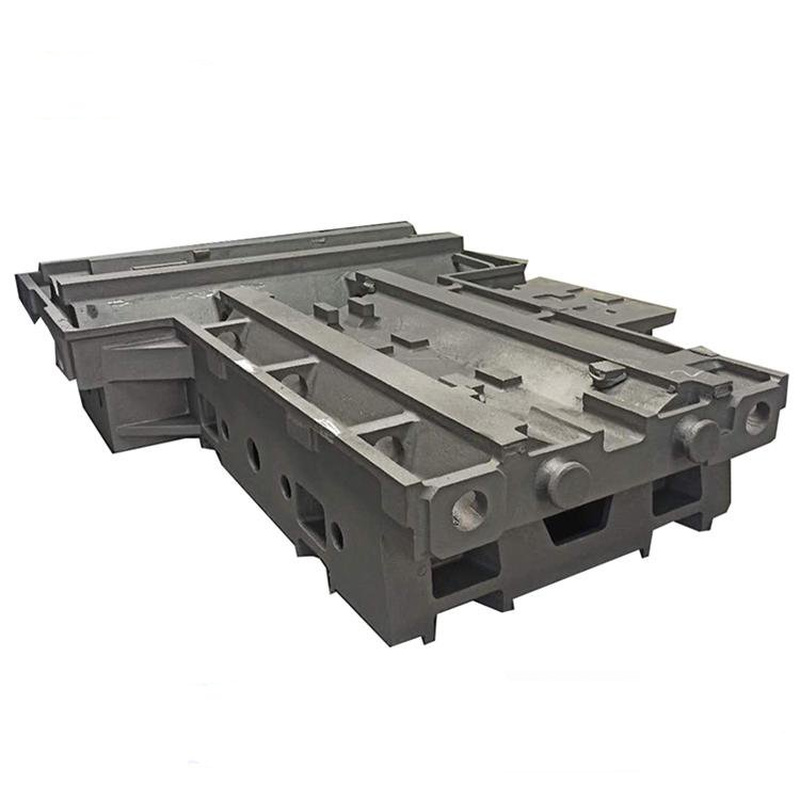
Machine bases and beds
Graphite flakes help absorb vibration, supporting stable machining and reducing unwanted chatter.
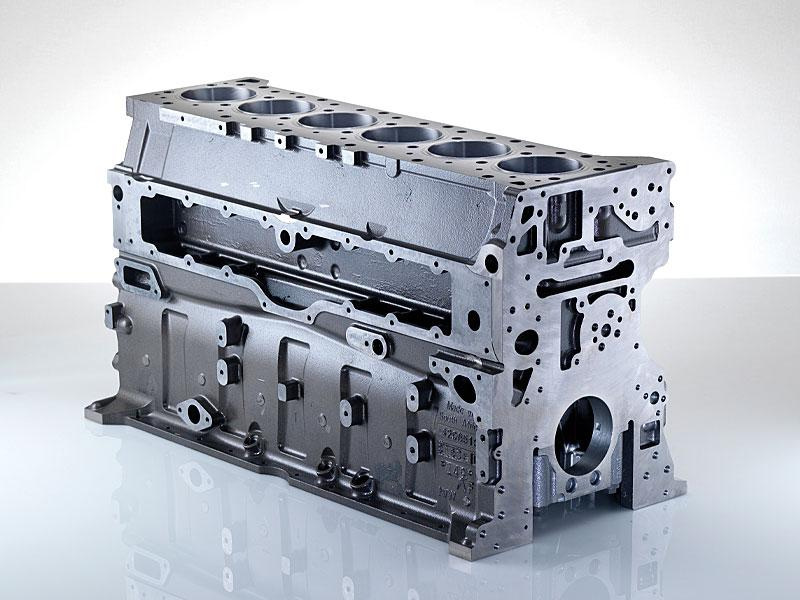
Engine blocks and housings
Castability, wear behavior, and thermal characteristics make gray iron suitable for selected engine and machinery components.
For CNC-machined gray iron, carbide tooling is commonly used. The graphite structure often allows efficient cutting, but the casting skin may contain abrasive or locally hard regions. Foundry quality, casting condition, and the amount of material removed can therefore affect tool life and dimensional consistency.
A practical example is a machine-tool base with precision mounting pads. The casting provides the overall shape, while CNC milling or grinding establishes the final flatness and alignment. The drawing should distinguish machined datum surfaces from unmachined casting surfaces rather than applying unnecessarily tight tolerances to every feature.
4. Ductile Iron: Strength, Toughness, and Load-Bearing Performance
Ductile iron, also called nodular iron or spheroidal graphite iron, is produced by controlling the formation of graphite so that it develops primarily as rounded nodules rather than flakes. Magnesium is commonly used in the treatment process. Compared with gray iron, this graphite morphology reduces stress concentration and allows substantially greater tensile strength and elongation.
Why Choose Ductile Iron?
Ductile iron is useful when a component needs the shape flexibility of casting but must withstand higher tensile loads, impact, or deformation before fracture. Depending on the grade, its tensile strength can range from approximately 400 MPa to over 800 MPa, with higher-strength grades available. These figures are indicative, not universal design values.
Common applications include:
- Water and wastewater pipes.
- Automotive hubs, crankshafts, and selected suspension components.
- Pump bodies, valve bodies, and industrial housings.
- Heavy-duty machinery parts that combine complex geometry with mechanical loading.
Consider a rotating hub that must carry a repeated load. Gray iron’s brittleness may be a disadvantage, whereas an appropriately specified ductile iron grade can provide better resistance to crack initiation and propagation. However, the final selection must account for fatigue, impact, temperature, geometry, and the applicable material standard.
CNC Machining Considerations
Ductile iron is machinable using appropriate carbide tools, but its cutting behavior differs from that of gray iron. Grade, matrix structure, hardness, casting condition, and heat treatment influence cutting forces and tool wear. A part that has been locally hardened or contains casting defects may require adjustments to the machining strategy.
For precision parts, it is also important to allow for casting stock, stress relief where appropriate, and a stable machining sequence. Critical bores and mounting faces should be machined from controlled datums to maintain alignment. For a pump housing, for instance, the relationship between the bearing bore, shaft axis, and mounting face may matter more than the tolerance of the overall external profile.
5. White Cast Iron: High Hardness for Abrasive Environments
White cast iron is distinguished by carbon that is largely combined in iron carbides rather than appearing as free graphite. This carbide-rich microstructure makes it very hard and resistant to abrasion, but also brittle. Rapid cooling and composition control can promote the formation of this structure.
Where Is White Cast Iron Used?
White cast iron is suitable for components exposed to severe sliding abrasion, particle impact, or material erosion, provided the application can accommodate its limited toughness. Examples include selected mill liners, wear plates, and components used in mineral processing.
The primary benefit is resistance to material loss. However, a part that experiences substantial shock loading may fracture even if its hardness is excellent. Engineers must therefore consider both wear resistance and the actual load conditions.
Can White Cast Iron Be CNC Machined?
Conventional machining can be difficult because the hard carbide structure causes substantial tool wear. Ordinary high-speed steel tooling may be unsuitable for demanding operations, and carbide tooling can also struggle with particularly hard grades. Grinding or specialized machining processes may be more appropriate.
For example, if a wear plate requires a precisely finished sealing face, the manufacturer should assess the grade’s hardness and machining allowance before promising a specific surface finish. Whenever possible, critical geometry should be incorporated into the casting design to reduce unnecessary material removal. This can lower machining time and reduce the risk of damaging the part.
6. Malleable Cast Iron and Compacted Graphite Iron
Malleable cast iron and compacted graphite iron are two additional materials that address requirements not fully met by conventional gray or ductile iron.
Malleable Cast Iron
Malleable iron is produced by heat-treating white iron for an extended period. This process changes the carbon distribution and creates temper-carbon aggregates, improving ductility and toughness compared with the original white iron.
IEEE Technology Navigator+1
It has traditionally been used for pipe fittings, brackets, hardware, and selected agricultural or industrial components. Its combination of castability, useful strength, and moderate machinability can make it suitable for smaller components with relatively intricate shapes.
When selecting malleable iron, specify the relevant grade and heat-treatment condition. Two parts with similar external dimensions may perform differently if their matrix structures and mechanical properties differ.
Compacted Graphite Iron (CGI)
Compacted graphite iron contains graphite with a short, interconnected, vermicular shape rather than the flakes typical of gray iron or the rounded nodules of ductile iron. Its properties can provide a balance of thermal conductivity, stiffness, strength, and casting performance.
CGI is used in selected engine blocks and cylinder heads where thermal loading and structural performance are important. However, it is not a universal upgrade over gray or ductile iron. The appropriate grade depends on the component’s operating temperature, pressure, fatigue loading, and manufacturing requirements.
For CNC machining, both materials require grade-specific cutting strategies. The foundry’s process control and the casting’s consistency are particularly important when machining thin walls, intersecting passages, or precision sealing surfaces.
7. Wrought Iron vs. Steel: What Is the Difference?
Wrought iron and steel are often confused because both are iron-based materials, and many modern products sold as “wrought iron” are actually made from mild steel.
Traditional wrought iron is a low-carbon material containing elongated slag inclusions. It is known for its workability, corrosion behavior under suitable conditions, and characteristic fibrous structure. Modern structural and decorative steel, by contrast, is manufactured with more controlled chemistry and mechanical properties.
Comparison of Wrought Iron and Steel
| Property | Traditional wrought iron | Mild steel |
|---|---|---|
| Carbon content | Generally very low | Commonly up to approximately 0.25% |
| Microstructure | Iron with slag inclusions | Primarily ferrite and pearlite, depending on grade |
| Forming | Suitable for hot working | Suitable for forming, rolling, and machining |
| Welding | Depends on condition and joining method | Generally good for suitable low-carbon grades |
| Typical uses | Historic railings, decorative ironwork | Brackets, shafts, frames, machined components |
The carbon figures are approximate, and actual properties depend on the material and production route.
Which Material Is Better for CNC Machining?
For most modern precision manufacturing projects, a specified steel grade is more practical than traditional wrought iron. Mild steel is widely available in bars, plates, and other stock forms, and its properties are generally easier to verify through material certificates.
For example, a custom mounting bracket with tapped holes and accurately positioned slots may be manufactured from a suitable low-carbon steel using CNC milling and drilling. A wrought-iron decorative gate, however, is typically selected for its traditional appearance and forming characteristics rather than precision machining performance.
The important purchasing rule is to specify the actual material grade instead of relying on a generic description such as “iron metal.”
8. Mechanical Properties of Different Iron Metals
Understanding mechanical properties helps engineers compare iron metals according to the demands of a component. Tensile strength indicates resistance to pulling forces, elongation measures deformation before fracture, hardness relates to resistance to indentation, and compressive strength describes resistance to crushing loads.
These properties are related but not interchangeable. A hard material is not necessarily tough, and a material with high tensile strength may not offer the best vibration damping or machinability.
Iron Metal Properties Comparison
| Material | Relative hardness | Tensile behavior | Ductility | Main advantage |
|---|---|---|---|---|
| Gray cast iron | Grade-dependent | Relatively low tensile strength | Very low | Vibration damping |
| Ductile iron | Grade-dependent | Commonly 400–800+ MPa tensile strength | Moderate to high, grade-dependent | Strength and toughness |
| White cast iron | High to very high | Grade-dependent; brittle behavior | Very low | Abrasion resistance |
| Malleable cast iron | Grade-dependent | Moderate to high strength | Improved over white iron | Toughness and formability |
| Compacted graphite iron | Grade-dependent | Intermediate between common gray and ductile grades | Limited to moderate | Thermal and mechanical balance |
| Mild steel | Usually moderate or low in the as-supplied condition | Commonly around 350–550 MPa tensile strength, depending on grade | Generally good | Versatility and fabrication |
Values and descriptions are indicative engineering comparisons, not acceptance criteria. Actual properties depend on the specified grade, specimen dimensions, heat treatment, casting quality, and applicable test standard. Steel values are illustrative rather than universal.
How Should Engineers Interpret These Differences?
Suppose two components have identical dimensions but serve different functions. One is a machine base designed to minimize vibration, while the other is a rotating component subjected to repeated tensile and bending loads. Gray iron may be a strong candidate for the base, whereas ductile iron or a suitable steel grade may be more appropriate for the rotating component.
The correct choice should be based on the complete loading condition, not a single headline strength value. For production parts, request the relevant material standard, mechanical-property requirements, and inspection documentation before approving a supplier.
9. CNC Machining, Dimensional Tolerances, and Surface Finishing
The machinability of iron metals varies substantially with graphite morphology, hardness, matrix structure, and casting quality. These differences affect cutting force, tool life, chip formation, achievable surface finish, and the cost of producing precision features.
Machinability Comparison
| Iron metal | General machining difficulty | Common manufacturing approach | Main consideration |
|---|---|---|---|
| Gray cast iron | Low to moderate | CNC milling, turning, drilling, grinding | Abrasive casting skin and fine particulate |
| Ductile iron | Moderate | CNC turning, milling, drilling | Grade-dependent cutting forces and tool wear |
| Malleable cast iron | Low to moderate | CNC milling, turning, drilling | Heat-treatment condition |
| White cast iron | High | Grinding or specialized machining | High hardness and tool wear |
| Compacted graphite iron | Moderate, grade-dependent | CNC milling and turning | Material consistency and tool selection |
| Mild steel | Low to moderate | CNC turning, milling, drilling | Grade, hardness, and chip control |
These are general comparisons. A specific grade may behave differently, so cutting parameters should be established through the material specification and machining trials.
Dimensional Tolerances and Inspection
A CNC machine can produce accurate features in suitable iron materials, but the achievable tolerance depends on more than machine capability. Casting distortion, residual stress, workholding, tool wear, thermal effects, and the datum strategy can all influence the finished dimensions.
For a precision pump housing, for example, the bearing bore may require a tighter tolerance than the external casting profile. The bore’s position relative to the mounting face may also be critical. A sensible machining plan establishes the mounting face first, then uses it as a reference for the bore and other functional features.
A coordinate measuring machine (CMM), bore gauge, micrometer, or other appropriate instrument can verify critical dimensions. The inspection method should match the drawing requirements and the geometry being measured.
Surface Finishing and Corrosion Protection
Iron metals may require additional finishing after CNC machining, depending on their application and operating environment. Common options include:
- Grinding: Improves dimensional accuracy and surface finish on suitable surfaces.
- Polishing: Reduces surface irregularities where the material and application permit.
- Protective coating or painting: Helps reduce corrosion when the coating system is appropriate for the service environment.
- Plating: May be suitable for certain grades and applications, subject to surface preparation and process compatibility.
Gray iron’s graphite structure and porosity can affect coating appearance and adhesion. Castings may also contain surface defects that become visible only after machining. For parts exposed to moisture or chemicals, coating selection should account for the operating environment, not merely the desired appearance.
10. How to Choose the Right Iron Metal for Your Application
Selecting the right iron metal begins with identifying the part’s primary function. A machine frame, wear liner, rotating hub, and fluid-handling housing may all be manufactured from iron-based materials, but they have different mechanical and manufacturing requirements.
Match Material to Application
| Application | Potential material | Why it may be suitable |
|---|---|---|
| CNC machine base | Gray cast iron | Vibration damping and rigid support |
| Automotive hub | Ductile iron or suitable steel | Load-bearing capability and fatigue considerations |
| Abrasion-resistant liner | White cast iron | High wear resistance |
| Industrial pipe fitting | Ductile or malleable iron | Depends on pressure, geometry, and applicable standards |
| Engine block | Gray iron or compacted graphite iron | Thermal behavior and structural requirements |
| Precision mounting bracket | Suitable carbon or alloy steel | Machinability, strength, and stock availability |
These are starting points rather than universal prescriptions. Pressure-containing components, safety-critical parts, and components subjected to cyclic loading require appropriate engineering validation.
Five Questions to Ask Before Ordering
- What loads will the component experience? Determine whether the main concern is compression, tension, impact, fatigue, or abrasion.
- Does the part need to be cast or machined from stock? Complex internal passages may favor casting, while simpler geometries may be economical to machine from bar or plate.
- Which dimensions are functionally critical? Specify bore sizes, datum relationships, flatness, and positional tolerances where they matter.
- What environmental protection is necessary? Consider moisture, chemicals, temperature, wear, and the required service life.
- What inspection evidence is required? Identify material certificates, hardness checks, dimensional reports, and any application-specific testing before production starts.
A well-defined specification helps the supplier select the appropriate grade, manufacturing process, machining allowance, and finishing method. It also reduces the risk of expensive changes after the first production batch.
Conclusion: Find the Right Iron Metal for Your CNC Machining Project with Xavier
Choosing among the different types of iron metals requires a balance between mechanical performance, manufacturing feasibility, dimensional accuracy, and total production cost. Gray cast iron is a strong candidate for vibration-sensitive machinery, ductile iron offers greater tensile ductility for many load-bearing castings, and white cast iron is suited to specialized wear-resistant applications. Malleable iron, compacted graphite iron, and steel provide additional options for more specific engineering requirements.
At Xavier, we provide CNC machining services for custom metal components, supporting customers with material selection, machining process planning, and precision manufacturing requirements. Whether your project involves industrial housings, mechanical brackets, equipment components, or custom-machined metal parts, defining the correct material and critical dimensions is an important first step.
Planning a custom metal component? Visit Xavier CNC Machining Services to discuss your drawings, material requirements, dimensional tolerances, and production needs. Share your 2D drawings or 3D CAD files to request a manufacturing review and quotation for your project.
As an integrated CNC machining manufacturer and trading supplier, Xavier specializes in CNC contract manufacturing and precision machining of metal components. We provide custom machining solutions for a wide range of materials and applications, including CNC machining of aluminum, CNC machining of PEEK, and CNC machining of stainless steel. Our manufacturing capabilities support diverse industries, from robotics and aerospace to marine engineering, automotive manufacturing, medical equipment, and precision industrial components.
As a professional CNC aluminum machining manufacturer, we offer reliable PEEK CNC machining services for bulk production. Contact us to inquire about stainless steel CNC machining prices and discuss your project requirements.
Some of the images and text in this article are collected and compiled from the internet. If there is anything inappropriate, please contact us for processing.