
Type II vs Type III Anodize: What Is the Difference?
When ordering CNC machined aluminum parts, anodizing is often treated as a simple finishing option: choose black, silver, or another color and move on. However, Type II vs. Type III anodize is not simply a difference in color or appearance. The two processes produce substantially different oxide layers and should be selected according to the part’s mechanical function, dimensional requirements, wear conditions, and operating environment.
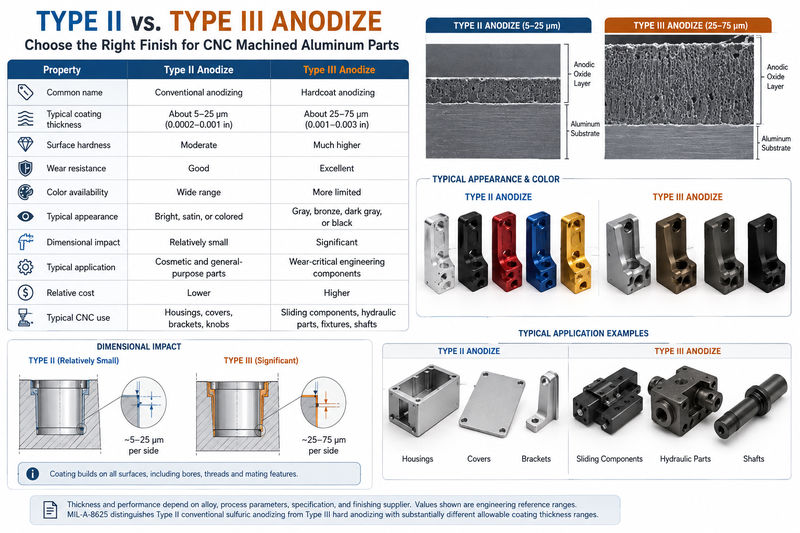
Both Type II and Type III anodizing are sulfuric-acid anodizing processes covered by the MIL-A-8625 family of specifications. Type II is generally used for conventional corrosion protection, appearance, and coloring, while Type III, commonly called hardcoat anodizing, is designed for applications where abrasion and wear resistance are much more important.
For CNC machined aluminum components, the choice becomes particularly important when the part contains precision bores, threaded holes, sliding surfaces, bearing seats, mating features, or tight dimensional tolerances.
| Property | Type II Anodize | Type III Anodize |
|---|---|---|
| Common name | Conventional anodizing | Hardcoat anodizing |
| Typical coating thickness | About 5–25 μm (0.0002–0.001 in) | About 25–75 μm (0.001–0.003 in) |
| Surface hardness | Moderate | Much higher |
| Wear resistance | Good | Excellent |
| Color availability | Wide range | More limited |
| Typical appearance | Bright, satin, or colored | Gray, bronze, dark gray, or black |
| Dimensional impact | Relatively small | Significant |
| Typical application | Cosmetic and general-purpose parts | Wear-critical engineering components |
| Relative cost | Lower | Higher |
| Typical CNC use | Housings, covers, brackets, knobs | Sliding components, hydraulic parts, fixtures, shafts |
The exact thickness and performance depend on the alloy, process parameters, specification, and finishing supplier. Therefore, these values should be treated as engineering reference ranges rather than universal guarantees. MIL-A-8625 specifically distinguishes Type II conventional sulfuric anodizing from Type III hard anodizing and provides substantially different allowable coating thickness ranges.
Type II vs. Type III Anodize: Thickness, Hardness, and Basic Differences
Type II Anodize Is Primarily a General-Purpose Finish
Type II anodizing is the conventional sulfuric acid anodizing process and is one of the most widely used finishes for CNC machined aluminum parts.
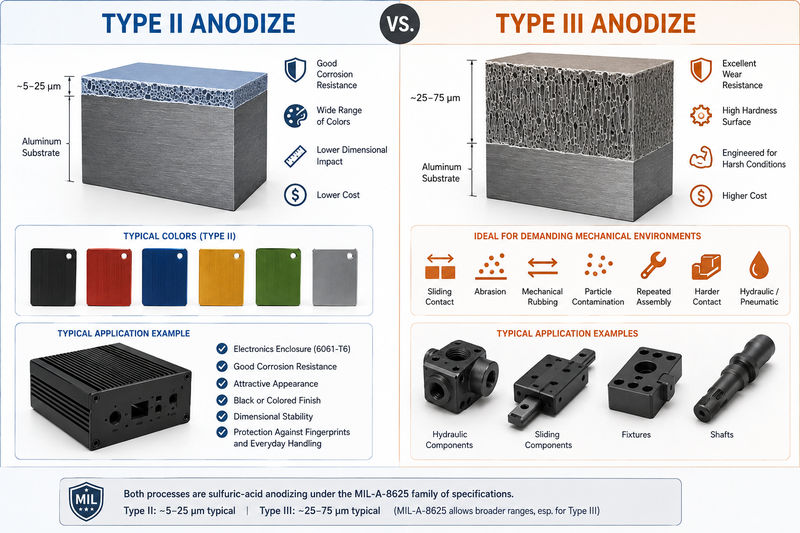
Its oxide layer is relatively thin compared with Type III. Typical Type II thickness is approximately 5–25 μm, although the exact specification may permit a wider range. This relatively thin coating provides a useful combination of corrosion resistance, surface protection, and decorative appearance without creating as much dimensional change as a hardcoat.
One major advantage is its ability to accept dyes. Depending on the aluminum alloy, surface preparation, dye, and process control, Type II anodizing can produce colors such as black, red, blue, gold, green, and other shades.
For example, consider a CNC-machined 6061-T6 aluminum electronics enclosure. The enclosure does not contain a sliding bearing surface and will not experience significant mechanical abrasion. The primary requirements may be:
- Good corrosion resistance
- Attractive appearance
- Black or other colored finish
- Reasonable dimensional stability
- Protection against fingerprints and everyday handling
Type II is generally a logical choice for this type of component.
Type III Anodize Creates a Much Thicker Engineering Surface
Type III anodizing, also known as hardcoat anodizing or hard anodizing, is intended for more demanding mechanical environments.
A typical Type III coating may be approximately 25–75 μm thick, with the exact value depending on the specification and application. MIL-A-8625 allows a substantially broader Type III thickness range, extending from approximately 0.0005 to 0.0045 inch.
The thicker oxide layer is especially valuable when aluminum parts experience:
- Sliding contact
- Repeated abrasion
- Mechanical rubbing
- Particle contamination
- Repeated assembly and disassembly
- Contact with harder components
- Hydraulic or pneumatic service
The important point is that Type III should not simply be described as “Type II but harder.” Its greater thickness, denser oxide structure, process conditions, and resulting surface characteristics make it a substantially different engineering finish.
Wear Resistance, Corrosion Protection, and Real-World Performance
Why Type III Is Preferred for Wear Surfaces
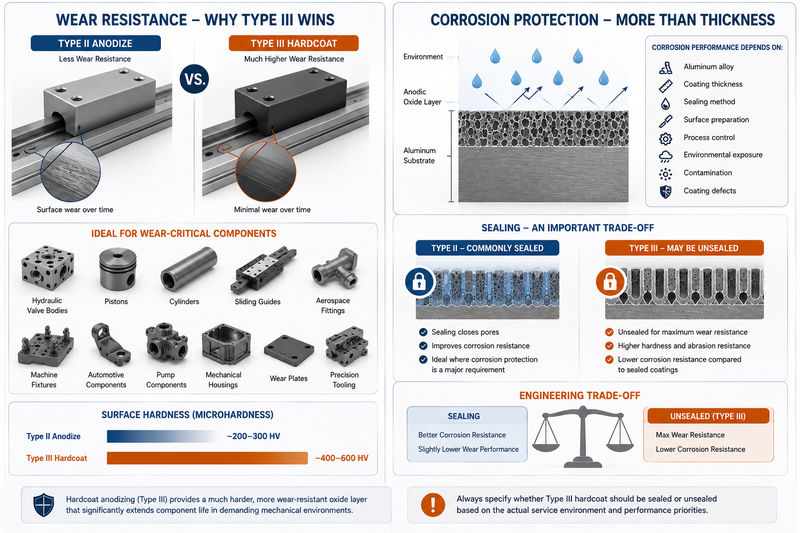
The biggest practical difference between Type II and Type III is usually wear resistance.
Aluminum itself is relatively soft compared with steel and many hardened engineering materials. If an untreated aluminum component repeatedly slides against steel, another aluminum component, or abrasive particles, the aluminum surface can wear relatively quickly.
Hardcoat anodizing creates an aluminum oxide surface that is significantly more resistant to abrasion.
For example, imagine a CNC-machined aluminum guide block that moves along a steel rail 10,000 times per day. A conventional Type II anodized surface may provide adequate protection in a lightly loaded environment, but if the contact pressure and sliding distance are high, the surface can eventually wear.
A properly specified Type III hardcoat can substantially improve the service life of the contact surface.
This is why Type III is frequently considered for components such as:
- Hydraulic valve bodies
- Pistons
- Cylinders
- Sliding guides
- Aerospace fittings
- Machine fixtures
- Automotive components
- Pump components
- Mechanical housings
- Wear plates
- Precision tooling
Industry references commonly report Type III microhardness in the approximate 400–600 HV range, although actual values depend strongly on alloy and process conditions. Type II coatings are generally lower, commonly around 200–300 HV in published engineering references.
Corrosion Resistance Is Important, but Thickness Alone Does Not Tell the Whole Story
Both Type II and Type III anodizing can improve aluminum’s corrosion resistance because the anodic oxide layer acts as a protective barrier.
However, corrosion performance also depends on:
- Aluminum alloy
- Coating thickness
- Sealing method
- Surface preparation
- Process control
- Environmental exposure
- Contamination
- Coating defects
Type II anodizing is commonly sealed after anodizing, especially where corrosion resistance is a major requirement. Type III may be left unsealed when maximum wear resistance is more important.
This creates an important engineering trade-off.
Sealing can improve corrosion resistance by reducing the permeability of the porous anodic layer, but sealing can also alter some surface characteristics. For a wear-critical hardcoat component, an engineer should therefore specify whether the Type III coating is sealed or unsealed rather than allowing the finishing supplier to make the decision automatically.
Example: Choosing the Finish for a Hydraulic Component
Suppose a CNC-machined 6061 aluminum hydraulic valve block has internal passages, mounting holes, and a machined sliding interface.
If the outside surface only needs corrosion protection and an attractive appearance, Type II may be sufficient.
If an internal or external surface repeatedly contacts another component and must resist abrasion, Type III becomes much more attractive.
In other words:
Type II protects and decorates. Type III protects while also functioning as a wear-resistant engineering surface.
Dimensional Growth and CNC Machining Tolerance Compensation
Anodizing Does Change the Size of a CNC Part
One of the most frequently overlooked issues when specifying anodizing is dimensional growth.
Anodizing is not simply a thin material painted onto the outside of the part. The aluminum surface is converted into an anodic oxide structure. As the oxide develops, part dimensions change.
For general Type II work, this dimensional change may be small enough that it does not cause problems for ordinary mechanical features.
Type III is different.
Because the hardcoat layer is much thicker, the dimensional change can become significant when working with precision bores, shafts, threads, slots, and mating surfaces.
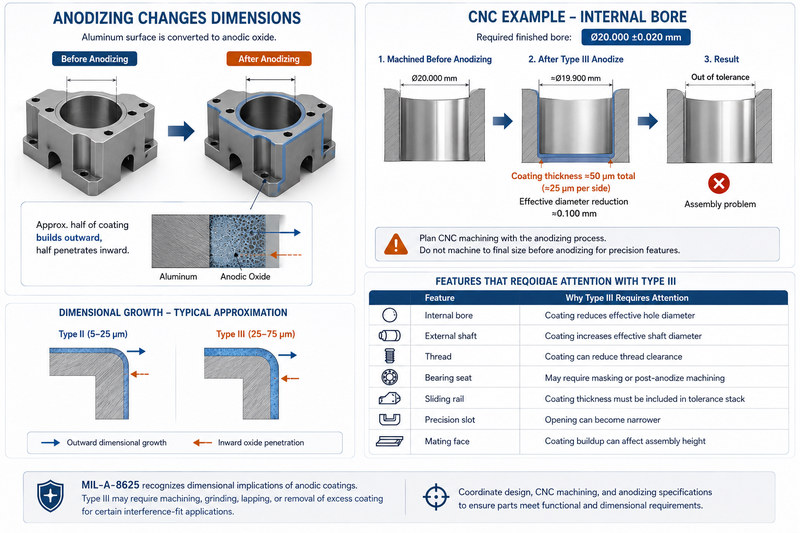
A commonly used engineering approximation is that roughly half of the coating thickness contributes to outward dimensional growth, while the remainder penetrates into the original aluminum surface. The exact behavior depends on alloy and process, so this should not replace supplier-controlled process data.
A Simple CNC Machining Example
Suppose a CNC aluminum component requires a finished internal bore of:
Ø20.000 ±0.020 mm
If the component will receive a Type III hardcoat with approximately 50 μm total coating thickness, simply machining the bore to the final dimension before anodizing can create an assembly problem.
If approximately half of the coating thickness contributes to dimensional buildup on each surface, the effective diameter reduction can be on the order of tens of microns.
For a general-purpose hole, that may be acceptable.
For a precision bearing bore, it may not be.
The CNC machining strategy should therefore be planned together with the anodizing process.
| Feature | Why Type III Requires Attention |
|---|---|
| Internal bore | Coating reduces effective hole diameter |
| External shaft | Coating increases effective shaft diameter |
| Thread | Coating can reduce thread clearance |
| Bearing seat | May require masking or post-anodize machining |
| Sliding rail | Coating thickness must be included in tolerance stack |
| Precision slot | Opening can become narrower |
| Mating face | Coating buildup can affect assembly height |
MIL-A-8625 also recognizes the dimensional implications of anodic coatings and specifically identifies Type III as a coating that can require machining, grinding, lapping, or removal of excess coating for certain interference-fit applications.
How CNC Machining and Hardcoat Anodizing Should Be Coordinated
For a precision Type III component, the correct workflow is not:
CNC machining → anodizing → hope the dimensions are correct.
A better workflow is:
Engineering drawing → coating specification → tolerance analysis → CNC machining allowance → anodizing → final inspection.
For example, if a bearing bore must remain within a tight tolerance after anodizing, the manufacturer may need to:
- Determine the required hardcoat thickness.
- Estimate dimensional buildup.
- Machine the pre-anodize bore accordingly.
- Mask critical surfaces if permitted.
- Anodize the part.
- Inspect the finished dimension.
- Perform controlled post-finishing operations if the specification allows them.
This is especially important for CNC components that use press fits, sliding fits, seals, bearings, or precision shafts.
Color, Surface Appearance, Sealing, and Material Compatibility
Type II Offers Much Better Color Flexibility
If appearance is a major requirement, Type II is usually the easier choice.
The porous structure produced during conventional sulfuric anodizing can absorb dyes effectively. This makes Type II suitable for consumer products, instrument housings, equipment panels, handles, brackets, and decorative CNC parts.
Common Type II colors include:
- Black
- Red
- Blue
- Gold
- Green
- Natural/clear
However, “black anodizing” is not a complete technical specification.
A drawing should ideally define the anodizing type, class, color requirement, thickness, and any appearance expectations.
For example:
MIL-A-8625, Type II, Class 2, Black
is much more informative than simply writing:
Black anodized aluminum
Type III Usually Has a Darker, Less Decorative Appearance
Type III hardcoat generally produces a darker and less vibrant appearance.
Natural hardcoat colors can range from gray to bronze and dark gray depending on the aluminum alloy and processing conditions. Black dye can also be used, but Type III black should not be expected to look exactly like Type II decorative black.
This difference becomes particularly obvious when comparing 6061 and 7075 aluminum.
Two parts manufactured with the same hardcoat process can have noticeably different shades because alloy composition affects anodizing behavior.
For customers who need a highly consistent cosmetic color across large production batches, alloy selection and process control should therefore be discussed before production.
Aluminum Alloy Has a Major Influence on Anodizing Results
Not every aluminum alloy anodizes in exactly the same way.
6061-T6 is widely regarded as one of the more predictable choices for CNC anodized parts, especially when both appearance and engineering performance are important.
7075 can also be anodized, but its alloying elements can influence color uniformity and appearance.
High-silicon cast aluminum alloys can be considerably more difficult for Type III hardcoat applications. Some published hardcoat guidance specifically notes that high-silicon die-cast alloys can have difficulty achieving thick, consistent hardcoat layers.
Therefore, when a customer specifies:
“Type III black anodized”
the CNC manufacturer should also ask:
“What aluminum alloy are you using?”
This question can prevent unexpected color, thickness, or performance problems later.
How to Choose Type II or Type III for Different CNC Aluminum Parts
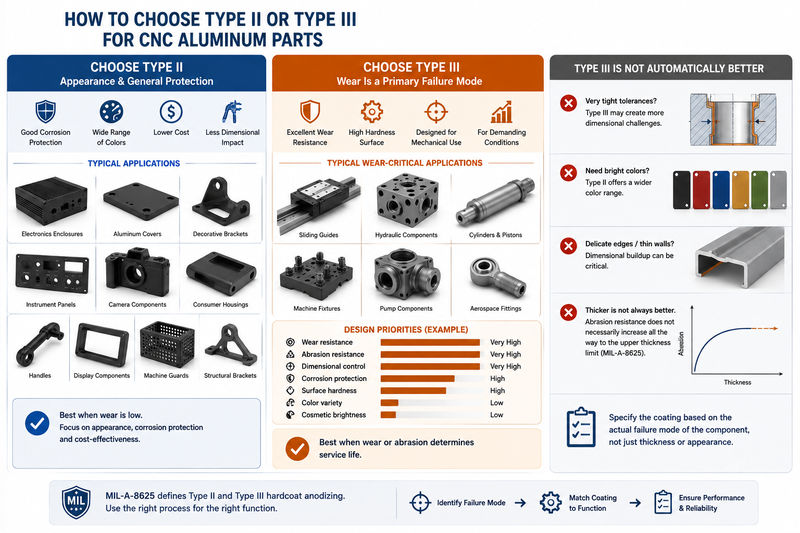
Choose Type II When Appearance and General Protection Matter Most
Type II is generally the better choice when the component does not experience severe mechanical wear.
Typical examples include:
- CNC electronics enclosures
- Aluminum covers
- Decorative brackets
- Instrument panels
- Camera components
- Consumer product housings
- Handles
- Display components
- General machine guards
- Lightweight structural brackets
For example, a CNC-machined aluminum enclosure for electronic equipment may need a black finish, corrosion resistance, and good appearance. It probably does not need a 50 μm hardcoat.
Using Type III in this situation may increase cost and create unnecessary dimensional complications without delivering a meaningful functional benefit.
Choose Type III When Wear Is a Primary Failure Mode
Type III becomes more appropriate when surface wear could determine the service life of the component.
Consider a CNC-machined aluminum sliding guide.
If the guide travels back and forth thousands or millions of times, surface abrasion becomes more important than cosmetic appearance.
In this case, the design priorities may look like this:
| Requirement | Priority |
|---|---|
| Wear resistance | Very high |
| Abrasion resistance | Very high |
| Dimensional control | Very high |
| Color variety | Low |
| Cosmetic brightness | Low |
| Corrosion protection | High |
| Surface hardness | High |
That profile strongly favors Type III.
Type III Is Not Automatically Better
A common mistake is assuming that Type III is always superior because it is thicker and harder.
That is not necessarily true.
If a part has very tight dimensional tolerances, a Type III coating may create more engineering challenges.
If the customer needs bright red, blue, gold, or green, Type II is generally more appropriate.
If the part has delicate edges, extremely thin walls, or features that cannot tolerate dimensional buildup, the coating specification must be reviewed carefully before production.
There is also no simple rule that says “thicker Type III is always better.” One published MIL-A-8625 reference notes that abrasion resistance does not necessarily continue increasing as hardcoat thickness approaches the upper end of the range.
The correct approach is to specify the coating based on the actual failure mode of the component.
Practical Type II vs. Type III Decision Guide
A simple engineering decision can be made by asking five questions.
Question 1: Does the part need a decorative color?
If yes, Type II is usually the first option to evaluate.
Question 2: Will the surface experience continuous sliding or abrasion?
If yes, Type III should be strongly considered.
Question 3: Does the part contain tight bores, threads, or bearing seats?
If yes, coating thickness and dimensional growth must be included in the CNC machining plan.
Question 4: Is the component exposed to a corrosive environment?
Both Type II and Type III can provide corrosion protection, but sealing requirements should be specified according to the operating environment.
Question 5: Is the aluminum alloy suitable for the required finish?
If the alloy is 6061-T6, both Type II and Type III are commonly considered. If the alloy is 7075, 2024, or a high-silicon casting alloy, appearance, thickness, and process limitations should be discussed with the anodizing supplier before production.
Recommended Drawing Callouts for CNC Anodizing
A vague drawing callout such as:
“Black anodize”
does not provide enough information for precision manufacturing.
A better callout identifies the anodizing type and other critical requirements.
For a conventional cosmetic component, a specification might identify:
MIL-A-8625, Type II, Class 2, Black
For a wear-critical component, the drawing might specify:
MIL-A-8625, Type III, Class 1, 0.002 in coating thickness
If the hardcoat must remain unsealed for wear performance, that requirement should also be explicitly stated.
The exact drawing callout should always follow the applicable revision of the customer’s required specification and the agreement between the designer, CNC manufacturer, and finishing supplier. MIL-A-8625 guidance recommends that coating thickness be specifically identified in purchase documents or drawings.
Type II vs. Type III Anodize: A CNC Manufacturer’s Final Recommendation
For CNC machined aluminum parts, Type II and Type III anodizing should be viewed as two different engineering solutions rather than two versions of the same cosmetic finish.
Type II is usually the practical choice when you need:
- Attractive appearance
- Multiple color options
- General corrosion protection
- Moderate surface protection
- Lower finishing cost
- Less dimensional impact
Type III is the stronger candidate when you need:
- High wear resistance
- Abrasion resistance
- A thick protective oxide layer
- Better performance on sliding or rubbing surfaces
- Increased surface durability
- Protection for demanding industrial environments
The most important consideration is not simply whether Type III is “better.” The correct question is:
What does the aluminum part need to survive during actual service?
If the component is mainly exposed to handling, moisture, and cosmetic requirements, Type II is often the more economical and practical solution. If the component is continuously exposed to friction, abrasion, mechanical contact, or harsh operating conditions, Type III hardcoat can provide a much more suitable surface.
At Xavier, we approach anodizing as part of the CNC manufacturing process rather than as an isolated finishing step. Our team can evaluate the aluminum alloy, machining tolerances, critical features, coating thickness, surface requirements, and intended application before production. For precision components requiring Type II or Type III anodizing, coordinating CNC machining allowances with the finishing process helps reduce dimensional problems and ensures the finished parts meet the functional requirements of the design.
When you are unsure whether your project requires conventional Type II anodizing or Type III hardcoat, providing the 3D model, 2D drawing, aluminum alloy, required color, critical tolerances, and application conditions gives the CNC manufacturer enough information to recommend the appropriate finishing process.
We are an integrated trading and manufacturing company specializing in CNC machining services, with a strong focus on custom CNC machining and the production of precision metal components. Our capabilities include CNC machining aluminum, CNC machining PEEK, and CNC machining titanium, along with a wide range of other metals and engineering plastics. We provide machining solutions for robot components, aerospace parts, marine components, automotive parts, medical components, and other precision-engineered parts.
CNC machining aluminum manufacturer, offering high-volume CNC machining PEEK services, and contact us for CNC machining titanium pricing. Feel free to contact us to discuss your machining requirements.
Some of the images and text in this article are collected and compiled from the internet. If there is anything inappropriate, please contact us for processing.