
How Much to Get a Metal Part Made: CNC Machining Price Factors Explained
Key Points of This Article:
1. Factors That Determine the Cost of Making a Metal Part
Users mainly want to understand why metal part prices vary significantly. Manufacturing companies usually explain cost factors such as material, machining time, complexity, tolerance, tooling, and labor.
2. Material Selection and Its Impact on Metal Part Manufacturing Cost
Metal type is one of the largest cost drivers. Aluminum, stainless steel, titanium, brass, and specialty alloys have different raw material prices and machining difficulties.
3. Manufacturing Process Options and Their Price Differences
The manufacturing method directly affects cost. CNC machining, sheet metal fabrication, casting, forging, and metal 3D printing all have different cost structures.
4. Quantity, Tolerance and Part Complexity Affecting Manufacturing Cost
Production volume, precision requirements, and geometric complexity strongly influence unit price. A prototype part and a 10,000-piece production order can have completely different pricing.
5. Additional Finishing and Post-Processing Costs
Surface treatments such as anodizing, plating, polishing, heat treatment, and coating can add significant value and cost to a finished metal component.
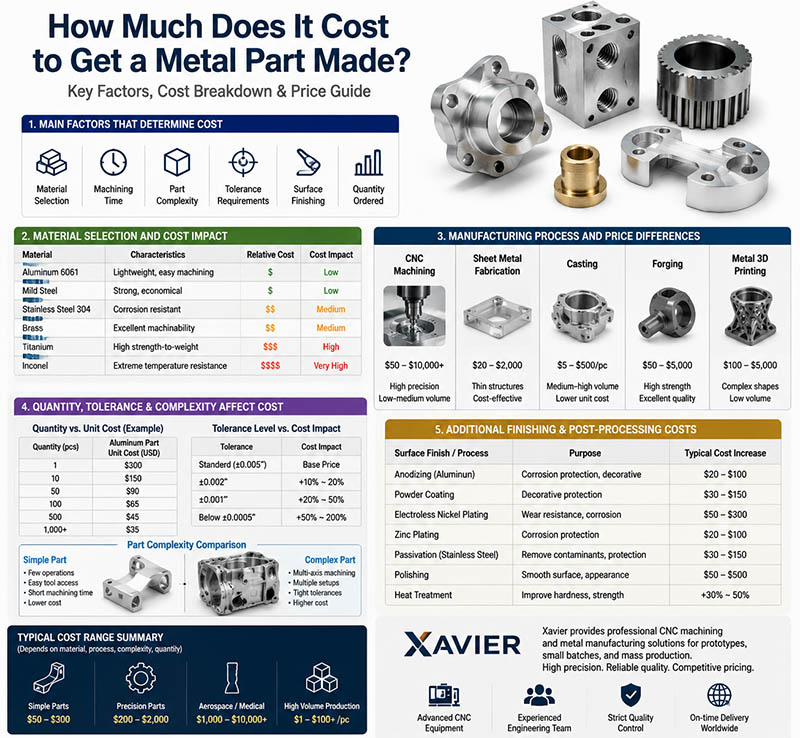
How Much Does It Cost to Get a Metal Part Made?
When companies need a custom metal component, one of the first questions they ask is: “How much does it cost to get a metal part made?”
The answer is not a fixed number because metal part manufacturing costs depend on multiple engineering and production factors. A simple aluminum bracket may cost only a few dollars, while a complex aerospace titanium component can cost hundreds or even thousands of dollars.
For most custom metal parts, the typical price range is:
| Part Type | Typical Cost Range |
|---|---|
| Simple machined metal prototype | $50 – $300 |
| Small CNC metal component | $30 – $500 per piece |
| Precision industrial part | $200 – $2,000 per piece |
| Complex aerospace or medical component | $1,000 – $10,000+ per piece |
| High-volume production parts | $1 – $100+ per piece depending on quantity |
The actual manufacturing cost depends on the design requirements, selected material, production process, order quantity, and finishing requirements.
Understanding these cost factors helps engineers make better decisions before requesting a manufacturing quote.
Factors That Determine the Cost of Making a Metal Part
The cost of manufacturing a metal part is calculated based on several direct and indirect production expenses. Professional manufacturers normally evaluate the entire manufacturing process instead of only calculating raw material costs.
A common misunderstanding is that the price of a metal component equals the weight of the material used. In reality, machining time, programming, tooling, inspection, and finishing often represent a much larger portion of the final price.
The basic cost structure can be divided as follows:
| Cost Factor | Approximate Influence on Total Cost |
|---|---|
| Material cost | 10%-30% |
| CNC machining time | 30%-60% |
| Programming and setup | 10%-25% |
| Tooling and fixtures | 5%-20% |
| Surface finishing | 5%-30% |
| Inspection and quality control | 5%-15% |
These percentages vary depending on part complexity and production volume.
Material Cost Is the Starting Point of Metal Part Pricing
The first factor manufacturers evaluate is the raw material required to produce the component.
Different metals have different market prices, machining characteristics, and waste rates.
For example:
| Material | Typical Characteristics | Relative Cost |
|---|---|---|
| Aluminum 6061 | Lightweight, easy machining | Low |
| Mild Steel | Strong and economical | Low |
| Stainless Steel 304 | Corrosion resistant | Medium |
| Brass | Excellent machinability | Medium |
| Titanium | Lightweight and high strength | High |
| Inconel | Extreme temperature resistance | Very High |
A small aluminum CNC component may use only $5-$10 worth of raw material, but the same design produced from titanium may require $50-$100 or more in material.
However, material cost is not only determined by purchase price. Manufacturers must also consider:
- Material availability
- Minimum order quantity
- Material waste
- Machining difficulty
- Tool wear
- Scrap rate
For example, titanium is expensive not only because the raw material costs more, but also because it requires slower cutting speeds and specialized tooling.
Machining Time Has the Biggest Impact on CNC Metal Part Cost
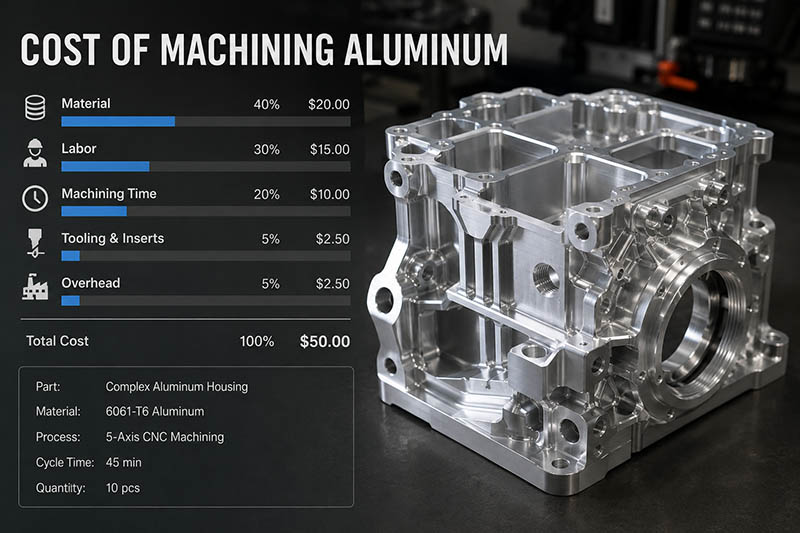
For CNC machined metal parts, machining time is usually the largest contributor to manufacturing cost.
A CNC machine charges based on the time required to complete operations such as:
- Milling
- Turning
- Drilling
- Threading
- Boring
- Surface finishing
A simple cylindrical aluminum spacer may require only 10 minutes of machining.
However, a complex five-axis aerospace component with deep pockets, thin walls, and tight tolerances may require several hours of machining.
Example:
| Part Example | Machining Time | Estimated CNC Cost |
|---|---|---|
| Aluminum spacer | 10 minutes | $20-$50 |
| Stainless steel bracket | 1 hour | $80-$200 |
| Precision gearbox housing | 5-8 hours | $500-$1,500 |
| Titanium aerospace structure | 15+ hours | $2,000+ |
The longer the machine runs, the higher the cost becomes.
Manufacturers also consider machine type:
| Machine Type | Typical Application | Cost Level |
|---|---|---|
| 3-axis CNC milling | Simple parts | Lower |
| CNC turning | Round components | Medium |
| 4-axis machining | More complex geometry | Higher |
| 5-axis machining | Aerospace precision parts | Highest |
A major reason why design optimization matters is that reducing machining time directly reduces manufacturing costs.
Part Design Complexity Directly Influences Manufacturing Price
A metal part with a simple shape is significantly cheaper to manufacture than a complex precision component.
Manufacturers evaluate:
- Number of setups
- Number of machining operations
- Internal cavities
- Thin walls
- Deep pockets
- Complex curves
- Difficult-to-access areas
For example:
A rectangular aluminum plate with four holes can usually be completed in one setup.
A turbine impeller requires:
- Multi-axis machining
- Complex tool paths
- Advanced programming
- Multiple inspections
The manufacturing cost can increase by 10 times or more.
The following comparison shows how design complexity changes pricing:
| Design Feature | Cost Impact |
|---|---|
| Simple holes | Low |
| Multiple pockets | Medium |
| Tight internal channels | High |
| Curved freeform surfaces | High |
| Micron-level tolerance | Very High |
Engineers can reduce costs by designing parts according to manufacturing principles, such as:
- Avoiding unnecessary tight tolerances
- Reducing deep cavities
- Using standard tool sizes
- Simplifying part geometry
Tolerance Requirements Increase Manufacturing Costs
Tolerance refers to the allowable variation in a part’s dimensions.
For example:
A general machining tolerance may be:
±0.005 inch (±0.127 mm)
A precision component may require:
±0.0005 inch (±0.0127 mm)
Achieving tighter tolerances requires:
- More accurate machines
- Additional machining operations
- Better inspection equipment
- Controlled temperature environments
- More experienced operators
Example:
| Tolerance Requirement | Typical Cost Effect |
|---|---|
| Standard tolerance | Base price |
| ±0.002 inch | +10%-20% |
| ±0.001 inch | +20%-50% |
| Below ±0.0005 inch | +50%-200% |
For industries such as aerospace, medical devices, and semiconductor equipment, precision requirements are often necessary. However, unnecessary ultra-tight tolerances can increase costs without improving product performance.
Material Selection and Its Impact on Metal Part Manufacturing Cost
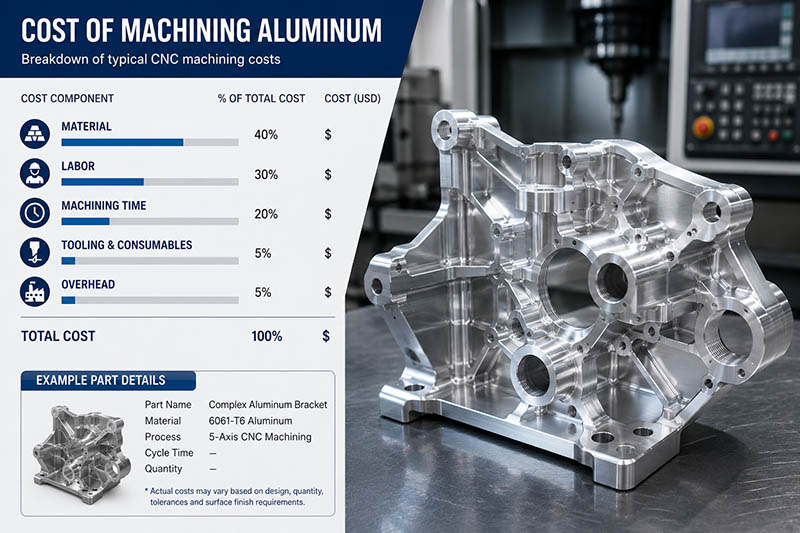
The material chosen for a metal part has a direct influence on the final manufacturing price. Many engineers focus only on the initial material purchase price, but professional manufacturers evaluate the complete cost impact, including machining difficulty, tool consumption, production speed, heat treatment requirements, and finishing compatibility.
Two metal parts with identical dimensions can have completely different manufacturing costs because the materials behave differently during machining.
For example, producing a small mechanical bracket from aluminum 6061 may cost $80, while producing the same bracket from titanium may cost several hundred dollars due to slower cutting speeds, expensive tooling, and longer machining cycles.
A professional manufacturer normally considers the following material-related factors:
| Material Cost Factor | Effect on Manufacturing Cost |
|---|---|
| Raw material price | Direct increase or decrease |
| Material hardness | Affects machining speed |
| Cutting tool wear | Increases production expenses |
| Heat resistance | Influences machining difficulty |
| Material availability | Impacts purchasing cost |
| Scrap value | Affects overall waste cost |
Aluminum Parts Usually Have Lower Manufacturing Costs
Aluminum is one of the most popular materials for custom metal parts because it provides a good balance between strength, weight, corrosion resistance, and machinability.
Common aluminum grades used in CNC machining include:
- Aluminum 6061
- Aluminum 7075
- Aluminum 5052
- Aluminum 2024
Among these, aluminum 6061 is widely used because it is easy to machine and suitable for many industrial applications.
Typical aluminum applications include:
- Automotive components
- Electronic housings
- Robotics parts
- Heat sinks
- Aerospace brackets
- Consumer products
Example cost comparison:
| Aluminum Part Type | Estimated Manufacturing Cost |
|---|---|
| Simple mounting plate | $50-$150 |
| CNC enclosure | $200-$600 |
| Complex aluminum aerospace bracket | $500-$2,000 |
Although aluminum material itself is relatively affordable, complex designs can still become expensive because machining time remains the dominant cost factor.
Stainless Steel Manufacturing Costs More Due to Machining Difficulty
Stainless steel is widely used when corrosion resistance, durability, and strength are required.
Common grades include:
- Stainless steel 304
- Stainless steel 316
- Stainless steel 17-4 PH
Compared with aluminum, stainless steel is harder and requires slower machining speeds.
The higher cost comes from:
- Longer cutting time
- Increased tool wear
- More expensive cutting tools
- Additional finishing requirements
For example:
A stainless steel component that takes 30 minutes to machine from aluminum may require 60-90 minutes when produced from stainless steel.
Cost comparison:
| Material | Machining Difficulty | Relative Manufacturing Cost |
|---|---|---|
| Aluminum 6061 | Easy | $ |
| Mild Steel | Medium | $$ |
| Stainless Steel 304 | Medium-Hard | $$$ |
| Titanium | Difficult | |
| Inconel | Extremely Difficult | $ |
Stainless steel is commonly selected for:
- Medical equipment
- Food processing machinery
- Marine components
- Industrial valves
- Chemical equipment
Titanium and Specialty Alloys Create High-Cost Metal Parts
Titanium and nickel-based alloys are among the most expensive materials used in precision manufacturing.
Titanium is valued because it offers:
- High strength-to-weight ratio
- Excellent corrosion resistance
- High temperature performance
However, titanium machining is challenging because:
- It generates significant heat during cutting
- It reacts with cutting tools
- It requires slower feed rates
- It increases tool replacement frequency
A titanium component may cost 3-10 times more than an aluminum equivalent.
Example:
| Component | Aluminum Version | Titanium Version |
|---|---|---|
| Aerospace bracket | $300 | $1,200-$2,500 |
| Lightweight structural part | $500 | $2,000+ |
| Medical implant component | Not common | $1,000-$5,000 |
Nickel alloys such as Inconel are even more expensive because they are designed for extreme environments.
Applications include:
- Aircraft engines
- Gas turbines
- Chemical processing equipment
- High-temperature systems
Manufacturing Process Options and Their Price Differences
The manufacturing method selected for a metal part has a major influence on cost.
A common mistake is assuming CNC machining is always the cheapest solution. In reality, the best manufacturing process depends on:
- Required quantity
- Part complexity
- Material
- Accuracy requirements
- Production timeline
Different manufacturing methods have different cost structures.
| Manufacturing Process | Best For | Typical Cost Range |
|---|---|---|
| CNC machining | Precision custom parts | $50-$10,000+ |
| Sheet metal fabrication | Thin metal structures | $20-$2,000 |
| Metal casting | Large volume parts | $5-$500/unit |
| Forging | High-strength components | $50-$5,000 |
| Metal 3D printing | Complex prototypes | $100-$5,000 |
CNC Machining Cost Structure for Custom Metal Parts
CNC machining is one of the most common methods for producing custom metal components.
The process uses computer-controlled machines to remove material from a metal block or bar stock.
The total CNC machining cost usually includes:
| CNC Cost Element | Description |
|---|---|
| CAD programming | Creating machining instructions |
| Machine setup | Installing tools and fixtures |
| Cutting time | Actual production time |
| Tool consumption | Cutting inserts and drills |
| Inspection | Measuring final dimensions |
For low-volume production, CNC machining is often the most economical choice because there is little upfront tooling investment.
Example:
A company needs 10 custom aluminum housings.
CNC machining:
- Programming: $100
- Setup: $150
- Machining: $80 each
- Finishing: $20 each
Total:
$100 + $150 + ($80 × 10) + ($20 × 10)
= $1,350 total
Unit price:
$135 per part
CNC Machining vs Casting: Which One Costs Less?
Casting becomes more economical when production quantities increase.
For example:
A company needs 10,000 identical aluminum housings.
CNC machining:
- High machining time
- Large material waste
- Higher labor cost
Casting:
- Mold cost required initially
- Lower unit cost afterward
Comparison:
| Quantity | CNC Machining | Casting |
|---|---|---|
| 1-50 pcs | Better choice | Expensive |
| 100-1,000 pcs | Depends on design | Competitive |
| 10,000+ pcs | Expensive | Usually cheaper |
A casting mold may cost several thousand dollars, but the unit price can drop significantly during mass production.
Sheet Metal Fabrication Can Reduce Costs for Certain Designs
Sheet metal manufacturing is suitable for parts made from thin metal sheets.
Typical processes include:
- Laser cutting
- Bending
- Welding
- Punching
- Riveting
Common applications:
- Electrical cabinets
- Machine covers
- Metal brackets
- Chassis panels
A sheet metal enclosure may cost only $50-$200 because the manufacturing process requires less material removal compared with CNC machining.
However, sheet metal is not suitable for parts requiring:
- Complex 3D shapes
- Tight machining tolerances
- Internal cavities
- Precision mechanical interfaces
Metal 3D Printing Is Valuable for Complex Low-Volume Parts
Metal additive manufacturing has become an alternative option for certain specialized applications.
Technologies include:
- Direct Metal Laser Sintering (DMLS)
- Selective Laser Melting (SLM)
- Electron Beam Melting (EBM)
Advantages:
- Produces complex geometries
- Reduces material waste
- Eliminates traditional tooling
However, the cost remains high because:
- Equipment investment is expensive
- Powder materials are costly
- Post-processing is required
Metal 3D printing is mainly used for:
- Aerospace lightweight structures
- Medical implants
- Research prototypes
- Complex internal channels
For a one-off complex titanium part, additive manufacturing may actually be cheaper than creating expensive machining fixtures.
Quantity, Tolerance and Part Complexity Affecting Manufacturing Cost
The quantity of metal parts required has one of the biggest impacts on the final unit price. A single prototype part and a production order of thousands of pieces may use the same material and design, but their manufacturing costs can be completely different.
Manufacturers calculate pricing based on both fixed costs and variable costs.
Fixed costs include:
- CAD programming
- Machine setup
- Tool preparation
- Fixture design
- Engineering review
- Inspection planning
Variable costs include:
- Raw material consumption
- Machine running time
- Cutting tools
- Labor
- Finishing processes
When production quantity increases, fixed costs are distributed across more parts, reducing the average cost per piece.
Prototype Metal Parts Usually Have the Highest Unit Cost
Prototype manufacturing involves producing a small number of parts, sometimes only one piece.
Although the material quantity is small, the preparation cost remains almost the same as a larger production order.
For example:
A CNC manufacturer receives an order for one custom aluminum component.
Cost calculation:
| Cost Item | Amount |
|---|---|
| CAD programming | $120 |
| Machine setup | $150 |
| Material | $30 |
| Machining | $180 |
| Inspection | $50 |
| Total | $530 |
The first prototype costs $530.
However, if the customer orders 100 identical parts:
| Cost Item | Total Cost |
|---|---|
| Programming | $120 |
| Setup | $150 |
| Material | $3,000 |
| Machining | $18,000 |
| Inspection | $500 |
| Total | $21,770 |
Unit price:
$21,770 ÷ 100 = $217.70 per piece
The production quantity reduces the unit cost by more than 50%.
Small Batch Production Provides a Balance Between Cost and Flexibility
Small batch manufacturing usually refers to quantities between:
- 10 pieces
- 100 pieces
- 1,000 pieces
This production method is popular among:
- Product developers
- Engineering companies
- Industrial equipment manufacturers
- Robotics companies
- Startups
Advantages include:
- Lower inventory risk
- Faster product improvements
- No expensive molds required
- Suitable for customized designs
Example:
A robotics company needs 50 precision aluminum joints.
CNC machining may be the ideal choice because:
- No injection mold is required
- Design changes are easy
- Each component can be inspected individually
Estimated pricing:
| Quantity | Aluminum CNC Part Cost |
|---|---|
| 1 piece | $300 |
| 10 pieces | $150 each |
| 50 pieces | $90 each |
| 500 pieces | $45 each |
The larger the order quantity, the lower the average production cost becomes.
Mass Production Can Reduce Metal Part Costs Significantly
For high-volume production, manufacturers often optimize every step of the process.
Cost reduction methods include:
- Automated loading systems
- Dedicated fixtures
- Multi-spindle machines
- Faster tooling strategies
- Batch processing
For example, an automotive manufacturer may produce 100,000 metal components annually.
The manufacturing cost may decrease from:
$20 per part → $3 per part
because:
- Setup costs are spread over more units
- Machines run continuously
- Operators handle multiple parts simultaneously
However, mass production usually requires:
- Higher upfront investment
- Strict quality control systems
- Production planning
How Part Complexity Changes Metal Manufacturing Cost
Part complexity is one of the most underestimated cost factors.
Two components with identical dimensions can have completely different prices because their shapes require different manufacturing strategies.
Manufacturers analyze:
- Number of machining operations
- Tool accessibility
- Required machine axes
- Internal features
- Surface requirements
- Inspection difficulty
Simple Metal Parts Are Usually Less Expensive
Simple parts normally include:
- Flat plates
- Shafts
- Spacers
- Brackets
- Simple housings
Example:
A CNC aluminum mounting plate:
Features:
- 100 mm × 80 mm size
- Four drilled holes
- Basic tolerance
- No special finishing
Manufacturing process:
- Cut raw material
- Mill outer dimensions
- Drill holes
- Deburr edges
Estimated cost:
$50-$150 per piece.
Complex Precision Parts Require More Manufacturing Operations
Complex components may require:
- Multiple setups
- 5-axis machining
- Custom tooling
- Advanced programming
- Detailed inspection
Examples:
- Turbine blades
- Medical implants
- Robot joints
- Aerospace structural components
- Hydraulic valve bodies
A complex part may require:
| Manufacturing Stage | Time |
|---|---|
| Engineering review | 2 hours |
| CAM programming | 5 hours |
| Machine setup | 1 hour |
| CNC machining | 12 hours |
| Inspection | 3 hours |
Total production preparation can exceed 20 hours.
This explains why a small precision metal component can cost hundreds or thousands of dollars despite using only a small amount of material.
Tight Tolerances Increase Inspection and Manufacturing Expenses
Precision requirements directly affect cost.
Manufacturers use advanced inspection equipment such as:
- Coordinate Measuring Machines (CMM)
- Optical measurement systems
- Surface roughness testers
- Digital microscopes
A normal industrial part may only require basic measurement.
A medical or aerospace component may require:
- Full dimensional inspection reports
- Material certification
- Process documentation
- Traceability records
Example:
| Requirement | Cost Impact |
|---|---|
| Standard tolerance | Base cost |
| Precision machining | +20%-50% |
| Aerospace tolerance | +50%-150% |
| Medical-grade inspection | +30%-100% |
Therefore, specifying only necessary tolerances is one of the best ways to control manufacturing costs.
Additional Finishing and Post-Processing Costs
Many metal parts require additional surface treatments after machining.
These processes improve:
- Corrosion resistance
- Appearance
- Wear resistance
- Electrical properties
- Surface hardness
However, finishing processes add extra manufacturing costs.
Common finishing options include:
| Surface Finish | Purpose | Typical Cost Increase |
|---|---|---|
| Anodizing | Aluminum protection | $20-$100 |
| Powder coating | Decorative protection | $30-$150 |
| Electroless nickel plating | Wear resistance | $50-$300 |
| Zinc plating | Corrosion protection | $20-$100 |
| Passivation | Stainless steel protection | $30-$150 |
| Polishing | Smooth appearance | $50-$500 |
Anodizing Costs for Aluminum Parts
Anodizing is one of the most common finishes for aluminum CNC components.
Benefits:
- Improved corrosion resistance
- Better surface hardness
- Decorative colors
- Longer service life
Typical applications:
- Consumer electronics
- Aerospace brackets
- Camera components
- Machine parts
Example:
A CNC aluminum enclosure:
Machining cost:
$150
Anodizing cost:
+$40
Final cost:
$190
The finishing process adds value but does not usually dominate the total cost.
Plating Costs Depend on Surface Requirements
Metal plating is commonly used when parts require:
- Electrical conductivity
- Improved wear resistance
- Corrosion protection
Examples:
Electroless Nickel Plating
Used for:
- Precision mechanical components
- Hydraulic parts
- Industrial equipment
Advantages:
- Uniform coating thickness
- Excellent hardness
- Good corrosion resistance
Zinc Plating
Used for:
- Steel fasteners
- Automotive components
- General industrial parts
Advantages:
- Affordable corrosion protection
- Suitable for high-volume production
Heat Treatment Can Increase Metal Part Performance and Cost
Some applications require stronger mechanical properties.
Heat treatment processes include:
- Hardening
- Tempering
- Annealing
- Aging
Common materials requiring heat treatment:
- Tool steel
- Stainless steel
- Aluminum alloys
- Titanium alloys
Heat treatment adds cost because it requires:
- Additional processing time
- Specialized equipment
- Quality testing
For example:
A hardened steel gear may cost 30%-50% more than a standard machined steel gear.
However, the improved strength and durability may significantly extend product life.
How Much Should You Expect to Pay for a Custom Metal Part?
A realistic price estimate depends on the combination of all factors discussed above.
Typical examples:
| Application | Material | Quantity | Estimated Cost |
|---|---|---|---|
| Aluminum prototype bracket | Aluminum 6061 | 1-5 pcs | $100-$500 |
| Stainless steel machine component | SS304 | 10-100 pcs | $200-$1,000 |
| Precision robot part | Aluminum/Steel | 50-500 pcs | $50-$300 each |
| Aerospace titanium component | Titanium | 1-20 pcs | $1,000-$10,000+ |
To receive an accurate quotation, manufacturers usually need:
- 3D CAD file
- 2D drawing
- Material specification
- Quantity requirement
- Surface finish requirement
- Tolerance information
Choosing the Right Manufacturer for Custom Metal Parts
Selecting a manufacturer is not only about finding the lowest price.
A reliable supplier should provide:
- Engineering support
- Material options
- Quality inspection
- Stable production capability
- Clear communication
- Experience with complex components
A low quotation may sometimes indicate:
- Limited inspection capability
- Lower-grade materials
- Poor process control
- Lack of manufacturing experience
For critical applications, manufacturing quality is often more important than the initial price.
Custom Metal Part Manufacturing With Xavier
When companies need reliable custom metal parts, Xavier provides professional CNC machining and metal manufacturing solutions for prototypes, small batches, and production components.
With experience in precision CNC machining, Xavier supports a wide range of materials including aluminum, stainless steel, titanium, brass, copper, and engineering plastics. The company focuses on producing accurate and durable components for industries such as automation, robotics, aerospace, medical equipment, and industrial machinery.
From simple brackets to complex precision-machined parts, Xavier helps customers optimize designs, select suitable materials, control manufacturing costs, and achieve consistent quality.
By combining advanced CNC equipment, experienced engineers, and strict quality control processes, Xavier delivers cost-effective custom metal part manufacturing solutions based on each customer’s specific requirements.
We are an integrated CNC machining manufacturer specializing in custom CNC machining services and precision metal parts manufacturing. With extensive experience in CNC machining various metal components, we provide reliable production solutions and support advanced finishing processes, including CNC anodizing surface finishing, CNC electrogalvanizing surface treatment, and CNC electropolishing surface finishing.
As a professional CNC anodizing surface finishing manufacturer, we provide high-quality CNC electrogalvanizing surface treatment services and offer competitive CNC electropolishing surface finishing prices for customers worldwide. Contact us today for customized CNC machining and surface finishing solutions.
Some of the images and text in this article are collected and compiled from the internet. If there is anything inappropriate, please contact us for processing.