
Automotive Component Weight Reduction Methods: Practical Engineering Strategies for Lightweight Vehicle Design
Vehicle lightweighting has become one of the most important engineering objectives in modern automotive manufacturing. Whether developing internal combustion vehicles, hybrid systems, or electric vehicles, reducing component weight directly improves fuel efficiency, extends battery range, enhances acceleration, lowers emissions, and improves overall vehicle dynamics.
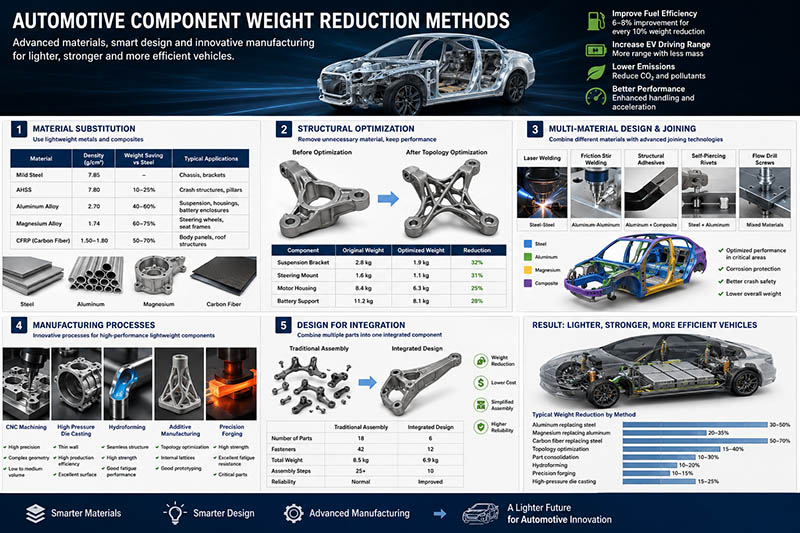
According to numerous automotive engineering studies, reducing total vehicle weight by approximately 10% can improve fuel economy by 6–8%, while battery electric vehicles can gain additional driving range through mass reduction alone. For this reason, automakers increasingly invest in lightweight materials, optimized structural designs, advanced manufacturing processes, and integrated component development.
The following sections explain the most effective automotive component weight reduction methods currently adopted across the industry.
Material Substitution with Lightweight Metals and Composites
Material replacement remains the fastest and most effective method for reducing automotive component weight. Instead of redesigning an entire assembly, engineers often substitute conventional materials with alternatives offering higher specific strength and lower density.
Comparison of Common Lightweight Materials
| Material | Density (g/cm³) | Relative Weight Saving vs Steel | Typical Automotive Applications |
|---|---|---|---|
| Mild Steel | 7.85 | Baseline | Chassis, brackets |
| AHSS | 7.80 | 10–25% | Crash structures, pillars |
| Aluminum 6061/7075 | 2.70 | 40–60% | Suspension, housings, battery enclosures |
| Magnesium AZ91 | 1.74 | 60–75% | Steering wheels, seat frames |
| CFRP | 1.50–1.80 | 50–70% | Supercar body panels, roof structures |
Although aluminum is only about one-third the density of steel, replacing steel directly is not always feasible. Aluminum has a lower elastic modulus, meaning thicker sections may be required to achieve comparable stiffness. Consequently, engineers redesign the geometry rather than simply exchanging materials.
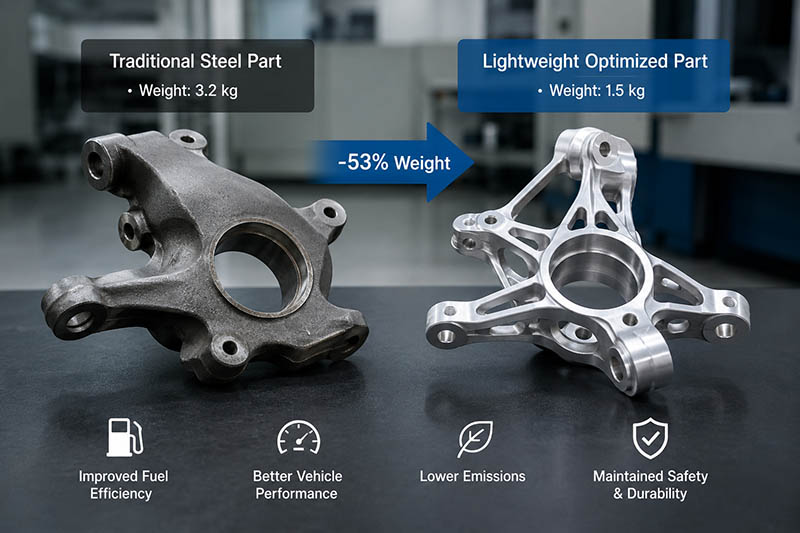
For example, an aluminum suspension knuckle can reduce component weight by nearly 45% while maintaining comparable mechanical performance after topology optimization.
Magnesium offers even greater weight savings, but its susceptibility to corrosion, lower fatigue resistance, and higher material cost restrict large-scale applications.
Carbon fiber composites provide the highest strength-to-weight ratio but remain concentrated in premium vehicles because of long production cycles and expensive raw materials.
Material Selection Example
| Component | Traditional Material | Lightweight Alternative |
|---|---|---|
| Engine Mount | Cast Iron | Aluminum Alloy |
| Battery Tray | Steel | Extruded Aluminum |
| Seat Frame | Mild Steel | AHSS |
| Hood Panel | Steel | Aluminum Sheet |
| Driveshaft | Steel | Carbon Fiber Composite |
The most successful lightweight designs rarely rely on one material alone. Instead, modern vehicles combine steel, aluminum, magnesium, and composites according to each component’s loading conditions.
Structural Optimization Through Topology Design
Material selection alone cannot achieve maximum weight reduction. Structural optimization often produces equal or greater savings without compromising safety.
Topology optimization uses computer algorithms to determine where material is structurally necessary and where it can be removed.
Typical Topology Optimization Workflow
- Define design space
- Apply loading conditions
- Set displacement constraints
- Run finite element analysis
- Remove low-stress material
- Convert optimized geometry into manufacturable CAD
- Validate through simulation and testing
Instead of beginning with the existing component geometry, engineers define the maximum allowable design volume. Optimization software gradually removes unnecessary material until the desired stiffness-to-weight ratio is achieved.
This often produces organic-looking structures resembling bone tissue because material naturally concentrates along primary load paths.
Example Weight Reduction
| Component | Original Weight | Optimized Weight | Reduction |
|---|---|---|---|
| Suspension Bracket | 2.8 kg | 1.9 kg | 32% |
| Steering Mount | 1.6 kg | 1.1 kg | 31% |
| Motor Housing | 8.4 kg | 6.3 kg | 25% |
| Battery Support | 11.2 kg | 8.1 kg | 28% |
Modern optimization software also considers manufacturing constraints, ensuring the resulting geometry can be machined, forged, cast, or produced using additive manufacturing.
Topology optimization has become particularly valuable for EV battery trays, chassis crossmembers, and suspension systems, where every kilogram saved contributes directly to vehicle efficiency.
Multi-Material Component Design and Joining Technologies
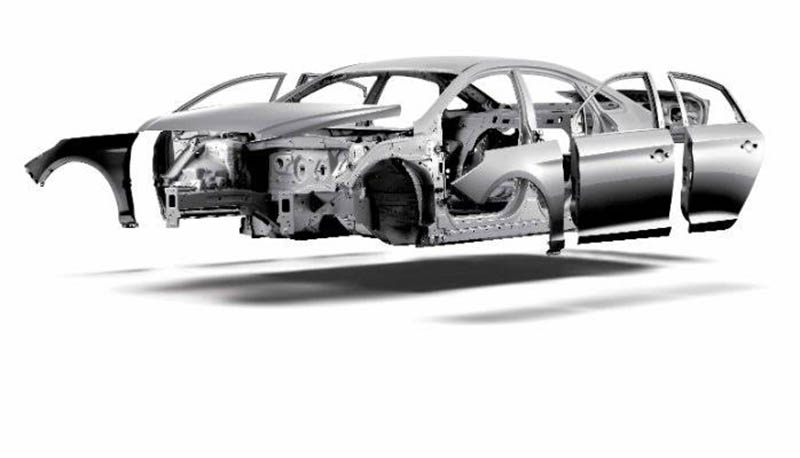
The next generation of lightweight vehicles increasingly relies on multi-material construction rather than a single material throughout the vehicle.
Different materials are selected according to local performance requirements:
- Steel for crash zones
- Aluminum for structural frames
- Magnesium for interior supports
- Composites for exterior panels
However, joining dissimilar materials introduces significant engineering challenges.
Common Joining Technologies
| Joining Method | Suitable Materials | Advantages |
|---|---|---|
| Laser Welding | Steel-Steel | High precision |
| Friction Stir Welding | Aluminum-Aluminum | Excellent joint quality |
| Structural Adhesives | Aluminum + Composite | Uniform stress distribution |
| Self-Piercing Rivets | Steel + Aluminum | No pre-drilling required |
| Flow Drill Screws | Mixed Materials | High productivity |
One critical issue involves galvanic corrosion. When aluminum contacts steel under moist conditions, electrochemical reactions accelerate corrosion. Engineers therefore use insulating adhesives, coatings, or sealants between dissimilar metals.
Structural adhesives have become increasingly popular because they distribute loads across the entire joint instead of concentrating stress around individual fasteners.
For battery enclosures, combining adhesives with self-piercing rivets provides excellent stiffness, fatigue resistance, and crash performance while minimizing added mass.
Manufacturing Processes for Lightweight Components
Selecting lightweight materials is only part of the equation. The manufacturing process itself has a significant impact on the final weight, dimensional accuracy, production cost, and mechanical performance of automotive components. An optimized production method can reduce machining allowances, minimize waste, and enable complex geometries that would be impossible with conventional fabrication.
Today, automotive manufacturers commonly combine CNC machining, die casting, hydroforming, precision forging, and additive manufacturing to achieve both weight reduction and high production efficiency.
CNC Machining for Precision Lightweight Components
CNC machining remains one of the most important manufacturing technologies for lightweight automotive parts, particularly during prototype development, low-volume production, and high-precision applications.
Unlike casting, CNC machining removes material only where necessary, allowing engineers to produce optimized geometries with tight tolerances.
Typical CNC-machined automotive components include:
| Component | Common Material | Machining Process |
|---|---|---|
| Suspension Knuckle | 6061-T6 Aluminum | 5-Axis CNC Milling |
| EV Battery Housing | 6082 Aluminum | CNC Milling + Drilling |
| Brake Caliper | 7075 Aluminum | Precision CNC Machining |
| Motor End Cap | Aluminum Alloy | CNC Turning |
| Transmission Housing | Aluminum Casting + CNC Finish | Milling & Boring |
Modern 5-axis machining centers allow engineers to manufacture intricate internal cavities, thin-wall structures, and curved surfaces while maintaining excellent dimensional consistency.
For example, reducing wall thickness from 5 mm to 3 mm on an aluminum motor housing can decrease component weight by nearly 25%, provided structural analysis confirms sufficient rigidity.
Another advantage of CNC machining is flexibility. Design revisions can be implemented by updating the machining program rather than producing new tooling, significantly reducing development time for prototype vehicles.
High Pressure Die Casting (HPDC)
High Pressure Die Casting has become one of the most widely adopted processes for aluminum automotive components.
Molten aluminum is injected into hardened steel molds at extremely high pressures, enabling:
- Thin-wall sections
- High dimensional accuracy
- Excellent surface finish
- Short production cycles
- Reduced secondary machining
The automotive industry increasingly utilizes HPDC for:
- Transmission housings
- Motor housings
- Battery enclosures
- Steering components
- Structural crossmembers
Tesla’s Gigacasting approach has further demonstrated how large die-cast aluminum structures can consolidate dozens of individual stamped parts into a single casting, reducing both weight and assembly complexity.
Hydroforming for Hollow Lightweight Structures
Hydroforming uses high-pressure hydraulic fluid to expand metal tubes or sheets into complex dies.
Compared with conventional welded assemblies, hydroformed components typically offer:
| Advantage | Benefit |
|---|---|
| Fewer weld seams | Higher fatigue strength |
| Continuous geometry | Better crash energy absorption |
| Uniform wall thickness | Improved stiffness-to-weight ratio |
| Reduced assembly steps | Lower manufacturing costs |
Hydroforming is commonly used for:
- Chassis rails
- Engine cradles
- Exhaust systems
- Roof rails
- Suspension arms
Because hydroforming produces seamless hollow structures, it often achieves equivalent strength with substantially less material than welded fabrications.
Additive Manufacturing for Lightweight Prototypes
Although additive manufacturing is not yet suitable for every high-volume automotive application, it has become an invaluable tool for lightweight component development.
Metal 3D printing enables engineers to manufacture:
- Internal lattice structures
- Conformal cooling channels
- Organic topology-optimized geometries
- Hollow internal cavities
These features are nearly impossible to produce using traditional subtractive machining.
For example, a topology-optimized aluminum bracket manufactured by selective laser melting (SLM) may weigh 40–60% less than a conventionally machined counterpart while maintaining equivalent stiffness.
As production costs continue to decline, additive manufacturing is expected to play an increasingly important role in motorsports, electric vehicles, and low-volume specialty vehicles.
Precision Forging for High-Strength Lightweight Parts
Certain automotive components must withstand extreme cyclic loads while remaining as light as possible.
Precision forging improves the internal grain flow of metals, resulting in:
- Higher fatigue strength
- Greater impact resistance
- Better load-bearing capability
- Reduced material usage
Forged lightweight components commonly include:
- Connecting rods
- Steering arms
- Wheel hubs
- Crankshafts
- Suspension links
Because forged parts possess superior mechanical properties, engineers can often reduce section thickness compared to cast components, achieving additional weight savings without sacrificing durability.
Design for Functional Integration and Part Consolidation
Another highly effective weight reduction strategy is minimizing the number of individual components within an assembly.
Rather than optimizing each part separately, engineers redesign entire systems so that multiple functions are incorporated into a single integrated component.
This approach not only reduces mass but also simplifies manufacturing, lowers inventory requirements, and improves reliability.
Why Part Consolidation Matters
Every individual part contributes more than its own weight.
Additional mass comes from:
- Bolts
- Nuts
- Washers
- Brackets
- Welds
- Fasteners
- Mounting bosses
- Assembly fixtures
By eliminating unnecessary interfaces, manufacturers can significantly reduce total system weight.
Consider the following example:
| Design Approach | Number of Parts | Fasteners | Total Weight |
|---|---|---|---|
| Traditional Assembly | 18 | 42 | 8.5 kg |
| Integrated Design | 6 | 12 | 6.9 kg |
Although each redesigned component may only save a few hundred grams, the cumulative reduction across thousands of vehicles becomes substantial.
Functional Integration Examples
Modern electric vehicles increasingly integrate multiple functions into single housings.
Examples include:
Battery enclosure
Instead of separate:
- Cooling channels
- Structural supports
- Mounting brackets
- Wiring trays
A single aluminum extrusion or casting incorporates all these features.
Motor housing
Modern motor housings often integrate:
- Cooling jackets
- Bearing seats
- Mounting interfaces
- Sensor mounts
This reduces machining operations while increasing structural rigidity.
Dashboard carrier
Traditional dashboards required multiple steel brackets.
Today’s magnesium or composite cross-car beams integrate mounting points for:
- HVAC systems
- Airbags
- Steering columns
- Instrument clusters
- Electronic modules
This approach removes numerous brackets and fasteners while improving assembly efficiency.
Lightweight Design Trade-Offs
Weight reduction should never compromise vehicle safety or long-term durability.
Engineers must balance several competing objectives:
| Objective | Challenge |
|---|---|
| Lower Weight | May reduce stiffness |
| Lower Cost | May limit material options |
| Improved Crash Safety | Often requires stronger structures |
| Better Manufacturability | May restrict optimized geometry |
| Corrosion Resistance | Depends on material combinations |
Finite Element Analysis (FEA), fatigue testing, crash simulations, and durability validation are therefore essential before implementing any lightweight design.
Successful lightweight engineering is not about removing as much material as possible—it is about placing material only where it contributes to structural performance.
Real-World Automotive Lightweighting Results
The following table summarizes typical weight reductions achieved through various methods:
| Method | Typical Weight Reduction |
|---|---|
| Aluminum replacing steel | 30–50% |
| Magnesium replacing aluminum | 20–35% |
| Carbon fiber replacing steel | 50–70% |
| Topology optimization | 15–40% |
| Part consolidation | 10–30% |
| Hydroforming | 10–20% |
| Precision forging | 10–15% |
| High-pressure die casting | 15–25% |
These methods are often combined within a single vehicle platform to maximize overall efficiency. For instance, an electric vehicle may employ an aluminum battery enclosure produced by high-pressure die casting, topology-optimized suspension brackets machined from forged aluminum, hydroformed chassis members, and composite body panels—all contributing to significant weight savings while meeting stringent safety and performance standards.
Conclusion
Reducing automotive component weight requires a holistic engineering approach that integrates advanced materials, intelligent structural optimization, innovative joining methods, and highly efficient manufacturing processes. No single technique provides the ideal solution for every application; instead, the most successful vehicle platforms combine multiple lightweighting strategies tailored to each component’s functional requirements.
As automotive technology continues to evolve toward electrification and higher efficiency, precision manufacturing becomes increasingly important. High-quality CNC machining enables engineers to produce lightweight, high-strength components with exceptional dimensional accuracy, making it a critical process for prototypes, performance vehicles, and production-ready parts.
Xavier specializes in precision CNC machining and custom manufacturing for the automotive industry. From complex aluminum suspension components and lightweight motor housings to precision brackets, battery enclosure parts, and prototype assemblies, Xavier delivers high-quality machining solutions that help customers reduce weight without compromising strength, reliability, or dimensional accuracy. Whether you require rapid prototyping or full-scale production, Xavier’s experienced engineering team can help transform optimized designs into high-performance automotive components.
We are an integrated CNC manufacturing and trading company specializing in custom CNC machining services, including CNC contract manufacturing and precision machining of various metal parts. We provide professional CNC anodizing surface finishing, CNC electroless nickel surface finishing, and CNC passivation surface finishing solutions to meet different industrial requirements.
As an experienced CNC anodizing manufacturer, we offer high-quality electroless nickel service for batch production and provide competitive passivation price options for customers worldwide. Feel free to contact us for more details.
For industries requiring lightweight and high-performance components, you can also learn more about automotive component weight reduction methods and advanced manufacturing solutions.
Some of the images and text in this article are collected and compiled from the internet. If there is anything inappropriate, please contact us for processing.