
Anodized Aluminum vs Aluminum: Which One Is Better for Your CNC Project?
5 Key Points of This Article:
- What Is the Difference Between Anodized Aluminum and Bare Aluminum?
- Corrosion Resistance and Outdoor Durability
- Surface Hardness, Wear Resistance, and Scratch Performance
- Electrical Conductivity, Thermal Conductivity, and Machining Characteristics
- Typical Applications, Cost Comparison, and How to Choose the Right Material
Aluminum has become one of the most widely used engineering metals because of its excellent strength-to-weight ratio, corrosion resistance, machinability, and affordability. However, one important decision engineers often face is whether to use raw aluminum or anodized aluminum.
At first glance, the two materials appear almost identical because anodizing does not add another coating like paint or powder coating. Instead, anodizing transforms the aluminum surface into a hard aluminum oxide layer that becomes part of the metal itself.
For CNC machined components, choosing between anodized aluminum and bare aluminum affects durability, appearance, conductivity, maintenance requirements, manufacturing cost, and product lifespan.
This article provides a detailed comparison from both manufacturing and engineering perspectives.
What Is the Difference Between Anodized Aluminum and Bare Aluminum?
Before comparing performance, it’s important to understand what anodizing actually changes.
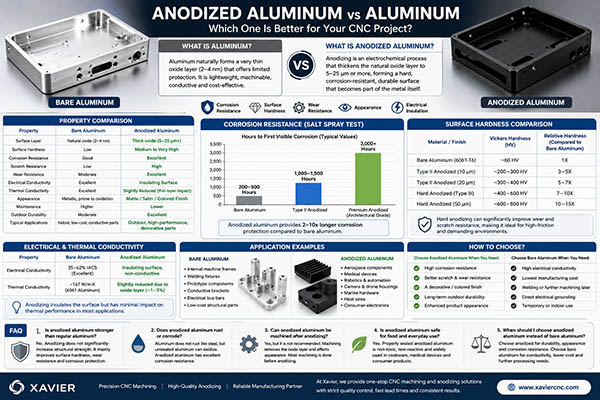
Bare aluminum naturally reacts with oxygen in the air, creating an extremely thin oxide layer only a few nanometers thick. This natural film offers limited protection against corrosion but is easily damaged.
During anodizing, the aluminum part is immersed in an acid electrolyte while electrical current passes through it. Oxygen ions react with the surface, growing a controlled aluminum oxide layer that becomes significantly thicker and much harder than the naturally formed oxide.
Unlike paint, plating, or powder coating, the anodized layer becomes an integral part of the aluminum substrate and therefore cannot peel or flake.
Structural Comparison
| Property | Bare Aluminum | Anodized Aluminum |
|---|---|---|
| Surface Layer | Natural oxide | Electrochemically grown oxide |
| Typical Oxide Thickness | 2–4 nm | 5–25 μm (Type II), thicker for hard anodizing |
| Surface Hardness | Original alloy hardness | Significantly increased |
| Surface Finish | Metallic | Matte, satin or dyed finish |
| Can Peel? | No | No |
What Actually Changes?
Many people assume anodizing changes the aluminum itself.
This is only partially true.
The core mechanical properties remain almost unchanged:
- Density
- Yield strength
- Tensile strength
- Elastic modulus
Instead, anodizing mainly improves:
- Surface hardness
- Wear resistance
- Corrosion resistance
- Appearance
- Electrical insulation
- UV stability
For example, a CNC-machined 6061 aluminum enclosure still has the same internal strength after anodizing, but its surface becomes much more resistant to scratches, oxidation, and weathering.
Corrosion Resistance and Outdoor Durability
One of the biggest advantages of anodized aluminum is its outstanding corrosion resistance.
Although raw aluminum naturally resists rust better than steel, aggressive environments such as saltwater, industrial chemicals, and coastal climates eventually attack the thin natural oxide layer.
Anodizing creates a much thicker protective barrier.
Comparison of Corrosion Protection
| Environment | Bare Aluminum | Anodized Aluminum |
|---|---|---|
| Indoor Office | Excellent | Excellent |
| Outdoor Exposure | Good | Excellent |
| Marine Environment | Fair | Excellent |
| Industrial Pollution | Moderate | Excellent |
| High Humidity | Moderate | Excellent |
Salt Spray Performance
Laboratory salt spray testing clearly demonstrates the difference.
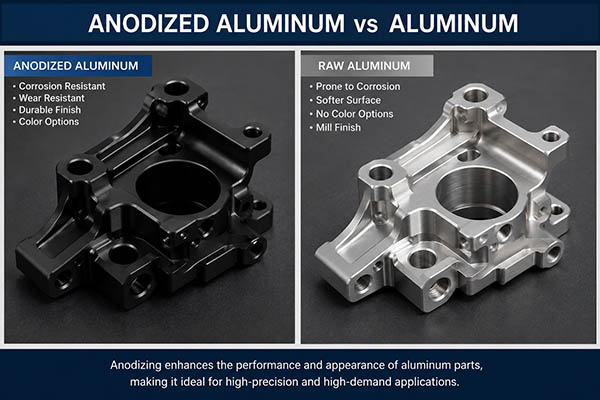
Typical anodized aluminum components can withstand well over 1,000 hours of salt spray exposure, while premium architectural anodizing systems may achieve 3,000+ hours under relevant specifications. Bare aluminum generally shows much earlier surface degradation in chloride-rich environments.
Real Manufacturing Example
Consider two CNC machined camera housings.
Housing A
- CNC machined
- No surface treatment
After one year near the ocean:
- Surface dullness
- White oxidation spots
- Reduced cosmetic quality
Housing B
- CNC machined
- Type II anodized
- Properly sealed
After one year:
- Original appearance maintained
- Minimal corrosion
- Easy cleaning
This is why marine electronics, drones, bicycles, and outdoor equipment almost always use anodized aluminum.
Surface Hardness, Wear Resistance, and Scratch Performance
Surface durability is where anodizing creates the greatest improvement.
Raw aluminum is relatively soft.
Even high-strength alloys like 7075 can still scratch when steel fasteners, bearings, or moving components contact the surface.
Anodizing converts the outer layer into aluminum oxide, a ceramic-like material.
Surface Hardness Comparison
| Property | Bare Aluminum | Type II Anodized | Hard Anodized (Type III) |
|---|---|---|---|
| Relative Hardness | Low | Medium | Very High |
| Scratch Resistance | Low | High | Extremely High |
| Abrasion Resistance | Moderate | Excellent | Outstanding |
Some hard-anodized surfaces can approach hardness levels comparable to hardened steel while remaining lightweight.
Wear Performance
Imagine two CNC guide rails operating continuously.
Bare Aluminum
After thousands of cycles:
- Visible scratches
- Surface polishing
- Dimensional wear
Hard Anodized Rail
After identical testing:
- Minimal wear
- Stable dimensions
- Reduced friction
Research also shows anodized aluminum exhibits lower friction coefficients and lower wear rates than untreated aluminum under both water-lubricated and oil-lubricated conditions.
Industries That Benefit Most
Hard anodizing is commonly used in:
- Hydraulic components
- Pneumatic cylinders
- Firearm accessories
- Automotive suspension parts
- Aerospace brackets
- Medical equipment
- Robotics
For these applications, extending wear life is often more valuable than the additional finishing cost.
Electrical Conductivity, Thermal Conductivity, and Machining Characteristics
One of the biggest misconceptions about anodized aluminum is that anodizing improves every performance characteristic. In reality, anodizing greatly enhances surface durability, but it also changes how the material behaves electrically and thermally. Understanding these trade-offs is essential when designing CNC-machined parts for electronics, automation equipment, aerospace systems, or industrial machinery.
Electrical Conductivity
Bare aluminum is an excellent electrical conductor. Depending on the alloy, its electrical conductivity ranges from approximately 35–62% IACS (International Annealed Copper Standard), making it one of the most commonly used conductive metals after copper.
During anodizing, however, the aluminum oxide layer that forms on the surface is an electrical insulator. Although the aluminum core remains conductive, current cannot easily pass through the anodized surface.
| Property | Bare Aluminum | Anodized Aluminum |
|---|---|---|
| Core Conductivity | Excellent | Excellent |
| Surface Conductivity | Conductive | Insulating |
| Electrical Resistance | Low | High |
| Suitable for Grounding | Yes | Requires masking or post-machining |
| Suitable for Electrical Contacts | Yes | No |
This distinction is critical in product design. For example:
- Heat sink mounting surfaces often need to maintain electrical grounding with the chassis.
- Battery terminals require direct metal-to-metal contact.
- Bus bars and conductive brackets should not be anodized on contact areas.
- Electronic enclosures may require selective masking before anodizing to preserve conductive mounting points.
For these reasons, manufacturers frequently mask threaded holes, grounding pads, and electrical contact surfaces before anodizing.
Thermal Conductivity
Aluminum is well known for its high thermal conductivity, which is why it is widely used in:
- CPU heat sinks
- LED lighting systems
- Electric vehicle battery cooling plates
- Industrial cooling equipment
- Power electronics
The aluminum oxide layer produced by anodizing has a lower thermal conductivity than aluminum itself. However, because the oxide layer is extremely thin—typically 5–25 μm for Type II anodizing—its effect on overall heat transfer is relatively small in most applications.
| Material | Approximate Thermal Conductivity |
|---|---|
| Pure Aluminum | ~235 W/m·K |
| 6061 Aluminum | ~167 W/m·K |
| Aluminum Oxide Layer | ~20–35 W/m·K |
Although the oxide layer conducts heat less efficiently than the base metal, it is so thin that most CNC heat sinks experience only a minor reduction in thermal performance.
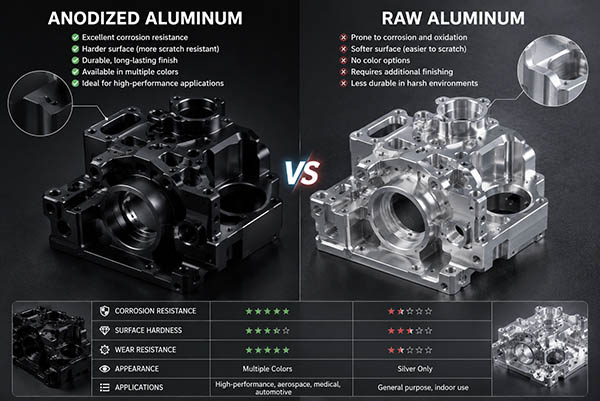
Interestingly, black anodized heat sinks often improve radiative heat dissipation because dark surfaces have higher emissivity than polished aluminum.
Example: CNC Heat Sink
Consider two identical CNC-machined 6061 aluminum heat sinks.
Heat Sink A
- Natural machined finish
- Bright metallic appearance
- Excellent conduction
- Lower emissivity
Heat Sink B
- Black anodized
- Slightly lower surface conductivity
- Better corrosion resistance
- Improved thermal radiation
- Higher visual quality
For LED lighting, industrial controllers, and power supplies, black anodized aluminum is generally the preferred option because the benefits outweigh the slight reduction in surface thermal conductivity.
Machining Characteristics Before and After Anodizing
From a manufacturing perspective, anodizing is not simply a finishing step—it also influences machining tolerances, dimensional accuracy, thread quality, and cosmetic appearance.
Machining Is Always Performed First
Anodizing is almost always the final process after CNC machining.
A typical manufacturing workflow looks like this:
Material Cutting ↓CNC Milling / Turning ↓Deburring ↓Cleaning ↓Surface Inspection ↓Anodizing ↓Sealing ↓Final Inspection
Since anodizing changes the surface dimensions slightly, engineers must account for oxide growth during the design stage.
Dimensional Growth
Unlike paint or plating, anodizing does not simply add thickness on top of the surface.
Instead:
- Approximately 50% of the oxide grows outward.
- Approximately 50% penetrates into the aluminum substrate.
For example:
| Anodized Layer Thickness | External Growth |
|---|---|
| 10 μm | ~5 μm |
| 20 μm | ~10 μm |
| 25 μm | ~12.5 μm |
| 50 μm (Hard Anodizing) | ~25 μm |
For precision CNC components with tight tolerances (such as ±0.01 mm), these dimensional changes must be included in the machining allowance.
Thread Considerations
Threaded holes are another important consideration.
If internal threads are anodized:
- The oxide layer reduces thread clearance.
- Assembly torque increases.
- Thread wear may occur during installation.
Manufacturers commonly address this issue by:
- Masking threads before anodizing
- Re-tapping threads after anodizing
- Increasing thread tolerance during CNC programming
These practices help ensure proper fit without damaging the protective oxide layer.
Surface Finish Before Anodizing Determines Final Appearance
Anodizing does not hide machining marks. Instead, it tends to make existing surface textures more visible.
| Surface Before Anodizing | Appearance After Anodizing |
|---|---|
| Mirror Polished | Glossy Finish |
| Fine Bead Blasted | Uniform Matte Finish |
| Fine CNC Toolpath | Satin Metallic Finish |
| Rough Milling Marks | Visible Machining Texture |
For premium consumer products—such as laptop housings, camera bodies, drones, and audio equipment—manufacturers often bead blast or polish parts before anodizing to achieve a refined appearance.
Typical Applications, Cost Comparison, and How to Choose the Right Material
Ultimately, the choice between anodized aluminum and bare aluminum depends on the product’s functional requirements, operating environment, expected lifespan, and budget.
Typical Applications
Bare Aluminum
Bare aluminum is commonly selected for applications where:
- High electrical conductivity is required
- Surface appearance is not critical
- Components remain indoors
- Parts are temporary or disposable
- Cost must be minimized
Examples include:
- Internal machine frames
- Welding fixtures
- Prototype components
- Conductive brackets
- Electrical bus bars
Anodized Aluminum
Anodized aluminum is preferred for products that require durability, corrosion resistance, and an attractive finish.
Common applications include:
- Aerospace structural components
- Medical equipment
- Robotics
- Electric vehicles
- Bicycle components
- Camera housings
- Consumer electronics
- Marine hardware
- LED heat sinks
- Architectural aluminum products
Cost Comparison
Although anodizing adds manufacturing cost, it often reduces long-term maintenance and replacement expenses.
| Cost Factor | Bare Aluminum | Anodized Aluminum |
|---|---|---|
| Material Cost | Same | Same |
| CNC Machining Cost | Same | Same |
| Surface Treatment | None | Additional |
| Corrosion Maintenance | Higher | Lower |
| Product Lifespan | Shorter in harsh environments | Longer |
| Appearance Retention | Moderate | Excellent |
For high-volume production, anodizing typically represents only a small percentage of the total manufacturing cost, especially when compared with the increased service life and improved product quality.
Decision Guide
The following table summarizes which option is better for different priorities.
| If You Need… | Recommended Choice |
|---|---|
| Lowest manufacturing cost | Bare Aluminum |
| Maximum corrosion resistance | Anodized Aluminum |
| Better scratch resistance | Anodized Aluminum |
| Decorative appearance | Anodized Aluminum |
| Electrical conductivity | Bare Aluminum |
| Outdoor durability | Anodized Aluminum |
| Marine applications | Anodized Aluminum |
| Lightweight structural parts | Both |
| Precision electronic housings | Anodized Aluminum |
| Electrical grounding surfaces | Bare Aluminum or masked anodizing |
Real-World Example
Imagine you are manufacturing a CNC enclosure for an industrial automation controller.
Option 1: Bare Aluminum
Advantages:
- Lower production cost
- Excellent conductivity
- Easier secondary machining
Disadvantages:
- Scratches easily during assembly
- Surface oxidizes over time
- Appearance deteriorates in outdoor environments
Option 2: Black Anodized Aluminum
Advantages:
- Professional appearance
- Excellent corrosion resistance
- Improved wear resistance
- Better UV stability
- Lower maintenance over the product lifecycle
Disadvantages:
- Slightly higher finishing cost
- Electrical contact areas require masking or secondary machining
For most commercial products, the second option delivers a better balance of performance, durability, and aesthetics.
Conclusion: Which Should You Choose?
There is no universal “better” material—only the right choice for your application.
If your project prioritizes electrical conductivity, low cost, or easy post-processing, bare aluminum remains an excellent option. It is lightweight, highly machinable, and suitable for many indoor or conductive applications.
However, if your components will face outdoor exposure, frequent handling, abrasive environments, or demanding cosmetic requirements, anodized aluminum offers significant advantages. Its hard oxide layer provides superior corrosion resistance, scratch protection, wear performance, UV stability, and long-term appearance while preserving the lightweight nature of aluminum.
For most precision CNC-machined products, anodizing represents a small investment that can substantially increase product value and service life.
At Xavier, we specialize in high-precision CNC machining and premium anodizing services for aluminum components. Whether you require natural, black, clear, hard-coat, or custom-colored anodized finishes, our engineering team helps optimize material selection, machining tolerances, and surface treatment to ensure every part meets your performance and quality requirements. From rapid prototypes to high-volume production, Xavier delivers reliable manufacturing solutions tailored to your project.
FAQ
1. Is anodized aluminum stronger than regular aluminum?
No. Anodizing does not significantly increase the structural strength of aluminum. The tensile strength, yield strength, and overall mechanical properties of the base metal remain nearly the same. What anodizing does improve is the surface hardness, scratch resistance, wear resistance, and corrosion protection, making the part more durable in everyday use.
2. Does anodized aluminum rust or corrode?
Aluminum does not rust like steel because it contains no iron. However, untreated aluminum can oxidize and gradually lose its appearance when exposed to moisture, salt, or chemicals. Anodized aluminum has a much thicker aluminum oxide layer that provides excellent corrosion resistance, making it ideal for outdoor, marine, and industrial environments.
3. Can anodized aluminum be machined after anodizing?
Yes, but it is generally not recommended unless necessary. Machining after anodizing removes the protective oxide layer, exposing bare aluminum underneath and creating visible differences in color and finish. For this reason, most CNC machining operations are completed before anodizing, with only minor post-processing performed if required.
4. Is anodized aluminum safe for food and everyday use?
Yes. Properly sealed anodized aluminum is non-toxic, non-reactive, and widely used in cookware, food processing equipment, medical devices, consumer electronics, and household products. The anodized surface is durable, easy to clean, and more resistant to staining than untreated aluminum.
5. When should I choose anodized aluminum instead of bare aluminum?
Choose anodized aluminum if your project requires:
- Better corrosion resistance
- Improved scratch and wear resistance
- A decorative or colored finish
- Long-term outdoor durability
- Enhanced product appearance
Choose bare aluminum if your application primarily requires:
- High electrical conductivity
- Lower manufacturing cost
- Further welding or machining after production
- Direct electrical grounding or conductive contact surfaces
For most precision CNC machined parts used in aerospace, automotive, electronics, robotics, and consumer products, anodized aluminum offers the best balance of durability, aesthetics, and long-term performance.
As a trusted CNC machining company with integrated manufacturing capabilities, we specialize in custom CNC machining and precision manufacturing for a wide variety of metal and engineering plastic parts. Our expertise includes CNC Stainless Steel Machining, CNC Nylon Machining, and CNC Copper Machining. We manufacture high-quality components for robotics, aerospace, marine, automotive, medical, and other demanding precision engineering industries. We also provide professional solutions for anodized aluminum to improve corrosion resistance, wear resistance, and product appearance.
As a reliable CNC Stainless Steel Machining Manufacturer, we offer cost-effective high-volume CNC Nylon Machining Services. Contact us today to receive competitive CNC Copper Machining Prices and let our experienced engineering team support your next custom machining project.
Some of the images and text in this article are collected and compiled from the internet. If there is anything inappropriate, please contact us for processing.