
Introduction
5052 aluminum is one of the most widely used non-heat-treatable aluminum alloys in modern manufacturing. Thanks to its excellent corrosion resistance, moderate-to-high strength, outstanding formability, and good weldability, it has become a preferred material for industries ranging from marine engineering to electronics, transportation, and precision CNC machining.
Among all its mechanical properties, yield strength is one of the most important parameters engineers evaluate when selecting materials. Yield strength determines the point at which aluminum begins to deform permanently under load. Designing parts without understanding this value can result in structural failure, excessive deformation, or unnecessary manufacturing costs.
This guide explores the yield strength of 5052 aluminum in detail, compares it with other popular aluminum alloys, explains the factors influencing its performance, and demonstrates why it plays a crucial role in CNC machining and engineering applications.
What Is the Yield Strength of 5052 Aluminum?
Yield strength refers to the stress level at which a material permanently deforms after the elastic region. Below the yield point, the material returns to its original shape after the force is removed. Beyond this point, permanent deformation occurs.
For engineers, yield strength often serves as the design limit for structural components because operating below this value helps ensure dimensional stability and long-term reliability.
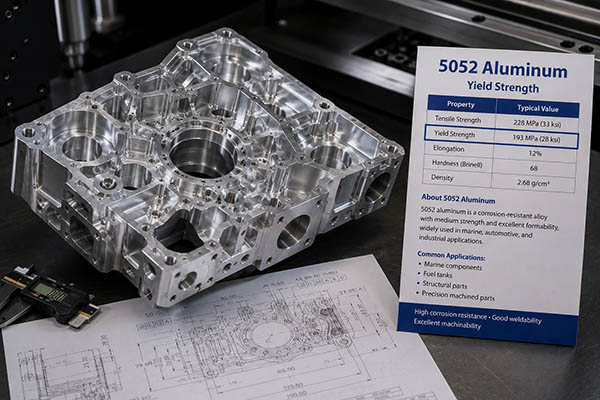
Typical Yield Strength Values
Different tempers of 5052 aluminum exhibit different yield strengths because cold working increases dislocation density inside the material.
| Temper | Typical Yield Strength | Tensile Strength | Elongation |
|---|---|---|---|
| O (Annealed) | 28 MPa (4 ksi) | 170 MPa | 25% |
| H32 | 193 MPa (28 ksi) | 228 MPa | 12% |
| H34 | 214 MPa (31 ksi) | 255 MPa | 9% |
| H36 | 235 MPa (34 ksi) | 262 MPa | 8% |
| H38 | 255 MPa (37 ksi) | 276 MPa | 7% |
Among these, 5052-H32 is by far the most commonly used temper in CNC machining because it provides an excellent balance between strength and machinability.
Understanding Yield Strength with a Practical Example
Imagine a CNC-machined equipment bracket made from 5052-H32 aluminum.
Suppose the bracket experiences a bending stress of 150 MPa during operation.
Since the material’s yield strength is approximately 193 MPa, the bracket will elastically deform under load and return to its original shape after the force is removed.
However, if the applied stress reaches 210 MPa, the aluminum begins to plastically deform. Even after unloading, the bracket will remain permanently bent.
This illustrates why engineers generally design aluminum components with a safety factor rather than approaching the theoretical yield strength.
Yield Strength vs Tensile Strength
Many beginners confuse these two mechanical properties.
| Property | Yield Strength | Tensile Strength |
|---|---|---|
| Definition | Permanent deformation begins | Material fractures |
| Design Importance | Primary engineering limit | Failure limit |
| Typical 5052-H32 | 193 MPa | 228 MPa |
Think of yield strength as the point where damage starts, while tensile strength is where complete failure occurs.
For precision CNC components, permanent deformation is often unacceptable long before fracture occurs, making yield strength the more critical design parameter.
Why Engineers Focus on Yield Strength
Several engineering decisions rely directly on yield strength:
- Minimum wall thickness
- Maximum allowable load
- Bolt spacing
- Fastener design
- Fixture rigidity
- Structural stability
- Fatigue resistance estimation
For example, when machining a lightweight aerospace panel, engineers may reduce wall thickness to save weight. However, the remaining material must still provide sufficient yield strength to resist permanent deformation during service.
This balance between lightweight construction and mechanical reliability explains why 5052 aluminum is frequently selected for transportation and aerospace support structures.
Mechanical Properties of 5052 Aluminum Compared with Other Aluminum Alloys
Choosing an aluminum alloy involves balancing several mechanical characteristics rather than considering yield strength alone.
The following comparison highlights where 5052 fits among commonly machined aluminum alloys.
Comparison of Popular CNC Aluminum Alloys
| Alloy | Yield Strength | Corrosion Resistance | Machinability | Weldability |
|---|---|---|---|---|
| 5052-H32 | 193 MPa | Excellent | Good | Excellent |
| 6061-T6 | 276 MPa | Very Good | Excellent | Excellent |
| 7075-T6 | 503 MPa | Fair | Excellent | Poor |
| 5083-H116 | 215 MPa | Excellent | Moderate | Excellent |
| 3003-H14 | 145 MPa | Excellent | Fair | Excellent |
The table shows that 5052 is not the strongest aluminum alloy, but it provides one of the best overall combinations of corrosion resistance, fabrication capability, and weldability.
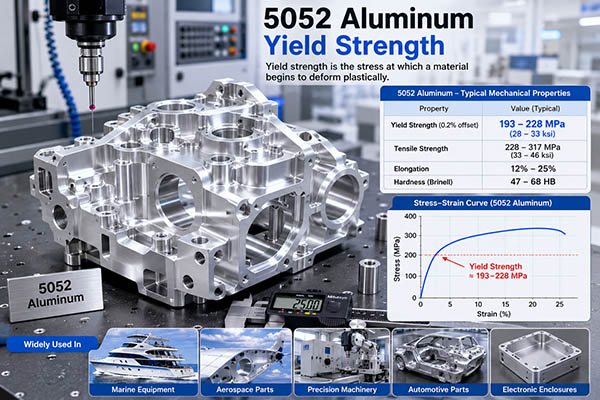
5052 vs 6061 Aluminum
These are probably the two most frequently compared aluminum alloys.
5052 advantages:
- Better saltwater corrosion resistance
- Easier bending
- Superior forming capability
- Better welding performance
- Lower risk of cracking during forming
6061 advantages:
- Higher yield strength
- Better stiffness
- Better CNC machinability
- Easier threading
- Higher structural capacity
For example:
A marine enclosure exposed to seawater generally benefits from 5052 because corrosion resistance is the priority.
A machine frame requiring precise threaded holes and higher rigidity is usually better manufactured from 6061-T6.
5052 vs 7075 Aluminum
7075 is significantly stronger than 5052.
| Property | 5052-H32 | 7075-T6 |
|---|---|---|
| Yield Strength | 193 MPa | 503 MPa |
| Corrosion Resistance | Excellent | Moderate |
| Weldability | Excellent | Poor |
| Cost | Lower | Higher |
Although 7075 is ideal for aerospace load-bearing components, its poor weldability and reduced corrosion resistance often make 5052 the better choice for outdoor equipment, marine applications, and fabricated assemblies.
Why Many Manufacturers Still Choose 5052
Despite not offering the highest strength, 5052 remains one of the industry’s favorite alloys because it delivers:
- Stable dimensional performance
- Consistent forming quality
- Lower fabrication costs
- Excellent surface finishing
- Reliable corrosion resistance
- High production efficiency
For many sheet metal parts, electrical enclosures, brackets, panels, tanks, and covers, these practical advantages outweigh the benefits of higher strength alloys.
Factors That Affect the Yield Strength of 5052 Aluminum
Although manufacturers often refer to a single yield strength value for 5052 aluminum, the actual performance of the material depends on several variables. Engineers who understand these factors can make more accurate material selections and avoid unexpected deformation during manufacturing or service.
Temper Condition Has the Greatest Influence
Unlike 6061 or 7075 aluminum, 5052 cannot be strengthened through heat treatment. Instead, its strength primarily comes from strain hardening (cold working).
The temper designation indicates the amount of cold work applied after annealing.
| Temper | Description | Relative Strength | Formability |
|---|---|---|---|
| O | Fully annealed | Lowest | Excellent |
| H32 | Quarter hard, stabilized | Medium | Very Good |
| H34 | Half hard | High | Good |
| H36 | Three-quarter hard | Higher | Moderate |
| H38 | Full hard | Highest | Limited |
As the temper increases, yield strength rises because cold working increases the density of dislocations within the aluminum crystal structure. These dislocations make it more difficult for atoms to slide past one another under load.
However, there is a trade-off. Higher strength generally means lower ductility, making the material less suitable for complex bending or deep drawing operations.
Example
If a manufacturer is producing a deeply formed electrical enclosure, 5052-O may be selected because it can undergo significant deformation without cracking.
If the same enclosure must support heavier loads after forming, it may instead be manufactured from 5052-H32 to achieve a better balance between strength and workability.
Cold Working Increases Yield Strength
Cold working refers to plastic deformation performed below the recrystallization temperature, such as:
- Rolling
- Stretching
- Bending
- Drawing
- Press forming
During cold working, microscopic crystal defects accumulate and hinder further movement of dislocations. As a result, the material becomes stronger.
The relationship can be summarized as follows:
| Amount of Cold Work | Yield Strength | Ductility |
|---|---|---|
| Low | Lower | Higher |
| Moderate | Balanced | Balanced |
| High | Highest | Lowest |
For manufacturers, this means that choosing the correct temper before machining is often more effective than trying to increase strength after production.
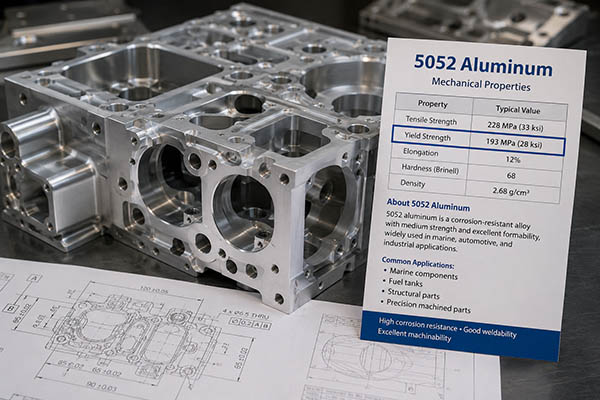
Operating Temperature Changes Mechanical Performance
Like most aluminum alloys, 5052 loses strength as temperature increases.
The following table illustrates the general trend.
| Temperature | Yield Strength Trend |
|---|---|
| -50°C | Slightly higher |
| 20°C | Standard value |
| 100°C | Moderate reduction |
| 150°C | Significant reduction |
| Above 200°C | Rapid strength loss |
For this reason, 5052 aluminum is rarely recommended for components that operate continuously at elevated temperatures.
Engineering Example
A battery enclosure for an electric vehicle may occasionally experience temperatures of 60–80°C during operation. At these temperatures, 5052 retains most of its mechanical properties and remains a suitable material.
However, an exhaust heat shield exposed to temperatures above 200°C would require a different alloy specifically designed for high-temperature service.
Welding Can Reduce Local Yield Strength
One of the advantages of 5052 aluminum is its excellent weldability. However, welding introduces localized heat that partially removes the effects of strain hardening.
The heat-affected zone (HAZ) around the weld often exhibits lower yield strength than the original material.
| Region | Relative Yield Strength |
|---|---|
| Base material | 100% |
| Heat-affected zone | 70–90% |
| Weld bead | Depends on filler metal |
This reduction is especially important when welded joints are subjected to repeated loading or vibration.
Design Recommendation
Whenever possible:
- Avoid placing welds in highly stressed regions.
- Increase material thickness near welded joints.
- Consider mechanical fasteners if maximum strength must be maintained.
Grain Structure Also Matters
Although less obvious than temper, grain size influences yield strength according to the Hall–Petch relationship.
In general:
- Smaller grains increase strength.
- Larger grains improve ductility.
- Uniform grains improve dimensional stability.
Modern aluminum rolling processes carefully control grain size to achieve consistent mechanical properties across large sheets.
This consistency is particularly important for CNC machining, where predictable material behavior contributes to higher precision.
Surface Defects Can Reduce Effective Strength
Yield strength values published in material datasheets assume defect-free material. In practice, manufacturing defects may reduce actual performance.
Common defects include:
- Deep scratches
- Corrosion pits
- Tool marks
- Surface cracks
- Inclusions
- Improper handling damage
Although these defects do not directly change the alloy’s intrinsic yield strength, they create stress concentrations where plastic deformation may begin earlier than expected.
For precision components, maintaining good surface quality is therefore just as important as selecting the correct alloy.
Why Yield Strength Matters in CNC Machining and Product Design
Yield strength influences nearly every stage of engineering, from CAD design to machining, assembly, and final product performance.
Ignoring this property often leads to oversized components, excessive material costs, or premature failure.
Determining Minimum Wall Thickness
One of the biggest challenges in CNC machining is balancing lightweight construction with sufficient rigidity.
Consider a machined electronics housing.
If the wall thickness is reduced excessively, the component may permanently deform during:
- Assembly
- Fastener tightening
- Transportation
- Normal service
Knowing the yield strength allows engineers to calculate the minimum safe wall thickness while minimizing material usage.
Preventing Permanent Deformation During Clamping
During CNC machining, fixtures apply considerable clamping forces.
Thin aluminum parts can deform before machining even begins.
For example:
A thin 5052 sheet clamped with excessive pressure may exceed its local yield strength, causing permanent distortion.
Even if machining is perfectly accurate, the finished part may spring into an incorrect shape after unclamping.
To prevent this, machinists often use:
- Vacuum fixtures
- Soft jaws
- Distributed clamping
- Reduced clamping pressure
- Additional support points
These techniques keep stresses below the material’s yield strength throughout the machining process.
Improving Product Safety
Many structural products experience repeated mechanical loading throughout their service life.
Examples include:
- Battery trays
- Instrument panels
- Marine brackets
- Equipment covers
- Transportation enclosures
Designing these products below the yield strength ensures they retain their original dimensions even after thousands of loading cycles.
Although fatigue behavior involves additional considerations, maintaining stresses below the yield limit significantly improves long-term reliability.
Optimizing Weight Without Sacrificing Strength
Lightweight design has become a priority across many industries.
Engineers frequently use finite element analysis (FEA) to identify low-stress regions where material can be removed.
For example:
Instead of machining a solid aluminum plate, engineers may create pockets or ribs that reduce weight while keeping local stresses safely below the yield strength.
This design strategy is widely used in:
- Aerospace components
- Robotics
- Medical equipment
- Electric vehicles
- Automation systems
By combining intelligent geometry with the known yield strength of 5052 aluminum, manufacturers can achieve substantial weight savings without compromising structural integrity.
Applications of 5052 Aluminum Based on Its Yield Strength
The combination of moderate yield strength, excellent corrosion resistance, outstanding formability, and reliable weldability makes 5052 aluminum one of the most versatile engineering materials available today. While stronger alloys such as 6061-T6 or 7075-T6 are often selected for highly loaded structural components, 5052 excels in applications where resistance to deformation, corrosion, and manufacturing efficiency must be balanced.
Below are some of the most common industries that rely on the yield strength characteristics of 5052 aluminum.
Marine Equipment and Offshore Components
One of the biggest advantages of 5052 aluminum is its exceptional resistance to seawater corrosion. Magnesium is the primary alloying element, allowing the material to maintain mechanical performance in harsh marine environments without suffering rapid corrosion.
Typical marine components include:
- Boat hull panels
- Deck plates
- Fuel tanks
- Storage cabinets
- Instrument housings
- Walkways
- Handrails
- Protective covers
Unlike carbon steel, which requires continuous painting and maintenance, 5052 aluminum naturally forms a stable oxide layer that protects the underlying metal.
For example, a CNC-machined electronics enclosure installed on a coastal vessel may experience:
- Salt spray
- High humidity
- Temperature fluctuations
- UV exposure
- Continuous vibration
A material with insufficient corrosion resistance may gradually weaken over time. By contrast, 5052-H32 retains both its structural integrity and appearance for many years with minimal maintenance.
Automotive Lightweight Components
The automotive industry continues to reduce vehicle weight in order to improve fuel efficiency and extend electric vehicle driving range.
5052 aluminum is frequently used for:
- Battery enclosures
- Interior brackets
- Heat shields
- Underbody panels
- Fuel system covers
- Splash guards
- HVAC components
Although its yield strength is lower than that of 6061-T6, many automotive parts do not require maximum structural strength. Instead, they benefit more from:
- Excellent stamping performance
- Lower forming forces
- Better corrosion resistance
- Lower production costs
Example
An electric vehicle battery cover often incorporates multiple bends, mounting holes, and embossed reinforcement ribs. These complex geometries can be manufactured efficiently using 5052 sheet without excessive springback or cracking.
Electronics and Electrical Enclosures
Precision electronic equipment requires housings that are:
- Lightweight
- Dimensionally stable
- Corrosion resistant
- Easy to machine
- Easy to fabricate
5052 aluminum satisfies all of these requirements.
Common applications include:
| Product | Why 5052 Is Suitable |
|---|---|
| Control cabinets | Good strength and corrosion resistance |
| Network equipment enclosures | Excellent dimensional stability |
| Instrument panels | Easy bending and punching |
| Communication housings | Lightweight and durable |
| Power supply covers | Good surface finish after anodizing |
In addition, 5052 aluminum offers excellent thermal conductivity, allowing electronic devices to dissipate heat more effectively than many engineering plastics.
Food Processing and Medical Equipment
5052 aluminum is widely used in hygienic environments because it offers:
- Smooth surface finishes
- Excellent corrosion resistance
- Easy cleaning
- Good weldability
- Low maintenance
Typical examples include:
- Food processing trays
- Conveyor guards
- Commercial kitchen equipment
- Medical device housings
- Laboratory equipment
- Pharmaceutical machinery covers
Because these industries often require frequent cleaning with water and mild chemicals, corrosion resistance becomes just as important as mechanical strength.
Industrial Automation Equipment
Modern automation systems contain numerous precision-machined aluminum components.
Examples include:
- Robot covers
- Sensor brackets
- Pneumatic mounting plates
- Machine guards
- Inspection fixtures
- Conveyor components
These parts rarely carry extremely heavy loads, but they must maintain dimensional accuracy over long periods.
A yield strength of approximately 193 MPa (5052-H32) is more than adequate for many automation applications while providing easier fabrication than stronger alloys.
Aerospace Support Structures
Although aircraft primary structures often use high-strength alloys such as 7075 or 2024, 5052 remains an excellent choice for many secondary components.
Examples include:
- Interior panels
- Access covers
- Ventilation ducts
- Equipment housings
- Cable management brackets
- Non-load-bearing support structures
The alloy’s high corrosion resistance and good formability simplify manufacturing while reducing maintenance requirements.
Material Selection Guide
Choosing the right aluminum alloy depends on balancing strength, corrosion resistance, machinability, and fabrication requirements.
The following table provides a practical comparison.
| Application Requirement | Recommended Alloy |
|---|---|
| Highest strength | 7075-T6 |
| Best general machining | 6061-T6 |
| Excellent corrosion resistance | 5052-H32 |
| Marine applications | 5052 / 5083 |
| Complex sheet metal forming | 5052-O or H32 |
| Precision CNC parts | 5052-H32 or 6061-T6 |
| Welded assemblies | 5052 |
| Lightweight enclosures | 5052 |
Rather than selecting the alloy with the highest yield strength, engineers should choose the material that best matches the application’s mechanical, environmental, and manufacturing requirements.
Design Tips for Engineers Working with 5052 Aluminum
When designing CNC-machined or fabricated parts using 5052 aluminum, the following best practices can help maximize performance and manufacturability:
Maintain an Appropriate Safety Factor
Design stresses should remain well below the material’s yield strength to account for variations in loading, manufacturing tolerances, and environmental conditions.
Account for Welded Areas
If welding is required, remember that the heat-affected zone may exhibit lower yield strength. Reinforcing critical welded regions can improve long-term reliability.
Optimize Wall Thickness
Avoid unnecessarily thick sections that increase weight and machining time. Finite element analysis (FEA) can help identify opportunities to reduce material while maintaining sufficient stiffness.
Consider Surface Finishing
Anodizing, powder coating, or chemical conversion coatings can improve corrosion resistance and appearance. However, designers should account for coating thickness in precision dimensions.
Choose the Correct Temper
For parts requiring extensive forming, softer tempers such as 5052-O may be appropriate. For CNC-machined structural components, 5052-H32 is generally the preferred choice due to its balanced mechanical properties.
Why Choose Xavier for Precision 5052 Aluminum CNC Machining?
Selecting the right aluminum alloy is only part of producing a high-quality component. Precision machining, process control, and quality assurance are equally important.
At Xavier, we specialize in custom CNC machining services for aluminum, stainless steel, titanium, brass, engineering plastics, and many other materials. Our engineering team works closely with customers to recommend the most suitable alloy and temper based on the functional requirements of each project.
Whether your application requires lightweight enclosures, marine components, precision brackets, prototype parts, or high-volume production, Xavier delivers:
- High-precision CNC milling and turning
- Tight dimensional tolerances
- Excellent surface finishing options
- Comprehensive quality inspection
- Rapid prototyping and production
- Competitive lead times
- Reliable global delivery
By combining extensive machining expertise with a deep understanding of material properties such as yield strength, Xavier helps customers produce durable, cost-effective components that meet demanding engineering standards.
Conclusion
Yield strength is one of the most important mechanical properties when selecting 5052 aluminum for engineering applications. It defines the stress level at which permanent deformation begins and directly influences product safety, structural reliability, and manufacturing decisions.
Although 5052 aluminum is not the strongest alloy available, its balanced combination of moderate yield strength, excellent corrosion resistance, superior formability, and outstanding weldability makes it one of the most practical materials for CNC machining, sheet metal fabrication, marine equipment, automotive components, electronic enclosures, and industrial machinery.
Understanding how temper conditions, cold working, temperature, welding, and manufacturing processes affect yield strength allows engineers to design more reliable products while optimizing cost and production efficiency.
For manufacturers seeking dependable custom machining solutions, Xavier combines advanced CNC capabilities with extensive material expertise to transform engineering designs into precision components that perform reliably in real-world applications.
As an integrated manufacturer specializing in CNC machining, we focus on delivering custom CNC machining solutions for precision metal and engineering plastic components. Our manufacturing capabilities include CNC Stainless Steel Machining, CNC Nylon Machining, and CNC Tool Steel Machining. We produce high-precision parts for robotics, aerospace, marine, automotive, medical, and other industries that demand tight tolerances and exceptional quality.
As a trusted CNC Stainless Steel Machining Manufacturer, we offer reliable high-volume CNC Nylon Machining Services. Contact us today for competitive CNC Tool Steel Machining Prices. You can also learn more about 5052 Aluminum Yield Strength on our material resource page, or get in touch with us for your custom machining requirements.
Some of the images and text in this article are collected and compiled from the internet. If there is anything inappropriate, please contact us for processing.