
What Is the Yield Point of Steel?
The yield point of steel is one of the most important mechanical properties used in engineering design, manufacturing, construction, automotive production, aerospace engineering, and CNC machining. It represents the stress level at which steel begins to deform plastically. Before reaching this point, steel behaves elastically and will return to its original shape once the applied load is removed. After the yield point is exceeded, permanent deformation occurs.
For engineers, the yield point serves as the practical limit of safe loading. Designing components to operate below this threshold ensures dimensional stability and structural integrity throughout their service life.
In simple terms:
| Stress Level | Steel Behavior | Permanent Deformation |
|---|---|---|
| Below Yield Point | Elastic deformation | No |
| At Yield Point | Plastic deformation begins | Yes |
| Above Yield Point | Plastic deformation increases rapidly | Yes |
| Ultimate Tensile Strength | Maximum load reached | Yes |
| Fracture | Material breaks | Complete failure |
Imagine bending a paper clip. The first slight bend springs back after release because the stress remains below the yield point. Once bent farther, it never returns to its original shape because the yield point has been exceeded.
This simple example perfectly illustrates why engineers pay close attention to yield point rather than only tensile strength.
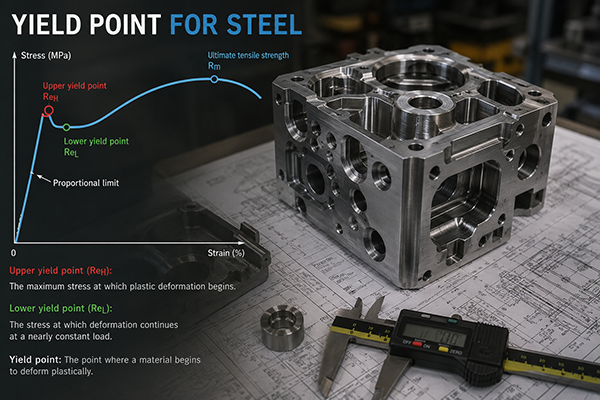
Elastic Region Explained
Within the elastic region, the atomic lattice stretches but does not permanently rearrange.
Characteristics include:
- Linear relationship between stress and strain
- Hooke’s Law applies
- No permanent dimensional changes
- High repeatability during cyclic loading
For precision CNC parts such as fixtures, robotic arms, machine frames, and aerospace brackets, remaining inside this elastic region is essential to maintain accuracy.
We are an integrated manufacturer specializing in CNC machining services, providing custom CNC machining solutions for a wide range of metal and plastic components. Our capabilities include
CNC Titanium Machining,
CNC PEEK Machining, and
CNC Stainless Steel Machining, along with precision manufacturing for robotics, aerospace, marine, automotive, medical, and other high-precision industries.
As a CNC Titanium Machining Manufacturer, we provide high-volume
CNC PEEK Machining Services. Contact us today for competitive
CNC Stainless Steel Machining Prices.
Plastic Region Explained
Once the applied stress reaches the yield point, the internal crystal structure begins to move through dislocation motion.
This results in:
- Permanent dimensional change
- Residual stress
- Reduced geometric accuracy
- Possible distortion after machining
For example, a precision aluminum mold base reinforced with steel inserts may lose flatness if the steel experiences stresses beyond its yield point during assembly.
Why Engineers Focus on Yield Point Instead of Breaking Strength
Many people mistakenly assume steel fails only when it breaks. In reality, a component often becomes unusable long before fracture occurs.
Consider a CNC-machined gearbox housing:
- Design load: 220 MPa
- Steel yield point: 355 MPa
- Ultimate tensile strength: 520 MPa
Although the housing will not fracture until around 520 MPa, once stresses exceed 355 MPa, permanent deformation may cause:
- Bearing misalignment
- Shaft eccentricity
- Gear noise
- Oil leakage
- Reduced service life
Therefore, design engineers usually calculate allowable stresses based on yield strength rather than tensile strength.
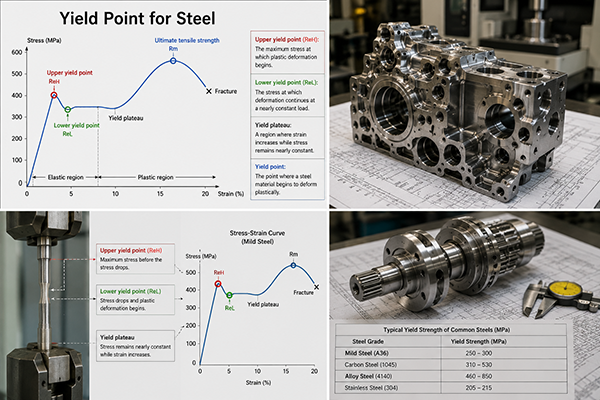
Typical Stress-Strain Behavior
A typical stress-strain curve for low-carbon steel consists of several stages:
| Stage | Description |
|---|---|
| Elastic Region | Linear deformation |
| Upper Yield Point | First plastic deformation |
| Lower Yield Point | Stable yielding |
| Strain Hardening | Strength increases with deformation |
| Ultimate Tensile Strength | Maximum stress |
| Necking | Localized reduction in cross-section |
| Fracture | Material failure |
One unique characteristic of mild steel is the existence of both an upper yield point and a lower yield point, which is not present in many other engineering metals such as aluminum alloys.
Yield Point vs Yield Strength: What’s the Difference?
Although many engineers use these terms interchangeably, yield point and yield strength are not always identical.
Understanding the distinction is essential when selecting steel grades or interpreting material datasheets.
| Property | Yield Point | Yield Strength |
|---|---|---|
| Definition | Actual point where yielding starts | Stress producing specified permanent strain (usually 0.2%) |
| Mostly Used For | Mild steel | Alloy steel, stainless steel, aluminum |
| Measured Directly | Yes (if distinct) | Often calculated |
| Exists for Every Material | No | Yes |
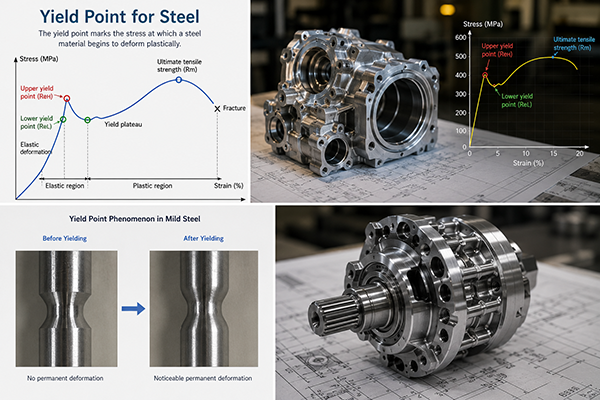
Yield Point
Yield point is observed only in certain steels, particularly low-carbon steels.
The stress-strain curve shows:
- Upper yield point
- Drop in stress
- Lower yield point
- Stable yielding plateau
This phenomenon is caused by dislocations breaking free from interstitial carbon and nitrogen atoms.
Yield Strength
Many steels do not display a clear yield point.
Examples include:
- Stainless steel
- Tool steel
- High-strength alloy steel
- Heat-treated steel
- Aluminum alloys
- Titanium alloys
Instead, engineers determine the 0.2% offset yield strength, representing the stress required to produce a permanent strain of 0.2%.
This method provides a consistent basis for comparing materials.
Engineering Example
Suppose two steels have the following properties:
| Property | Steel A | Steel B |
|---|---|---|
| Upper Yield Point | 250 MPa | None |
| Lower Yield Point | 235 MPa | None |
| 0.2% Yield Strength | 240 MPa | 880 MPa |
| Tensile Strength | 410 MPa | 980 MPa |
Steel A is a mild structural steel.
Steel B is a quenched-and-tempered alloy steel.
Even though Steel B has no visible yield point, it is significantly stronger and more suitable for high-load applications.
Which Value Should Designers Use?
Modern engineering standards generally recommend using yield strength because it applies to virtually all engineering materials.
However, when working with mild steels that exhibit distinct yielding behavior, understanding the actual yield point remains valuable for analyzing deformation mechanisms.
How Yield Point Is Measured (Stress-Strain Curve Explained)
Determining the yield point requires a standardized tensile test performed according to recognized testing standards such as ASTM or ISO methods.
The test measures how a steel specimen responds to increasing tensile force until fracture.
Step 1: Prepare the Test Specimen
The specimen is machined into a standardized shape with:
- Gauge length
- Uniform cross-sectional area
- Smooth surface finish
- Controlled dimensions
Accurate machining minimizes measurement errors.
Step 2: Mount the Specimen
The specimen is secured in a universal testing machine (UTM), ensuring precise alignment to avoid bending stresses.
Step 3: Apply Tensile Load
The machine gradually increases tensile force while recording:
- Load
- Extension
- Strain
- Stress
Thousands of data points are collected every second to generate the stress-strain curve.
Step 4: Identify the Yield Point
For mild steels, the curve typically shows:
- Linear elastic region
- Upper yield point
- Sudden drop to lower yield point
- Yield plateau
- Strain hardening
- Ultimate tensile strength
- Necking
- Fracture
The first noticeable departure from linearity indicates the onset of yielding.
Example Test Data
| Load (kN) | Stress (MPa) | Strain (%) |
|---|---|---|
| 10 | 50 | 0.02 |
| 20 | 100 | 0.05 |
| 30 | 150 | 0.08 |
| 40 | 200 | 0.10 |
| 48 | 240 | 0.12 |
| 50 | 250 | Upper Yield |
| 47 | 235 | Lower Yield |
| 60 | 310 | Strain Hardening |
| 85 | 430 | Ultimate Strength |
This dataset illustrates the characteristic yield drop observed in mild steel.
Why Accurate Measurement Matters
Accurate yield point data is critical for:
- Structural safety
- Product certification
- Finite Element Analysis (FEA)
- Material selection
- Fatigue assessment
- Quality assurance
- CNC process optimization
Even small inaccuracies can lead to overdesign, increased costs, or premature failure.
Yield Point Values of Common Steel Grades
Different steel grades exhibit significantly different yield points due to variations in composition, heat treatment, and processing.
The table below summarizes approximate yield strengths for commonly used steels.
| Steel Grade | Approx. Yield Strength (MPa) | Typical Applications |
|---|---|---|
| A36 Carbon Steel | 250 | Structural frames |
| S235 Structural Steel | 235 | Buildings, bridges |
| S275 Structural Steel | 275 | Machinery |
| S355 Structural Steel | 355 | Heavy equipment |
| 1018 Steel | 370 | CNC-machined parts |
| 1045 Steel | 530 | Shafts, gears |
| 4140 Alloy Steel (Q&T) | 655–950 | High-strength components |
| 4340 Alloy Steel | 740–1080 | Aerospace, defense |
| 17-4 PH Stainless Steel | 860–1170 | Medical and aerospace |
| 316 Stainless Steel | 205–310 | Corrosion-resistant equipment |
| Tool Steel D2 | 1500+ (heat-treated) | Dies and cutting tools |
Note: Values vary depending on heat treatment, product form (plate, bar, forging), and applicable material standards. Always verify the certified material test report (MTR) before final design.
Yield Point Comparison by Application
| Application | Recommended Minimum Yield Strength |
|---|---|
| General fabricated parts | 235–275 MPa |
| Precision CNC fixtures | 355 MPa |
| Hydraulic cylinders | 500 MPa+ |
| Automotive suspension | 600 MPa+ |
| Aerospace brackets | 800 MPa+ |
| Tooling and dies | 1000 MPa+ |
Practical Selection Tips
When selecting steel for CNC machining, higher yield strength is not always better. Designers should balance:
- Machinability: Lower-strength steels like 1018 are easier to machine and produce better surface finishes.
- Strength requirements: Medium-carbon and alloy steels such as 1045 and 4140 offer improved load-bearing capability.
- Cost: High-strength steels generally increase machining time, tool wear, and material costs.
- Heat treatment: Components intended for quenching and tempering should account for dimensional changes after heat treatment.
For example, a lightweight fixture that experiences moderate loading may perform perfectly with S355 steel, while a high-torque transmission shaft may require heat-treated 4140 steel to provide sufficient yield strength and fatigue resistance.
Factors Affecting the Yield Point of Steel
The yield point of steel is not a fixed value determined solely by the steel grade. Instead, it is influenced by multiple metallurgical and manufacturing factors, including chemical composition, heat treatment, grain size, cold working, manufacturing process, and service temperature. Understanding these factors enables engineers to select the most appropriate material and optimize component performance.
Chemical Composition
The alloying elements present in steel have a direct impact on its yield point by altering the microstructure and strengthening mechanisms.
| Alloying Element | Primary Effect | Influence on Yield Point |
|---|---|---|
| Carbon (C) | Increases hardness and strength | High |
| Manganese (Mn) | Improves hardenability | Medium-High |
| Chromium (Cr) | Enhances wear and corrosion resistance | Medium |
| Nickel (Ni) | Improves toughness | Medium |
| Molybdenum (Mo) | Improves high-temperature strength | High |
| Vanadium (V) | Grain refinement | Very High |
| Niobium (Nb) | Precipitation strengthening | Very High |
For example:
| Steel Grade | Carbon Content | Typical Yield Strength |
|---|---|---|
| A36 | 0.25% | 250 MPa |
| 1045 | 0.45% | 530 MPa |
| 4140 | 0.40% + Cr + Mo | 655–950 MPa |
As carbon content increases, the yield point generally rises. However, excessive carbon reduces ductility and weldability, which may not be desirable for every application.
Heat Treatment
Heat treatment is one of the most effective ways to increase the yield point.
Different heat-treatment methods produce different microstructures.
| Heat Treatment | Microstructure | Yield Strength Trend |
|---|---|---|
| Annealing | Ferrite + Pearlite | Lowest |
| Normalizing | Fine Pearlite | Moderate |
| Quenching | Martensite | Very High |
| Quenching & Tempering | Tempered Martensite | High with good toughness |
Example:
4140 alloy steel:
- Annealed: approximately 415 MPa
- Normalized: approximately 600 MPa
- Quenched and tempered: 850–950 MPa
The same material can nearly double its yield strength simply through appropriate heat treatment.
Grain Size
According to the Hall–Petch relationship, reducing grain size increases yield strength.
Smaller grains:
- Restrict dislocation movement
- Increase resistance to deformation
- Improve fatigue strength
- Enhance impact resistance
| Grain Size | Relative Yield Strength |
|---|---|
| Coarse | Low |
| Medium | Moderate |
| Fine | High |
| Ultra-Fine | Very High |
Modern thermo-mechanical controlled processing (TMCP) is widely used to produce fine-grained structural steels with excellent yield strength and toughness.
Cold Working
Cold rolling, drawing, and forging increase yield strength through strain hardening.
| Process | Yield Strength Change |
|---|---|
| Hot Rolled | Baseline |
| Cold Rolled | +20–50% |
| Cold Drawn | +30–70% |
Example:
1018 Steel
Hot rolled:
- Yield strength ≈ 370 MPa
Cold drawn:
- Yield strength ≈ 440 MPa
This increase comes at the expense of reduced ductility.
Temperature
Steel becomes significantly weaker as operating temperature increases.
Approximate reduction for carbon steel:
| Temperature | Remaining Yield Strength |
|---|---|
| 20°C | 100% |
| 200°C | 90% |
| 400°C | 70% |
| 600°C | 40% |
This explains why fire-resistant structural design must account for the reduction in yield strength during elevated-temperature exposure.
Manufacturing Process
The manufacturing route also affects the yield point.
| Manufacturing Method | Typical Characteristics |
|---|---|
| Hot Rolled | Good ductility |
| Cold Rolled | Higher yield strength |
| Forged | Dense grain structure |
| Cast | Lower mechanical consistency |
| Powder Metallurgy | Application-dependent |
Forged steels generally exhibit better grain flow and improved mechanical properties compared with cast steels.
Why Yield Point Matters in CNC Machining and Mechanical Design
For CNC manufacturers, the yield point is much more than a number listed on a material certificate—it directly influences machining quality, dimensional stability, product performance, and long-term reliability.
Maintaining Dimensional Accuracy
Precision-machined parts must remain stable during both machining and service.
If machining forces exceed the local yield point:
- Permanent deformation may occur.
- Flatness and perpendicularity can be affected.
- Tolerance stacks increase.
- Rework or scrap rates rise.
Example:
A precision aerospace bracket with a flatness tolerance of 0.02 mm may warp after machining if excessive clamping force induces plastic deformation.
Improving Structural Safety
Mechanical designers typically apply a safety factor to ensure that operational stresses remain below the material’s yield strength.
| Application | Typical Safety Factor |
|---|---|
| General machinery | 1.5–2.0 |
| Pressure vessels | 2.0–3.0 |
| Aerospace components | 2.5–4.0 |
| Lifting equipment | 3.0–5.0 |
Example Calculation
Material: S355 steel
Yield strength: 355 MPa
If a safety factor of 2 is used:
Allowable working stress = 355 ÷ 2 = 177.5 MPa
This conservative approach helps prevent permanent deformation under normal operating conditions.
Optimizing Material Costs
Choosing a steel with excessively high yield strength can unnecessarily increase costs due to:
- Higher raw material prices
- Longer machining cycles
- Increased cutting tool wear
- Greater power consumption
- More demanding heat-treatment processes
Conversely, selecting a material with insufficient yield strength may result in:
- Product deformation
- Warranty claims
- Premature failure
- Reduced customer satisfaction
An optimized material selection balances performance, machinability, and total manufacturing cost.
Impact on CNC Machinability
As yield strength increases, machining generally becomes more challenging.
| Yield Strength | Machining Difficulty |
|---|---|
| <300 MPa | Easy |
| 300–500 MPa | Moderate |
| 500–800 MPa | Difficult |
| >800 MPa | Requires advanced tooling |
High-strength steels often require:
- Carbide or ceramic cutting tools
- Reduced feed rates
- Optimized cutting speeds
- Enhanced coolant strategies
- Increased machine rigidity
Real-World CNC Example
Suppose a customer requires a hydraulic manifold capable of withstanding pressures up to 35 MPa.
Three candidate materials are evaluated:
| Material | Yield Strength | Machinability | Cost | Recommendation |
|---|---|---|---|---|
| 1018 Steel | 370 MPa | Excellent | Low | Suitable for low-pressure applications |
| 1045 Steel | 530 MPa | Good | Medium | Good balance for many industrial systems |
| 4140 Q&T | 900 MPa | Moderate | High | Recommended for high-pressure, high-fatigue environments |
By selecting 4140 quenched and tempered steel, engineers achieve higher structural reliability while maintaining acceptable machining efficiency for demanding applications.
Methods to Increase the Yield Point of Steel
Engineers often seek higher yield strength to reduce weight, improve load-bearing capacity, or extend service life. Several proven methods are available.
Heat Treatment
The most widely used approach.
Benefits include:
- Significant strength increase
- Controlled toughness
- Broad industrial applicability
Grain Refinement
Fine grains increase the number of grain boundaries, making dislocation movement more difficult.
This is commonly achieved through:
- Controlled rolling
- Thermo-mechanical processing
- Microalloying with Nb, Ti, or V
Alloying
Adding chromium, molybdenum, vanadium, nickel, or niobium improves yield strength through solid-solution and precipitation strengthening.
Example:
| Material | Yield Strength |
|---|---|
| Plain Carbon Steel | 250 MPa |
| HSLA Steel | 550 MPa |
| Low-Alloy Q&T Steel | 900 MPa |
Cold Working
Cold drawing, rolling, and forming increase dislocation density, resulting in strain hardening.
However, excessive cold work can reduce ductility and may require stress-relief heat treatment.
Surface Treatments
Some surface engineering processes can enhance resistance to localized yielding and wear, including:
- Nitriding
- Carburizing
- Induction hardening
- Shot peening (improves fatigue performance through compressive residual stresses)
These treatments primarily strengthen the surface while maintaining a tougher core.
How to Select the Right Steel Based on Yield Point
Selecting the optimal steel requires balancing mechanical performance, manufacturability, cost, and service conditions rather than simply choosing the highest yield strength.
Selection Guidelines
| Application | Recommended Steel | Typical Yield Strength |
|---|---|---|
| Structural frames | S235 / S355 | 235–355 MPa |
| General CNC parts | 1018 / 1045 | 370–530 MPa |
| Hydraulic components | 4140 | 655–950 MPa |
| Aerospace brackets | 4340 | 740–1080 MPa |
| Corrosion-resistant equipment | 316 Stainless | 205–310 MPa |
| High-strength tooling | D2 Tool Steel | 1500+ MPa |
Material Selection Checklist
Before specifying a steel grade, consider:
- Maximum working load
- Desired safety factor
- Operating temperature
- Corrosion environment
- Fatigue life requirements
- Weldability
- Machinability
- Heat-treatment requirements
- Surface finishing needs
- Total manufacturing cost
A comprehensive evaluation helps prevent overengineering while ensuring long-term reliability.
Conclusion: Partner with Xavier for Precision CNC Machining Solutions
Understanding the yield point for steel is essential for designing safe, durable, and high-performance components. Whether you are developing structural equipment, precision machine parts, automotive assemblies, or aerospace components, selecting a steel with an appropriate yield point is a critical engineering decision.
At Xavier, we combine extensive material expertise with advanced CNC machining capabilities to help customers manufacture precision components that meet demanding mechanical performance requirements. From mild carbon steels to high-strength alloy steels and stainless steels, our engineering team can recommend the most suitable material based on yield strength, machinability, service environment, and cost objectives.
Our capabilities include:
- Precision CNC milling and turning
- Multi-axis machining for complex geometries
- Tight-tolerance manufacturing
- Heat treatment coordination
- Surface finishing services
- Material selection support
- Prototype to high-volume production
Whether your project requires lightweight structural parts or high-strength mechanical components, Xavier is committed to delivering consistent quality, reliable performance, and cost-effective manufacturing solutions.
Some of the images and text in this article are collected and compiled from the internet. If there is anything inappropriate, please contact us for processing.