
15 Key Points from This Article:
- What Is Impeller Machining
- Types of Impellers and Their Applications
- 5-Axis CNC Machining for Impellers
- Materials Commonly Used for Impellers
- Closed vs Open Impeller Machining
- CAD/CAM Programming for Impeller Manufacturing
- Toolpath Strategies for Complex Blade Geometry
- Surface Finish Requirements for Impellers
- Tolerance Control in Impeller Machining
- Challenges in Thin Blade Machining
- High-Speed Machining (HSM) for Impellers
- Balancing and Post-Machining Inspection
- Impeller Machining Cost Factors
- Industries That Use Precision Impellers
- Future Trends in Advanced Impeller Manufacturing
Impeller Machining: A Complete Guide to Precision CNC Manufacturing
Impeller machining is one of the most technically demanding areas in precision CNC manufacturing. An impeller is a rotating component used in pumps, compressors, turbochargers, turbines, aerospace engines, and fluid transfer systems. Because impellers directly affect fluid flow efficiency, pressure generation, and rotational balance, machining accuracy is critical.
Modern impeller machining typically involves 5-axis CNC machining centers capable of producing highly complex curved blade surfaces with micron-level precision. Compared with ordinary CNC parts, impellers require tighter geometric tolerances, smoother surface finishes, and more advanced CAM programming strategies.
What Is Impeller Machining
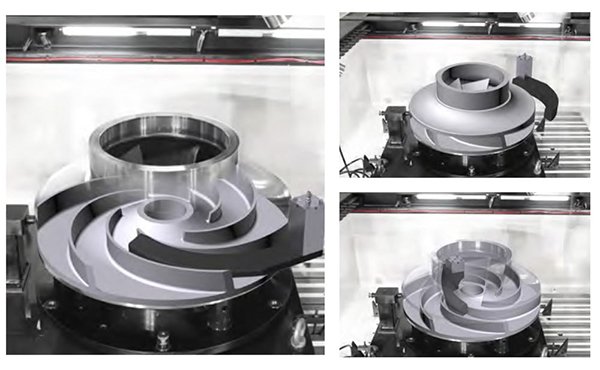
Impeller machining refers to the CNC manufacturing process used to produce rotating fluid-control components containing multiple blades or vanes.
The machining process usually starts from a forged billet, casting blank, or solid metal block. Material is progressively removed using high-speed milling tools until the final blade geometry is achieved.
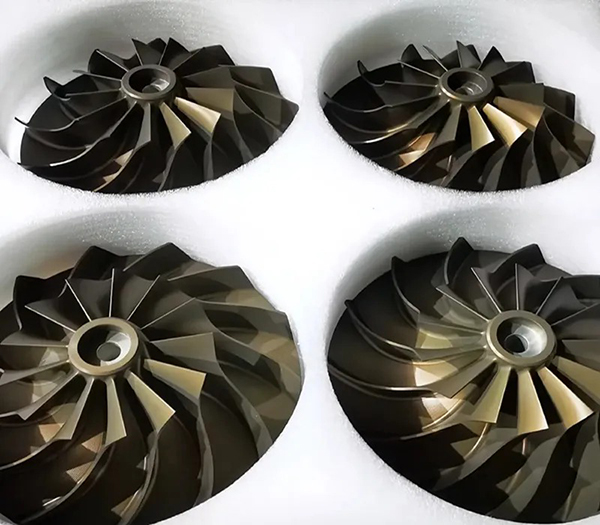
Main Machining Objectives
| Objective | Importance |
|---|---|
| Blade Accuracy | Controls fluid dynamics |
| Surface Finish | Reduces turbulence |
| Dynamic Balance | Prevents vibration |
| Geometric Precision | Ensures rotational stability |
| Material Integrity | Maintains fatigue resistance |
Even very small dimensional deviations can reduce pump or compressor efficiency significantly.
For example:
- A blade angle deviation of 1° may reduce aerodynamic efficiency by 3–5%
- Surface roughness above Ra 1.6 μm can increase flow resistance
- Imbalance at high RPM may cause catastrophic bearing failure
Types of Impellers and Their Applications
Different industries require different impeller designs depending on pressure, flow rate, and operational environment.
Open Impellers
Open impellers have visible blades without side covers.
Advantages:
- Easier cleaning
- Better handling of particles
- Lower manufacturing complexity
Applications:
- Wastewater pumps
- Slurry pumps
- Chemical systems
Closed Impellers
Closed impellers contain enclosed blade channels.
Advantages:
- Higher efficiency
- Better pressure performance
- Reduced leakage
Applications:
- Centrifugal pumps
- Turbo compressors
- Aerospace systems
Semi-Open Impellers
These combine characteristics of both open and closed designs.
Impeller Type Comparison
| Impeller Type | Efficiency | Machining Difficulty | Typical Industry |
|---|---|---|---|
| Open | Medium | Lower | Mining |
| Semi-Open | Medium-High | Medium | Chemical |
| Closed | Very High | Very High | Aerospace |
5-Axis CNC Machining for Impellers
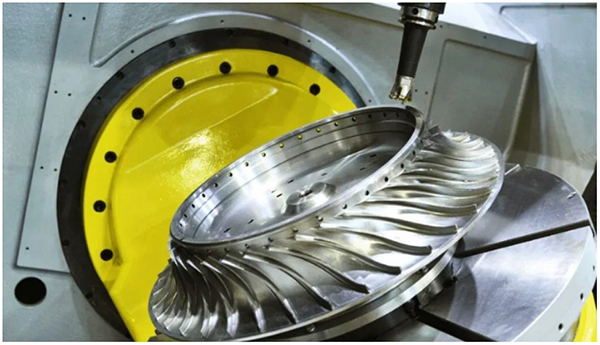
Impellers are among the most common applications for advanced 5-axis CNC machining.
Traditional 3-axis machines cannot effectively reach deep blade channels or maintain continuous tool orientation on curved surfaces.
Advantages of 5-Axis Machining
Continuous Tool Engagement
The cutting tool remains tangent to curved blade surfaces, improving finish quality.
Reduced Setup Errors
Complete machining can often be finished in one setup.
Shorter Tool Length
Shorter tools reduce vibration and chatter.
Improved Blade Accuracy
Simultaneous motion allows better contour precision.
Typical 5-Axis Machine Specifications
| Parameter | Typical Range |
|---|---|
| Spindle Speed | 12,000–30,000 RPM |
| Position Accuracy | ±0.005 mm |
| Repeatability | ±0.003 mm |
| Tool Holder Type | HSK63 / BT40 |
| Cooling System | Through-Spindle Coolant |
High-end aerospace impellers are often machined using fully simultaneous 5-axis toolpaths rather than indexed machining.
Materials Commonly Used for Impellers
Material selection affects machining difficulty, durability, corrosion resistance, and operating performance.
Aluminum Alloys
Popular grades:
- 6061
- 7075
Advantages:
- Lightweight
- Easy machining
- Good corrosion resistance
Applications:
- Automotive turbochargers
- General pumps
Stainless Steel
Popular grades:
- 304
- 316
- Duplex Stainless Steel
Advantages:
- Corrosion resistance
- High strength
Challenges:
- Work hardening
- Tool wear
Titanium Alloys
Titanium impellers are common in aerospace.
Advantages:
- High strength-to-weight ratio
- Heat resistance
Machining challenges:
- Heat concentration
- Low thermal conductivity
- Expensive tooling
Nickel-Based Superalloys
Used in:
- Jet engines
- Gas turbines
Examples:
- Inconel 718
- Hastelloy
These materials are extremely difficult to machine due to heat resistance and hardness.
Closed vs Open Impeller Machining
Closed impellers are substantially more difficult to manufacture because internal blade channels are partially enclosed.
Machining Challenges of Closed Impellers
| Challenge | Explanation |
|---|---|
| Limited Tool Access | Deep internal cavities |
| Long Reach Tools | Increased vibration |
| Chip Evacuation | Difficult coolant penetration |
| Surface Visibility | Harder inspection |
| Tool Collision Risk | Complex geometry |
Closed impellers usually require:
- Specialized CAM software
- Collision simulation
- Custom tooling
- Multi-step roughing and finishing
CAD/CAM Programming for Impeller Manufacturing
Advanced CAM software is essential for successful impeller machining.
Common CAM Software
| Software | Industry Usage |
|---|---|
| HyperMILL | Aerospace |
| Siemens NX CAM | Turbomachinery |
| Mastercam | General precision machining |
| PowerMill | Complex 5-axis machining |
Important CAM Functions
Blade Surface Projection
Ensures smooth tool movement across curved surfaces.
Collision Avoidance
Prevents holder or spindle collisions.
Toolpath Smoothing
Reduces sudden machine acceleration.
Adaptive Roughing
Improves material removal efficiency.
Toolpath Strategies for Complex Blade Geometry
Toolpath strategy directly influences machining quality and cycle time.
Common Toolpath Methods
| Strategy | Purpose |
|---|---|
| Swarf Milling | Blade wall finishing |
| Morph Between Curves | Smooth surface transition |
| Flowline Milling | Surface consistency |
| Z-Level Finishing | Steep surfaces |
| Pencil Milling | Corner cleanup |
Why Toolpath Optimization Matters
Poor toolpaths may cause:
- Surface marks
- Excessive scallops
- Vibration
- Premature tool wear
- Longer cycle time
In high-end aerospace machining, optimized toolpaths may reduce machining time by 20–35%.
Surface Finish Requirements for Impellers
Impeller surface quality directly affects fluid performance.
Typical Surface Roughness Standards
| Application | Recommended Ra |
|---|---|
| General Pumps | Ra 3.2 μm |
| Turbochargers | Ra 1.6 μm |
| Aerospace Compressors | Ra 0.8 μm |
| High-Speed Turbines | Ra 0.4 μm |
Why Smooth Surfaces Matter
Better surface quality helps:
- Reduce turbulence
- Increase flow efficiency
- Minimize cavitation
- Improve aerodynamic performance
In some aerospace applications, polishing alone can improve airflow efficiency measurably.
Tolerance Control in Impeller Machining
Impellers require strict dimensional and geometric tolerances.
Critical Tolerances
| Feature | Typical Tolerance |
|---|---|
| Blade Thickness | ±0.02 mm |
| Concentricity | ±0.01 mm |
| Bore Diameter | ±0.005 mm |
| Runout | ≤0.01 mm |
Sources of Machining Error
- Thermal expansion
- Tool deflection
- Fixture instability
- Machine vibration
- CAM programming errors
Temperature-controlled machining environments are often necessary for aerospace-grade impellers.
Challenges in Thin Blade Machining
Thin impeller blades are extremely prone to deformation.
Common Problems
Blade Chatter
Thin walls vibrate during cutting.
Thermal Distortion
Heat buildup may warp blades.
Edge Burr Formation
Sharp blade edges create burr problems.
Solutions
| Solution | Benefit |
|---|---|
| Reduced Step-Over | Lower cutting force |
| High-Speed Spindle | Smoother cutting |
| Sharp Carbide Tools | Reduced heat |
| Trochoidal Milling | Better chip evacuation |
| Dynamic Toolpaths | Stable machining |
High-Speed Machining (HSM) for Impellers
High-Speed Machining is widely used for complex impellers.
HSM Characteristics
| Parameter | Typical Value |
|---|---|
| Spindle Speed | 20,000+ RPM |
| Feed Rate | High |
| Radial Engagement | Low |
| Axial Depth | Moderate |
Advantages of HSM
- Better surface finish
- Reduced cutting force
- Lower deformation risk
- Shorter production time
However, HSM requires:
- High-rigidity machines
- Balanced tool holders
- Advanced coolant systems
Balancing and Post-Machining Inspection
Machining alone is insufficient. Impellers must also undergo balancing and inspection.
Dynamic Balancing
Impellers rotating at high speed must be balanced precisely.
Imbalance may cause:
- Noise
- Vibration
- Bearing wear
- Shaft failure
Common Inspection Methods
| Inspection Type | Purpose |
|---|---|
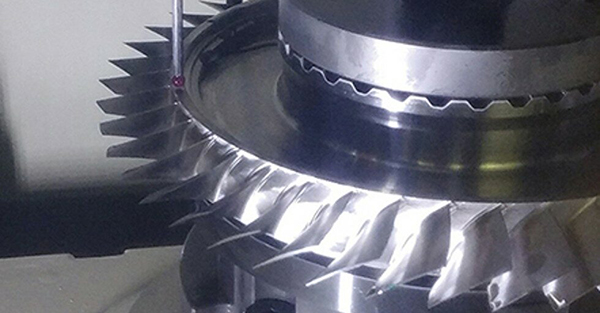
| CMM Inspection | Dimensional verification |
| Optical Scanning | Surface analysis |
| Dynamic Balancing | Rotational stability |
| Surface Roughness Test | Finish verification |
Impeller Machining Cost Factors
Impeller machining is significantly more expensive than standard CNC milling.
Main Cost Drivers
| Factor | Cost Impact |
|---|---|
| 5-Axis Machine Time | Very High |
| Material Type | High |
| CAM Programming | High |
| Tool Wear | High |
| Inspection Requirements | Medium-High |
| Surface Finish | Medium |
Example Comparison
| Part Type | Machining Time |
|---|---|
| Standard Bracket | 20 Minutes |
| Simple Open Impeller | 3–5 Hours |
| Aerospace Closed Impeller | 15–40 Hours |
The complexity difference explains the large pricing gap.
Industries That Use Precision Impellers
Aerospace
Applications:
- Jet engine compressors
- Turbine systems
- Auxiliary power units
Automotive
Applications:
- Turbocharger impellers
- Cooling pumps
Energy Industry
Applications:
- Gas turbines
- Hydroelectric systems
Medical Industry
Applications:
- Blood pumps
- Specialized fluid systems
Future Trends in Advanced Impeller Manufacturing
The future of impeller machining is increasingly digital and automated.
AI-Based Toolpath Optimization
Artificial intelligence can optimize:
- Tool engagement
- Feed rate variation
- Tool life prediction
Hybrid Manufacturing
Some manufacturers combine:
- Additive manufacturing
- CNC finishing
This is especially useful for extremely complex internal channels.
Digital Twin Simulation
Virtual simulations reduce:
- Programming errors
- Scrap rates
- Machine collision risk
Automation Integration
Modern smart factories use:
- Robotic loading
- Automatic tool monitoring
- Lights-out production
Why Xavier Is a Reliable Partner for Precision Impeller Machining
Impeller machining requires far more than standard CNC capability. It demands advanced 5-axis machining experience, deep CAM programming expertise, stable quality systems, and strict process control.
Xavier specializes in high-precision custom impeller machining for aerospace, automotive, energy, fluid control, and industrial applications. Whether manufacturing aluminum turbocharger impellers or complex titanium aerospace compressor wheels, Xavier focuses on precision, consistency, and production efficiency.
Key strengths include:
- Advanced simultaneous 5-axis CNC machining
- Experienced turbomachinery machining engineers
- High-speed machining capability
- Strict tolerance and balancing control
- Precision inspection systems
- Flexible prototype and production support
- Support for titanium, stainless steel, Inconel, and aluminum alloys
For customers seeking reliable impeller machining solutions with stable quality and fast turnaround, Xavier provides a professional manufacturing partnership capable of handling highly complex geometries and demanding engineering requirements.
We are a professional CNC machining manufacturer specializing in custom CNC machining services and precision machining solutions for a wide range of metal parts. We support CNC Electroless Nickel Plating Surface Finishing, CNC Chemical Conversion Coating Surface Finishing, and CNC Electrogalvanizing Surface Finishing.
We are a trusted CNC Electroless Nickel Plating Surface Finishing Manufacturer, providing large-volume CNC Chemical Conversion Coating Surface Finishing Services. Contact us today for the latest CNC Electrogalvanizing Surface Finishing Price.
Some of the images and text in this article are collected and compiled from the internet. If there is anything inappropriate, please contact us for processing.