PVC vs ABS Plastic: Differences, Properties, and Industrial Applications
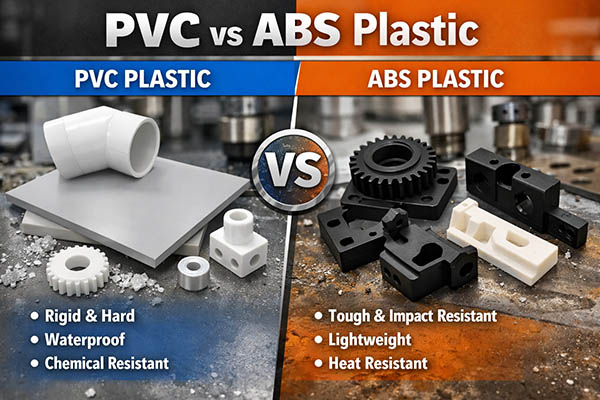
In modern manufacturing and CNC machining, PVC (Polyvinyl Chloride) and ABS (Acrylonitrile Butadiene Styrene) are two of the most widely used thermoplastics. Both materials are inexpensive, easy to process, and widely applied in industries such as construction, automotive, electronics, and consumer products. However, despite their similar popularity, their mechanical properties, chemical resistance, temperature tolerance, and machining behavior differ significantly.
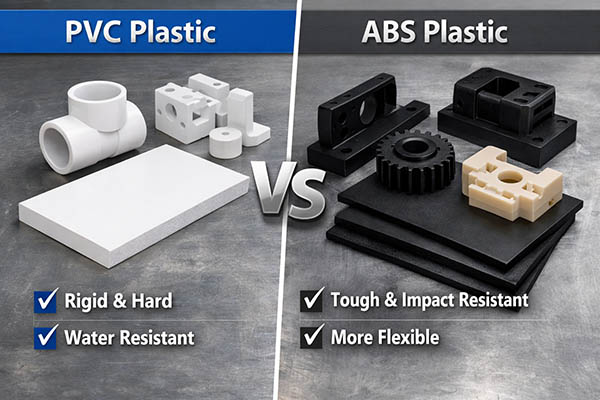
ABS is generally known for impact resistance and toughness, making it suitable for mechanical parts and housings. PVC, on the other hand, is widely recognized for chemical resistance, corrosion resistance, and cost efficiency, which makes it ideal for piping, insulation, and construction applications.
Understanding these differences helps engineers and CNC machining buyers choose the right plastic material for a specific project. The following 10 technical topics explain the key distinctions between PVC and ABS in detail.
Material Composition and Polymer Structure
Chemical Composition of PVC
PVC is a thermoplastic polymer produced from vinyl chloride monomers. Its molecular structure is based on repeating units of (C₂H₃Cl)n. The chlorine atoms in the molecular chain significantly improve chemical resistance and flame retardancy.
PVC materials are often modified by adding additives such as:
- Plasticizers (increase flexibility)
- Stabilizers (improve heat stability)
- Lubricants (enhance processing)
These additives allow manufacturers to produce both rigid PVC and flexible PVC materials.
Chemical Composition of ABS
ABS is a copolymer made from three monomers:
| Component | Function |
|---|---|
| Acrylonitrile | Chemical resistance and thermal stability |
| Butadiene | Toughness and impact resistance |
| Styrene | Rigidity and glossy appearance |
This combination gives ABS its well-known balance of strength, toughness, and surface quality.
Density and Weight Comparison
Material density affects product weight, machining performance, and structural design.
| Material | Density Range |
|---|---|
| ABS | 1.04 – 1.07 g/cm³ |
| PVC | 1.30 – 1.50 g/cm³ |
PVC is generally heavier than ABS, which may influence transportation costs and structural loads in large assemblies.
ABS’s lower density makes it attractive for lightweight industrial parts and consumer products.
Mechanical Strength and Impact Resistance
One of the biggest differences between PVC and ABS lies in mechanical performance.
| Property | ABS | PVC |
|---|---|---|
| Tensile Strength | 35–50 MPa | 40–55 MPa (rigid PVC) |
| Impact Strength | High | Lower |
| Toughness | Excellent | Moderate |
ABS is widely recognized for its high impact resistance and toughness, especially at low temperatures.
For example:
- Protective helmets
- Automotive bumpers
- Electronic housings
These products often use ABS because it can absorb shocks without cracking.
PVC, however, tends to be more brittle in rigid form.
Heat Resistance and Thermal Stability
Temperature performance plays a key role in plastic selection.
| Property | ABS | PVC |
|---|---|---|
| Vicat Softening Temperature | 88–105°C | 75–90°C |
| Heat Stability | Moderate | Lower |
ABS generally withstands higher temperatures compared with PVC, making it suitable for components exposed to moderate heat.
PVC tends to soften earlier under heat, which limits its use in high-temperature environments.
Chemical Resistance and Corrosion Resistance
PVC is known for its excellent chemical durability.
| Chemical Resistance | ABS | PVC |
|---|---|---|
| Acids | Moderate | Excellent |
| Alkalis | Moderate | Excellent |
| Solvents | Moderate | Moderate |
PVC’s chlorine content gives it strong resistance to acids, bases, and corrosive chemicals, which explains why it is widely used in chemical pipelines and industrial fluid systems. pvc vs abs plastic
ABS performs adequately against diluted chemicals but is more sensitive to organic solvents.

Flame Resistance and Safety Performance
PVC has a natural advantage in flame resistance.
| Property | ABS | PVC |
|---|---|---|
| Flame Resistance | Requires additives | Naturally flame retardant |
| Fire Behavior | Burns easily | Self-extinguishing |
PVC’s chlorine atoms help prevent flame propagation, making it common in:
- electrical cable insulation
- building materials
- industrial piping systems
ABS usually requires flame-retardant additives to meet fire safety standards.
Processing and Manufacturing Methods
Both plastics support a wide range of manufacturing processes.
ABS Processing
ABS is widely used in:
- injection molding
- CNC machining
- 3D printing
- thermoforming
Its good flow properties and dimensional stability make it easy to process.
PVC Processing
PVC is commonly produced using:
- extrusion
- injection molding
- blow molding
- calendaring
PVC processing often requires special temperature control to prevent thermal degradation.
Machinability in CNC Manufacturing
For CNC plastic machining, ABS often performs better.
| Property | ABS | PVC |
|---|---|---|
| Tool Wear | Low | Low |
| Dimensional Stability | Excellent | Good |
| Chip Formation | Clean | Slightly gummy |
ABS machines easily and produces clean edges, making it suitable for:
- electronic housings
- precision brackets
- custom mechanical parts
PVC can also be machined, but soft PVC grades may cause melting or burr formation during cutting.
Typical Industrial Applications
Both plastics are widely used across industries but for different reasons.
ABS Applications
Common ABS products include:
- LEGO bricks
- automotive interior parts
- luggage shells
- appliance housings
These applications benefit from ABS’s impact resistance and aesthetic surface quality.
PVC Applications
PVC is widely used in:
- plumbing pipes
- cable insulation
- flooring materials
- construction panels
PVC’s chemical resistance and low cost make it ideal for large-scale construction use.
Cost and Economic Considerations
Material cost is often a deciding factor in engineering projects.
| Material | Relative Cost |
|---|---|
| PVC | Low |
| ABS | Medium |
PVC is generally cheaper because its raw materials are more abundant and easier to manufacture.
ABS costs slightly more but provides superior mechanical performance.
How to Choose Between PVC and ABS
Choose PVC when:
- chemical resistance is critical
- fire safety is important
- cost must be minimized
- large piping systems are required
Choose ABS when:
- impact resistance is necessary
- good surface finish is required
- mechanical durability is critical
- parts require CNC machining precision
In many industries, the choice depends on balancing cost, mechanical strength, environmental exposure, and processing requirements.
Xavier Manufacturing Recommendation
For precision parts manufacturing, selecting the correct plastic material can significantly affect durability, machining quality, and product performance.
At Xavier, we provide professional CNC plastic machining services for engineering-grade thermoplastics including:
- ABS plastic for high-impact mechanical parts
- PVC plastic for corrosion-resistant industrial components
- Custom machined polymer parts for electronics and equipment
Our engineering team helps customers choose the right material based on strength requirements, chemical exposure, temperature conditions, and machining complexity. pvc vs abs plastic
Whether you need prototypes or large-scale production, Xavier delivers high-precision CNC plastic components with reliable quality and fast turnaround.
Some of the images and text in this article are collected and compiled from the internet. If there is anything inappropriate, please contact us for processing.