
7075 Alloy: A Detailed Guide to Properties, Heat Treatment, Machining, and Applications
7075 alloy is one of the most widely recognized high-strength aluminum alloys used for demanding engineering applications. It belongs to the 7000 series of aluminum alloys and is primarily alloyed with zinc, with magnesium and copper providing additional strengthening. Compared with common aluminum grades such as 6061, 7075 is selected when strength-to-weight ratio is more important than general-purpose corrosion resistance or weldability.
For CNC machining, 7075 aluminum is particularly attractive because it combines relatively low density with high mechanical strength and good machinability. It can be machined into lightweight structural components, aerospace fittings, housings, brackets, shafts, gears, and precision mechanical parts while maintaining tight dimensional tolerances.
However, “7075 aluminum” is not a single set of properties. The temper condition, product form, heat treatment, section thickness, and manufacturing process can significantly affect its mechanical performance. For this reason, engineers should distinguish between conditions such as 7075-T6, 7075-T651, 7075-T73, and 7075-T7351 when selecting material for a CNC-machined component.
1. What Is 7075 Alloy?
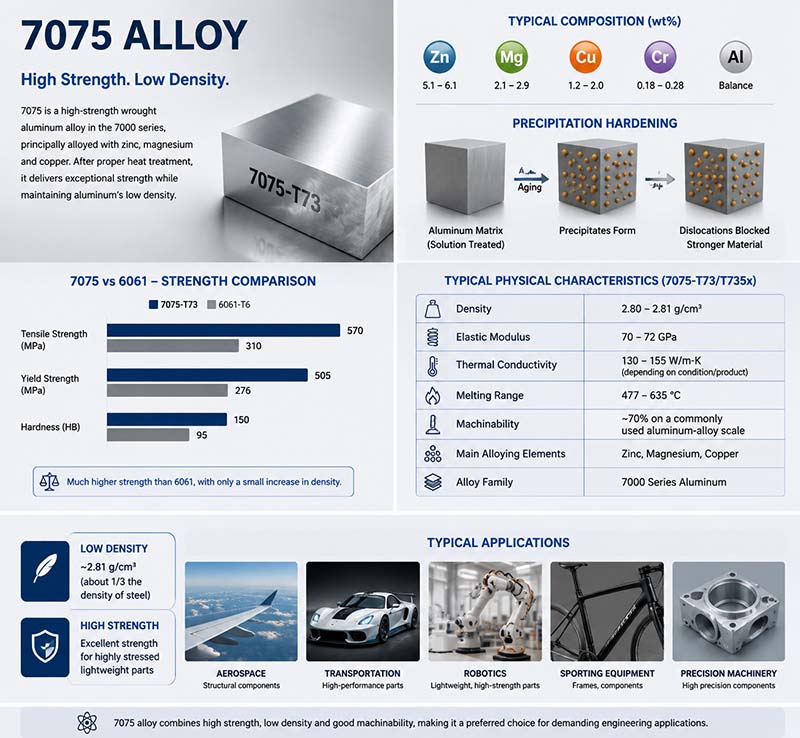
7075 is a wrought aluminum alloy in the 7000 series. Its principal alloying element is zinc, while magnesium and copper contribute significantly to precipitation hardening. Typical composition data for 7075-T73/T735x include approximately 2.1–2.9% magnesium, 1.2–2.0% copper, and 0.18–0.28% chromium, with aluminum making up the balance.
Why Zinc Makes 7075 Different
The high zinc content is one of the main reasons 7075 can achieve very high strength after appropriate heat treatment. During solution heat treatment and aging, alloying elements form strengthening precipitates within the aluminum matrix. These precipitates restrict dislocation movement, increasing hardness and strength.
This gives 7075 a different performance profile from more general-purpose alloys such as 6061. A component manufactured from 7075 can achieve considerably higher tensile and yield strength while retaining aluminum’s relatively low density.
Typical Physical Characteristics
| Property | Typical 7075 Value |
|---|---|
| Density | About 2.80–2.81 g/cm³ |
| Elastic Modulus | About 70–72 GPa |
| Thermal Conductivity | Approximately 130–155 W/m·K, depending on condition/product |
| Melting Range | Approximately 477–635°C |
| Machinability | Around 70% on a commonly used aluminum-alloy scale |
| Main Alloying Elements | Zinc, magnesium, copper |
| Alloy Family | 7000 Series Aluminum |
The density of 7075 is only about 2.81 g/cm³, which is considerably lower than many steels. At the same time, its strength can approach levels that make it useful for highly stressed lightweight components. MatWeb lists a density of 2.81 g/cm³ for 7075-T73/T735x.
This combination is one of the main reasons 7075 is popular in aerospace, transportation, robotics, sporting equipment, and precision machinery.
2. 7075 Alloy Mechanical Properties and Strength
The most important reason engineers choose 7075 is its high strength-to-weight ratio. The exact values depend heavily on temper, product form, thickness, grain direction, and applicable material specification.
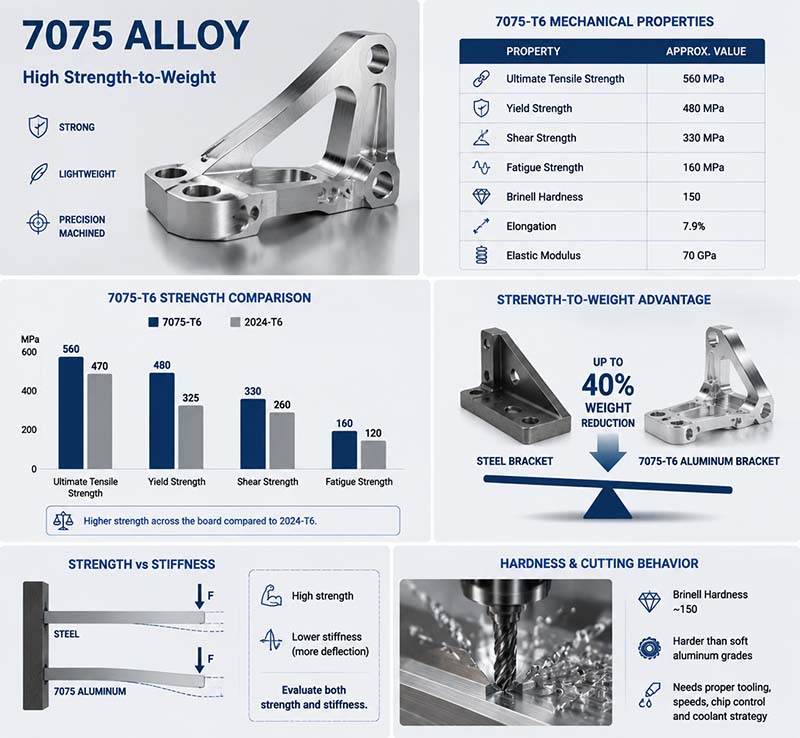
For example, a commonly referenced 7075-T6 condition has an ultimate tensile strength of approximately 560 MPa and a yield strength of approximately 480 MPa in published material-property data.
7075-T6 Mechanical Performance
| Property | 7075-T6 Approximate Value |
|---|---|
| Ultimate Tensile Strength | 560 MPa |
| Yield Strength | 480 MPa |
| Shear Strength | 330 MPa |
| Fatigue Strength | 160 MPa |
| Brinell Hardness | 150 |
| Elongation | 7.9% |
| Elastic Modulus | 70 GPa |
These figures illustrate why 7075-T6 is often considered when a machined part must carry substantial loads without becoming excessively heavy. For comparison, published data for 7075-T6 show higher tensile, yield, shear, and fatigue strength than the corresponding values listed for 2024-T6 in the same comparison dataset.
Strength-to-Weight Ratio Matters
Suppose a mechanical bracket needs to support a high load but the total assembly weight must be minimized. Replacing a steel bracket with a properly designed 7075 aluminum bracket may significantly reduce mass while retaining sufficient structural strength.
However, this does not mean that 7075 can simply replace steel at the same dimensions. Aluminum has a lower elastic modulus than steel, so a 7075 part may experience greater elastic deflection under the same load even when its ultimate strength is sufficient.
For precision CNC components, engineers therefore need to evaluate both strength and stiffness.
Hardness and Cutting Behavior
7075-T6 has a reported Brinell hardness of around 150 in one commonly referenced dataset. This is considerably harder than many softer aluminum grades, but it remains readily machinable with appropriate carbide tooling.
The practical implication is important: 7075 does not behave exactly like soft aluminum during CNC machining. Tool geometry, cutting speed, chip evacuation, workholding, and coolant strategy all influence surface finish and dimensional stability.
3. 7075-T6, T651, T73, and T7351: Why Temper Matters
A common mistake when specifying 7075 aluminum is to specify only “7075” without identifying the temper. The temper designation describes the material’s heat-treatment and mechanical condition and can substantially change the balance between strength and environmental resistance.
7075-T6
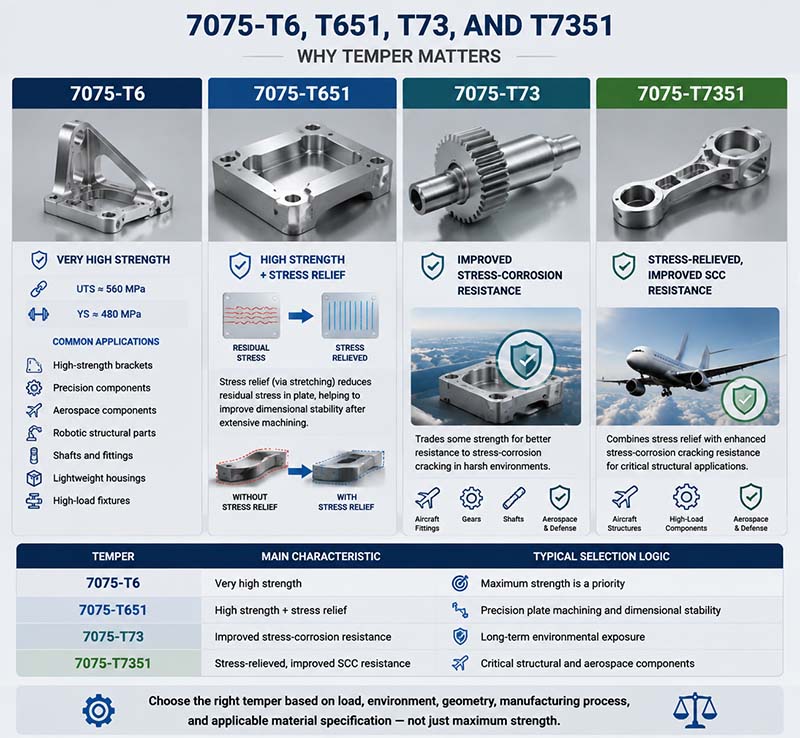
7075-T6 is solution heat-treated and artificially aged to achieve high strength. It is widely used when maximum or near-maximum strength is a primary design requirement. Published data give approximately 560 MPa ultimate tensile strength and 480 MPa yield strength for one 7075-T6 reference condition.
For CNC machining, T6 is commonly selected for:
- High-strength brackets
- Precision mechanical components
- Aerospace components
- Robotic structural parts
- Shafts and fittings
- Lightweight housings
- High-load fixtures
7075-T651
7075-T651 is also a high-strength condition but includes stress relieving after solution heat treatment, commonly through controlled stretching. This is particularly relevant to machined plates because residual stresses can influence dimensional stability when substantial amounts of material are removed.
For example, imagine machining a 50 mm thick 7075 plate into a component where 70–80% of the original material is removed. If the stock contains significant residual stress, machining can release that stress and cause the finished component to move or distort.
Using an appropriate stress-relieved temper can help reduce this risk.
7075-T73 and T7351
T73 and related T735x tempers intentionally trade some strength for improved resistance to stress-corrosion cracking. MatWeb specifically identifies the T7351 temper as offering improved stress-corrosion cracking resistance and lists applications including aircraft fittings, gears, shafts, and other aerospace and defense components.
This difference is critical in real engineering applications.
A designer working on a highly loaded aerospace component exposed to a corrosive environment may prefer T73/T7351 rather than automatically selecting T6 for maximum strength.
| Temper | Main Characteristic | Typical Selection Logic |
|---|---|---|
| 7075-T6 | Very high strength | Maximum strength is a priority |
| 7075-T651 | High strength + stress relief | Precision plate machining and dimensional stability |
| 7075-T73 | Improved stress-corrosion resistance | Long-term environmental exposure |
| 7075-T7351 | Stress-relieved, improved SCC resistance | Critical structural and aerospace components |
The correct temper should therefore be selected according to the actual load, environment, geometry, manufacturing process, and applicable material specification rather than simply choosing the strongest condition.
4. Is 7075 Aluminum Good for CNC Machining?
Yes. 7075 is generally considered a good CNC machining material, especially when compared with many high-strength steels and nickel-based alloys.
A commonly referenced material-property database assigns 7075-T73/T735x a machinability value of approximately 70% on its aluminum-alloy scale.
Cutting 7075 Aluminum
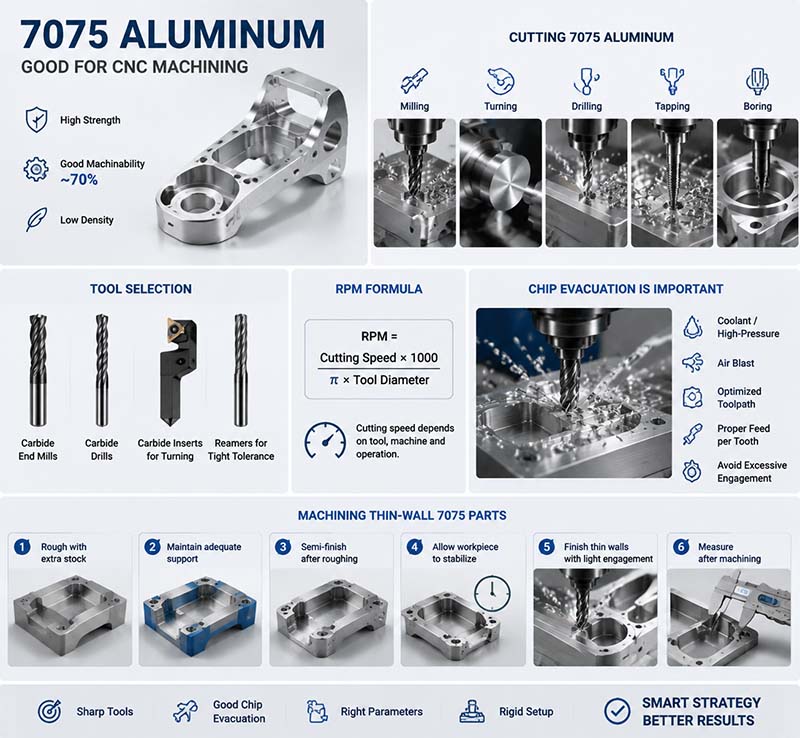
7075 responds well to milling, turning, drilling, tapping, boring, and other conventional CNC processes. Carbide tools are commonly preferred for production machining because they provide good wear resistance and allow higher cutting performance than many conventional tool materials.
For milling, sharp tools with suitable rake and clearance geometry help reduce cutting forces and prevent excessive rubbing. Because aluminum can form built-up edge under unsuitable cutting conditions, tool sharpness and chip evacuation are particularly important.
Tool Selection
A typical production setup may use:
- Carbide end mills for roughing and finishing
- Carbide drills for precision holes
- Suitable carbide or coated tooling for high-volume production
- Single-point carbide inserts for CNC turning
- Reamers where tighter hole size control is required
The exact cutting parameters should be established from the tool manufacturer’s recommendations, machine rigidity, tool diameter, radial engagement, axial depth of cut, coolant strategy, and required surface finish.
There is no single “best RPM” for every 7075 component.
For example, a small 6 mm end mill operating at a high spindle speed may be appropriate for one machine and tool combination, while a large 25 mm cutter requires completely different parameters.
A useful starting relationship is:
Spindle Speed (RPM) = Cutting Speed × 1000 ÷ (π × Tool Diameter)
The actual cutting speed should then be selected based on tool material and geometry rather than using a generic number for every machining operation.
Chip Evacuation Is Important
7075 produces relatively manageable chips when machined correctly, but poor chip evacuation can still create problems.
During deep-pocket milling, chips trapped inside a cavity can be recut repeatedly. This increases heat generation and can damage the surface finish. It may also cause chips to weld onto the cutting edge.
For this reason, production machining of 7075 often benefits from:
- High-pressure or well-directed coolant
- Air blast where appropriate
- Optimized toolpath strategies
- Sufficient flute spacing
- Proper feed per tooth
- Avoiding excessive radial engagement
Machining Thin-Wall 7075 Parts
7075 is strong, but a thin wall can still deflect during machining.
Consider a 7075 housing with a 1.0 mm wall. The material itself may have excellent tensile strength, but the wall has very little structural stiffness because stiffness depends strongly on geometry.
A better machining strategy may involve:
- Roughing the component while leaving additional stock.
- Maintaining adequate support around thin features.
- Performing semi-finishing after roughing.
- Allowing the workpiece to stabilize.
- Finishing thin walls with lighter radial engagement.
- Measuring the part after machining.
For demanding aerospace or precision components, machining strategy can be just as important as the nominal material specification.
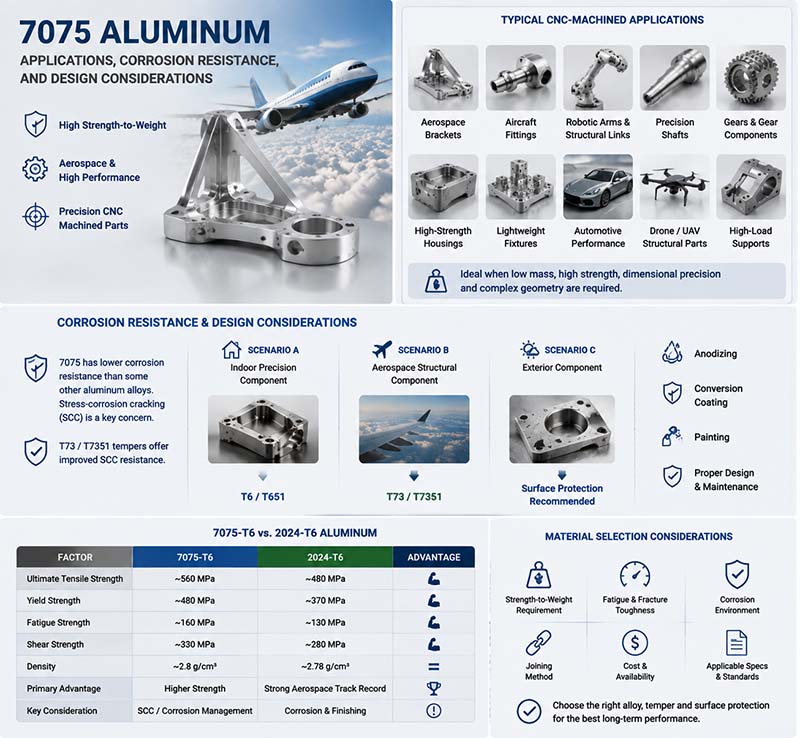
5. 7075 Aluminum Applications, Corrosion Resistance, and Design Considerations
7075 is widely associated with aerospace because its high strength-to-weight ratio makes it suitable for highly stressed structural and mechanical components.
Published material references list applications such as aircraft fittings, gears, shafts, fuse parts, meter shafts, worm gears, and aerospace and defense components for 7075-T73/T735x materials.
Typical CNC-Machined Applications
7075 is suitable for components such as:
- Aerospace brackets
- Aircraft fittings
- Robotic arms and structural links
- Precision shafts
- Gears and gear components
- High-strength housings
- Lightweight fixtures
- Automotive performance components
- Drone and UAV structural parts
- High-load mechanical supports
For CNC machining, the material is especially useful when the finished part requires a combination of low mass, high strength, dimensional precision, and complex geometry.
Corrosion Resistance
7075 requires more careful consideration of corrosion than some more corrosion-resistant aluminum alloys.
This is particularly important because high-strength 7075 contains copper and has a microstructure optimized for strength. Depending on temper and environment, stress-corrosion cracking can become a significant design consideration.
This is one reason T73/T7351 conditions exist. MatWeb specifically notes improved stress-corrosion cracking resistance for 7075-T7351 compared with high-strength conditions.
The choice between T6 and T73 should therefore not be based solely on tensile strength.
For example:
Scenario A — Indoor precision machine component
A 7075-T6 or T651 component may be appropriate when the environment is controlled and high strength is the primary requirement.
Scenario B — Aerospace structural component
A T73/T7351 condition may be more appropriate if long-term resistance to stress-corrosion cracking is a major requirement.
Scenario C — Exterior component
The material specification and surface protection should be evaluated together. Depending on the application, anodizing, conversion coating, painting, or another suitable finishing process may be considered.
7075 vs. 2024 Aluminum
7075 and 2024 are both widely used aerospace aluminum alloys, but they are not interchangeable.
One published comparison lists 7075-T6 at approximately 560 MPa ultimate tensile strength and 480 MPa yield strength, compared with approximately 480 MPa ultimate tensile strength and 370 MPa yield strength for 2024-T6 in that dataset.
| Factor | 7075-T6 | 2024-T6 |
|---|---|---|
| Ultimate Tensile Strength | ~560 MPa | ~480 MPa |
| Yield Strength | ~480 MPa | ~370 MPa |
| Fatigue Strength | ~160 MPa | ~130 MPa |
| Shear Strength | ~330 MPa | ~280 MPa |
| Density | ~2.8 g/cm³ | ~2.78 g/cm³ |
| Primary Advantage | Higher strength | Strong aerospace performance and established applications |
| Key Consideration | SCC/corrosion management | Corrosion and finishing requirements |
The comparison shows why 7075 is attractive when strength is the dominant requirement. However, material selection should also consider fatigue, fracture toughness, corrosion environment, joining method, cost, availability, and required temper.
Choosing 7075 for a CNC-Machined Part
When requesting CNC machining for a 7075 component, providing the material grade and temper is much better than simply specifying “7075 aluminum.”
A complete drawing or RFQ should ideally identify:
- Material: Aluminum 7075
- Temper: T6, T651, T73, T7351, etc.
- Material standard when required
- Finished dimensions
- Critical tolerances
- Surface finish requirements
- Surface treatment
- Heat-treatment requirements
- Quantity
- Inspection requirements
For example, instead of writing:
Material: 7075 Aluminum
a more useful specification could be:
Material: Aluminum 7075-T651, machined from plate, with specified dimensional tolerances and surface finish.
This gives the CNC manufacturer much more information for material sourcing, process planning, machining, inspection, and quality control.
Why 7075 Is a Strong Choice for Precision CNC Manufacturing
7075 alloy offers a particularly useful combination of properties for precision CNC manufacturing. Its density is only around 2.8 g/cm³, while high-strength tempers can provide tensile strengths around 500–560 MPa or higher depending on product form and specification.
The material is therefore well suited to applications where engineers need to remove weight without sacrificing load-carrying capability.
At the same time, 7075 should not be treated as a generic aluminum grade. Temper selection, residual stress, corrosion environment, tool selection, workholding, machining strategy, and surface finishing can all influence the final performance of a CNC-machined component.
For prototypes and production parts, Xavier provides CNC machining solutions for demanding aluminum components, including high-strength 7075 alloy. From material selection and machining strategy to precision milling, turning, drilling, finishing, and dimensional inspection, Xavier can help transform 7075 designs into production-ready components.
If your drawing specifies 7075-T6, 7075-T651, 7075-T73, or another condition, providing the complete material designation with your CAD file allows the machining team to select the appropriate process and quality-control requirements from the beginning.
We are an integrated trading and manufacturing company specializing in CNC machining services, with a primary focus on custom CNC machining and the production of precision metal parts. We support CNC machining of alloy steel, CNC machining of PEEK, CNC machining of titanium, as well as aluminum, brass, bronze, copper, Inconel, Invar 36, low-carbon steel, stainless steel, tool steel, ABS, FR4, G-10, nylon, PEI, PET, PMMA (acrylic), polycarbonate, polyethylene, polypropylene, POM (polyacetal/acetal), PPSU, PTFE (polytetrafluoroethylene), and PVC. Our CNC machining capabilities are suitable for robot components, aerospace parts, marine components, automotive parts, medical components, and other precision-engineered parts.
We are an alloy steel machining manufacturer offering PEEK machining services in volume, and you can contact us for titanium machining prices. Feel free to contact us for your custom CNC machining requirements.
Some of the images and text in this article are collected and compiled from the internet. If there is anything inappropriate, please contact us for processing.