In-Depth Guide to 14 Gauge Metal in Manufacturing and CNC Fabrication
What 14 Gauge Metal Means in Sheet Metal Standards
In sheet metal fabrication, the gauge system is widely used to describe material thickness instead of metric units. The key rule is simple but often confusing: the lower the gauge number, the thicker the metal sheet.
The system originated during early rolling-mill manufacturing, where thickness was defined by the number of rolling passes needed to reach the final sheet thickness. Over time, it became standardized for industrial communication.
Today, sheet metal gauges are used extensively in industries such as:
- Automotive manufacturing
- HVAC duct fabrication
- Electrical enclosures
- Structural brackets
- CNC sheet metal parts
For example, a fabrication engineer ordering sheet material may specify:
Material: 14 Gauge Mild Steel
Process: Laser cutting + CNC bending
Finish: Powder coating
This single specification tells suppliers both the material type and approximate thickness, which determines strength, machining parameters, and cost.
Exact Thickness of 14 Gauge Metal (Steel, Stainless, Aluminum)
A common misconception is that 14 gauge always equals one exact thickness, but in reality the value varies slightly depending on the material standard used.
Typical values are shown below.
| Material | Thickness (inch) | Thickness (mm) |
|---|---|---|
| Mild Steel | 0.0747 in | 1.90 mm |
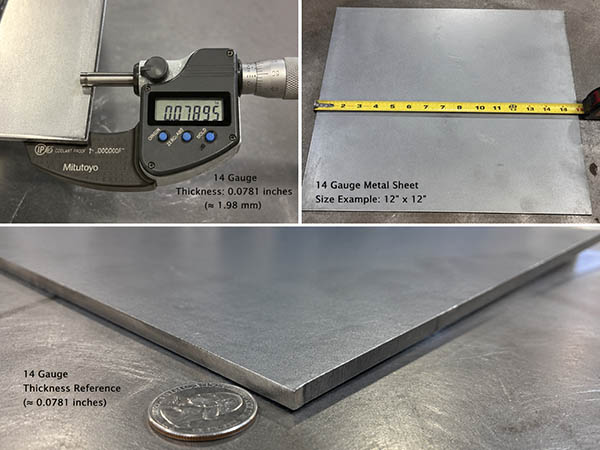
| Stainless Steel | 0.0781 in | ~2.0 mm |
| Aluminum | 0.0641 in | ~1.63 mm |
| Galvanized Steel | ~0.0785 in | ~1.99 mm |
Standard 14 gauge carbon steel is about 0.0747 inches (1.9 mm) thick according to U.S. sheet metal gauge charts.
Because aluminum and stainless steel use slightly different gauge charts, the same gauge number can represent different actual thickness values.
For CNC manufacturing, it is always recommended to specify:
14 gauge stainless steel (0.078 in)
rather than only writing “14 gauge”.
Gauge System vs Metric Thickness in Manufacturing
Modern manufacturing often uses millimeters or decimal inches, but the gauge system remains popular in North America because of historical standardization.
A typical conversion table used in sheet metal workshops looks like this:
| Gauge | Inches | Millimeters |
|---|---|---|
| 12 | 0.1046 | 2.66 |
| 14 | 0.0747 | 1.90 |
| 16 | 0.0598 | 1.52 |
| 18 | 0.0478 | 1.21 |
In international CNC production, designers usually provide both units in engineering drawings to avoid misunderstandings between suppliers.
Example:
Material thickness: 1.9 mm (14 gauge steel)
Tolerance: ±0.05 mm
This improves manufacturing accuracy and prevents procurement errors.
Weight Calculation of 14 Gauge Sheet Metal
Weight estimation is critical when designing sheet metal parts, particularly for structural frames or large panels.
The basic formula used by engineers is:
Weight = Length × Width × Thickness × Density
Typical weight per unit area for 14 gauge sheets:
| Material | Weight (lb/ft²) | Weight (kg/m²) |
|---|---|---|
| Mild Steel | 3.125 | 15.25 |
| Stainless Steel | 3.281 | 16.01 |
| Aluminum | 1.875 | 9.15 |
For example:
A 1 m × 1 m 14-gauge steel sheet weighs about 14.9 kg using standard density calculations.
Weight estimation helps engineers design:
- mounting brackets
- load-bearing panels
- equipment housings
without exceeding structural limits.
Mechanical Strength and Structural Properties
14 gauge metal is generally classified as a medium-thickness sheet metal that provides a strong balance between strength and formability.
Typical advantages include:
- High structural rigidity
- Good impact resistance
- Acceptable bending performance
- Strong load-bearing capability
For example:
| Thickness | Typical Use |
|---|---|
| 18 gauge | Lightweight covers |
| 16 gauge | Cabinets and housings |
| 14 gauge | Structural panels and brackets |
| 12 gauge | Heavy-duty frames |
This balance makes 14 gauge particularly popular for industrial equipment and fabrication.
14 Gauge vs 12 Gauge vs 16 Gauge Comparison
Understanding thickness differences helps designers select the correct material.
| Gauge | Thickness | Typical Strength |
|---|---|---|
| 12 Gauge | 0.1046 in | Very strong |
| 14 Gauge | 0.0747 in | Medium-heavy |
| 16 Gauge | 0.0598 in | Medium |
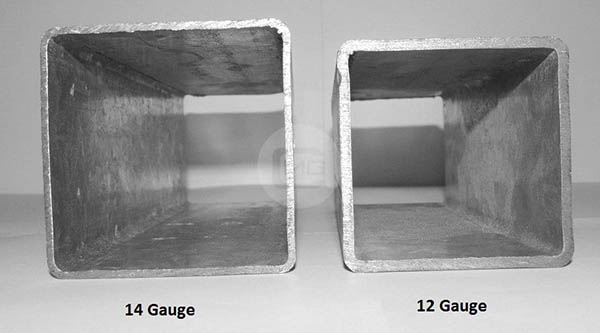
12 gauge steel is roughly 40% thicker and heavier than 14 gauge, making it suitable for heavy-duty structural components.
Meanwhile, 16 gauge is thinner and easier to form, but it provides less rigidity.
Typical Materials Available in 14 Gauge
Several metals are commonly produced in 14 gauge thickness.
Common sheet metals include:
- Carbon steel
- Stainless steel (304 / 316)
- Aluminum alloys (5052 / 6061)
- Galvanized steel
- Copper
Each material provides different advantages:
| Material | Key Advantage |
|---|---|
| Carbon Steel | Strength + low cost |
| Stainless Steel | Corrosion resistance |
| Aluminum | Lightweight |
| Galvanized Steel | Rust protection |
Selecting the right alloy is often more important than choosing the gauge alone.
Common Industrial Applications
14 gauge metal appears in many fabrication industries due to its balanced mechanical properties.
Typical applications include:
- automotive floor pans
- electrical enclosures
- HVAC duct systems
- trailer frames
- equipment guards
- decorative architectural panels
Manufacturers prefer 14 gauge because it maintains structural stability while remaining machinable with standard sheet metal equipment.
CNC Cutting Methods for 14 Gauge Metal
Several CNC cutting technologies work efficiently with 14 gauge sheet metal.
Common methods include:
Laser cutting
Advantages:
- extremely precise edges
- minimal heat distortion
- ideal for complex shapes
CNC plasma cutting
Advantages:
- fast cutting speed
- cost-effective for thick steel
Waterjet cutting
Advantages:
- no heat-affected zone
- excellent for aluminum and stainless steel
In most precision manufacturing environments, fiber laser cutting is the preferred process for 14 gauge sheet metal components.
Bending and Forming Considerations
14 gauge metal requires careful bending design to avoid cracking or deformation.
Important design rules include:
- minimum bend radius ≈ 1× material thickness
- correct press brake tooling selection
- grain direction consideration
Example bending guideline:
| Material | Recommended Bend Radius |
|---|---|
| Mild steel | 1 × thickness |
| Stainless steel | 1.5 × thickness |
| Aluminum | 2 × thickness |
Following these rules prevents micro-cracking along bend lines.
Welding Characteristics of 14 Gauge Metal
Welding is commonly used when assembling sheet metal structures.
Suitable welding processes include:
- MIG welding
- TIG welding
- spot welding
Advantages of 14 gauge thickness:
- strong weld penetration
- manageable heat distortion
- good structural joint strength
However, welders must control heat input to avoid warping thin sheet sections.
Corrosion Resistance and Surface Treatments
Because sheet metal often operates in harsh environments, protective coatings are widely used.
Popular finishing methods include:
| Finish | Purpose |
|---|---|
| Powder coating | Durable decorative finish |
| Galvanizing | Rust protection |
| Anodizing | Aluminum corrosion resistance |
| Brushed finish | Decorative stainless surfaces |
Selecting the correct finishing process greatly extends product lifespan.
Manufacturing Tolerances and Quality Standards
High-precision CNC fabrication requires strict tolerances.
Typical sheet metal tolerances include:
| Feature | Tolerance |
|---|---|
| Thickness | ±0.05 mm |
| Laser cutting | ±0.1 mm |
| Bend angle | ±1° |
Industries such as aerospace or electronics often require tighter specifications.
Cost Factors and Material Efficiency
Several factors influence the price of 14 gauge sheet metal parts.
Key cost drivers include:
- material type
- sheet size utilization
- CNC machining complexity
- surface finishing process
For example:
A complex laser-cut enclosure with multiple bends may cost 3–5× more than a flat panel, even when using the same material thickness.
Efficient nesting during laser cutting can significantly reduce material waste. cnc turning
How to Choose the Right 14 Gauge Metal for Your Project
Engineers typically evaluate three main factors:
- Structural strength requirements
- Environmental exposure conditions
- Manufacturing processes involved
Example selection:
| Project | Recommended Material |
|---|---|
| Outdoor enclosure | 14 ga galvanized steel |
| Food equipment | 14 ga stainless steel |
| Lightweight panels | 14 ga aluminum |
Selecting the proper material ensures durability and production efficiency.
Why Xavier CNC Manufacturing Is a Reliable Partner
When designing sheet metal components, precision manufacturing capabilities make a major difference in final product quality.
Xavier CNC Manufacturing specializes in:
- precision laser cutting
- CNC bending and forming
- complex sheet metal fabrication
- stainless steel and aluminum machining
With advanced CNC equipment and experienced engineers, Xavier ensures that 14 gauge sheet metal components are produced with tight tolerances, consistent quality, and competitive pricing. cnc machining service
Whether you need custom brackets, machine enclosures, or structural panels, Xavier can deliver high-precision parts tailored to your project specifications.
Some of the images and text in this article are collected and compiled from the internet. If there is anything inappropriate, please contact us for processing.