
Deburr Parts: Complete Guide to Burr Removal Methods, Quality Standards, and CNC Manufacturing
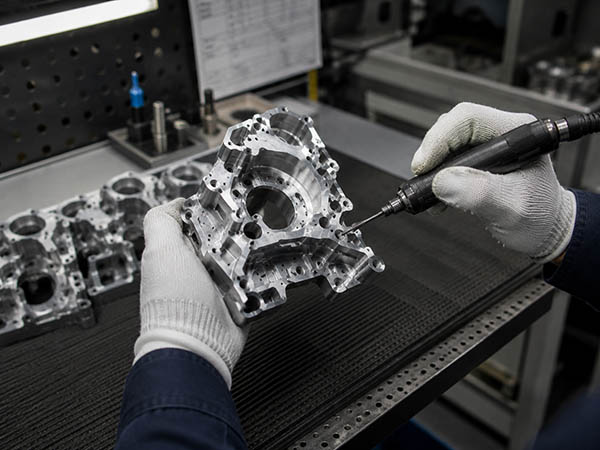
Although burrs are often measured in fractions of a millimeter, they can significantly influence product quality, assembly accuracy, operator safety, coating performance, and component lifespan. Whether manufacturing aerospace brackets, automotive transmission housings, medical implants, or precision electronic enclosures, deburring is one of the final yet most critical finishing operations.
Modern CNC machining facilities no longer treat deburring as a simple cosmetic process. Instead, it is integrated into production planning, inspection procedures, and quality assurance because even microscopic burrs may cause sealing failures, inaccurate assemblies, electrical shorts, or premature wear. Automated CNC deburring, vibratory finishing, thermal deburring, and electrochemical deburring are increasingly replacing manual operations to improve consistency and reduce production costs.
Before selecting a deburring process, manufacturers should understand the type of burr, material characteristics, production volume, tolerance requirements, and downstream surface treatments.
Five Key Topics Covered in This Guide
- What Are Burrs and Why Deburring Matters
- Common Burr Types Found in CNC Machined Parts
- Comparing Different Deburring Methods and Their Applications
- How to Select the Right Deburring Process for Different Materials
- Inspection Standards and Best Practices for Burr-Free Components
What Are Burrs and Why Is Deburring Important?
A burr is an unwanted projection of material that remains attached to the edge of a workpiece after machining, drilling, milling, turning, punching, laser cutting, or other manufacturing operations.
Rather than being intentionally designed, burrs are produced because cutting forces plastically deform the material before the chip separates completely. Softer materials like aluminum usually produce larger rollover burrs, while stainless steel often forms harder, sharper burrs requiring more aggressive removal methods.
How Burrs Affect Manufacturing
Many people assume burrs only affect appearance, but their influence extends much further.
| Manufacturing Aspect | Possible Problem Caused by Burrs |
|---|---|
| Assembly | Interference fit, poor alignment |
| Safety | Sharp edges causing operator injuries |
| Surface Coating | Paint or anodizing adhesion problems |
| Sealing | O-rings cannot seat properly |
| Bearings | Increased friction and wear |
| Electronics | Short circuits caused by conductive chips |
| Medical Devices | Difficult sterilization and contamination risk |
| Aerospace Parts | Stress concentration leading to fatigue cracks |
For example, a burr only 0.08 mm high around a hydraulic port may prevent an O-ring from sealing correctly, eventually causing hydraulic leakage under pressure.
Likewise, burrs left inside threaded holes may generate inaccurate torque values during assembly because the fastener contacts the burr before fully seating.
Why Modern CNC Shops Treat Deburring as a Quality Process
High-end manufacturers no longer perform deburring simply because “parts look better.”
Instead, deburring contributes directly to:
- Dimensional consistency
- Functional reliability
- Better coating adhesion
- Improved fatigue resistance
- Reduced warranty claims
- Higher assembly efficiency
- Enhanced operator safety
Many ISO-certified manufacturers include deburring checkpoints within their quality management systems rather than leaving it as a final manual operation.
Typical Manufacturing Processes That Produce Burrs
Almost every machining operation creates burrs.
| Process | Burr Formation Risk |
|---|---|
| CNC Milling | High |
| CNC Turning | Medium |
| Drilling | Very High (hole exits) |
| Tapping | Medium |
| Laser Cutting | High |
| Waterjet Cutting | Low |
| Stamping | High |
| Saw Cutting | Medium |
| Grinding | Low |
Among these, drilled holes often produce the largest exit burrs because the cutting tool breaks through unsupported material at the end of the operation.
Economic Cost of Ignoring Burrs
The true cost of burrs is often hidden.
A single burr can lead to:
- Assembly rejection
- Additional inspection
- Rework
- Machine downtime
- Coating failure
- Customer complaints
- Product recalls
Consider the following example.
A manufacturer producing 20,000 aluminum housings per month experienced a 3% assembly rejection rate due to hole-exit burrs.
After introducing automated brush deburring directly on the CNC machining center:
- Assembly defects dropped from 3.0% to 0.2%
- Manual labor decreased by approximately 60 hours per month
- Average production cost per part fell by 8%
Although the deburring tool added several seconds to the machining cycle, the reduction in downstream rework more than compensated for the increased machining time.
Burr Size Classification
Manufacturers frequently classify burrs by height.
| Burr Height | Typical Classification |
|---|---|
| <0.02 mm | Precision |
| 0.02–0.05 mm | Minor |
| 0.05–0.15 mm | Moderate |
| >0.15 mm | Heavy Burr |
Industries such as aerospace and medical manufacturing often require burr heights below 0.02 mm on critical functional edges.
Common Deburring Specifications on Engineering Drawings
Instead of simply writing “Remove Burrs,” many engineering drawings include more detailed notes such as:
- Break all sharp edges.
- Remove all visible burrs.
- Edge break 0.2–0.5 mm.
- Maximum burr height 0.03 mm.
- No raised material permitted on sealing surfaces.
- Burr-free threaded holes.
These specifications reduce interpretation differences between machining operators and quality inspectors.
Example: CNC Aluminum Valve Body
Consider an aluminum hydraulic valve body containing:
- 18 drilled holes
- 4 threaded ports
- Multiple intersecting oil passages
- Precision sealing faces
Without proper deburring:
- Burr fragments may detach and block hydraulic channels.
- Sharp edges damage O-rings during installation.
- Anodizing becomes uneven around hole entrances.
- Hydraulic pressure loss increases due to imperfect sealing.
For this reason, manufacturers often combine CNC chamfering, internal brushing, ultrasonic cleaning, and final visual inspection before shipment.
Common Burr Types Found in CNC Machined Parts
Not all burrs are created equal. Their shape, hardness, size, and attachment strength vary depending on the machining process, cutting parameters, tool geometry, and material properties. Correctly identifying the burr type is the first step toward selecting an efficient deburring method.
In precision manufacturing, burrs are commonly classified according to how they are formed rather than simply by size. Different burr types require different removal techniques. For example, a soft rollover burr on aluminum can often be removed with a nylon brush, while a hardened Poisson burr on stainless steel may require abrasive flow machining or electrochemical deburring.
Primary Burr Types in CNC Manufacturing
| Burr Type | Formation Mechanism | Typical Location | Removal Difficulty |
|---|---|---|---|
| Rollover Burr | Material bends instead of shearing | Hole exits, outer edges | Easy |
| Breakout Burr | Material fractures as tool exits | Drilled holes | Medium |
| Poisson Burr | Material expands under compressive stress | Hole entrances | Medium |
| Tear Burr | Material tears unevenly | Soft alloys, plastics | Medium |
| Feather Burr | Extremely thin edge projection | Thin-wall components | Difficult |
| Cutoff Burr | Material remains after part separation | Sawing, parting operations | Medium |
| Recast Burr | Molten material resolidifies | Laser or EDM machining | Difficult |
Although these names are widely recognized throughout manufacturing, actual burr geometry often combines several characteristics, particularly in multi-axis CNC machining.
Rollover Burr
The rollover burr is the most common burr encountered in CNC machining.
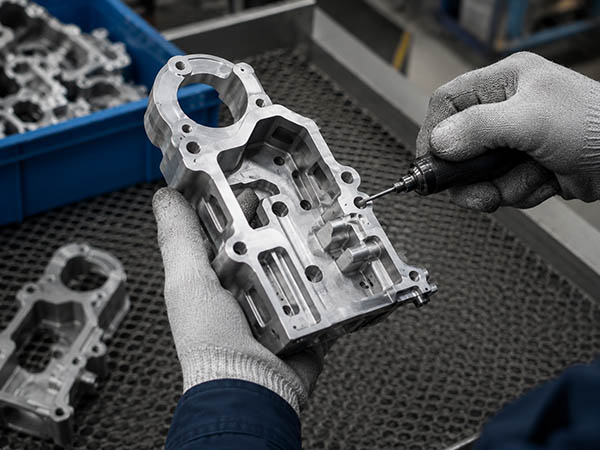
Instead of separating cleanly, the material plastically bends over the cutting edge before finally breaking away. This leaves a thin lip attached to the edge of the part.
Typical causes include:
- Low cutting speed
- Excessive tool wear
- Large feed per tooth
- Ductile materials
- Poor cutter exit support
Common materials include:
- Aluminum 6061
- Brass
- Copper
- Mild steel
- Polycarbonate
- Acrylic
Example:
A CNC milled aluminum enclosure may exhibit a continuous burr approximately 0.05–0.12 mm high along the outside perimeter after profile milling. While visually minor, this burr can prevent proper seating of a gasket or create sharp edges that fail customer handling requirements.
Characteristics of Rollover Burrs
| Characteristic | Description |
|---|---|
| Appearance | Thin curled lip |
| Hardness | Similar to base material |
| Removal Method | Brushing, tumbling, manual deburring |
| Inspection | Visual + tactile |
Because rollover burrs are relatively soft, they are among the easiest burrs to remove.
Breakout Burr
Breakout burrs occur when the cutting tool exits the material.
As the remaining material becomes thinner, it loses structural support and fractures rather than shearing cleanly.
This burr is especially common during:
- Drilling
- Reaming
- Countersinking
- Deep-hole machining
Example:
Imagine drilling a 12 mm through-hole in a 20 mm thick stainless steel plate.
The drill cuts smoothly through most of the material. However, during the final 0.5 mm of breakthrough, the unsupported material bends outward before breaking away, leaving a raised burr around the hole exit.
Factors Increasing Breakout Burr Size
| Factor | Effect |
|---|---|
| Worn drill | Larger burr |
| High feed rate | Larger burr |
| Thick material | Moderate increase |
| Dull cutting edge | Significant increase |
| Lack of backup plate | Large exit burr |
Many production facilities reduce breakout burrs by placing a sacrificial backing plate beneath the workpiece during drilling.
Poisson Burr
Unlike breakout burrs, Poisson burrs form before the cutting edge exits the material.
As the drill compresses the material around the hole entrance, the surrounding metal expands slightly due to Poisson’s effect, creating a small raised ridge around the entry.
Although often less noticeable, Poisson burrs can interfere with precision assemblies and cosmetic finishes.
Typical applications affected include:
- Precision locating holes
- Bearing seats
- Electronic housings
- Medical instruments
Because Poisson burrs are usually very small, chamfering operations are frequently integrated into CNC programs to remove them automatically.
Tear Burr
Tear burrs form when material fractures unevenly instead of being cleanly cut.
These burrs are common in:
- Soft aluminum alloys
- Copper
- Plastics
- Composite materials
Instead of a smooth edge, the material appears torn or fibrous.
Example:
When machining acrylic at an excessively high feed rate with an insufficiently sharp cutter, the chips may pull material away from the edge rather than cutting cleanly, leaving irregular burrs that also reduce optical clarity.
Visual Characteristics
- Jagged edge
- Uneven height
- Rough surface texture
- Random orientation
These burrs often require light sanding or abrasive finishing in addition to standard deburring.
Feather Burr
Feather burrs are extremely thin and flexible.
They resemble metallic foil or hair-like projections extending from the edge of the workpiece.
Typical locations include:
- Thin-wall aerospace parts
- Sheet metal components
- Precision medical instruments
- Fine aluminum ribs
Although feather burrs are small, they are surprisingly problematic because they can bend during inspection, making them difficult to detect visually.
Why Feather Burrs Are Dangerous
Because feather burrs are fragile, they may detach during service and contaminate sensitive systems.
Examples include:
- Hydraulic valves
- Fuel injectors
- Aerospace actuators
- Semiconductor equipment
- Medical implants
For these industries, ultrasonic cleaning is often performed after deburring to ensure loose particles are completely removed.
Cutoff Burr
Cutoff burrs appear after separating a component from stock material.
Processes include:
- CNC turning part-off
- Band saw cutting
- Circular saw cutting
- Automatic bar feeders
The burr usually forms at the final separation point.
Example:
A turned shaft produced from bar stock often exhibits a raised nub at the cutoff face. Secondary facing or brushing operations are commonly added to eliminate this burr before shipment.
Recast Burr
Unlike mechanical burrs, recast burrs originate from thermal machining processes.
These include:
- Electrical Discharge Machining (EDM)
- Laser cutting
- Plasma cutting
Molten material resolidifies along the edge, forming a hard, irregular burr that differs significantly from plastically deformed burrs.
Because recast layers may contain micro-cracks and altered metallurgical properties, they often require grinding, abrasive blasting, or chemical finishing rather than simple brushing.
Burr Formation by Manufacturing Process
| Manufacturing Process | Most Common Burr Type |
|---|---|
| CNC Milling | Rollover Burr |
| CNC Turning | Cutoff Burr |
| Drilling | Breakout Burr |
| Reaming | Poisson Burr |
| Tapping | Thread Burr |
| Saw Cutting | Cutoff Burr |
| Laser Cutting | Recast Burr |
| EDM | Recast Burr |
| Stamping | Tear Burr |
Understanding which burr is most likely to occur during a specific manufacturing process allows engineers to incorporate preventive measures—such as optimized tool paths, sharp tooling, chamfering cycles, or backing fixtures—before secondary deburring is even required.
Case Study: Burr Analysis on a Precision Stainless Steel Manifold
A manufacturer producing 316 stainless steel hydraulic manifolds experienced recurring assembly issues despite maintaining tight dimensional tolerances. Inspection revealed that the problem was not caused by machining accuracy but by multiple burr types:
| Feature | Burr Type | Effect |
|---|---|---|
| Cross-drilled oil passages | Breakout Burr | Restricted fluid flow |
| Thread entrances | Poisson Burr | Difficult fitting installation |
| Milled sealing faces | Rollover Burr | O-ring leakage |
| External edges | Feather Burr | Operator safety risk |
The production team implemented a revised finishing process consisting of:
- Integrated CNC chamfering immediately after machining.
- Nylon rotary brushing for external edges.
- Thermal deburring for intersecting internal passages.
- Ultrasonic cleaning to remove loose particles.
- 100% visual and borescope inspection of critical oil channels.
As a result, assembly rejects decreased by over 90%, while downstream leak-test failures were virtually eliminated.
Comparing Different Deburring Methods and Their Applications
Selecting the right deburring method is just as important as choosing the correct machining process. A method that works well for a simple aluminum bracket may be completely unsuitable for a complex stainless steel hydraulic manifold with intersecting internal passages.
Manufacturers typically evaluate a deburring process based on several factors:
- Material type
- Burr size and hardness
- Part geometry
- Surface finish requirements
- Production volume
- Cost per part
- Automation capability
- Consistency and repeatability
In modern CNC production, no single deburring technique is universally applicable. Many manufacturers combine two or more methods to achieve the desired edge quality while maintaining production efficiency.
Comparison of Major Deburring Methods
| Deburring Method | Suitable Materials | Typical Applications | Automation Level | Cost | Precision |
|---|---|---|---|---|---|
| Manual Deburring | All materials | Small batches, prototypes | Low | Low | High (operator dependent) |
| Rotary Brush Deburring | Aluminum, steel, brass | External edges, hole entrances | High | Low | Medium |
| Vibratory Finishing | Metals, plastics | Large-volume small parts | High | Very Low | Medium |
| Thermal Deburring (TEM) | Most metals | Internal passages, cross-holes | High | High | Excellent |
| Electrochemical Deburring (ECD) | Conductive metals | Precision internal burrs | High | Medium | Excellent |
| Abrasive Flow Machining (AFM) | Hardened alloys | Complex internal channels | Medium | High | Excellent |
| Robotic Deburring | All materials | Mass production | Very High | Medium | High |
Each method offers unique advantages depending on the manufacturing scenario.
Manual Deburring
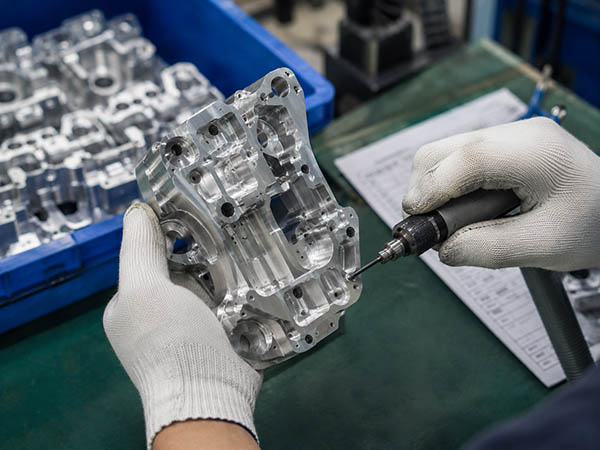
Manual deburring remains one of the most widely used techniques, especially for prototypes, low-volume production, and parts with unique geometries.
Operators typically use:
- Hand scrapers
- Deburring knives
- Rotary files
- Abrasive stones
- Sandpaper
- Small pneumatic grinders
Advantages
- Extremely flexible
- Low equipment investment
- Suitable for one-off parts
- Easy to perform localized edge corrections
Limitations
- Labor-intensive
- Quality depends heavily on operator skill
- Difficult to maintain consistency
- Not ideal for high-volume manufacturing
Example:
A CNC machine shop producing 20 custom titanium aerospace brackets per month may choose manual deburring because programming an automated system would not be economically justified.
Rotary Brush Deburring
Rotary brushing is one of the most common automated deburring processes integrated directly into CNC machining centers.
Brushes may be manufactured from:
- Nylon abrasive filaments
- Stainless steel wire
- Brass wire
- Ceramic-infused fibers
- Silicon carbide abrasive filaments
These brushes rotate at controlled speeds to remove light burrs without significantly altering part dimensions.
Typical Applications
- Hole entrances
- Hole exits
- Chamfered edges
- Milled profiles
- Pocket edges
- Counterbores
Many machining centers automatically switch from the cutting tool to a brush tool within the same machining cycle, eliminating secondary operations.
Example
A manufacturer machining 6061 aluminum electronic enclosures reduced manual finishing time by 70% after integrating automatic brush deburring into the CNC program.
Average deburring time per part decreased from:
- Manual process: 90 seconds
- Automated brush cycle: 22 seconds
The improvement also reduced variation between operators.
Vibratory Finishing
Vibratory finishing is one of the most economical methods for processing large quantities of small components.
The process places parts inside a vibrating bowl or tub filled with abrasive media.
As vibration causes continuous movement between the media and the workpieces, burrs are gradually worn away.
Common Media Types
| Media | Typical Use |
|---|---|
| Ceramic | Heavy burr removal |
| Plastic | General finishing |
| Porcelain | Surface polishing |
| Stainless Steel Pins | Burnishing |
| Walnut Shell | Soft polishing |
| Corn Cob | Dry finishing |
Media selection significantly influences both material removal rate and final surface appearance.
Best Applications
- Fasteners
- Small brackets
- Aluminum fittings
- Brass connectors
- Medical hardware
- Automotive clips
Because thousands of parts can be processed simultaneously, vibratory finishing offers one of the lowest costs per component.
Limitations
Not suitable for:
- Large components
- Thin-wall precision parts
- Delicate cosmetic surfaces
- Deep internal channels
Parts may also contact each other during processing, potentially causing minor surface marks.
Thermal Deburring (TEM)
Thermal Energy Method (TEM), often referred to as explosion deburring, is designed specifically for removing burrs from complex internal features that are inaccessible by conventional tools.
The process works by placing components inside a sealed chamber filled with a controlled mixture of oxygen and fuel gas.
When ignited, the gas burns for only a few milliseconds, generating temperatures exceeding 2,500°C.
Because burrs have a very high surface-area-to-volume ratio, they oxidize almost instantly, while the bulk material remains largely unaffected.
Ideal Applications
- Hydraulic manifolds
- Fuel injectors
- Valve bodies
- Brake systems
- Aerospace fluid components
Advantages
- Removes burrs from internal cross-holes
- Processes multiple parts simultaneously
- Highly repeatable
- Excellent for hidden burrs
Limitations
- Higher equipment investment
- Not suitable for certain non-metallic materials
- Oxide residue often requires post-cleaning
Electrochemical Deburring (ECD)
Electrochemical deburring removes burrs by controlled anodic dissolution rather than mechanical abrasion.
The workpiece serves as the anode, while a specially designed tool acts as the cathode. Electrolyte flows between them, and electrical current dissolves only the burr because it experiences the highest current density.
Typical Applications
- Cross-drilled holes
- Fuel system components
- Medical devices
- Precision valve seats
- Transmission components
Advantages
- No mechanical force
- No tool wear
- Extremely accurate
- Excellent for inaccessible burrs
Limitations
- Conductive materials only
- Requires electrolyte handling
- Higher process complexity
Example:
Automotive fuel injector manufacturers commonly use electrochemical deburring to remove burrs inside intersecting fuel passages where conventional rotary tools cannot reach.
Abrasive Flow Machining (AFM)
Abrasive Flow Machining forces a highly viscous polymer media containing abrasive particles through internal passages under pressure.
The flowing media gently removes burrs while simultaneously polishing internal surfaces.
Suitable Components
- Turbine blades
- Aerospace manifolds
- Medical implants
- Injection molds
- Additively manufactured parts
Benefits
- Deburring and polishing in one process
- Excellent for complex internal geometries
- Improves flow efficiency in fluid channels
- Produces consistent surface finishes
Drawbacks
- Longer cycle times
- Specialized equipment
- Higher operating costs
- Media must be replaced periodically
Robotic Deburring
Industrial robots equipped with force-controlled spindles and vision systems have become increasingly common in high-volume manufacturing.
Modern robotic cells can:
- Identify part orientation
- Apply constant contact force
- Adjust tool paths automatically
- Measure wear compensation
- Perform automatic tool changes
Industries Using Robotic Deburring
- Automotive
- Aerospace
- Heavy equipment
- Consumer electronics
- Medical manufacturing
Compared with manual operations, robotic systems provide significantly greater consistency while reducing labor requirements.
Choosing the Right Deburring Method
The table below summarizes recommended methods based on manufacturing conditions.
| Manufacturing Requirement | Recommended Method |
|---|---|
| Prototype Parts | Manual Deburring |
| High-Volume Aluminum Parts | Rotary Brush + Vibratory Finishing |
| Precision Hydraulic Manifolds | Thermal Deburring |
| Fuel Injector Components | Electrochemical Deburring |
| Complex Internal Channels | Abrasive Flow Machining |
| Large-Scale Automated Production | Robotic Deburring |
| Cosmetic Consumer Products | Vibratory Finishing + Manual Inspection |
| Thin-Wall Aerospace Parts | Brush Deburring + Manual Finishing |
Case Study: Improving Productivity with a Hybrid Deburring Process
A CNC manufacturer producing approximately 15,000 stainless steel valve bodies per month originally relied on manual deburring after machining. Although dimensional tolerances met specification, inconsistent burr removal led to leak-test failures and extended production time.
To address these issues, the company implemented a hybrid process:
- In-machine chamfering immediately after milling and drilling to minimize burr formation.
- Rotary brush deburring on all external edges and hole entrances.
- Thermal deburring for intersecting internal oil passages that mechanical tools could not access.
- Ultrasonic cleaning to remove residual particles.
- 100% visual inspection and random borescope verification of critical internal features.
The results after three months were significant:
| Performance Metric | Before Improvement | After Improvement |
|---|---|---|
| Manual deburring time per part | 4.8 min | 1.2 min |
| Leak-test failure rate | 2.6% | 0.3% |
| Overall production throughput | Baseline | +18% |
| Customer quality complaints | 11 per quarter | 2 per quarter |
This example demonstrates that combining multiple deburring technologies often delivers better quality and lower overall manufacturing costs than relying on a single process.
How to Select the Right Deburring Process for Different Materials
Different materials produce different burr characteristics. Factors such as hardness, ductility, thermal conductivity, work-hardening behavior, and brittleness all influence how burrs form and how easily they can be removed. A deburring process that works well for aluminum may damage a plastic component, while a method suitable for stainless steel may be unnecessarily aggressive for brass.
For this reason, experienced manufacturers do not adopt a “one-process-fits-all” approach. Instead, they tailor the deburring method to the material, part geometry, and functional requirements.
Material Properties and Their Impact on Burr Formation
| Material Property | Influence on Burr Formation | Deburring Consideration |
|---|---|---|
| High ductility | Produces larger rollover burrs | Mechanical brushing or vibratory finishing |
| High hardness | Forms smaller but tougher burrs | Abrasive or electrochemical methods |
| Work-hardening tendency | Burrs become harder during cutting | Minimize burr formation with optimized tooling |
| Brittleness | Chips break cleanly but may leave micro-fractures | Light edge conditioning |
| Low melting point | Heat can deform edges | Avoid excessive grinding heat |
Understanding these characteristics allows engineers to reduce burr formation during machining instead of relying solely on secondary finishing.
Deburring Aluminum Parts
Aluminum alloys such as 6061, 7075, and 2024 are widely used in CNC machining because of their excellent machinability. However, their ductility often leads to larger rollover burrs, particularly when tools become worn or cutting parameters are not optimized.
Common Burr Characteristics
- Thin rollover burrs
- Soft edge deformation
- Hole-exit burrs after drilling
- Minor feather burrs on thin walls
Recommended Deburring Methods
| Production Volume | Recommended Process |
|---|---|
| Prototype | Manual deburring + chamfering |
| Medium volume | Rotary nylon brush |
| High volume | CNC brush + vibratory finishing |
| Cosmetic parts | Fine abrasive brushing + polishing |
For anodized aluminum components, deburring should be completed before surface treatment. Burrs left on the part can create uneven anodizing thickness and poor cosmetic appearance.
Deburring Stainless Steel Parts
Stainless steels such as 304, 316, and 17-4 PH produce smaller but much harder burrs due to their strength and tendency to work harden.
Typical Challenges
- Tough burrs at drilled-hole exits
- Work-hardened edges
- Difficult manual removal
- Increased tool wear during deburring
Recommended Processes
- Carbide rotary brushes
- Ceramic abrasive tools
- Electrochemical deburring for internal passages
- Thermal deburring for hydraulic manifolds
Example:
A 316 stainless steel valve block with intersecting oil passages may require:
- CNC chamfering of accessible edges.
- Thermal deburring for internal burrs.
- Ultrasonic cleaning.
- Endoscopic inspection of critical channels.
This sequence ensures burr-free passages without damaging precision sealing surfaces.
Deburring Titanium Parts
Titanium alloys are commonly used in aerospace and medical applications because of their high strength-to-weight ratio and corrosion resistance. However, titanium’s low thermal conductivity and tendency to gall make burr removal more challenging.
Burr Characteristics
- Strongly attached burrs
- Localized work hardening
- Heat-sensitive edges
- Difficult chip evacuation
Recommended Methods
| Application | Preferred Method |
|---|---|
| Aerospace brackets | Manual precision deburring |
| Medical implants | Fine abrasive brushing |
| Complex manifolds | Abrasive Flow Machining (AFM) |
| High-volume production | Robotic deburring with force control |
When deburring titanium, excessive pressure should be avoided to prevent smearing or altering the edge geometry.
Deburring Brass and Copper Components
Brass and copper machine relatively easily, but their softness can result in rolled edges and cosmetic imperfections if aggressive tools are used.
Typical applications include:
- Electrical terminals
- Plumbing fittings
- Decorative hardware
- Precision connectors
Recommended Techniques
- Soft nylon brushes
- Fine ceramic media
- Light vibratory finishing
- Hand polishing for visible surfaces
Because these materials are often used in electrical or decorative applications, maintaining surface quality is just as important as removing burrs.
Deburring Engineering Plastics
Engineering plastics such as POM (Delrin), PEEK, ABS, Nylon, PTFE, and Polycarbonate require a different approach from metals.
Plastic burrs are usually softer and more flexible, making them prone to bending rather than breaking.
Common Issues
- Stringy burrs
- Melted edges from excessive heat
- Surface scratching
- Edge whitening on transparent plastics
Recommended Methods
| Plastic Material | Preferred Deburring Method |
|---|---|
| POM | Sharp manual trimming + brushing |
| PEEK | Fine abrasive brushing |
| ABS | Rotary nylon brush |
| PTFE | Precision knife trimming |
| Acrylic (PMMA) | Fine polishing and edge scraping |
| Polycarbonate | Light abrasive finishing |
Grinding wheels designed for metals should generally be avoided, as they can generate excessive heat and permanently damage plastic edges.
Material-Specific Process Selection Guide
| Material | Burr Difficulty | Recommended Deburring Method | Surface Finish Consideration |
|---|---|---|---|
| Aluminum | Low | Brush + Vibratory | Excellent before anodizing |
| Stainless Steel | High | Thermal / ECD / Ceramic Brush | Preserve sealing surfaces |
| Titanium | High | AFM / Manual Precision | Avoid heat buildup |
| Brass | Low | Nylon Brush | Maintain cosmetic finish |
| Copper | Medium | Fine Brush | Prevent scratches |
| POM | Low | Knife + Brush | Avoid melting |
| PEEK | Medium | Fine Abrasive | Protect dimensional accuracy |
| Acrylic | Medium | Scraping + Polishing | Preserve optical clarity |
Factors Beyond Material Selection
Material is only one part of the decision. Engineers should also evaluate:
- Part geometry: Deep cavities, intersecting holes, and thin walls often require specialized processes.
- Tolerance requirements: Precision components may need non-contact methods such as electrochemical deburring.
- Surface treatment: Parts destined for anodizing, plating, or painting should be completely burr-free beforehand.
- Production volume: High-volume production benefits from automated brushing, vibratory finishing, or robotic systems.
- Inspection requirements: Critical industries may require borescopes, microscopes, or tactile measurements to verify burr removal.
Practical Example: Selecting a Deburring Process for Three Different Components
| Component | Material | Key Features | Recommended Deburring Route |
|---|---|---|---|
| Electronic enclosure | 6061 Aluminum | External edges, threaded holes | CNC chamfer → Rotary brush → Vibratory finish |
| Hydraulic manifold | 316 Stainless Steel | Cross-drilled passages, sealing faces | CNC chamfer → Thermal deburring → Ultrasonic cleaning → Borescope inspection |
| Medical instrument handle | PEEK | Thin ribs, cosmetic surface | Precision trimming → Fine abrasive brushing → Visual inspection |
These examples illustrate that the optimal deburring strategy depends on the combination of material, geometry, functional requirements, and production scale, rather than on any single factor.
Inspection Standards and Best Practices for Burr-Free Components
Producing burr-free components requires more than selecting the right deburring method. A reliable quality control process is equally important to ensure that every finished part meets design requirements, assembly expectations, and industry standards. Inspection should verify not only that visible burrs have been removed, but also that hidden internal burrs, loose particles, and edge conditions comply with engineering specifications.
In industries such as aerospace, medical devices, automotive, and industrial hydraulics, burr inspection is often integrated into the final quality assurance workflow to prevent downstream failures and improve long-term product reliability.
Common Inspection Methods
Manufacturers use different inspection techniques depending on part complexity, tolerance requirements, and production volume.
| Inspection Method | Suitable Applications | Advantages | Limitations |
|---|---|---|---|
| Visual Inspection | External edges | Fast and economical | Operator dependent |
| Tactile Inspection | Sharp edge detection | Simple and effective | Cannot quantify burr height |
| Optical Microscope | Precision components | High magnification | Slower inspection speed |
| Digital Microscope | Detailed documentation | Image recording | Higher equipment cost |
| Borescope Inspection | Internal passages | Ideal for hidden features | Limited accessibility in very small holes |
| Coordinate Measuring Machine (CMM) | Critical dimensions | High accuracy | Does not directly measure all burrs |
| Surface Roughness Tester | Functional sealing surfaces | Quantitative data | Evaluates finish rather than burr size |
For mass production, manufacturers often combine rapid visual inspection with periodic microscopic verification to balance efficiency and quality.
Typical Burr Acceptance Criteria
Engineering drawings frequently specify acceptable edge conditions rather than simply stating “remove burrs.”
| Feature | Typical Requirement |
|---|---|
| External edges | Free from sharp burrs |
| Threaded holes | No raised material |
| Sealing surfaces | Burr-free |
| Precision bores | Maximum burr height ≤0.02 mm |
| Cosmetic surfaces | No visible burrs under normal lighting |
| Internal fluid passages | No loose particles or detached burrs |
These requirements vary depending on the function of the component. A decorative consumer product may emphasize appearance, while a hydraulic valve body prioritizes clean internal passages and sealing integrity.
Preventing Burrs Before They Form
The most cost-effective burr is the one that never forms. Reducing burr generation during machining minimizes secondary finishing, shortens production time, and improves consistency.
Best Practices
- Use sharp cutting tools and replace worn inserts promptly.
- Optimize cutting speed and feed rate for the material.
- Apply appropriate coolant or lubrication to reduce heat and built-up edge.
- Add programmed chamfers where functional.
- Use backing plates during drilling to reduce breakout burrs.
- Select tool geometries designed for burr reduction.
- Maintain rigid workholding to minimize vibration.
Preventive process optimization often reduces both burr size and deburring time.
Integrating Deburring into the Manufacturing Workflow
Rather than treating deburring as a separate finishing step, leading manufacturers incorporate it throughout the production process.
A typical workflow may include:
| Production Stage | Deburring-Related Activity |
|---|---|
| CNC Programming | Add edge breaks and chamfers |
| Machining | Minimize burr formation through optimized parameters |
| Secondary Finishing | Brush, vibratory, thermal, or electrochemical deburring |
| Cleaning | Remove loose particles via ultrasonic or high-pressure washing |
| Inspection | Verify edge quality and burr removal |
| Packaging | Protect finished edges from damage during transport |
This integrated approach improves efficiency and reduces the likelihood of rework.
Real-World Example: Burr Control in Hydraulic Valve Manufacturing
A manufacturer producing precision hydraulic valve bodies implemented a standardized deburring and inspection process for all production batches.
The workflow included:
- CNC chamfering immediately after milling and drilling.
- Thermal deburring for intersecting internal oil passages.
- Ultrasonic cleaning to eliminate residual particles.
- Digital microscope inspection of sealing faces.
- Borescope examination of critical internal channels.
- Final pressure and leak testing.
After six months of implementation:
| Performance Indicator | Before | After |
|---|---|---|
| Assembly rejection rate | 2.4% | 0.2% |
| Leak-test failures | 1.8% | 0.1% |
| Manual rework time | 100% | Reduced by 68% |
| Customer quality complaints | 9 per quarter | 1 per quarter |
The company not only improved product quality but also reduced production costs by minimizing rework and warranty claims.
Why Deburring Is Essential for Precision Manufacturing
Although deburring is often one of the final operations in the manufacturing process, it has a direct impact on product performance, safety, and customer satisfaction. Proper burr removal improves assembly efficiency, enhances coating quality, protects sealing surfaces, and extends component service life.
As CNC machining continues to advance toward higher precision and greater automation, deburring is evolving from a manual finishing task into a controlled manufacturing process supported by intelligent tooling, automated inspection, and standardized quality procedures.
About Xavier Precision Machining
At Xavier, deburring is considered an integral part of precision manufacturing rather than a secondary finishing operation. Every CNC-machined component undergoes a process tailored to its material, geometry, tolerance requirements, and end-use application. From aluminum and stainless steel to titanium, brass, and high-performance engineering plastics, Xavier combines advanced machining, appropriate deburring technologies, and rigorous inspection procedures to deliver components with clean edges, reliable functionality, and consistent quality.
Whether your project requires prototype development, low-volume production, or high-volume precision manufacturing, Xavier’s experienced engineering team can recommend the most effective machining and deburring solution to ensure every part is ready for assembly and long-term performance.
We are a China-based CNC machining service provider integrating manufacturing and trade. Our company specializes in CNC contract manufacturing and precision machining of a wide range of metal parts, delivering reliable and high-quality production solutions for global customers. We also support multiple surface finishing processes, including anodizing, electroless nickel plating, electrogalvanizing, passivation, electrolytic polishing, and chemical conversion coating.
Our surface treatment capabilities include cnc passivation surface finishing,
cnc electrolytic polishing surface finishing, and
cnc chemical conversion coating surface finishing, ensuring enhanced corrosion resistance and improved surface quality for machined components.
As a cnc passivation manufacturer, we provide bulk electrolytic polishing service, and offer competitive
chemical conversion coating price.
Contact us anytime for customized CNC machining solutions and professional support.
Some of the images and text in this article are collected and compiled from the internet. If there is anything inappropriate, please contact us for processing.