10 Related Knowledge Points
- What Is Cast Aluminum and Forged Aluminum?
- Manufacturing Process: Casting vs Forging
- Mechanical Strength and Material Properties
- Grain Structure and Internal Metallurgical Differences
- Fatigue Resistance, Impact Strength, and Durability
- Porosity, Internal Defects, and Quality Control
- CNC Machining Performance and Dimensional Accuracy
- Cost Comparison: Cast Aluminum vs Forged Aluminum
- Applications and Industry-Specific Uses
- How to Choose Between Cast and Forged Aluminum
Cast Aluminum vs Forged Aluminum: 10 Critical Differences You Should Know Before Choosing
Aluminum is widely used in automotive, aerospace, robotics, industrial machinery, and precision engineering because of its lightweight characteristics, corrosion resistance, and excellent strength-to-weight ratio. However, not all aluminum components have the same mechanical performance. The manufacturing process plays a major role in determining the final properties of a part.
Two common manufacturing methods are aluminum casting and aluminum forging. Although both produce aluminum components, they create different internal structures, mechanical properties, production costs, and application possibilities.
So, which is better: cast aluminum or forged aluminum? The answer depends on the component’s loading conditions, geometry, dimensional requirements, production volume, and budget.
Let’s examine the 10 most important differences to help engineers, manufacturers, and purchasing professionals make an informed decision.
1. What Is Cast Aluminum and Forged Aluminum?
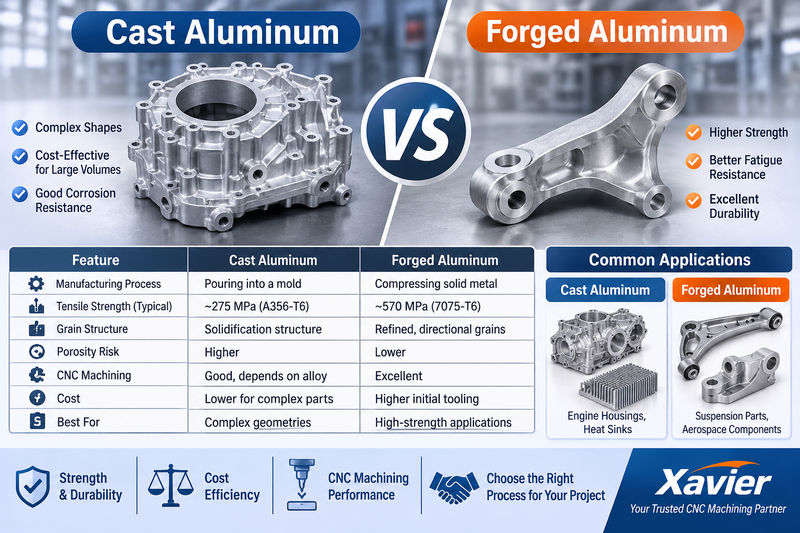
Cast aluminum is produced by melting aluminum alloy and pouring or injecting the molten metal into a mold. After cooling and solidification, the metal takes the shape of the mold. Depending on the manufacturing requirements, common casting methods include sand casting, permanent mold casting, investment casting, and high-pressure die casting.
A356 and A380 are two commonly used casting alloys. A356 is frequently selected for structural components requiring good castability and heat-treatment capability, while A380 is widely used for die-cast housings and enclosures.
Forged aluminum is manufactured by applying substantial compressive force to a solid aluminum billet or preform. The metal is shaped using specialized dies under controlled temperatures. Depending on the process, forging can be performed through open-die, closed-die, or precision forging.
Common forging alloys include 6061, 7075, and 2024, depending on the required mechanical performance and application.
The fundamental difference is that casting shapes aluminum through liquid solidification, whereas forging shapes solid aluminum through plastic deformation.
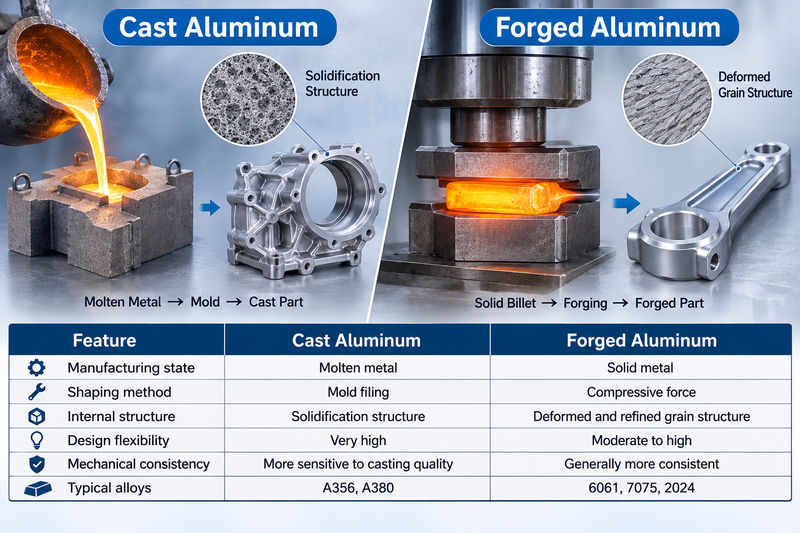
| Feature | Cast Aluminum | Forged Aluminum |
|---|---|---|
| Manufacturing state | Molten metal | Solid metal |
| Shaping method | Mold filling | Compressive force |
| Internal structure | Solidification structure | Deformed and refined grain structure |
| Design flexibility | Very high | Moderate to high |
| Mechanical consistency | More sensitive to casting quality | Generally more consistent |
| Typical alloys | A356, A380 | 6061, 7075, 2024 |
2. Manufacturing Process: Casting vs Forging
The manufacturing process directly influences material structure, production efficiency, and achievable component geometry.
Aluminum Casting Process
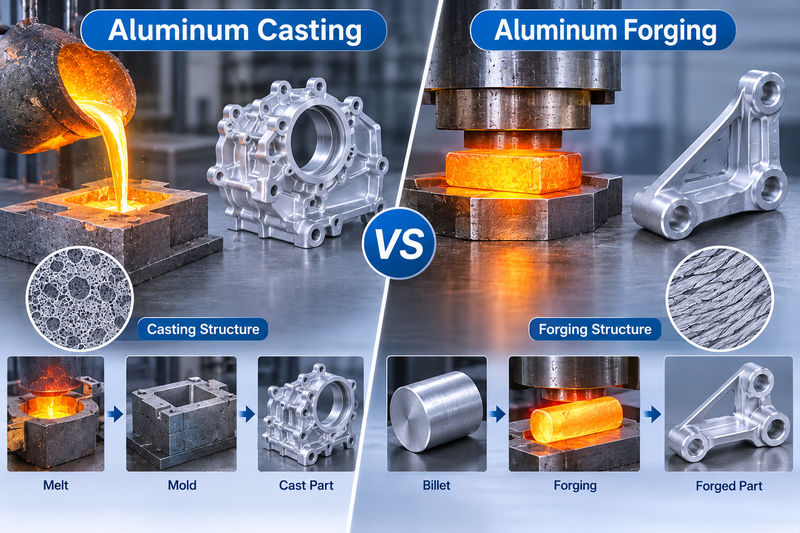
The casting process starts with melting aluminum alloy at a controlled temperature. The molten metal is transferred into a prepared mold and allowed to solidify. After cooling, the casting is removed, trimmed, cleaned, and inspected.
For example, a complex aluminum motor housing may require several internal cavities, mounting bosses, and cooling passages. Casting can create many of these features directly, reducing the amount of subsequent machining.
Different casting methods offer different advantages:
- Sand casting: Suitable for large components, prototypes, and relatively low production volumes.
- Permanent mold casting: Provides better dimensional consistency and surface quality than conventional sand casting in many applications.
- High-pressure die casting: Suitable for high-volume production of complex, thin-walled components.
- Investment casting: Useful for intricate geometries and detailed features.
Aluminum Forging Process
Forging generally begins with a solid billet that is heated to the appropriate processing temperature. A press or forging hammer applies compressive force to deform the material into the required shape.
The forged blank may then undergo heat treatment, trimming, surface preparation, and CNC machining.
For instance, a 7075 aluminum aerospace bracket may first be forged into a near-net shape. CNC milling subsequently creates accurate mounting surfaces, threaded holes, pockets, and other critical features.
Unlike casting, forging does not require molten aluminum to fill a cavity. This eliminates many solidification-related defects and allows the material’s grain structure to develop through deformation.
3. Mechanical Strength and Material Properties
Mechanical strength is often the first consideration when comparing cast aluminum vs forged aluminum.
In general, properly manufactured forged aluminum components offer higher tensile strength, yield strength, and ductility than many conventional cast aluminum components. However, the actual difference depends heavily on the alloy and temper.
Consider the following representative material data:
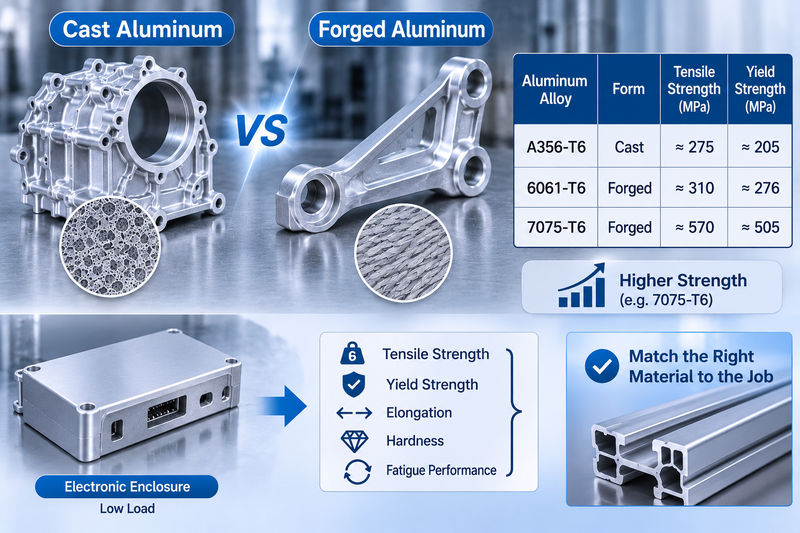
| Aluminum Alloy | Manufacturing Form | Tensile Strength (MPa) | Yield Strength (MPa) |
|---|---|---|---|
| A356-T6 | Cast | Approx. 275 | Approx. 205 |
| 6061-T6 | Wrought | Approx. 310 | Approx. 276 |
| 7075-T6 | Wrought | Approx. 570 | Approx. 505 |
These values are representative reference figures, not guaranteed specifications for every casting or forging. In particular, wrought 6061 and 7075 data should not be interpreted as direct comparisons with an identical-alloy casting.
The table illustrates why 7075-T6 is frequently selected for high-strength structural components. Its strength is substantially higher than that of typical A356-T6 castings.
However, higher strength does not automatically mean better performance in every application.
For example, an aluminum electronic enclosure may experience relatively low mechanical loads. Using 7075-T6 instead of a suitable cast aluminum alloy could increase material and manufacturing costs without delivering meaningful functional benefits.
Engineers should evaluate tensile strength, yield strength, elongation, hardness, fatigue performance, and the actual loading conditions together.
4. Grain Structure and Internal Metallurgical Differences
One of the most important differences between cast and forged aluminum is their internal grain structure.
During casting, molten aluminum cools and solidifies inside a mold. This process produces a solidification microstructure consisting of aluminum grains, dendritic structures, and alloying-element distributions.
Cooling rates vary throughout the component. As a result, different regions may develop different grain sizes and microstructural characteristics.
Forging produces a different result. Under compressive deformation, the original grain structure changes shape and can become refined. Grain flow may follow the contours of the forged component, creating directional mechanical properties.
This directional grain flow is particularly useful when the component geometry and forging design allow the grains to follow the primary load path.
For example, an aerospace structural fitting subjected to repeated tensile and bending loads may benefit from a properly designed forging because the grain structure can provide improved resistance to crack propagation.
However, grain flow is not automatically beneficial in every direction. Machining away important surface layers or orienting the forging incorrectly relative to the applied load can reduce the expected advantages.
Therefore, forging design, material orientation, and machining allowance should all be considered during engineering development.
5. Fatigue Resistance, Impact Strength, and Durability
Fatigue resistance describes a material’s ability to withstand repeated loading without developing cracks or eventually failing.
This property is particularly important for automotive suspension components, aircraft structural fittings, industrial machinery, and rotating equipment.
Forged aluminum generally provides better fatigue performance than conventional cast aluminum because its internal structure is more consolidated and typically contains fewer solidification-related defects.
Casting defects such as gas porosity, shrinkage cavities, and oxide inclusions can become stress concentration points. When a component experiences repeated loading, cracks may initiate around these imperfections.
Consider an automotive suspension control arm.
The component experiences alternating bending forces, vibration, and occasional impact loads. A forged aluminum control arm can provide a favorable combination of strength, fatigue resistance, and reduced weight.
A cast aluminum component may still be suitable if the design uses adequate wall thickness, appropriate alloy selection, and reliable casting quality.
The important consideration is that fatigue life cannot be determined from tensile strength alone. Surface finish, residual stress, geometry, stress concentration, material defects, and loading frequency all influence performance.
For safety-critical applications, fatigue testing and appropriate inspection procedures are essential.
6. Porosity, Internal Defects, and Quality Control
Internal defects are among the most important factors when evaluating cast aluminum components.
During solidification, molten aluminum can trap gas or develop shrinkage cavities as the metal cools. These defects may reduce mechanical strength and create leakage paths in pressure-containing components.
Common casting defects include:
- Gas porosity: Small gas-filled cavities formed during solidification.
- Shrinkage porosity: Voids caused by insufficient liquid metal feeding during solidification.
- Cold shuts: Incomplete bonding where separate metal flow fronts meet.
- Oxide inclusions: Oxide films or particles trapped within the casting.
- Hot tearing: Cracking caused by thermal contraction and restricted solidification.
Casting quality can be improved through melt degassing, filtration, optimized gating systems, controlled cooling, and appropriate mold design.
Forging avoids the gas and shrinkage porosity associated with liquid-metal solidification. However, forged parts are not completely defect-free. Forging laps, inclusions, internal cracking, and improper grain flow can still occur.
Quality inspection should therefore match the component’s application.
| Inspection Method | Main Purpose |
|---|---|
| Visual inspection | Identify surface defects |
| Dimensional inspection | Verify component dimensions |
| CMM inspection | Measure complex geometries accurately |
| X-ray inspection | Detect internal casting defects |
| Ultrasonic testing | Identify internal discontinuities |
| Dye penetrant testing | Detect surface-breaking cracks |
For pressure-tight cast housings, X-ray inspection and leak testing may be especially important. For highly loaded forged aerospace components, ultrasonic inspection and material traceability may be required.
7. CNC Machining Performance and Dimensional Accuracy
Both cast and forged aluminum can be processed using CNC milling, CNC turning, drilling, boring, tapping, and other precision machining operations.
However, their machining behavior can differ considerably.
Cast aluminum often contains complex geometries and variable material structures. Its machinability depends on the alloy composition, casting method, porosity, hardness, and heat-treatment condition.
For example, A356 aluminum is commonly machined into automotive housings, structural components, and wheel-related parts. Machining operations may include facing, pocket milling, drilling, and precision boring.
Forged aluminum, particularly 6061-T6 and 7075-T6, is widely used for precision-machined structural components.
These materials offer predictable mechanical properties when supplied in properly controlled conditions. They are suitable for machining complex pockets, thin walls, precision holes, threaded features, and accurately positioned mounting surfaces.
One important consideration is distortion.
When substantial material is removed from a forged aluminum billet, residual stresses may cause dimensional movement. This is particularly relevant when machining thin-walled components or removing large amounts of material from one side.
A practical solution is to use balanced material removal, appropriate workholding, stress-relieved material when necessary, and intermediate inspection.
It is also important to distinguish between material capability and machining capability. Neither casting nor forging automatically guarantees a specific CNC tolerance. Final dimensional accuracy depends on the machine, tooling, fixture, machining strategy, and inspection process.
8. Cost Comparison: Cast Aluminum vs Forged Aluminum
Manufacturing cost is another major consideration when choosing between casting and forging.
Cast aluminum is often more economical for complex geometries and large production quantities because it can produce near-net-shape components with relatively little material removal.
However, tooling costs vary significantly between sand casting, permanent mold casting, and high-pressure die casting.
Forging generally requires specialized dies, powerful presses, and additional process control. The initial tooling and production costs can therefore be higher.
CNC machining may also be required after forging to achieve the final dimensions and surface finish.
| Cost Factor | Cast Aluminum | Forged Aluminum |
|---|---|---|
| Initial tooling | Low to high, depending on method | Generally high |
| Material utilization | Often efficient for complex shapes | Depends on preform and machining allowance |
| CNC machining | Depends on casting quality and geometry | Often required for precision features |
| Complex internal shapes | Excellent capability | More limited |
| High-volume production | Very suitable | Suitable for specific high-performance parts |
| Typical cost advantage | Complex geometries | High-strength components |
For example, producing 10,000 aluminum electronic housings may favor high-pressure die casting because the mold cost can be distributed across a large quantity.
By comparison, a small batch of high-strength aerospace brackets may justify forging because mechanical reliability and weight reduction are more important than the initial tooling investment.
The correct comparison should consider the total finished-part cost, including raw material, tooling, machining, inspection, scrap, and assembly.
9. Applications and Industry-Specific Uses
Cast aluminum and forged aluminum serve different engineering requirements across multiple industries.
Automotive Industry
Cast aluminum is widely used for engine housings, transmission cases, motor housings, and other complex components.
Forged aluminum is frequently selected for suspension arms, steering components, connecting rods, and structural parts requiring higher mechanical performance.
Aerospace Industry
Forged 7075 and 2024 aluminum alloys are commonly used for highly loaded structural components, brackets, fittings, and other aircraft parts.
Cast aluminum is also used in selected aerospace housings and non-primary structural components where geometry and manufacturing efficiency are important.
Robotics and Industrial Machinery
Cast aluminum is suitable for motor housings, gearbox enclosures, equipment covers, and complex mounting structures.
Forged aluminum is advantageous for lightweight robotic arms, high-load brackets, precision fixtures, and structural components exposed to repeated mechanical forces.
Consumer and Electronic Equipment
Cast aluminum is frequently used for heat sinks, protective housings, and electronic enclosures because it supports complex shapes and integrated design features.
Forged or wrought aluminum is more appropriate when a component requires greater structural strength or extensive precision machining.
10. How to Choose Between Cast and Forged Aluminum
There is no universally superior option. The correct manufacturing process should be determined by the component’s engineering requirements rather than by material strength alone.
Choose cast aluminum when:
- The component has complex geometries or internal cavities.
- High production efficiency is important.
- The design requires integrated mounting features.
- Mechanical loading is moderate and properly validated.
- The total manufacturing cost needs to be optimized.
Choose forged aluminum when:
- High tensile and yield strength are required.
- The component experiences repeated cyclic loading.
- Impact resistance and structural reliability are critical.
- Weight reduction is important without sacrificing strength.
- The part is used in demanding aerospace, automotive, or industrial applications.
For example, a complex gearbox housing with multiple internal cavities is often better suited to casting. A lightweight aerospace mounting bracket exposed to significant mechanical loads may be better suited to forging followed by precision CNC machining.
Before making a final decision, engineers should evaluate the alloy grade, temper, loading direction, safety factor, manufacturing volume, dimensional tolerances, and inspection requirements.
Choose Xavier for Precision Aluminum CNC Machining
Selecting the right aluminum manufacturing process is only one part of producing a reliable component. Precision machining, material selection, dimensional control, and consistent quality inspection are equally important.
At Xavier, we specialize in CNC machining services and custom metal component manufacturing for international B2B customers. Our manufacturing capabilities support precision machining of aluminum alloys and a wide range of other engineering metals.
Whether your project requires CNC-machined 6061 aluminum brackets, 7075 aerospace components, precision aluminum housings, or custom-machined parts from cast aluminum blanks, our team can help evaluate the manufacturing approach according to your drawings and application requirements.
We focus on practical manufacturing solutions, accurate dimensions, consistent quality, and competitive production costs.
Looking for a reliable CNC machining manufacturer for your next aluminum component project?
Contact Xavier today and send us your 2D drawings or 3D CAD files. Our team can help assess material selection, machining feasibility, manufacturing processes, and production requirements to develop a cost-effective solution for your project.
As an integrated CNC machining manufacturer and trading company, Xavier specializes in custom CNC machining services and contract manufacturing of various metal components. We offer a wide range of surface treatment solutions, including CNC anodizing surface finishing, CNC electroless nickel plating surface finishing, and CNC zinc plating surface finishing to meet different industrial requirements.
As a professional CNC anodizing manufacturer, we provide bulk electroless nickel plating services and welcome you to contact us for zinc plating prices. Feel free to get in touch with our team to discuss your project requirements and receive a competitive quotation.
Some of the images and text in this article are collected and compiled from the internet. If there is anything inappropriate, please contact us for processing.