
10 Key Topics: Type II vs Type III Anodize
- What Is Type II vs Type III Anodizing? – Basic principles, chemical processes, and the differences between conventional anodizing and hardcoat anodizing.
- Coating Thickness and MIL-PRF-8625 Standards – Standard thickness ranges, coating classifications, and engineering specifications.
- Surface Hardness and Wear Resistance – Differences in oxide-layer hardness, abrasion resistance, and mechanical durability.
- Corrosion Resistance and Sealing Requirements – How sealing affects corrosion protection, surface porosity, and wear performance.
- Color Options and Surface Appearance – Clear anodizing, dyed finishes, hardcoat colors, and visual consistency.
- Dimensional Changes and CNC Machining Tolerances – Coating growth, bore dimensions, threads, precision fits, and masking.
- Aluminum Alloy Compatibility – How 6061, 7075, 2024, and other aluminum alloys respond to different anodizing processes.
- Applications and Industrial Uses – Typical applications in aerospace, automotive, electronics, machinery, and precision components.
- Cost, Production Time, and Process Selection – Differences in processing conditions, manufacturing costs, and production considerations.
- How to Choose Between Type II and Type III Anodizing – Practical selection criteria, engineering examples, and recommendations for CNC-machined components.
Type II vs Type III Anodize: 10 Key Differences, Thickness, Hardness, and Applications
Type II vs Type III Anodizing: What Is the Difference?
Anodizing is an electrochemical surface treatment that converts the surface of aluminum into a protective aluminum oxide layer. Unlike paint or conventional plating, the oxide coating is grown from the aluminum substrate itself. This creates a relatively durable surface with improved corrosion resistance, surface hardness, and appearance.
However, not all anodizing processes produce the same performance. When comparing Type II vs Type III anodize, the most important difference is the intended function of the coating.
Type II anodizing, commonly called conventional sulfuric acid anodizing, is primarily used for corrosion protection, decorative finishes, and color customization. Type III anodizing, also known as hardcoat anodizing, produces a thicker and harder oxide layer designed for components exposed to repeated friction, abrasion, and mechanical contact.
Both processes use sulfuric acid-based electrolytes, but their operating conditions differ. Type III typically requires lower bath temperatures, higher current density, and more carefully controlled processing conditions.
For example, an aluminum electronic enclosure may only need Type II anodizing to achieve a uniform black finish and protect against environmental corrosion. A hydraulic piston sleeve or sliding mechanical component may require Type III hardcoat anodizing to withstand repeated contact.
The correct choice depends on the component’s working environment, dimensional requirements, and expected service life.
Coating Thickness and MIL-PRF-8625 Standards
Coating thickness is one of the most important differences between Type II and Type III anodizing. A thicker coating generally provides more material for wear protection, but it also creates greater dimensional changes that must be considered during CNC machining.
The MIL-PRF-8625 specification defines requirements for anodic coatings on aluminum and aluminum alloys.
The following table provides commonly used engineering reference ranges.
| Specification | Type II Anodize | Type III Anodize |
|---|---|---|
| Common name | Conventional anodizing | Hardcoat anodizing |
| Typical thickness | 5–25 μm | 25–75 μm |
| Broader specification range | 1.8–25.4 μm | 12.7–114.3 μm |
| Main purpose | Corrosion protection and appearance | Wear and abrasion resistance |
| Coating structure | Relatively thin oxide layer | Thicker, harder oxide layer |
| Typical appearance | Clear, silver, black, colored | Gray, bronze, dark gray, black |
| Relative processing cost | Lower | Higher |
These ranges are reference values rather than universal requirements. Actual coating thickness depends on the aluminum alloy, processing conditions, customer specifications, and finishing supplier.
Type II coatings are commonly specified at approximately 10–20 μm for general industrial components. Type III coatings are frequently specified around 40–60 μm for wear-resistant mechanical parts.
For instance, if a CNC-machined 6061-T6 aluminum housing requires a black decorative finish, a 15 μm Type II coating may be sufficient. However, a mechanical guide component exposed to continuous sliding contact may require a 50 μm Type III coating.
When preparing engineering drawings, buyers should specify the anodizing type, coating thickness, color, sealing requirements, and applicable standard instead of simply writing “black anodized.”
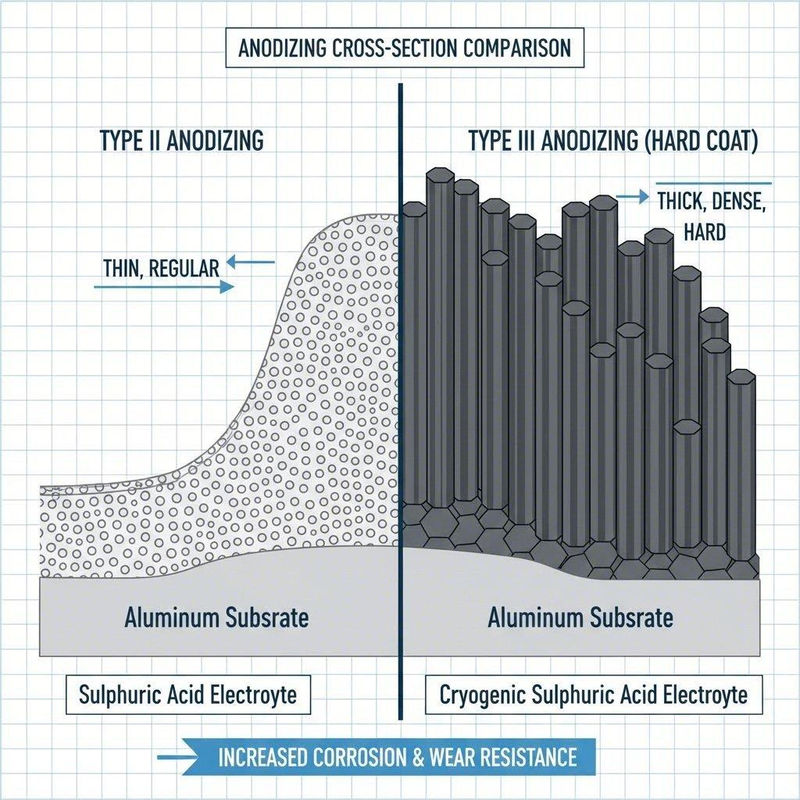
Surface Hardness and Wear Resistance
Surface hardness directly affects how well an anodized aluminum component withstands scratching, friction, and repeated mechanical contact.
Type II anodizing improves the surface hardness of aluminum compared with untreated material. However, its relatively thin oxide layer is not intended for severe abrasion or continuous sliding applications.
Type III hardcoat anodizing produces a much harder oxide layer. Depending on the aluminum alloy and process conditions, conventional Type II coatings may achieve approximately 200–400 HV, while Type III coatings can reach approximately 400–600 HV or higher in some processes.
These values are indicative rather than guaranteed acceptance limits. Hardness measurements also depend on coating thickness, substrate support, test load, and measurement method.
Consider two CNC-machined aluminum components:
- Component A: A 6061-T6 aluminum control panel cover that experiences occasional handling and light surface contact.
- Component B: A 6061-T6 aluminum sliding guide that repeatedly contacts another mechanical component.
Type II anodizing is generally suitable for Component A because appearance and corrosion protection are more important than extreme wear resistance.
Component B is a better candidate for Type III hardcoat anodizing because its working surface experiences repeated friction. The thicker oxide layer provides better resistance to abrasive damage and surface deterioration.
However, hard anodizing does not make aluminum completely resistant to wear. The oxide layer is hard but relatively brittle. Severe impact, excessive interference during assembly, or concentrated contact stress can cause cracking or local coating damage.
For high-load mechanical applications, engineers should also consider contact pressure, lubrication, counterface material, and operating temperature.
Corrosion Resistance and Sealing Requirements
Both Type II and Type III anodizing improve the corrosion resistance of aluminum by creating an aluminum oxide barrier. However, coating thickness alone does not determine corrosion performance. The condition of the oxide layer, sealing method, alloy composition, and exposure environment are also important.
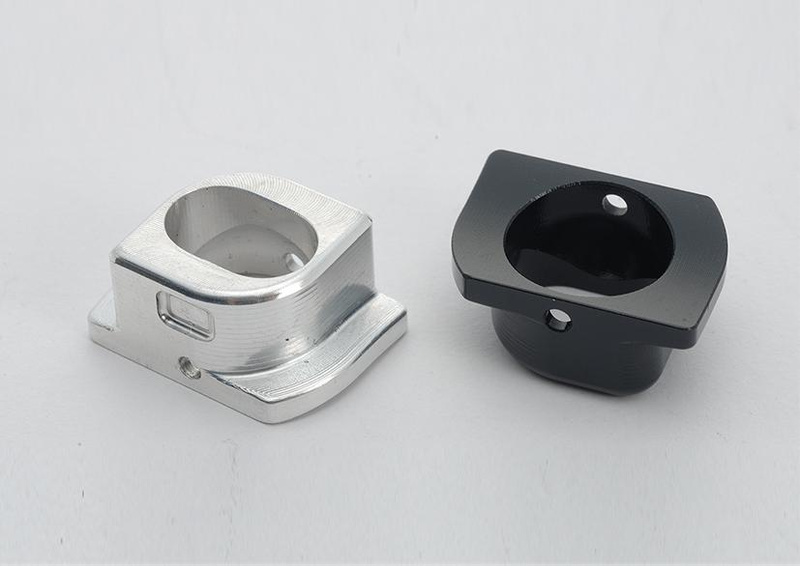
Type II anodizing normally produces a porous oxide structure. These pores can absorb dyes, allowing manufacturers to produce different colors. After dyeing, the coating is commonly sealed using hot deionized water, nickel acetate, or another approved sealing process.
Sealing closes much of the porous structure and improves resistance to moisture, contaminants, and corrosion.
Type III hardcoat anodizing also produces a porous oxide structure, but the coating is considerably thicker. It can provide excellent corrosion protection when properly processed and sealed.
However, there is an important engineering consideration: Type III hardcoat is often left unsealed when maximum abrasion resistance is the priority. Sealing can improve corrosion performance but may reduce certain wear-related properties.
| Performance factor | Type II | Type III |
|---|---|---|
| Corrosion protection | Good | Very good |
| Typical sealing | Commonly sealed | Depends on application |
| Porosity | Porous before sealing | Porous before sealing |
| Wear-focused configuration | Less suitable | Often left unsealed |
| Decorative dye absorption | Excellent | More limited |
For example, an aluminum outdoor equipment enclosure may benefit from sealed Type II anodizing because moisture protection and appearance are important. A hydraulic cylinder component may require unsealed Type III hardcoat to prioritize wear resistance.
Buyers should therefore specify whether the coating needs to be sealed rather than assuming that every anodized component receives the same treatment.
Color Options and Surface Appearance
Color is another major difference when selecting Type II vs Type III anodize.
Type II anodizing is widely used for decorative aluminum components because its porous oxide layer can absorb different dyes. Common finishes include clear, black, red, blue, gold, green, and bronze.
This makes Type II particularly suitable for consumer electronics, aluminum enclosures, automotive trim, product housings, and branded CNC-machined components.
Type III hardcoat anodizing generally produces darker and less predictable colors. Depending on the alloy and coating thickness, its natural appearance can range from gray and bronze to dark charcoal or black.
Although Type III can also be dyed, achieving bright and consistent colors is considerably more difficult than with conventional Type II anodizing.
Another factor is the original machined surface finish. Anodizing does not hide machining marks, scratches, or uneven surface textures. Instead, it can make certain surface imperfections more noticeable.
For example, if an aluminum component is machined with visible tool marks, a clear Type II finish may preserve those marks. If a more uniform appearance is required, the manufacturer may need to add bead blasting or polishing before anodizing.
For projects requiring consistent black aluminum components, 6061-T6 is often a practical material choice because it generally produces more predictable anodized appearances than copper-rich alloys such as 2024.
Dimensional Changes and CNC Machining Tolerances
Dimensional changes are among the most important considerations when applying anodizing to precision CNC-machined components.
Unlike paint, anodizing grows from the aluminum surface. Approximately half of the coating thickness typically extends outward, while the remaining portion penetrates into the original substrate. The exact distribution depends on the alloy and process.
This means that anodizing can affect external dimensions, internal bores, threaded holes, and mating surfaces.
Consider a CNC-machined aluminum shaft with a diameter of 20.000 mm.
If the component receives a 50 μm Type III coating, approximately 25 μm may grow outward on each side.
The finished diameter could therefore increase by approximately 50 μm, resulting in a diameter near 20.050 mm, assuming uniform growth.
Similarly, a 10.000 mm internal bore could decrease to approximately 9.950 mm.
| Feature | Before anodizing | Approximate coating | After anodizing |
|---|---|---|---|
| External diameter | 20.000 mm | 50 μm | 20.050 mm |
| Internal bore | 10.000 mm | 50 μm | 9.950 mm |
| External width | 30.000 mm | 50 μm | 30.050 mm |
These are simplified calculations assuming approximately 50% outward growth and uniform coating distribution.
For precision CNC machining, the manufacturer must account for this dimensional change before finishing.
There are three common approaches:
- Pre-machining compensation: Machine external dimensions slightly undersized or internal bores slightly oversized before anodizing.
- Masking: Protect critical areas such as bearing seats, threaded holes, electrical contact points, and precision mating surfaces.
- Post-anodizing machining: Grind, hone, or lap selected surfaces when the drawing and coating requirements permit it.
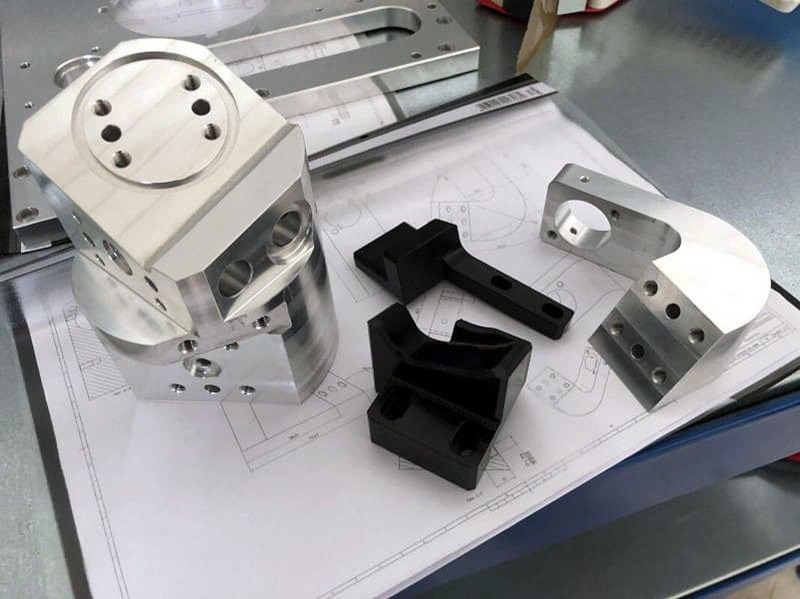
For example, a CNC-machined 6061 aluminum housing with an H7 bearing bore may require masking or a carefully controlled finishing allowance. Applying a thick Type III coating without dimensional compensation could make the bearing impossible to install.
This is why anodizing requirements should be reviewed during the CNC machining design stage, not after the parts have already been manufactured.
Aluminum Alloy Compatibility
Different aluminum alloys do not respond identically to Type II and Type III anodizing. Their chemical compositions affect coating thickness, hardness, color, uniformity, and overall finishing quality.
6061 aluminum is one of the most commonly used materials for CNC-machined anodized parts. It offers a practical balance of machinability, strength, corrosion resistance, and anodizing performance.
7075 aluminum provides higher strength and is frequently selected for aerospace and high-performance mechanical components. However, its higher copper and zinc content can influence anodized appearance and coating uniformity.
2024 aluminum also contains significant copper, which can make achieving consistent decorative anodized finishes more challenging.
| Aluminum alloy | Type II performance | Type III performance | Typical CNC applications |
|---|---|---|---|
| 6061-T6 | Good appearance and corrosion protection | Good hardcoat capability | Housings, brackets, fixtures |
| 7075-T6 | Appearance may be less uniform | Suitable with process control | Aerospace structures, precision parts |
| 2024-T3 | More challenging decorative finish | Requires careful process control | Aerospace components |
| 5052 | Good decorative finishing | Process-dependent | Panels, enclosures |
| 6063 | Good color consistency | Application-dependent | Profiles, architectural components |
For example, a customer manufacturing aerospace mounting brackets from 7075-T6 may prioritize strength and wear resistance over cosmetic appearance. Type III hardcoat could be appropriate if the coating requirements and alloy-specific process have been validated.
For a consumer electronics enclosure made from 6061-T6, Type II anodizing is generally a more practical choice because of its color flexibility and lower processing cost.
Before committing to large production quantities, requesting anodized samples is recommended, especially when color matching and coating uniformity are critical.
Applications and Industrial Uses
The best anodizing type depends on how the aluminum component functions after assembly.
Type II is commonly selected for components where appearance, corrosion resistance, and general surface protection are the primary requirements.
Typical applications include:
- CNC-machined electronic enclosures and instrument panels.
- Aluminum brackets and mounting plates.
- Camera housings and consumer electronics components.
- Automotive interior and exterior trim.
- Industrial equipment covers and protective housings.
Type III is more suitable for components exposed to repeated mechanical contact, friction, or abrasive operating conditions.
Typical applications include:
- Hydraulic valve bodies and piston sleeves.
- Mechanical sliding guides and wear plates.
- Industrial fixtures and positioning components.
- Aerospace mechanical components.
- Precision tooling and equipment parts.
Consider an aluminum robotic arm assembly. Its external covers may use Type II anodizing for appearance and corrosion protection, while selected sliding components may require Type III hardcoat to improve wear resistance.
This demonstrates that a single machine assembly does not necessarily need one anodizing type for every component. Selecting the finish according to each component’s function can improve performance while controlling manufacturing costs.
Cost, Production Time, and Process Selection
Type II anodizing is generally less expensive than Type III hardcoat anodizing. The difference comes from processing conditions, production time, equipment requirements, and quality-control procedures.
Type II typically operates under less demanding temperature and current-density conditions. It is widely available and suitable for high-volume production of decorative and general-purpose aluminum components.
Type III requires more tightly controlled processing conditions. The electrolyte is maintained at a much lower temperature, often close to 0°C, to control heat generation and produce a consistent hard oxide layer. Higher current density and longer processing cycles also contribute to production costs.
| Cost factor | Type II | Type III |
|---|---|---|
| Processing complexity | Moderate | High |
| Temperature control | Standard | More demanding |
| Processing time | Generally shorter | Generally longer |
| Equipment requirements | Standard anodizing equipment | Enhanced cooling and process control |
| Inspection requirements | Standard coating inspection | More demanding for wear-critical parts |
| Relative cost | Lower | Higher |
The actual price depends on part dimensions, coating thickness, batch quantity, masking requirements, alloy, and inspection standards.
For example, producing 100 aluminum mounting brackets with a 15 μm black Type II coating is generally more economical than applying a 50 μm Type III coating to the same parts.
However, choosing Type II simply to reduce the initial finishing cost can be a poor decision if the component operates under continuous friction. Premature coating failure may result in replacement costs, equipment downtime, and additional maintenance.
Manufacturers should evaluate the total service cost rather than comparing anodizing prices alone.
How to Choose Between Type II and Type III Anodizing
Choosing between Type II and Type III anodizing should start with the actual operating conditions of the aluminum component.
The most effective selection method is to evaluate five engineering factors:
- Surface appearance: If the component requires bright colors, consistent black finishes, or decorative surface quality, Type II is generally the better choice.
- Wear resistance: If the component experiences repeated sliding, rubbing, or abrasive contact, Type III should be considered.
- Dimensional accuracy: If the part contains precision bores, bearing seats, threads, or tight-fitting features, coating growth must be included in the machining plan.
- Corrosion environment: Both types can provide corrosion protection, but the correct sealing method and coating specification must match the operating environment.
- Manufacturing budget: Type II is usually more economical for general-purpose components, while Type III is justified when additional wear resistance is necessary.
The following examples illustrate how these factors influence the decision.
| CNC component | Recommended finish | Main reason |
|---|---|---|
| Aluminum electronic enclosure | Type II | Appearance and corrosion protection |
| CNC mounting bracket | Type II | General surface protection |
| Hydraulic piston sleeve | Type III | Sliding wear resistance |
| Precision machine guide | Type III | Repeated mechanical contact |
| Aerospace aluminum fixture | Type III | Wear resistance and durability |
| Decorative aluminum panel | Type II | Color consistency |
One important point: Type III is not automatically better than Type II. A thicker and harder coating does not necessarily produce a better component if the part primarily requires decorative appearance, precise assembly dimensions, or electrical conductivity.
The best anodizing specification is the one that satisfies the actual functional requirements without introducing unnecessary manufacturing costs or dimensional problems.
Why Choose Xavier for CNC Machining and Anodizing?
Selecting the correct anodizing process is only one part of producing high-quality aluminum components. The machining accuracy, material selection, surface preparation, coating thickness, and final inspection must all work together.
At Xavier, we provide professional CNC machining services for international B2B customers, specializing in custom-machined metal components and precision aluminum parts.
Our manufacturing capabilities support different aluminum machining requirements, including 6061, 7075, and other engineering alloys. We understand that Type II and Type III anodizing serve different purposes, and the correct finish should be selected according to the component’s geometry, operating environment, and dimensional tolerances.
Whether you need decorative Type II anodizing for aluminum housings or Type III hardcoat anodizing for wear-resistant mechanical components, our team can help evaluate the manufacturing requirements and coordinate suitable finishing solutions.
Our approach focuses on:
- Precision CNC milling and turning for custom aluminum components.
- Material selection based on mechanical and environmental requirements.
- Type II and Type III anodizing coordination.
- Dimensional allowance planning before surface finishing.
- Masking and protection of critical machining features.
- Quality inspection according to customer drawings and specifications.
Need custom CNC-machined aluminum parts with Type II or Type III anodizing?
Contact Xavier today and send us your 2D drawings, 3D files, material requirements, and surface finishing specifications. Our team can help evaluate your project, recommend a suitable manufacturing process, and provide a competitive quotation.
Visit Xavier CNC Machining to discuss your next precision aluminum manufacturing project.
As an integrated CNC machining manufacturer and trading supplier, Xavier specializes in custom CNC machining and contract manufacturing of precision metal components for global customers. We also offer professional CNC anodizing surface finishing, CNC electroless nickel plating, and CNC zinc electroplating surface treatments to meet different functional and aesthetic requirements.
As an experienced CNC anodizing surface finishing manufacturer, we provide bulk CNC electroless nickel plating services and competitive CNC zinc electroplating surface treatment pricing. Feel free to contact us to discuss your project requirements and obtain a customized quotation.
Some of the images and text in this article are collected and compiled from the internet. If there is anything inappropriate, please contact us for processing.