
Spot Welding vs Tack Welding: Key Differences, Applications, Advantages, and How to Choose
Understanding the difference between spot welding and tack welding is important when selecting a joining method for sheet metal fabrication, automotive components, industrial equipment, and precision-machined assemblies. Although both processes use localized welds, they serve different purposes and have distinct requirements for joint strength, positioning accuracy, production efficiency, and weld quality.
Spot welding is primarily a resistance welding process used to create permanent joints between overlapping metal sheets. Tack welding, in contrast, uses short, temporary or preliminary welds to hold components in the correct position before final welding or assembly.
Choosing the wrong method can result in dimensional distortion, weak joints, excessive rework, or unnecessary manufacturing costs. This guide explains their differences from a practical manufacturing perspective, including welding principles, materials, strength, equipment, tolerances, applications, and cost considerations.
10 Key Topics Covered in This Guide
- What Is Spot Welding? Working Principles and Process
- What Is Tack Welding? Purpose and Working Principles
- Spot Welding vs Tack Welding: Key Differences
- Welding Methods, Equipment, and Process Parameters
- Material Compatibility and Metal Thickness
- Joint Strength, Weld Quality, and Inspection
- Heat Input, Distortion, and Dimensional Accuracy
- Industrial Applications: Automotive, Sheet Metal, and CNC Assemblies
- Advantages, Disadvantages, and Manufacturing Costs
- How to Choose Between Spot Welding and Tack Welding
1. What Is Spot Welding? Working Principles and Process
Spot welding is a type of resistance welding that joins two or more overlapping metal sheets by applying electrical current and mechanical pressure through copper alloy electrodes. The electrical resistance at the contact interface generates heat, melting a small area of the metal and forming a fused region known as a weld nugget.
Unlike arc welding, spot welding does not normally require filler metal or shielding gas. The process relies on three essential factors: welding current, electrode force, and welding time. These parameters must work together to produce a consistent weld without excessive melting, expulsion, or electrode indentation.
How Does Spot Welding Work?
A typical resistance spot welding cycle involves four stages:
- Workpiece positioning: Two metal sheets are overlapped and positioned between the upper and lower electrodes.
- Electrode pressure: The electrodes clamp the sheets together, establishing consistent contact.
- Electrical heating: A high electrical current passes through the sheets. Resistance generates localized heat at the interface, forming a molten weld nugget.
- Cooling and solidification: Current stops while electrode pressure is maintained briefly, allowing the molten region to solidify into a permanent joint.
The heat generated can be described by Joule’s law:
[ Q=I^2Rt ]
Where:
- (Q) = heat generated
- (I) = welding current
- (R) = electrical resistance
- (t) = welding time
Because current is squared in this equation, even a relatively small change in welding current can significantly affect heat generation.
Typical Spot Welding Parameters
For example, resistance spot welding of two 1.0 mm mild steel sheets may use welding currents in the approximate range of 8–12 kA, depending on electrode geometry, equipment, surface condition, and welding schedule. Actual settings must be established through process trials and an approved welding procedure.
| Parameter | Typical consideration | Manufacturing impact |
|---|---|---|
| Welding current | Several kA, depending on material and thickness | Controls heat generation |
| Welding time | Usually measured in milliseconds or AC cycles | Influences nugget formation |
| Electrode force | Commonly several kN | Controls contact and containment |
| Electrode diameter | Selected according to sheet thickness | Affects weld size and indentation |
| Hold time | Maintained after current stops | Supports solidification |
For reference, one AC cycle at 50 Hz equals 0.02 seconds. Published welding schedules for low-carbon steel demonstrate how current, force, and welding time change with sheet thickness.
2. What Is Tack Welding? Purpose and Working Principles
Tack welding is a technique used to temporarily hold two or more metal components in their correct positions before completing the final welding operation. Instead of creating a continuous weld seam, the operator deposits several short welds at selected locations along the joint.
The primary purpose of tack welding is to maintain alignment, control joint gaps, prevent movement, and reduce dimensional changes during subsequent welding operations.
An important distinction is that tack welding is not a single independent welding process. Tack welds can be produced using MIG (GMAW), TIG (GTAW), stick welding (SMAW), or other suitable processes, depending on the material, component geometry, and production requirements.
How Tack Welding Works
A typical tack welding operation follows these steps:
- Clean the joint surfaces and remove contaminants that could affect weld quality.
- Position the components according to the engineering drawing.
- Use clamps, fixtures, or locating pins to establish the required dimensions.
- Apply short welds at selected positions to hold the components.
- Check alignment, flatness, and joint gaps before proceeding with final welding.
For example, consider a stainless steel equipment enclosure fabricated from several sheet metal panels. Before the final TIG welding operation, the fabricator may apply short tack welds at the corners and along the edges.
These welds prevent the panels from shifting when heat is introduced during the final welding process.
Common Tack Welding Arrangements
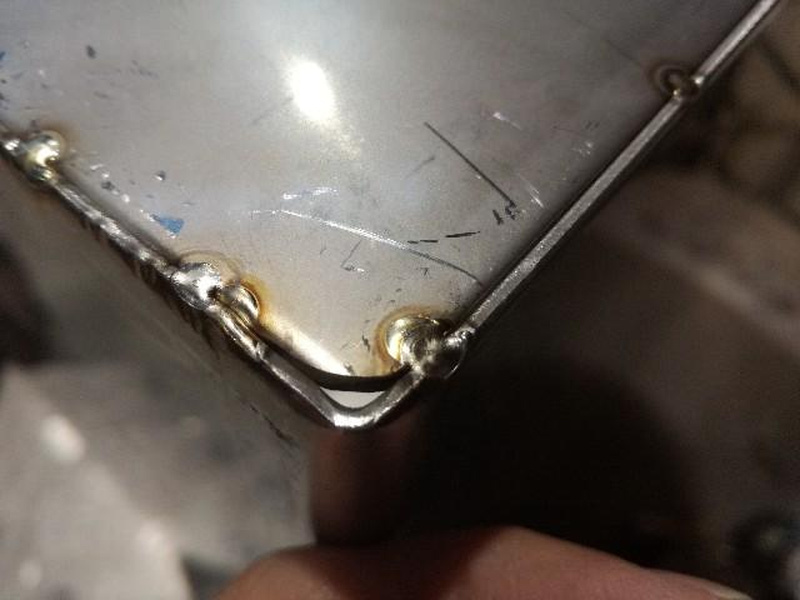
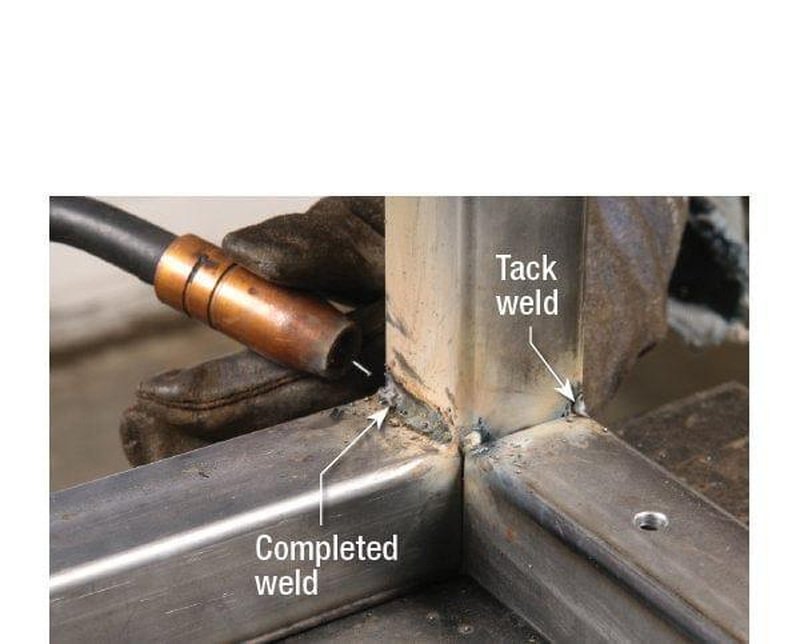
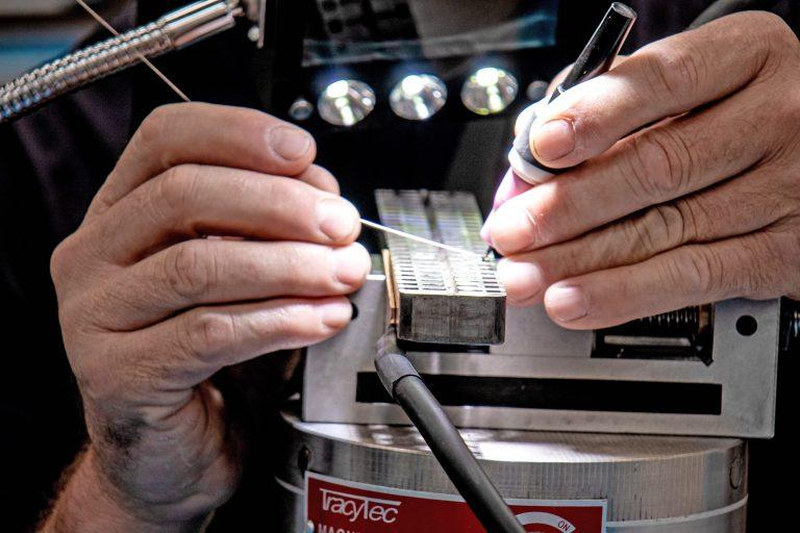
- Corner tacks: Hold two intersecting panels at a fixed angle.
- Edge tacks: Maintain alignment along butt or lap joints.
- Distributed tacks: Position short welds at intervals along a longer joint.
- Assembly tacks: Hold brackets, supports, and mounting plates before final joining.
Tack welds must be sufficiently strong to resist handling and subsequent welding forces. However, they should not introduce excessive heat or interfere with the final weld. When they become part of the completed joint, their quality and compatibility with the final welding procedure are important.
3. Spot Welding vs Tack Welding: Key Differences
The most important difference between spot welding and tack welding is their purpose. Spot welding creates permanent resistance-welded joints, whereas tack welding primarily maintains the position of components before final joining.
Although both processes produce localized weld areas, they differ in operating principles, equipment, joint configurations, and quality requirements.
Detailed Comparison Table
| Comparison factor | Spot welding | Tack welding |
|---|---|---|
| Main purpose | Permanent metal joining | Temporary positioning |
| Welding principle | Electrical resistance heating | Localized fusion welding |
| Common processes | Resistance spot welding | MIG, TIG, stick, sometimes resistance welding |
| Joint type | Mainly overlapping sheets | Butt, corner, lap, and other joints |
| Filler metal | Normally not required | Depends on welding process |
| Shielding gas | Normally not required | Required for many MIG/TIG applications |
| Equipment | Spot welding machine and electrodes | Welding torch, power source, and accessories |
| Weld appearance | Small electrode marks | Small visible weld beads |
| Production use | Repetitive production | Fabrication and assembly preparation |
| Final function | Usually remains as the finished joint | Often incorporated into or replaced by final welds |
Permanent Joint vs Temporary Joint
A spot weld is designed to provide the required structural connection between metal sheets. Once the weld nugget forms and solidifies, the joint becomes permanent and is not intended to be separated during normal service.
A tack weld, however, is primarily an assembly aid. In many applications, the final welding operation continues around or over the tacked joint. In other cases, the tack weld may be removed after the components have been secured by another joining method.
For instance, an automotive manufacturer may use hundreds of resistance spot welds to assemble a vehicle body. A custom sheet metal workshop may use several TIG tack welds to hold a stainless steel enclosure before completing its continuous seams.
These applications illustrate why the two methods should not be treated as interchangeable.
4. Welding Methods, Equipment, and Process Parameters
The equipment used for spot welding differs considerably from that used for conventional tack welding.
Spot welding requires a resistance welding system capable of delivering controlled electrical current and electrode pressure. Tack welding requires equipment suitable for the selected fusion welding process.
Spot Welding Equipment
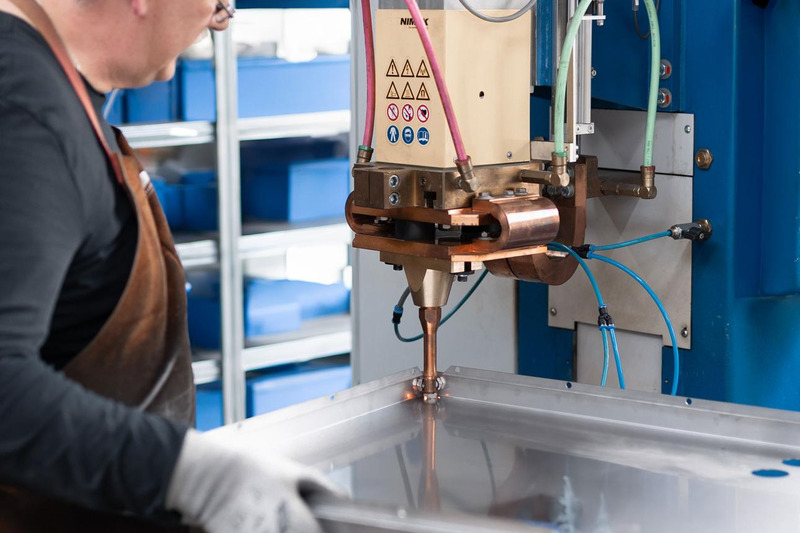
The main components include:
- Welding transformer or inverter: Supplies the required welding current.
- Copper alloy electrodes: Transfer current and apply pressure to the workpieces.
- Electrode holders: Maintain electrode positioning and alignment.
- Pneumatic or servo pressure system: Controls electrode force.
- Welding controller: Regulates current, squeeze time, weld time, and hold time.
Poor electrode alignment can produce uneven pressure and inconsistent weld nuggets. Worn electrode tips can also change the contact area, affecting the consistency of production welds.
Tack Welding Equipment
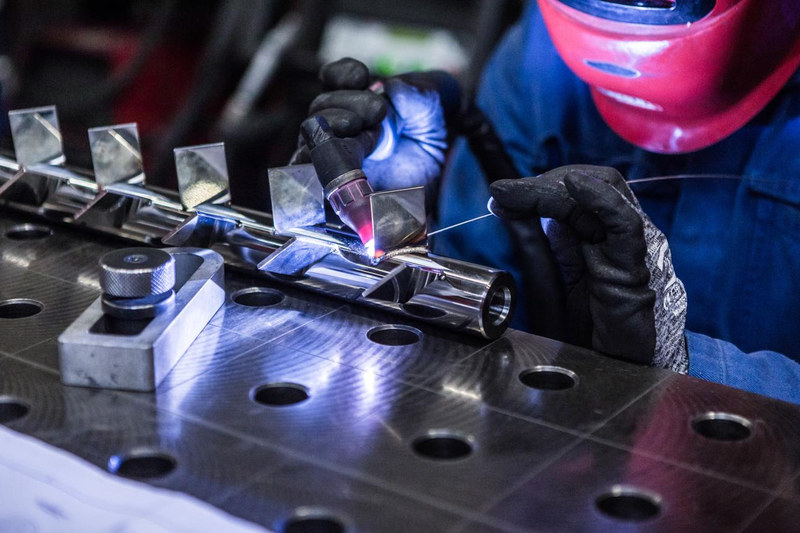
Depending on the application, tack welding may use:
- MIG welding machines for efficient steel fabrication.
- TIG welding machines for controlled, precise work on stainless steel and aluminum.
- Stick welding equipment for structural fabrication and thicker materials.
- Welding fixtures and clamps for maintaining assembly dimensions.
The operator controls tack length, location, heat input, and welding sequence. Unlike automated resistance spot welding, conventional tack welding often depends heavily on operator technique.
5. Material Compatibility and Metal Thickness
Material selection directly affects welding performance. Electrical conductivity, thermal conductivity, melting temperature, surface condition, and material thickness all influence the appropriate welding process.
Materials Suitable for Spot Welding
Spot welding is widely used for:
- Low-carbon steel
- Galvanized steel
- Stainless steel
- Aluminum alloys
- Certain nickel-based alloys
Low-carbon steel is generally easier to resistance spot weld because its electrical and thermal properties allow a practical welding window.
Aluminum requires different process settings because it has high electrical and thermal conductivity and a stable surface oxide layer. It generally needs higher welding current and specialized equipment compared with mild steel.
Materials Suitable for Tack Welding
Tack welding offers greater flexibility because the operator can select MIG, TIG, or another suitable fusion welding process.
| Material | Common tack welding process | Important consideration |
|---|---|---|
| Mild steel | MIG / TIG | Control heat input and distortion |
| Stainless steel | TIG / MIG | Prevent contamination and discoloration |
| Aluminum 6061 | TIG / MIG | Remove oxide and control heat |
| Carbon steel plate | MIG / Stick | Select suitable filler metal |
| Titanium | Specialized TIG | Strict shielding and cleanliness |
How Thickness Affects Process Selection
Spot welding is particularly effective for overlapping sheet metal. As thickness increases, the required current, electrode force, and welding time generally increase. Very thick components may exceed the practical capacity of the equipment or require alternative joining methods.
Tack welding is more adaptable to different thicknesses because the operator can adjust the welding process, filler material, and weld geometry.
For example, two 1.0 mm stainless steel panels forming a small enclosure may be spot welded if the design allows electrode access. A 6 mm steel mounting bracket attached to a thick base plate is generally better suited to MIG or TIG tack welding before completing the required structural weld.
6. Joint Strength, Weld Quality, and Inspection
Joint strength is one of the most important factors when comparing spot welding and tack welding. However, the strength of either method cannot be evaluated simply by looking at the visible weld size.
For spot welding, the most important feature is the internal weld nugget. A weld may look acceptable from the outside but still have insufficient fusion at the interface between the sheets.
For tack welding, strength depends on the tack length, throat thickness, penetration, material compatibility, and welding procedure.
How to Evaluate Spot Weld Quality
The weld nugget is the fused metal region connecting the overlapping sheets. Its diameter, penetration, and consistency directly affect joint performance.
Common inspection methods include:
- Visual inspection: Identifies surface cracks, excessive indentation, expulsion, and inconsistent weld appearance.
- Peel testing: Separates the joined sheets to examine the weld nugget and determine whether the failure occurs through the base metal or at the interface.
- Tensile shear testing: Measures the force required to separate the welded sheets under a specified loading arrangement.
- Metallographic examination: Uses a prepared cross-section to evaluate nugget diameter, penetration, porosity, and heat-affected zones.
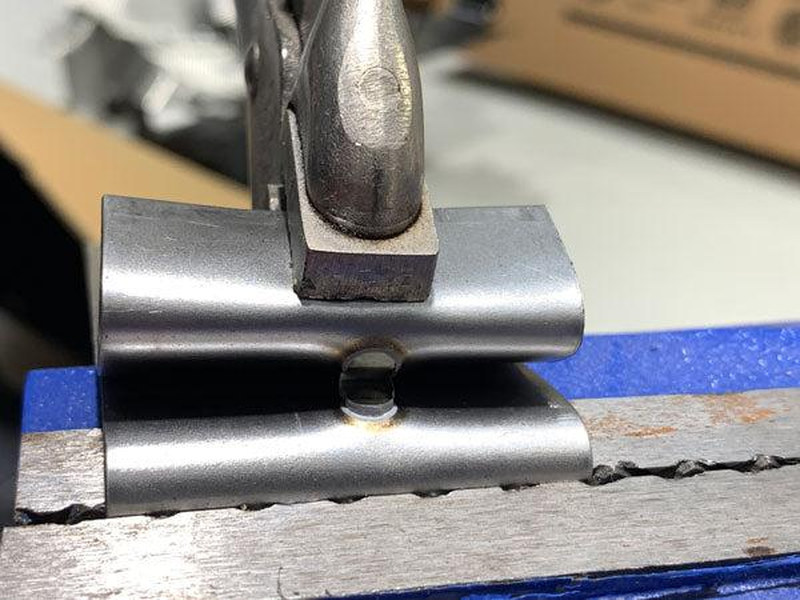
For example, when inspecting two 1.0 mm mild steel sheets, a technician may perform a peel test on sample welds from a production batch. A satisfactory weld often produces a visible metal button or plug pulled from one sheet rather than simply separating along the original interface.
However, acceptance criteria must follow the applicable drawing, welding specification, and material requirements. ISO 17677-1 provides terminology and measurement definitions for resistance spot welding.
How to Evaluate Tack Weld Quality
Tack weld inspection focuses on whether the welds can maintain the required assembly position and whether they are suitable for the subsequent welding operation.
Important inspection points include:
- No visible cracks or significant porosity.
- Correct tack locations according to the assembly drawing.
- Consistent component alignment and joint gaps.
- Adequate fusion without excessive burn-through.
- No contamination that could affect the final weld.
A common mistake is using undersized tack welds that break when the assembly is moved. Another problem occurs when oversized tacks create excessive local heat or interfere with the final welding pass.
Therefore, tack welds should be treated as controlled manufacturing operations rather than casual temporary connections.
7. Heat Input, Distortion, and Dimensional Accuracy
Heat management is particularly important when manufacturing precision sheet metal components and CNC-machined assemblies.
Although spot welding and tack welding both introduce localized heat, their thermal behavior is different.
Heat Distribution in Spot Welding
Resistance spot welding concentrates heat near the interface between the overlapping sheets. Because the welding cycle is relatively short, the overall heat-affected region is generally localized.
However, excessive current, incorrect electrode pressure, or excessive welding time can cause:
- Metal expulsion
- Excessive electrode indentation
- Burn-through
- Sheet deformation
- Inconsistent weld nugget dimensions
When producing thin stainless steel brackets, incorrect spot welding settings may cause visible indentation or distortion around the welded area.
Heat Distribution in Tack Welding
Tack welding introduces heat through an arc-based or other selected fusion welding process. Even though each tack is short, multiple tacks can produce cumulative thermal distortion.
For example, when fabricating a rectangular aluminum frame, placing several tack welds on one side without a balanced sequence may pull the frame out of square.
To reduce this risk, manufacturers can:
- Apply tacks symmetrically.
- Use appropriate fixtures and clamps.
- Distribute tack locations along the joint.
- Control tack size and welding sequence.
- Check dimensions before final welding.
The TWI welding distortion guidance also identifies tack welds as a useful method for maintaining joint gaps and controlling movement during fabrication.
Prevention by Fabrication Techniques+1
Which Method Is Better for Precision Components?
For repetitive thin-sheet assemblies with accessible overlapping joints, resistance spot welding can offer good consistency when the equipment and fixtures are properly controlled.
Tack welding is more flexible for complex geometries, but maintaining tight dimensional tolerances requires careful fixturing and inspection.
For CNC-machined components, the welding sequence should be planned before machining is completed. Critical mounting surfaces, bearing bores, and threaded holes may require protection from welding heat and subsequent distortion.
If a welded component requires tight positional tolerances, it may be necessary to perform finish machining after welding rather than relying entirely on pre-weld dimensions.
8. Industrial Applications: Automotive, Sheet Metal, and CNC Assemblies
Both welding methods are widely used in industrial manufacturing, but their applications are different.
Automotive Manufacturing
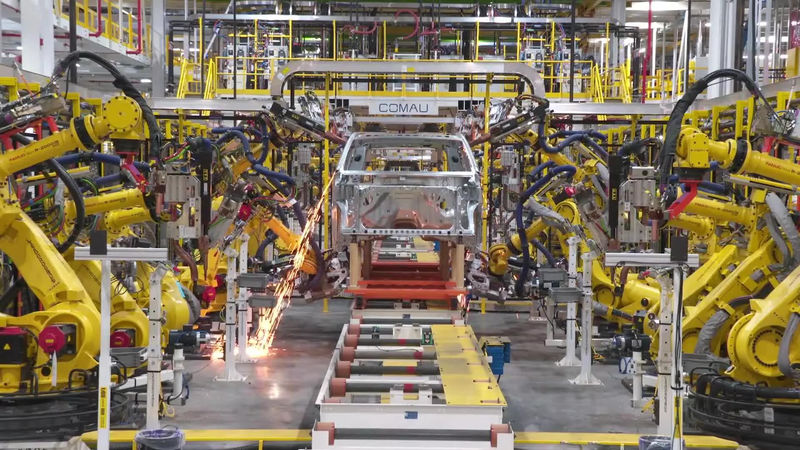
Spot welding is extensively used in automotive body production. Vehicle bodies contain many overlapping sheet metal components, including door panels, floor structures, roof panels, reinforcement plates, and body frames.
Automated resistance spot welding is suitable for these assemblies because:
- Individual welds can be produced rapidly.
- Welding positions can be programmed.
- Robots can repeat the same welding sequence.
- Large production volumes can be manufactured consistently.
Tack welding is more commonly used in fixture assembly, repair, prototype fabrication, and selected structural fabrication operations.
Sheet Metal Fabrication
In sheet metal manufacturing, spot welding is suitable for joining overlapping steel or stainless steel panels without creating a continuous visible seam.
For example, a manufacturer producing electrical control cabinets may use spot welding to join internal brackets and reinforcing plates.
Tack welding is useful when assembling cabinet frames, mounting brackets, support structures, and enclosures that require final seam welding.
CNC Machining and Precision Assemblies
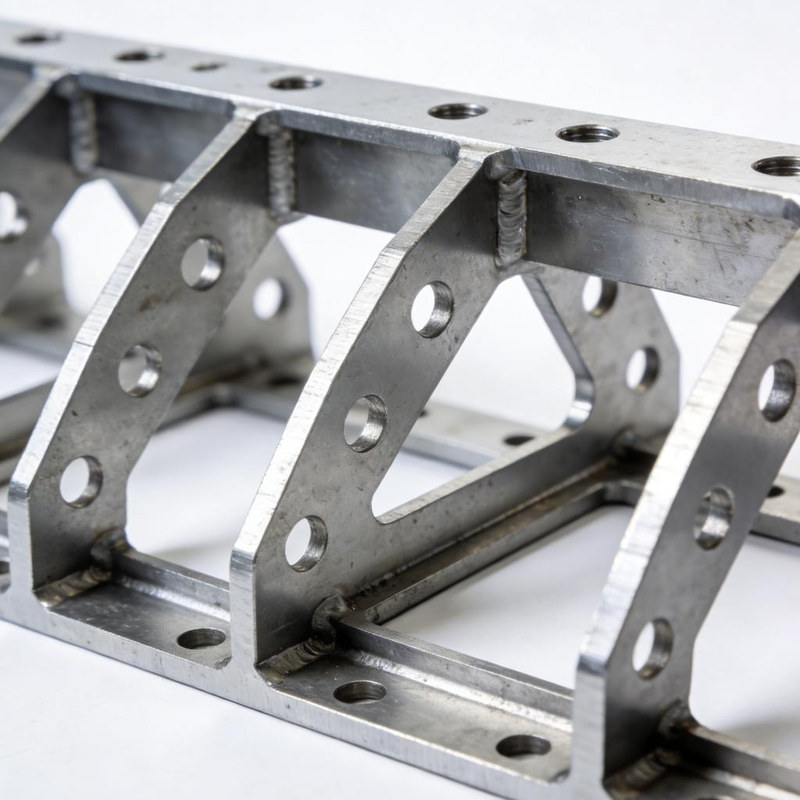
In CNC manufacturing, welding is often combined with milling, turning, drilling, and finishing operations.
Consider a custom industrial mounting assembly consisting of a machined steel base, two support brackets, and several sheet metal reinforcement plates.
A practical manufacturing sequence could be:
- CNC machine the base and support brackets.
- Inspect the mounting holes and critical reference surfaces.
- Position the components in a dedicated fixture.
- Apply tack welds to maintain alignment.
- Check perpendicularity and overall dimensions.
- Complete the specified welding operation.
- Perform dimensional inspection and any required finish machining.
- Apply surface treatment if specified.
This approach allows manufacturers to combine machining accuracy with the flexibility of welded fabrication.
9. Advantages, Disadvantages, and Manufacturing Costs
The most economical welding method depends on production volume, component geometry, material, joint requirements, and equipment investment.
A process that is inexpensive for one prototype may become inefficient when manufacturing thousands of identical components.
Advantages and Disadvantages
| Factor | Spot welding | Tack welding |
|---|---|---|
| Production speed | High in repetitive applications | Depends on operator and assembly |
| Automation | Highly suitable | Possible, but more process-dependent |
| Initial equipment cost | Relatively high | Generally lower |
| Joint flexibility | Limited mainly to suitable configurations | High |
| Filler material | Normally unnecessary | May be required |
| Precision | Good with controlled fixtures | Depends on setup and operator |
| Surface appearance | Localized electrode marks | Visible tack beads |
| Production consistency | High with validated settings | Requires controlled procedures |
What Affects Spot Welding Cost?
The main cost factors include:
- Resistance welding machine investment.
- Electrode materials and replacement frequency.
- Fixture design and manufacturing.
- Welding current and energy consumption.
- Inspection and production quality control.
- Automation and maintenance.
For high-volume automotive or appliance production, the initial equipment investment can be justified by fast cycle times and repeatability.
What Affects Tack Welding Cost?
Tack welding usually requires less specialized equipment, but labor costs can be higher because of manual positioning, welding, inspection, and adjustment.
The cost also increases when complex assemblies require custom fixtures or repeated dimensional corrections.
Manufacturing Example
Suppose a factory needs to manufacture 5,000 identical sheet metal brackets.
If the design uses overlapping 1.0 mm steel sheets and has accessible welding locations, automated spot welding may provide a more economical production solution.
However, if the same bracket includes several three-dimensional supports, irregular joints, and thick mounting plates, MIG or TIG tack welding followed by final welding may be more practical.
The correct decision should be based on the total manufacturing cost per acceptable component, not simply the price of one welding operation.
10. How to Choose Between Spot Welding and Tack Welding
Selecting the correct process requires evaluating the component design, production quantity, material, structural requirements, and dimensional tolerances.
Choose Spot Welding When:
- You need permanent joints between overlapping metal sheets.
- The components have relatively consistent thicknesses.
- The design provides sufficient access for opposing electrodes.
- You are manufacturing large quantities of similar parts.
- High production repeatability is important.
- The engineering design permits localized resistance welds instead of continuous seams.
Choose Tack Welding When:
- Components must be positioned before final welding.
- The assembly contains complex shapes or irregular joints.
- You need to maintain alignment and joint gaps.
- The parts include different thicknesses or configurations.
- The project involves prototypes or low-volume production.
- Final MIG, TIG, or another welding operation will follow.
A Practical Manufacturing Decision
| Manufacturing requirement | Recommended approach |
|---|---|
| Joining two overlapping thin steel sheets permanently | Spot welding |
| Holding a stainless steel enclosure before TIG welding | Tack welding |
| High-volume automotive body assembly | Spot welding |
| Positioning CNC-machined brackets before final welding | Tack welding |
| Repetitive sheet metal reinforcement production | Spot welding |
| Complex fabricated frames and structural assemblies | Tack welding |
One important point: tack welding and spot welding are not necessarily competing alternatives. In some manufacturing projects, they can be used together. Tack welds establish the assembly geometry, while resistance spot welds or other specified welding processes provide the permanent connections.
The engineering drawing and approved welding procedure should always determine the final joining method.
Xavier CNC Machining and Metal Fabrication Solutions
Choosing between spot welding and tack welding is only one part of producing a reliable metal component. Material selection, machining accuracy, joint design, welding sequence, surface finishing, and dimensional inspection all influence the final product quality.
At Xavier, we provide professional CNC machining services and custom metal parts manufacturing for international industrial customers. Our manufacturing capabilities support the production of precision components from aluminum, stainless steel, alloy steel, brass, copper, titanium, and other engineering materials.
Whether your project involves CNC-machined brackets, sheet metal assemblies, mechanical supports, or complex custom metal components, selecting the right manufacturing process is essential for achieving the required performance and cost efficiency.
Our team can help evaluate component drawings, material requirements, machining processes, and manufacturing considerations to develop a suitable production solution.
Looking for a reliable CNC machining manufacturer in China?
Contact Xavier today and send us your 2D drawings or 3D CAD files. We will help evaluate your component requirements and provide a manufacturing solution tailored to your project.
Request a Quote from Xavier: https://www.xavier-parts.com/
As an integrated CNC machining manufacturer and trading company, Xavier specializes in custom CNC machining and precision metal part manufacturing for global customers. Our surface finishing capabilities include CNC anodizing surface finishing, CNC electroless nickel surface finishing, and CNC passivation surface finishing.
We are a professional CNC anodizing surface finishing manufacturer, offering bulk CNC electroless nickel surface finishing services. Contact us today to inquire about CNC passivation surface finishing pricing and discuss your project requirements.
Some of the images and text in this article are collected and compiled from the internet. If there is anything inappropriate, please contact us for processing.