
Ferrous vs Non-Ferrous Metals: Strength, Weight, Cost & Corrosion
This article will cover the following 10 key points:
1. Ferrous vs. non-ferrous metals: definitions and fundamental differences.
2. Complete list of common ferrous metals and their engineering uses.
3. Complete list of common non-ferrous metals and their engineering uses.
4. Strength, hardness, density, and weight comparison.
5. Corrosion resistance, rust formation, and environmental performance.
6. Magnetic properties and electrical and thermal conductivity.
7. CNC machining characteristics, cutting tools, and manufacturing challenges.
8. Material selection for aerospace, automotive, robotics, medical, and industrial components.
9. Material cost, machining cost, surface finishing, and total production cost.
10. A practical material-selection guide for custom CNC-machined parts.
Ferrous vs. Non-Ferrous Metals: Understanding the Fundamental Difference
Ferrous and non-ferrous metals are two major categories of engineering materials. The key distinction is their chemical composition: ferrous metals are primarily iron-based, while non-ferrous metals use another metal as their principal constituent. This classification helps engineers narrow their material choices, but it does not determine every mechanical or manufacturing property.
Ferrous metals include carbon steel, alloy steel, stainless steel, cast iron, and tool steel. They are widely used for structural components, shafts, gears, machine frames, and load-bearing parts. Non-ferrous metals include aluminum, copper, brass, bronze, titanium, magnesium, zinc, and nickel-based alloys. These materials are selected for characteristics such as low density, electrical conductivity, corrosion resistance, or high strength-to-weight ratio.
For CNC machining, the distinction influences material cost, cutting parameters, tool selection, chip formation, dimensional stability, and surface treatment. However, the specific alloy grade is more important than the category alone. For example, 6061 aluminum is generally straightforward to machine, whereas titanium Grade 5 requires more careful heat management despite both being non-ferrous metals.
Complete List of Ferrous Metals and Their Applications
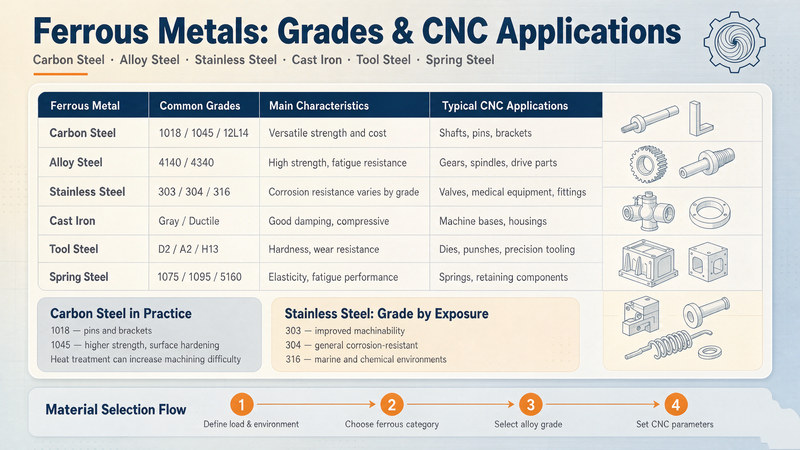
Ferrous metals are essential in manufacturing because they offer a broad range of strength, hardness, wear resistance, and affordability. Their properties vary considerably according to carbon content, alloying elements, heat treatment, and manufacturing condition.
| Ferrous metal | Common grades or types | Main characteristics | Typical CNC applications |
|---|---|---|---|
| Carbon steel | 1018, 1045, 12L14 | Versatile strength and cost | Shafts, pins, brackets |
| Alloy steel | 4140, 4340 | High strength and fatigue resistance | Gears, spindles, drive components |
| Stainless steel | 303, 304, 316 | Corrosion resistance varies by grade | Valves, medical equipment, fittings |
| Cast iron | Gray iron, ductile iron | Good damping and compressive performance | Machine bases, housings |
| Tool steel | D2, A2, H13 | Hardness and wear resistance | Dies, punches, precision tooling |
| Spring steel | 1075, 1095, 5160 | Elasticity and fatigue performance | Springs, retaining components |
Carbon steel is a practical choice for general-purpose machined parts. Grade 1018 is often suitable for pins and brackets, while 1045 may be preferred when higher strength or surface hardening is required. Alloy steel such as 4140 is useful for components exposed to repeated loading, although heat treatment can increase machining difficulty and introduce dimensional changes.
Stainless steel deserves special attention because it is ferrous but can provide excellent corrosion resistance. Grade 303 is designed for improved machinability, 304 is widely used for general corrosion-resistant components, and 316 is frequently selected for marine or chemical environments. The appropriate grade depends on the actual exposure conditions rather than the assumption that all stainless steels perform identically.
Complete List of Non-Ferrous Metals and Their Applications
Non-ferrous metals serve applications where conventional steel may be too heavy, insufficiently conductive, or unsuitable for the operating environment. They also cover a wide performance range, from easily machined brass to demanding titanium and nickel-based superalloys.
| Non-ferrous metal | Common grades or types | Main characteristics | Typical CNC applications |
|---|---|---|---|
| Aluminum | 6061-T6, 7075-T6, 2024 | Lightweight and machinable | Frames, brackets, housings |
| Copper | C101, C110 | High electrical and thermal conductivity | Busbars, electrodes, heat-transfer parts |
| Brass | C360, C260 | Good machinability and corrosion resistance | Fittings, connectors, threaded parts |
| Bronze | Tin bronze, aluminum bronze | Wear resistance and suitable corrosion performance | Bushings, bearings, marine components |
| Titanium | Grade 2, Grade 5 | High strength-to-weight ratio | Aerospace and medical components |
| Magnesium | AZ31, AZ91 | Very low density | Lightweight housings and structural parts |
| Zinc | Zamak alloys | Good die-casting characteristics | Housings, hardware, small complex parts |
| Nickel-based alloys | Inconel 625, 718 | High-temperature and corrosion resistance | Turbine, chemical-processing components |
Aluminum 6061-T6 is a common starting point for CNC-machined brackets, enclosures, and fixtures because it balances machinability, strength, and cost. Aluminum 7075-T6 offers higher strength for weight-sensitive applications, but corrosion protection, joining requirements, and service conditions need closer evaluation.
Copper is valuable for electrical and thermal applications, although its softness and tendency to adhere to cutting tools can complicate machining. Brass is often easier to turn into precise fittings and threaded components. Titanium is appropriate when its performance justifies its higher machining cost, while nickel-based alloys are reserved for demanding heat or chemical environments.
One important distinction: non-ferrous does not mean lightweight or easy to machine. Copper is relatively dense, and nickel alloys can be more difficult to machine than many steels.
Strength, Hardness, Density, and Weight Comparison
Material selection should begin with the actual load, stiffness, wear, and weight requirements of the component. Choosing the strongest available alloy can increase raw-material and machining costs without improving the finished product’s function.
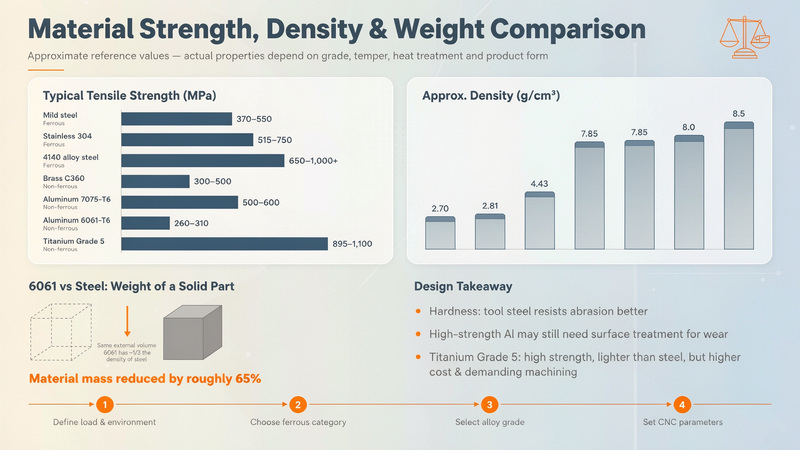
The following table gives approximate reference values for representative materials. These are not guaranteed design values; actual properties depend on grade, temper, heat treatment, and product form.
| Material | Classification | Approx. density (g/cm³) | Typical tensile strength (MPa) |
|---|---|---|---|
| Mild steel | Ferrous | 7.85 | 370–550 |
| 4140 alloy steel | Ferrous | 7.85 | 650–1,000+ |
| Stainless steel 304 | Ferrous | 8.0 | 515–750 |
| Aluminum 6061-T6 | Non-ferrous | 2.70 | 260–310 |
| Aluminum 7075-T6 | Non-ferrous | 2.81 | 500–600 |
| Brass C360 | Non-ferrous | 8.5 | 300–500 |
| Titanium Grade 5 | Non-ferrous | 4.43 | 895–1,100 |
Aluminum 6061 has approximately one-third the density of steel. For a solid part with the same external volume, replacing steel with aluminum can reduce its material mass by roughly 65%. However, the replacement is not automatically structurally equivalent: stiffness, fatigue life, thread strength, deflection, and joint design must also be checked.
Titanium Grade 5 offers substantially higher tensile strength than many common aluminum alloys while remaining lighter than steel. Its advantage is especially relevant when reducing weight without sacrificing load capacity. The trade-off is higher material cost and more demanding machining.
Hardness also matters. A hardened tool-steel component may resist abrasion better than a softer alloy, while a high-strength aluminum component may still be unsuitable for a high-wear contact surface without an appropriate surface treatment.
Corrosion Resistance and Rust Formation
Corrosion performance is determined by alloy chemistry, surface condition, moisture, temperature, chemicals, and contact with other metals. It should never be judged solely by whether a material is ferrous or non-ferrous.
Ordinary carbon steel can form red rust when exposed to moisture and oxygen. Protective measures may include painting, plating, black oxide, or other coatings. Stainless steel resists corrosion through its chromium-rich passive film, but it can still suffer pitting, crevice corrosion, or chloride-related damage under unfavorable conditions.
Aluminum forms a thin oxide layer that helps protect the underlying metal. Anodizing can improve surface durability and corrosion protection, depending on the alloy and process. Copper and copper alloys may develop a patina, while titanium generally performs well in many corrosive environments.
For marine CNC components, selecting stainless steel 316 or a suitable bronze or titanium grade may be more appropriate than choosing carbon steel without a protective system. For outdoor aluminum brackets, the alloy, anodizing specification, drainage design, and fastener material should all be considered.
Galvanic corrosion is another important issue. When dissimilar metals contact each other in the presence of an electrolyte, one metal may corrode faster. For example, an aluminum housing connected to a stainless steel fastener in a wet environment may require isolation washers, sealing, or another engineered mitigation method.
Magnetic Properties and Electrical and Thermal Conductivity
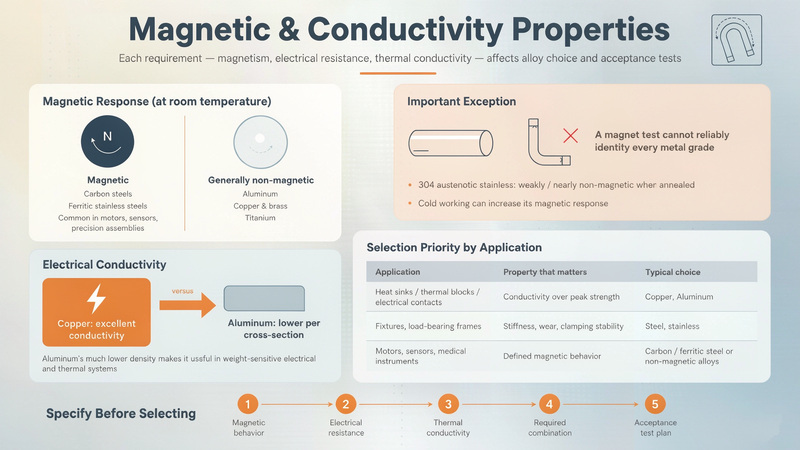
Magnetism can be important in motors, sensors, medical equipment, scientific instruments, and precision assemblies. Many carbon steels and ferritic stainless steels are magnetic, whereas aluminum, copper, brass, and titanium are generally non-magnetic under ordinary conditions.
However, the distinction is not absolute. Austenitic stainless steels such as 304 are usually weakly magnetic or nearly non-magnetic in their annealed condition, but cold working can increase their magnetic response. A magnet test alone cannot reliably identify every metal grade.
Electrical and thermal conductivity create a different set of selection priorities. Copper is widely used for electrical conductors because of its excellent conductivity. Aluminum offers lower conductivity per unit cross-sectional area but much lower density, making it useful in weight-sensitive electrical and thermal systems.
For CNC-machined heat sinks, electrical contacts, and thermal transfer blocks, conductivity may matter more than maximum tensile strength. Conversely, a steel fixture may be preferred where stiffness, wear resistance, and stable clamping are more important than heat transfer.
Engineers should specify whether the requirement is magnetic behavior, electrical resistance, thermal conductivity, or a combination of these properties. Each can affect the choice of alloy and the acceptance tests required.
CNC Machining Characteristics and Manufacturing Challenges
The two metal categories behave differently during cutting, but there is no universal rule that one is always easier to machine. Aluminum and free-machining brass can support high productivity, while titanium and nickel-based alloys demand specialized cutting strategies. Carbon steel and stainless steel also vary significantly in machinability.
| Material | General CNC machinability | Common machining challenge | Practical response |
|---|---|---|---|
| Aluminum 6061 | Excellent | Burrs, thin-wall distortion | Sharp tools, suitable workholding |
| Brass C360 | Excellent | Grade-specific regulatory requirements | Confirm material specification |
| Carbon steel 1045 | Good | Cutting forces and heat | Match tooling and cutting parameters |
| Stainless steel 304 | Moderate | Work hardening and heat | Maintain suitable feed and tool sharpness |
| Copper C110 | Moderate | Tool adhesion and burr formation | Sharp tooling and effective chip control |
| Titanium Grade 5 | Difficult | Heat concentration and tool wear | Rigid setup, controlled cutting conditions |
| Inconel 718 | Very difficult | Work hardening and high cutting temperature | Specialized tooling and stable engagement |
Aluminum machining often benefits from high cutting speeds and effective chip evacuation. Thin walls and narrow ribs, however, may deflect under cutting forces, causing dimensional errors even when the machine itself is accurate. A good manufacturing plan may use staged roughing, stress management where appropriate, and a controlled finishing pass.
Stainless steel 304 requires attention to work hardening. If the tool rubs instead of cutting, the surface can become harder, making subsequent passes more difficult. Titanium and Inconel create additional challenges because heat concentrates near the cutting edge, accelerating tool wear.
A CNC supplier should therefore assess the alloy, part geometry, tool access, tolerance requirements, batch size, and surface finish before estimating cycle time. Material classification is useful for initial screening, but the exact machining plan determines production performance.
Choosing Materials for Aerospace, Automotive, Robotics, and Industrial Parts
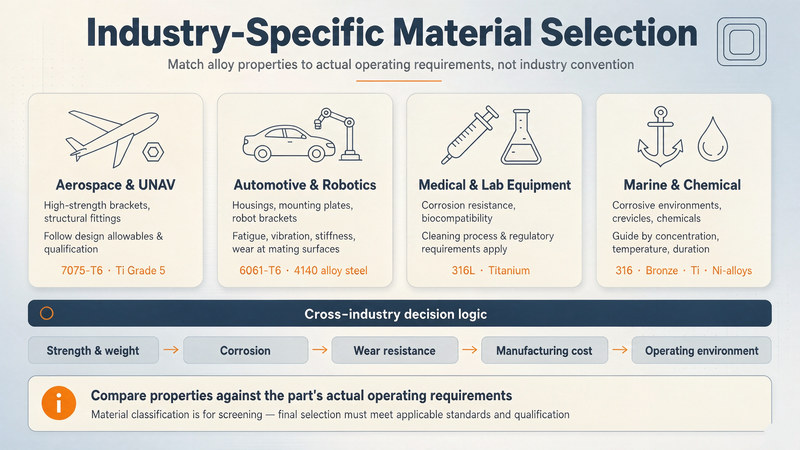
Different industries prioritize different combinations of strength, weight, corrosion resistance, wear resistance, and manufacturing cost. A material that performs well in one application may be inefficient or unsafe in another.
Aerospace and UAV components: Aluminum 7075-T6 is frequently considered for high-strength brackets and structural fittings. Titanium Grade 5 may suit highly loaded components where weight and corrosion performance justify its cost. Final selection must follow the applicable design allowables and qualification requirements.
Automotive and robotics: Aluminum 6061-T6 works well for many housings, mounting plates, and robot brackets. Alloy steel 4140 may be more appropriate for shafts, gears, or heavily loaded mechanical parts. The decision should account for fatigue, vibration, stiffness, and wear at mating surfaces.
Medical and laboratory equipment: Stainless steel 316L and titanium are common candidates for components requiring corrosion resistance or particular biocompatibility characteristics. A material’s suitability depends on the specific application, cleaning process, and relevant regulatory requirements; the metal name alone does not establish medical-grade compliance.
Marine and chemical equipment: Stainless steel 316, suitable bronze alloys, titanium, and selected nickel-based alloys may offer advantages in corrosive environments. The actual chemical concentration, temperature, exposure duration, and crevice conditions should guide selection.
For each application, compare the material’s properties with the part’s actual operating requirements rather than selecting an alloy based only on industry convention.
Material Cost, CNC Machining Cost, and Surface Finishing
The purchase price of raw metal is only one part of the finished-component cost. Material availability, stock dimensions, material removal, tool wear, setup time, inspection, heat treatment, and finishing can change the final quotation significantly.
Aluminum 6061 often provides an economical combination of material price and machining productivity. Stainless steel may cost more to machine because of cutting forces and tool wear, while titanium and nickel-based alloys may require longer cycle times and more expensive tooling. Brass can be highly productive for turned parts, but the exact grade and applicable material restrictions must be confirmed.
Surface finishing also affects the total cost. Anodizing is commonly used for aluminum, passivation for suitable stainless steels, and plating or other protective coatings for selected steel components. Finishing can add lead time and may change critical dimensions, so coating thickness and masking requirements should be agreed upon before production.
For example, an aluminum bracket with tight-fitting holes may need its dimensions checked against the final anodized condition. A steel shaft requiring a hardened surface may need grinding after heat treatment to achieve its final size. Quoting only the initial CNC operation would overlook these essential manufacturing steps.
A reliable RFQ should identify the material grade and temper, quantity, critical tolerances, surface finish, heat treatment, coating requirements, inspection criteria, and delivery expectations. These details allow suppliers to compare manufacturing routes on a consistent basis.
How to Select the Right Metal for Custom CNC-Machined Parts
A practical selection process begins with function rather than a preference for ferrous or non-ferrous metals. First, define the loads, operating temperature, environment, weight limit, electrical or magnetic requirements, and expected service life. Next, identify the grades that can satisfy these requirements, then compare their machining and finishing costs.
Consider a precision mounting bracket as an example. If low weight and anodized appearance are important, 6061-T6 aluminum may be a sensible starting point. If the bracket experiences high mechanical loads and requires greater strength, 7075-T6 could be evaluated. If it operates in a corrosive environment, the material and protective finish should be assessed together. If stiffness and wear resistance dominate, an alloy-steel alternative may be worth considering.
Before releasing a drawing, confirm the following:
- Exact material grade, temper, and applicable material standard.
- Critical dimensions, geometric tolerances, and surface roughness.
- Expected mechanical loads and operating environment.
- Required heat treatment, plating, anodizing, or passivation.
- Inspection methods, material certification, and traceability.
- Prototype quantity, production volume, and target delivery date.
These checks reduce ambiguity during quotation and help prevent avoidable redesigns, rework, and production delays.
Why Choose Xavier for CNC-Machined Metal Components?
At Xavier, material selection and machining strategy should work together from the beginning of a project. Choosing the right metal involves more than comparing a ferrous vs. non-ferrous metals list; it requires matching the material’s properties to the part’s function, tolerances, surface finish, and production requirements.
Whether your project requires aluminum brackets, stainless steel precision components, alloy-steel shafts, brass fittings, titanium parts, or other custom-machined metal components, a clear technical specification helps establish a practical manufacturing route.
Share your 2D drawings or 3D CAD files, material requirements, estimated order quantity, and critical inspection criteria with Xavier. Our team can review the component requirements and help evaluate suitable material and CNC machining options for your application.
Contact Xavier today to discuss your custom CNC machining project and request a quotation. A well-defined material choice is the first step toward producing reliable parts with consistent quality and controlled manufacturing costs.
As an integrated CNC machining manufacturer and trading company, Xavier specializes in custom CNC machining services and the contract manufacturing of a wide range of metal components. We work with diverse materials and provide CNC PEEK machining, CNC titanium machining, and CNC stainless steel machining, along with precision manufacturing solutions for alloy steel, aluminum, brass, bronze, copper, Inconel, Invar 36, mild steel, tool steel, ABS, FR4, G-10, nylon, PEI, PET, PMMA (acrylic), polycarbonate, polyethylene, polypropylene, POM (acetal), PPSU, PTFE, and PVC. Our custom-machined components serve a broad range of industries, including robotics, aerospace, marine engineering, automotive manufacturing, medical equipment, and other precision engineering applications.
We are a professional CNC PEEK machining manufacturer, offering high-volume CNC titanium machining services. Contact us for CNC stainless steel machining pricing. We look forward to discussing your project requirements and providing a suitable manufacturing solution.
Some of the images and text in this article are collected and compiled from the internet. If there is anything inappropriate, please contact us for processing.