
Knowledge Points Related to Tungsten vs Titanium
Before comparing tungsten and titanium in detail, here are the eight topics that consistently appear in high-ranking engineering and manufacturing resources:
- Density and Weight Comparison
- Mechanical Strength and Hardness
- Heat Resistance and Melting Point
- Corrosion Resistance and Chemical Stability
- CNC Machining Characteristics
- Typical Industrial Applications
- Cost and Material Availability
- How to Choose Between Tungsten and Titanium
Density and Weight: The Most Significant Difference Between Tungsten and Titanium
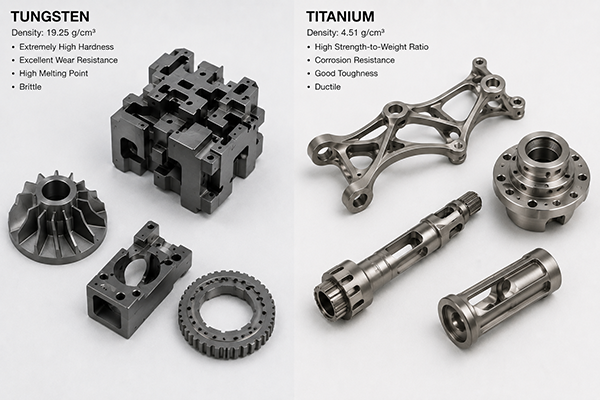
Among all physical properties, density is the biggest factor that separates tungsten from titanium. Although both materials are considered premium engineering metals, they are designed for completely different purposes.
Tungsten is one of the densest metals used in manufacturing, while titanium is well known for combining high strength with an exceptionally low weight.
| Property | Tungsten | Titanium (Grade 5) |
|---|---|---|
| Density | 19.25 g/cm³ | 4.43 g/cm³ |
| Relative Weight | About 4.3× heavier | Lightweight |
| Specific Strength | Moderate | Extremely High |
| Typical Use | Counterweights, radiation shielding | Aerospace, medical, automotive |
For a machined component measuring 100 × 100 × 20 mm:
| Material | Approximate Weight |
|---|---|
| Titanium | 0.89 kg |
| Tungsten | 3.85 kg |
The tungsten component weighs more than four times as much while occupying exactly the same volume.
Why Density Matters in Engineering
Density directly influences numerous engineering considerations:
- Transportation costs
- Rotational inertia
- Structural loading
- Vibration behavior
- Assembly weight
- Fuel efficiency
For aerospace manufacturers, reducing every kilogram of unnecessary mass improves fuel economy and increases payload capacity. Titanium has therefore become a standard material for aircraft structural parts.
Examples include:
- Aircraft brackets
- Landing gear components
- Engine compressor parts
- Satellite structures
- UAV frames
Conversely, tungsten is intentionally selected when designers need as much mass as possible in the smallest available space.
Examples include:
- Balancing weights
- Gyroscope rotors
- Missile guidance counterweights
- Radiation shielding blocks
- Medical collimators
Specific Strength: Where Titanium Excels
Instead of considering weight alone, engineers often compare specific strength, which is the ratio between tensile strength and density.
Approximate comparison:
| Material | Tensile Strength | Density | Specific Strength |
|---|---|---|---|
| Tungsten | 700–1000 MPa | 19.25 g/cm³ | Low |
| Titanium Grade 5 | 900–1100 MPa | 4.43 g/cm³ | Very High |
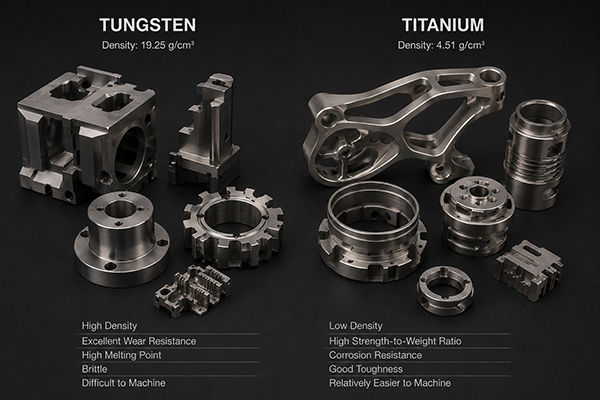
Although their tensile strengths are comparable, titanium provides nearly the same strength while weighing only about one quarter as much.
This explains why titanium dominates industries where lightweight construction is essential.
Engineering Example
Consider a robotic arm designed for high-speed automation.
If tungsten components were used throughout the arm:
- Servo motors would require significantly higher torque.
- Acceleration would decrease.
- Energy consumption would rise.
- Bearings would wear faster.
Replacing these parts with titanium allows:
- Faster movement
- Lower inertia
- Reduced vibration
- Longer service life
On the other hand, if the application requires a vibration damper or balancing block, tungsten becomes the superior choice because its higher mass improves stability without increasing component size.
CNC Manufacturing Perspective
From a CNC machining standpoint, weight also affects manufacturing operations.
Heavy tungsten workpieces:
- Require more rigid fixturing.
- Increase spindle load during handling.
- Demand stronger lifting equipment.
- Increase shipping costs after machining.
Titanium components are much easier to transport between machining stations, reducing overall production logistics.
Mechanical Strength and Hardness: Which Material Performs Better?
Many engineers assume tungsten is always stronger because it is much heavier. In reality, strength is not determined solely by density.
Different strength measurements evaluate different performance characteristics:
- Tensile strength
- Yield strength
- Hardness
- Elastic modulus
- Fracture toughness
- Fatigue resistance
Each property tells a different part of the story.
Mechanical Property Comparison
| Property | Tungsten | Titanium Grade 5 |
|---|---|---|
| Tensile Strength | 700–1000 MPa | 900–1100 MPa |
| Yield Strength | High | Very High |
| Hardness | ~350 HB | ~330–360 HB |
| Elastic Modulus | 400 GPa | 114 GPa |
| Fracture Toughness | Low | Excellent |
| Fatigue Resistance | Moderate | Outstanding |
While tungsten has an extremely high elastic modulus, titanium offers significantly better toughness and fatigue performance.
Hardness Does Not Mean Toughness
One of the most common misconceptions is confusing hardness with toughness.
Hardness measures resistance to surface deformation.
Toughness measures resistance to cracking or sudden fracture.
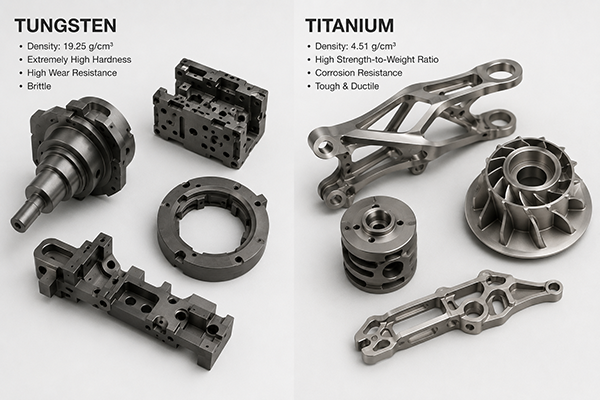
Tungsten is exceptionally hard, but it is also relatively brittle.
Titanium is slightly softer, yet it can absorb much higher impact energy before failure.
This distinction becomes critical for parts subjected to vibration, shock, or cyclic loading.
Fatigue Performance in Real Applications
Aircraft components may experience millions of loading cycles during their service life.
Titanium’s outstanding fatigue resistance allows it to withstand repeated stress without developing cracks.
Typical fatigue-sensitive titanium parts include:
- Wing fittings
- Suspension components
- Connecting rods
- Bicycle frames
- Racing vehicle suspension arms
Because tungsten is comparatively brittle, it is generally avoided in applications involving continuous vibration or repeated impacts.
Elastic Modulus and Structural Rigidity
Elastic modulus describes how much a material deforms under load.
| Material | Elastic Modulus |
|---|---|
| Tungsten | ~400 GPa |
| Titanium | ~114 GPa |
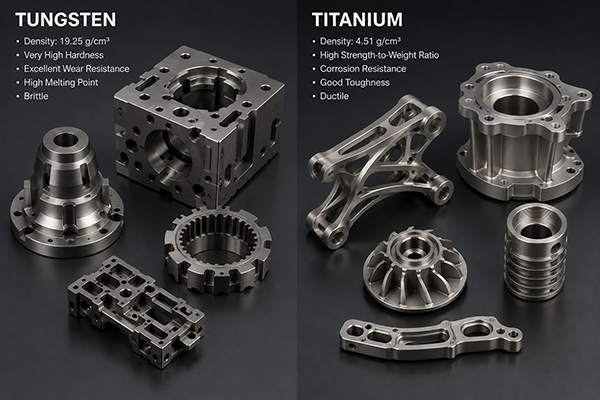
Tungsten is nearly four times stiffer than titanium.
This makes it ideal for:
- Precision measuring equipment
- High-stiffness tooling
- EDM electrodes
- Heavy-duty dies
Titanium, while less rigid, provides greater flexibility without permanent deformation, making it better suited for structural components exposed to dynamic loads.
CNC Design Considerations
When designing CNC-machined components, engineers rarely select materials based on a single mechanical property.
For example:
A medical implant requires:
- High fatigue resistance
- Excellent biocompatibility
- Low weight
- Corrosion resistance
Titanium clearly outperforms tungsten.
Conversely, a balancing rotor in precision machinery benefits from:
- Maximum density
- High stiffness
- Dimensional stability
In this case, tungsten becomes the preferred material.
Heat Resistance and Melting Point: Performance Under Extreme Temperatures
Temperature capability is another area where tungsten and titanium differ dramatically.
Tungsten possesses the highest melting point of any pure metal, making it indispensable for extreme-temperature applications. Titanium, while offering good heat resistance for many industrial uses, is designed for environments where strength-to-weight ratio is more critical than ultra-high-temperature stability.
Melting Point Comparison
| Property | Tungsten | Titanium |
|---|---|---|
| Melting Point | 3,422°C (6,192°F) | 1,668°C (3,034°F) |
| Boiling Point | 5,555°C | 3,287°C |
| Maximum Continuous Service Temperature (Typical) | >2,000°C in vacuum/inert atmosphere | Approximately 400–600°C depending on alloy |
The melting point of tungsten is more than twice that of titanium, making it one of the few engineering materials capable of maintaining structural integrity in extremely high-temperature environments.
High-Temperature Strength Retention
Many metals lose a significant percentage of their strength as temperature rises.
Titanium alloys retain useful mechanical properties up to approximately 500°C, which is sufficient for many aerospace compressor components and high-performance automotive exhaust systems.
However, at temperatures beyond this range, titanium begins to lose strength more rapidly and becomes susceptible to oxidation unless protected by coatings or controlled environments.
Tungsten, by contrast, maintains exceptional strength at temperatures where most structural metals have already softened or melted. This is why it is commonly used in:
- Furnace heating elements
- Aerospace propulsion research
- Plasma-facing components
- High-temperature molds
- Electron beam equipment
Oxidation Considerations
Although tungsten excels in extreme heat, it is not immune to oxidation.
Above approximately 500–600°C in air, tungsten begins to oxidize rapidly, forming volatile tungsten oxides that can degrade the material. As a result, tungsten components operating at very high temperatures are often used in:
- Vacuum furnaces
- Inert gas environments
- Hydrogen atmospheres
- Argon-protected systems
Titanium also forms an oxide layer, but unlike tungsten, this thin titanium oxide film acts as a protective barrier and contributes to its excellent corrosion resistance at moderate temperatures.
Example: Aerospace Engine Components
Modern jet engines illustrate how both materials can coexist in the same system.
Titanium alloys are widely used for:
- Fan blades
- Compressor blades
- Structural casings
These components benefit from titanium’s low weight and high specific strength.
Tungsten, meanwhile, may be used in specialized high-temperature or balancing applications where density and thermal stability are more important than weight reduction.
CNC Manufacturing Implications
Heat resistance also affects machining.
Titanium has relatively low thermal conductivity, causing heat to concentrate near the cutting edge during CNC machining. This accelerates tool wear and requires optimized cutting parameters, coolant strategies, and sharp carbide tools.
Tungsten and tungsten heavy alloys are even more challenging to machine because of their hardness and stiffness. Manufacturers often reduce cutting speeds, use rigid fixturing, and select wear-resistant tooling grades to maintain dimensional accuracy and extend tool life.
Corrosion Resistance and Chemical Stability: Which Material Lasts Longer in Harsh Environments?
Corrosion resistance is often one of the deciding factors when selecting engineering materials. While both tungsten and titanium demonstrate good resistance under certain conditions, they behave very differently depending on the operating environment.
Titanium is widely recognized as one of the most corrosion-resistant structural metals available. Its outstanding performance comes from a naturally occurring oxide film (TiO₂) that forms almost instantly when the surface is exposed to oxygen. This passive layer continuously repairs itself if scratched or damaged, allowing titanium to withstand aggressive environments for decades with minimal degradation.
Tungsten, on the other hand, exhibits excellent chemical stability at room temperature but becomes more vulnerable in oxidizing environments at elevated temperatures. It performs exceptionally well in vacuum, inert gases, and certain chemical applications but is generally less versatile than titanium for marine or chemical-processing equipment.
Corrosion Resistance Comparison
| Property | Tungsten | Titanium |
|---|---|---|
| Natural Passive Film | Limited | Excellent TiO₂ Layer |
| Seawater Resistance | Moderate | Outstanding |
| Salt Spray Resistance | Moderate | Excellent |
| Acid Resistance | Good (depends on acid) | Excellent (many acids) |
| Alkali Resistance | Good | Good |
| High-Temperature Oxidation | Poor in air | Better below ~600°C |
| Medical Compatibility | Limited | Excellent |
From a corrosion standpoint, titanium is clearly the more versatile engineering material.
Titanium in Marine Engineering
Seawater is highly corrosive because it contains chlorides that rapidly attack many metals such as carbon steel and aluminum alloys.
Titanium, however, remains remarkably stable even after years of continuous seawater exposure. This makes it an ideal choice for:
- Offshore platforms
- Shipboard heat exchangers
- Desalination plants
- Subsea connectors
- Marine pump shafts
- Propeller components
For example, titanium heat exchanger tubes in desalination facilities often remain in service for more than 20 years with minimal maintenance, whereas stainless steel may require periodic replacement depending on water chemistry.
Tungsten in Specialized Chemical Applications
Although tungsten is not typically selected for seawater service, it performs exceptionally well in specialized industrial environments where:
- High temperatures are present
- Wear resistance is critical
- Components operate in vacuum furnaces
- Molten metals are processed
Examples include:
- High-temperature crucibles
- Sputtering targets
- Semiconductor manufacturing equipment
- Furnace fixtures
- X-ray tube components
Its resistance to erosion and dimensional stability often outweigh its limitations regarding oxidation.
Galvanic Corrosion Considerations
When dissimilar metals are assembled together, galvanic corrosion can occur in the presence of an electrolyte.
Titanium is relatively noble in the galvanic series, meaning that when paired with more active metals such as aluminum or carbon steel, the less noble metal may corrode more rapidly.
Engineers therefore use insulating washers, coatings, or isolation bushings when assembling titanium components with other alloys.
Tungsten is less commonly involved in galvanic corrosion because it is typically used in isolated high-density components rather than large structural assemblies.
Real-World Example
Consider a CNC-machined valve body designed for offshore oil and gas production.
If manufactured from titanium:
- Long service life
- Minimal corrosion maintenance
- Excellent resistance to chloride attack
- Lower lifecycle cost
If manufactured from tungsten:
- Significantly heavier
- Higher machining cost
- No substantial corrosion advantage in seawater
For this application, titanium is the clear engineering choice.
CNC Machining Characteristics: Which Material Is Easier to Machine?
Although both tungsten and titanium are considered premium engineering materials, neither is particularly easy to machine. However, the reasons are entirely different.
Titanium is classified as a difficult-to-machine material because of its low thermal conductivity and tendency to work harden. Tungsten presents challenges due to its extreme hardness, stiffness, and abrasiveness.
Selecting appropriate tooling, cutting parameters, and machining strategies is essential for achieving high-quality components with tight tolerances.
Machinability Comparison
| Property | Tungsten | Titanium |
|---|---|---|
| Machinability | Poor | Fair |
| Tool Wear | Very High | High |
| Cutting Speed | Low | Medium-Low |
| Heat Generation | Moderate | Very High at Cutting Edge |
| Chip Formation | Brittle Chips | Continuous Chips |
| Surface Finish | Good with Proper Tooling | Excellent with Optimized Parameters |
Both materials require experienced CNC programmers and machinists, but titanium generally offers greater flexibility for producing complex precision parts.
Machining Titanium
Titanium’s greatest machining challenge lies in heat management.
Unlike aluminum or copper, titanium conducts heat very poorly. During cutting, approximately 80% of the generated heat remains concentrated near the cutting edge instead of being carried away by the chips.
This can lead to:
- Rapid tool wear
- Built-up edge formation
- Poor surface finish
- Dimensional inaccuracies
To overcome these issues, manufacturers often use:
- Sharp carbide end mills
- High-pressure coolant systems
- Constant tool engagement strategies
- Trochoidal milling paths
- Optimized feeds and speeds
For aerospace-grade titanium components, toolpath optimization can significantly extend tool life while maintaining tight tolerances.
Machining Tungsten
Tungsten heavy alloys and pure tungsten are considerably more difficult to machine.
Challenges include:
- Extremely high hardness
- High cutting forces
- Increased vibration
- Accelerated insert wear
- Potential edge chipping
Successful machining typically requires:
- Rigid machine tools
- Premium carbide or PCD tooling (where applicable)
- Lower spindle speeds
- Light depths of cut
- Stable fixturing
For intricate features, processes such as wire EDM or precision grinding may be preferred over conventional milling.
Surface Finishing Options
After machining, both materials can undergo secondary finishing processes to improve appearance, functionality, or corrosion resistance.
Titanium Common Finishes
- Precision polishing
- Bead blasting
- Anodizing (decorative and functional)
- Passivation
- Laser marking
Tungsten Common Finishes
- Precision grinding
- Polishing
- Lapping
- Coating (application-specific)
- EDM finishing
Choosing the appropriate finish depends on the final application, dimensional tolerance, and aesthetic requirements.
Example: Aerospace Bracket vs. Counterweight
A lightweight aerospace bracket with thin walls, complex pockets, and multiple threaded holes is ideally suited for titanium. Although machining requires careful thermal control, the resulting component delivers exceptional strength while minimizing weight.
By contrast, a compact counterweight for a precision balancing system benefits from tungsten’s exceptional density. Even though machining is more demanding, the ability to achieve maximum mass within a limited volume makes tungsten the preferred material.
Final Verdict: Tungsten vs. Titanium — Which Material Should You Choose?
There is no universal winner between tungsten and titanium. The optimal choice depends entirely on the requirements of the application.
The table below summarizes the key decision points.
| If Your Priority Is… | Recommended Material |
|---|---|
| Lightweight Structures | Titanium |
| Maximum Density | Tungsten |
| High Specific Strength | Titanium |
| Extreme Temperature Resistance | Tungsten |
| Marine Corrosion Resistance | Titanium |
| Medical Applications | Titanium |
| Radiation Shielding | Tungsten |
| Aerospace Components | Titanium |
| Counterweights | Tungsten |
| CNC Precision Structural Parts | Titanium |
Quick Selection Guide
Choose Titanium if you need:
- Lightweight components
- High strength-to-weight ratio
- Excellent corrosion resistance
- Long fatigue life
- Biocompatibility
- Aerospace-grade performance
- Medical or marine applications
Choose Tungsten if you need:
- Extremely high density
- Outstanding stiffness
- Exceptional heat resistance
- Radiation shielding
- Compact balancing weights
- High-temperature industrial equipment
Rather than asking which material is “better,” engineers should ask which material better satisfies the performance requirements of the finished product.
Why Choose Xavier for Precision CNC Machining?
Material selection is only the first step toward manufacturing a high-quality component. Achieving consistent dimensional accuracy, excellent surface finishes, and reliable production also depends on the machining expertise of your manufacturing partner.
At Xavier, we specialize in precision CNC machining for complex metal and plastic components used across industries including aerospace, medical devices, robotics, automotive, energy, and industrial automation.
Our capabilities include:
- 3-axis, 4-axis, and 5-axis CNC machining
- High-precision milling and turning
- Tight tolerances down to ±0.005 mm (application dependent)
- Prototype, low-volume, and mass production
- Machining of titanium, tungsten heavy alloys, stainless steel, aluminum, Inconel, brass, copper, PEEK, and other engineering materials
- Multiple surface finishing services, including anodizing, passivation, electropolishing, nickel plating, and bead blasting
- Comprehensive quality inspection using advanced metrology equipment
Whether your project requires lightweight titanium aerospace components or high-density tungsten precision parts, Xavier’s engineering team can help optimize material selection, manufacturability, and production efficiency to reduce costs while maintaining exceptional quality.
Partner with Xavier to transform your CAD designs into precision-machined components that meet the demanding requirements of modern industries.
We are a vertically integrated CNC machining manufacturer specializing in CNC contract manufacturing and the production of various metal and plastic precision parts. We provide high-quality custom machining solutions for global customers across multiple industries, including robotics, aerospace components, marine parts, automotive components, medical devices, and precision engineering applications. Our manufacturing capabilities cover a wide range of materials such as alloys, stainless steel, and advanced engineering plastics.
We support precision machining of a wide variety of materials, including
CNC machining titanium,
CNC machining PEEK,
and
CNC machining nylon,
along with many other engineering materials like aluminum, brass, copper, Inconel alloys, Invar 36, low carbon steel, stainless steel, tool steel, ABS, FR4, G-10, PEI, PET, PMMA (acrylic), polycarbonate, polyethylene, polypropylene, POM (acetal), PPSU, PTFE, and PVC.
We also provide customized machining solutions for industries such as robotics parts, aerospace components, marine equipment, automotive systems, medical devices, and other high-precision applications.
CNC machining titanium manufacturer, we provide bulk CNC machining PEEK service, and you can consult us for CNC machining nylon price. Contact us today for more details.
Some of the images and text in this article are collected and compiled from the internet. If there is anything inappropriate, please contact us for processing.